
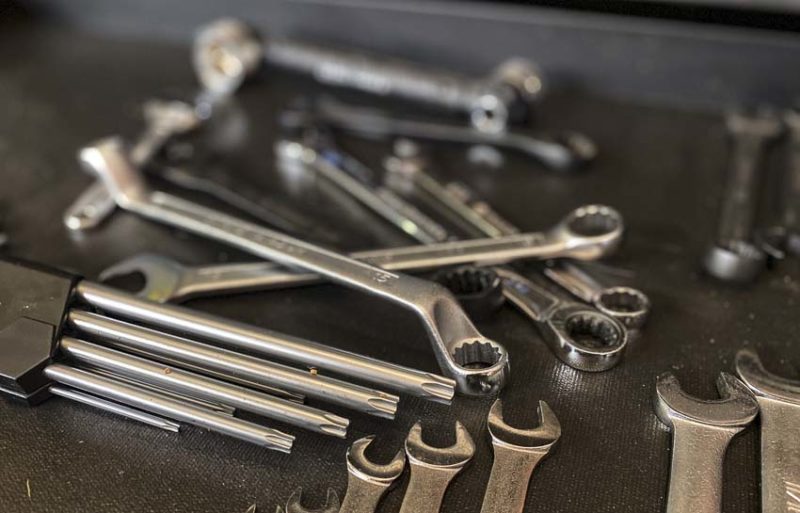
Since 2008 we’ve reviewed literally hundreds of wrenches. The best of these tighten and loosen nuts, bolts, and other threaded items easily and with minimal hassle. Often, you have to use these tools in tight areas where you also need a lot of torque. With that said—having a source for the best wrench reviews can hopefully help point you to the best products—regardless of your trade or focus. Of course, many different types of wrenches exist. We included our top recommendations below.
Best Wrench Set Overall
Gearwrench 28-Pc Full Polish SAE/Metric Combination Wrench Set

We love this Gearwrench 28 Pc. 6-point combination SAE/Metric wrench set for a variety of reasons. First, we find it an incredible value for what you get. You can get an entire 28-piece set for less than $100. Plus, when starting out, picking up a set that covers a large array of both SAE and metric sizes makes good sense.
These wrenches give you a nice 15° offset for better access in tight spaces. That means you don’t approach the nut or bolt completely “flat” but have a bit of leverage to get some torque on the fastener. It also gives you a nice 6-point set which we actually prefer since it grips better on the box-end of the wrench with less chance of rounding off nuts or bolt heads. Finally, the bright, full polish chrome cleans easily. We like it when our wrenches look new even after years of use!
Additional Options
- Sunex Tools 25-Piece Metric Master Wrench Set – $134.99
- DeWalt DWMT72166 10pc Metric Wrench Set – $39
Best Ratcheting Wrench Set
GearWrench 120XP Spline Ratcheting Wrench Set (SAE and/or Metric)

When Gearwrench came out with these 120XP ratcheting wrenches, we immediately got them in for review. The best ratcheting wrench set has to work flawlessly. It also has to deliver a small enough adjustment arc so you can get into tight spaces. The GearWrench 120XP Spline ratcheting wrenches do that in spades. And they come in various kit sizes as well as individual wrenches in case you lose one. We specifically recommend the 16-pc kits as they offer a great value.
Not only do these ratcheting wrenches feel good in the hand, the blue (metric) and red (SAE) markings help you easily identify them. You can go cheaper, but do you want to? You only want to buy an SAE and metric set like this once—make it a good one.
More Ratcheting Wrench Options
Best Adjustable Wrench
Klein Tools Reverse Jaw Adjustable Wrench

Pictured alongside some slim jaw models, Klein reverse jaw adjustable wrenches provide solid performance and great ergonomics. The dipped handles, easy adjustment, secure positioning, and accurate scale just work. As a bonus, the Klein 2-in-1 Reversible Jaw Adjustable Pipe Wrench gives you some added functionality—one side of the jaw is knurled when using it that way.
Klein’s premium hand tools do come at a cost. Prices run between $28 and $45. Compare that to something like Milwaukee adjustable wrenches that compare in performance, but without the dipped handles. Those run between $15 and $20 each. While not made in the USA like many Klein hand tools, we still like them for their versatility.
Another Great Adjustable Wrench Option
- Milwaukee adjustable wrenches – $15 to $20
Best Torque Wrench
Milwaukee M12 Fuel Ratcheting Digital Torque Wrench

OK, we said this is the best torque wrench—not the cheapest. The thing is, most people need a torque wrench to drive a fastener snug and then finish off to 20 foot-pounds or whatever the torque specs states. With two drive sizes to choose from, the Milwaukee M12 FUEL Ratcheting Digital Torque Wrench covers the basics while combining two tools into one. It really revolutionizes what’s possible in a torque wrench—and it amps up your productivity by giving you a cordless ratchet in the process.
You can get this wrench in a 3/8-inch drive or 1/2-inch. The 1/2-inch model maxes out at 150 ft-lbs, so you may need to supplement with a higher-capacity tool if you work on larger vehicles. This tool, however, covers a majority of torque tasks—and does it with a single tool. We do acknowledge the bulk on this tool, however. If you want a smaller, more manual solution, see our next recommendation below.
Best Torque Wrench – Manual
Sunex 1/2 in. 10 to 150 lbs. Torque Wrench

I think the simplicity of this Sunex 1/2-inch torque wrench makes it our favorite manual solution. You can get fancier solutions, but the scale on this tool gives you both metric and SAE readings, and it just works. No-fuss, no-muss, and Sunex gives you a 90-day calibration warranty on the tool to boot. The fact that you can grab a tool like this for under $43 that covers 10-150 ft-lbs of torque measurements is amazing. You’ll pay more for the same capacity from Kobalt Tools or Craftsman!
Best Digital Torque Wrench Option
- Gearwrench Flex Head Electronic Torque Wrench 85079 – $199
Best Pipe Wrench
Milwaukee Aluminum Pipe Wrench
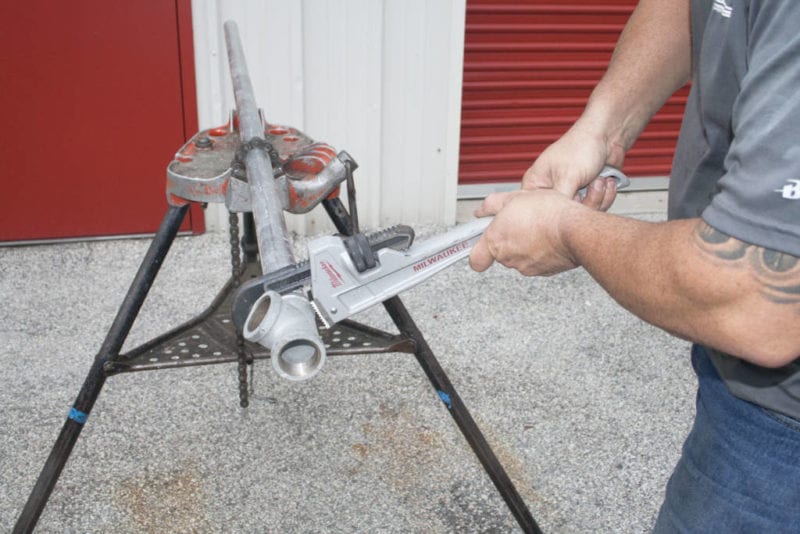
We like everything about the Milwaukee aluminum pipe wrench, having tested out the 18-inch model. We enjoyed the super light weight and the dual coil springs. The handle length seems perfect and gives you a comfortable grip. Once it bites, the force of the overbite jaws does its work easily without slipping. We can easily recommend it to other Pros. Be aware, however, you have to be mindful that this wrench creates a lot of torque. We actually had one degraded pipe collapse under the Milwaukee wrench’s strength during our review. You can pick these up for anywhere from $30-$300 depending on the size you need.
Other Best Pipe Wrench Options
Tips on Buying the Best Wrenches
When buying a set of wrenches or even a single tool, many things play a part in coming away with a great tool. We go into some of this below and then continue on to the various types of wrenches you may need to have in your tool kit.
Handle and Tool Material
A number of different types of wrenches exist—each with its own special use. When shopping for the best wrench, look at the manufacturing method. The best hand wrenches used a forged carbon alloy steel process. They often bear the marking of “Cr-V”. This stands for the alloying materials of Chromium for corrosion resistance and Vanadium for added strength. Additionally, many wrenches will also have chrome-nickel plating to give greater corrosion resistance. You can also find aluminum-handled products that drop weight. Good wrenches will be clearly and permanently labeled with the measurement.
On the handle side—you want something comfortable but also sturdy. For most tools, we prefer polished steel. It cleans up easily and gives you a nice, comfortable grip. Dipped handles also help tools not to slip out of your hands as easily—they clean up easily as well.
Making Your First Purchase
Initially, the best way to purchase these tools is in sets. For open-end, box, combination, and ratcheting wrenches make sure that you have both metric and standard (SAE) sizes in the kit you buy. There’s no telling what kind of fasteners you will encounter. The increments of the measurements are usually in millimeters for metric and in 1/16 of an inch for the standard (SAE).
Getting a Good Fit
When using wrenches, make sure that they fit snuggly on the fastener. If you are not sure of the exact size of the fastener, try several tools until you find the one that fits the tightest. You want to have a snug fit to avoid rounding off the edges of the fastener. This happens when the tool is loose or too big. Most of these hand tools fall into a few major categories.
Where’s Snap-on?
You might ask: Where’s Snap-on? The short answer: Not here. Snap-on makes some great hand tools. More and more, however, those tools seem very expensive compared to others that provide (as far as we can ascertain) the same level of quality and performance. We find smarter mechanics shopping online where they can get better deals—made even better when not financing tools over the long term. If you work at a place that has a Snap-on truck coming by every day then perhaps it makes sense to go that route. For most folks, however, the alternatives (and savings) are too great to ignore.
Types of Wrenches
Open Ended Wrench
The open-ended wrench is the most basic type. With U-shaped openings on the ends, the two opposite faces of the opening grip the fastener. Nowadays, most have different sized open-end wrenches on each end of the handle. They can also feature both an open-end and box-end on the same handle. We refer to the latter as combination wrenches.
Box Wrenches
The box or box-ended wrench is another very common tool. These surround, or “box” the fastener completely with the end of the tool. Box end wrenches normally have 6 or 12 corners or points.
We find 6 point box wrenches the most stable. They work best for high torque applications and apply an equal amount of force to all edges of the fastener. 12 point tools double the amount of positions that you can fit the box end on the fastener. This becomes especially helpful in very tight spaces where there is a limited amount of space to swing an arc. The trouble with using a 12 point box end for high torque applications is you have more opportunity for roundover. They more easily strip the heads of fasteners.
More recently ratcheting box wrenches have become popular. They operate much like a ratchet and socket combo. With these tools, you don’t have to reposition the box end at the end of a turn. It really speeds up the job. Look for models with a higher tooth count and a smaller swing arc. They will get you better results in narrow or hard-to-reach areas.
Tube or Flare Wrenches
Tube or flare wrenches serve a special purpose. They look very much like a 6 point box end wrench except for a missing section. This opening lets the tool slip over a bolt or tubing, making it possible to easily place it over the fastener.
Typically the nuts used to secure copper tubing are somewhat delicate or made of soft materials like brass or plastic. The use of a regular open-end wrench can lead to rounding off the corners of the nut since it doesn’t contact all sides of the softer material.
Flare wrenches or tube wrenches work really well when working on car brake line systems or compression fittings on copper piping for dishwashers, water filters, or ice machines.
Adjustable Wrench
The adjustable wrench functions just like an open-ended wrench. With a mechanism to adjust the parallel distance between the jaws, they fit a variety of nut or bolt sizes. This tool works great when you don’t have the right size wrench and don’t need a lot of torque. The only negative is that the jaws tend to “drift”. They often move slightly on each use, causing you to slip off and possibly round off the edges of the nut or bolt. When using an adjustable wrench, you have to keep checking that the adjustment keeps the tool snug on the fastener.

We often see these tools called Crescent wrenches. That trademarked name actually dates back to Cooper Tool Company and is now owned by Apex Tool Group. You can pick them up in various sizes to better accommodate the different sizes of fasteners encountered.
Pipe Wrench
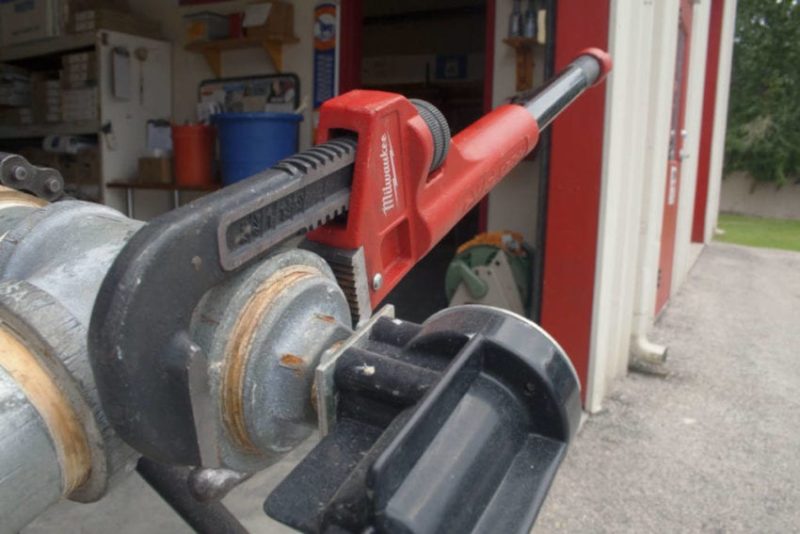
Another common, yet specialized type of adjustable wrench is the pipe wrench. These heavy-duty tools have a fixed upper jaw and a movable lower jaw. The jaws are heavily serrated so that they can bite into galvanized or steel pipe. The jaws are usually pinned into place so they can be replaced when they wear out. Smooth jaws are also available so they don’t damage the surface that is being turned for certain applications.
Typically, these rugged plumbing tools come with steel handles. For those wanting to save some weight, lightweight aluminum handle models come at a much higher price.
Ratchets and Sockets
Ratchets and Sockets are a great substitute for regular wrenches. The advantage is that a ratchet can be fitted with numerous sockets. These snugly fit varying sizes of nuts and bolts.
Sockets are cylindrical. One end features a square hole that matches one of the common ratchet sizes. The other end of the socket is sized to fit the fasteners. They can use either a 6 or 12 point configuration. You can also find sockets with multi-point, Allen, Torx, and other configurations. The size of the socket is usually permanently stamped into the side of the socket for quick identification.
Ratchets work on the same principle as wrenches. They have a long handle that lets you put a lot of torque on the fastener. The main difference is how securely the socket fits the fastener from above.
This facilitates quicker fastener turning. You don’t have to remove and reset the head position every time you make a turn as with a wrench. The most common drive sizes for ratchets are 1/4”, 3/8”, and 1/2”. 3/4″ and 1″ sizes are available for certain industrial uses. Ratchets work with both metric and standard (SAE) sockets as long as the socket drive size matches the ratchet drive.
Conclusion
When starting your collection of wrenches, look for quality sets to get the best start-up value. The good thing is that the set sizes range greatly and the variety included also varies. There should be sets on the market for just about any budget. Some manufactures like Craftsman and Snap-On offer lifetime warrantees that will replace broken tools as long as they were used in the way they were designed.
Why You Can Trust Pro Tool Reviews
Ever check out a “review” site and you can’t tell if they actually tested the tools or if they’re just “recommending” the Amazon top sellers? That’s not us. We won’t recommend anything unless we’d actually use it ourselves, and we don’t really care who the primary retailer is. It’s all about giving you a legitimate recommendation and our honest opinion of each product.
We’ve been in business since 2008 covering tools, writing reviews, and reporting on industry news in the construction and lawn care industries. Our Pro reviewers work in the trades and have the skills and experience to know whether tools can perform well in the field.
Each year, we bring in and review more than 250 individual products. Our team will put our hands on hundreds of additional tools at media events and trade shows throughout the year.
Pro Tool Reviews consults with innovators in the technology and design of tools to gain a broader grasp of where these products fit and how they work.
We work with more than two dozen professional contractors around the United States who review products for us on real job sites. We consult with them extensively on testing methods, categories, and practical applications.
Our site will provide more than 500 pieces of new content this year absolutely free for our readers. That includes objective evaluations of individual tools and products.
The end result is information you can trust because of the editorial, scientific, and real-world professional experience we collectively utilize each and every time we pick up and test a tool.