

With the advent of newer trimmer and lawn products that include 4-cycle engines, we are often asked the question: 2 Cycle vs 4 Cycle Engines – Which is Better?
The issue concerns whether these new 4-cycle OPE tools are better than their 2-cycle counterparts (literally: “Which is better, 2-stroke or 4-stroke?”) The answer may be simpler than you think, but first, it’s important to understand the differences between the two technologies. Each has its strengths, though we wouldn’t consider them fairly matched—at least not for the purposes of portable lawn care products. Check out our review of the Makita EM2650LH 4-stroke string trimmer.
The Basics of 2-Cycle vs 4-Cycle Engines
2-cycle (sometimes referred to as 2-stroke) engines are typically thought of as those motors which accept a pre-mixed gas-oil mixture. This mixture, which can range from 50:1 to 20:1 depending on the motor, both supplies fuel, and lubrication to the motor during operation.
4-cycle (sometimes referred to as 4-stroke) engines are more akin to what you will find in your car. 4-stroke motors also have a crankcase and an oil distribution system that keeps the oil separate from the gas as it lubricates the engine components. Since the oil is separate, it also needs to be periodically changed—typically after every 25 hours of use.
Four cycle engines use the same gas you buy for your vehicle and can contain up to 10% ethanol (you should not use E85 gas as it is not compatible with either 2-cycle or 4-cycle motors commonly found in small lawn trimmers and cutting machines).
How Two-Cycle vs Four-Cycle Engines Work
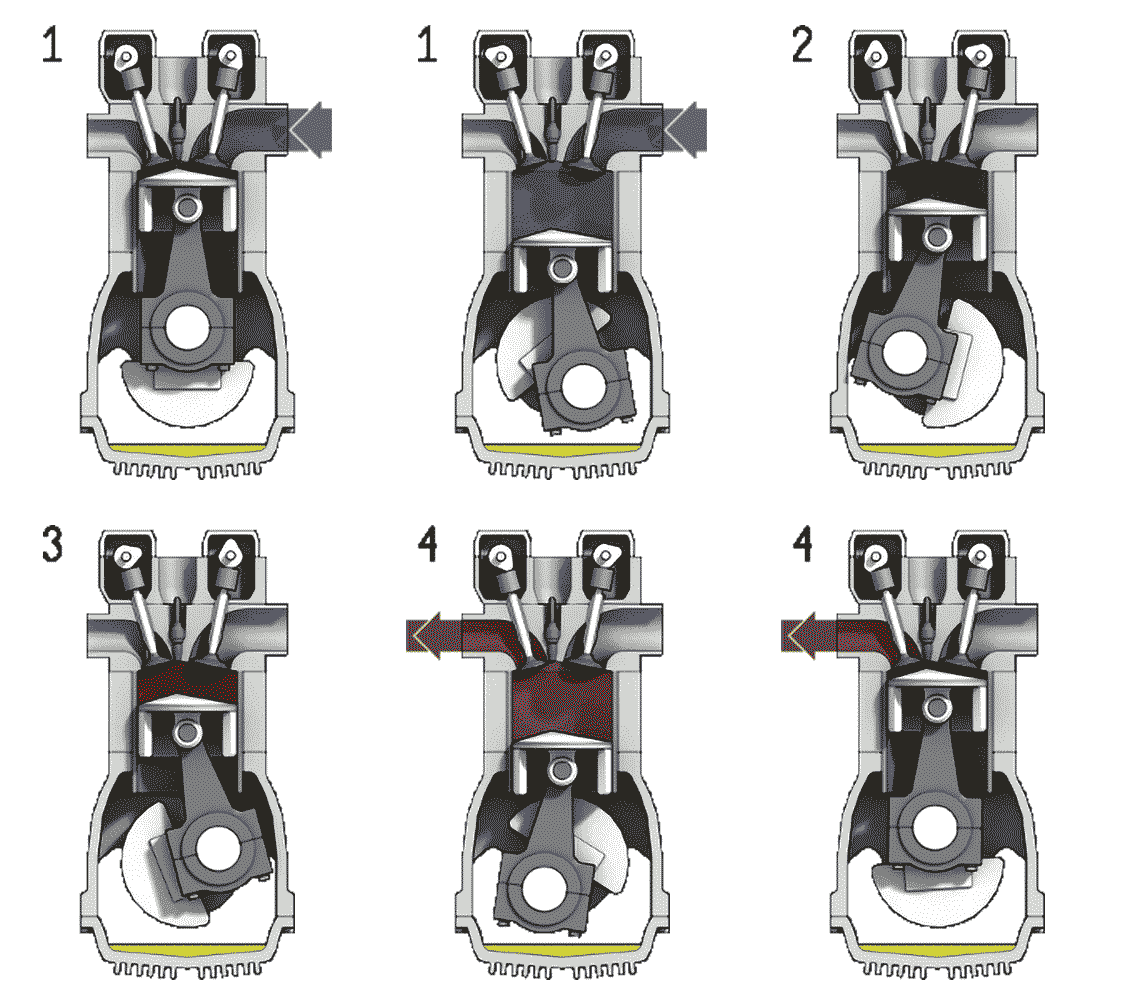
There is a marked difference between a 2-cycle vs 4-cycle engines operation. A 4-cycle motor works, as you might expect, in four stages. There is the power (down) stroke, the exhaust (up) stroke, the intake (down again) stroke, and the compression (up again) stroke. It takes two full revolutions of the crankshaft to deliver these four strokes. It’s the power stroke that sends the piston through each of the three remaining stages.
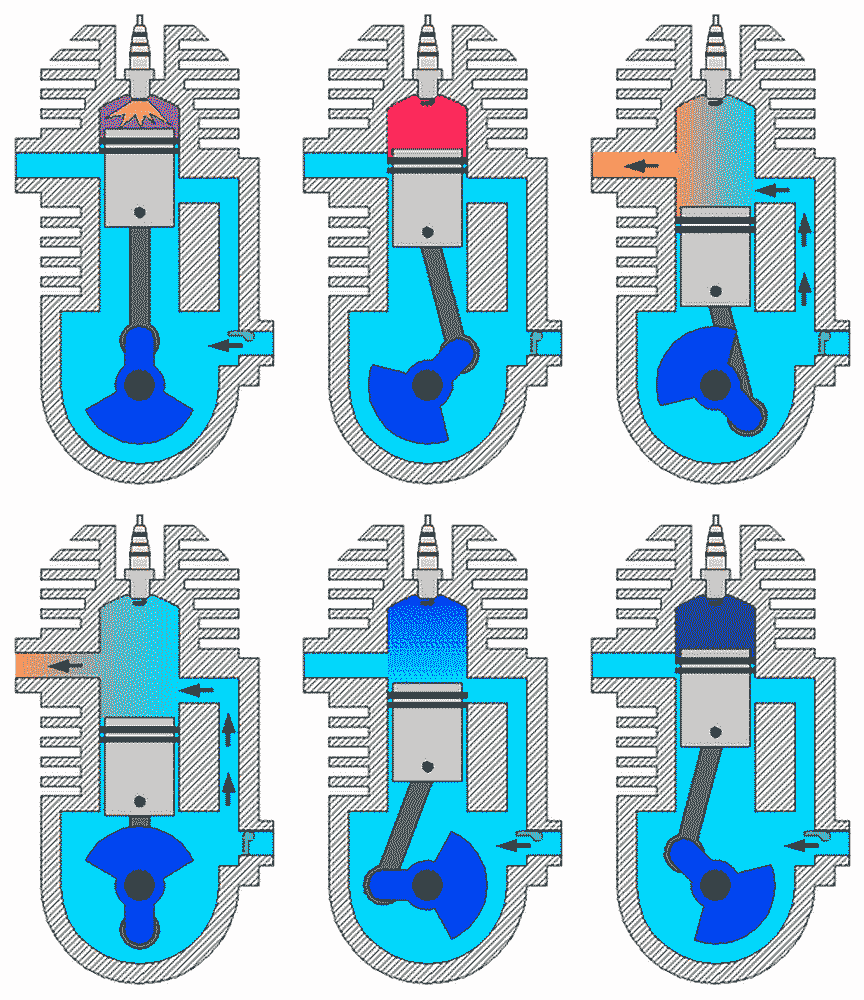
A 2-cycle engine literally has just two cycles that combine the above duties. The first stroke is the combined power and exhaust stroke and the second combines the compression and intake stroke. Both power and combustion happen as the piston reaches the top of its stroke. At the bottom, the exhaust and intake occur. It takes just a single revolution to generate two strokes and propel the piston through its full cycle.
More Parts = More to Break
Four-cycle engines have a lot more moving parts. They have a crankshaft, camshaft, connecting rod, valves, lifters, and piston. A two-cycle engine really has only three major moving parts. This includes the crankshaft, connecting rod, and piston. In small-size two-cycle engines, there are no cams, lifters, or valves. As a general rule, fewer parts equals less potential for failure and easier maintenance.
Overall, the 2-cycle engine is typically smaller in displacement and size as compared to 4-cycle which, many times, is almost double the displacement and overall size to achieve the same power. The reason for this is because since the 2-cycle combines two functions in one rotation, it makes the power twice as quickly as a 4-stroke.
Pros and Cons of 2-Cycle vs 4-Cycle Engines
From the description so far you might think that 2-cycle has complete domination over 4-cycle… Well in small marine applications and home lawn care it probably does. Comparing 2-cycle vs 4-cycle engines take a bit more work, however. The fact is, 4-cycle only has a few advantages: greater potential torque, higher fuel economy, and better emissions. With that said, let’s look at a list of pros and cons for both 2-cycle and 4-cycle and lay out the case for each:
| 2-cycle | 4-cycle | |
|---|---|---|
| Parts | ADVANTAGE | More moving parts |
| Maintenance | ADVANTAGE | Must change oil |
| Storage | ADVANTAGE | Must keep level |
| Vibration | ADVANTAGE | Higher vibration |
| Fuel Economy | Less efficient | ADVANTAGE |
| Emissions | Burns oil | ADVANTAGE |
| Torque | Less potential | ADVANTAGE |
| Starting | ADVANTAGE | Much harder to start |
| Weight | ADVANTAGE | More parts = more weight |
Comparing 2-Stroke vs 4-Stroke
As you can see there are definitely a couple of advantages to owning a 4-cycle motor for a trimmer or other lawn care application, but for the most part, there is a reason 2-cycle motors are currently king. They are simply reliable, have less to break, and are much easier to start and use. For high torque considerations, 4-cycle may indeed be the way to go, but generally, we recommend sticking with the tried and true 2-cycle models – the pros do!
The bad news is, that the current environmentalist focus seems to drive many municipal decisions right now. In the near future, stricter emissions rules may eventually phase out 2-cycle engines entirely. When this happens, we hope manufacturers can improve 4-cycle technology and deliver products that perform as conveniently and easily as their 2-cycle counterparts.