
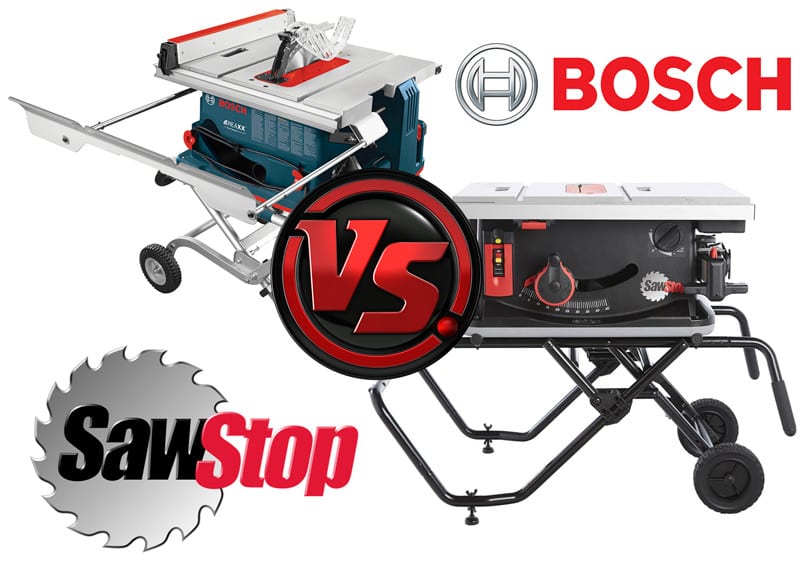
The SawStop vs Bosch Reaxx lawsuit ended in favor of SawStop with the ruling coming from Administrative Law Judge Thomas B. Pender. As it has been since the Reaxx was first announced, the lawsuit is based on patent infringement.
Editor’s Note: This story contains all the information we’ve received as it has become available and reported by Pro Tool Reviews. Read from the beginning to follow the story in its entirety or jump to other sections as you see fit.
Table of Contents
- A Bit of History on the SawStop vs Bosch Reaxx Lawsuit
- Power Tool Institute Arguments
- Differences in Table Saw Protection Methods
- The Judge’s Decision
- SawStop’s Reaction
- Robert Bosch North America Lawsuit Reaxxion
- SawStop vs Bosch Reaxx lawsuit Potential Consequences
- Patent Infringement
- The Bottom Line
- Updated: 1/27/2017 – Final Nail in the Coffin for Bosch Reaxx?
- Updated: 2/07/2017
- Official Response from Robert Bosch Corporation
- Official Response from SawStop
- Final Update: 3/23/2017
A Bit of History on the SawStop vs Bosch Reaxx Lawsuit
The Bosch Tools table saw lawsuit actually arose before Bosch created its own flesh-detecting table saw solution: the Bosch Reaxx table saw.
SawStop was developed and patented by Steve Gass, a lawyer and “avid woodworker”. He came up with an idea to make table saws (or any electric saw for that matter) safer for users who come into accidental contact with the blade during use.
What came next is a bit of controversy. Mr. Gass attempted to pursue legislation to make his patented technology mandatory through the Consumer Protection Safety Commission. This apparently occurred after receiving little support for his proposal to license the technology to manufacturers. Somewhere around June of 2006, in response to a petition from Gass, engineers at the U.S. Consumer Product Safety Commission recommended that the government begin a “rulemaking process”. That could result in mandatory safety standards for table saws. The agency’s commissioners then turned the power tool industry on its ear by agreeing with Gass’ recommendation.
In a CPSC meeting on May 8, 2007:
“Mr. Schiech indicated that if the Commission issued a mandatory rule it would be extremely difficult for the industry to comply because of patent restrictions on sensor technology. Ms. Weller pointed out that the Commission does not mandate design requirements… If it did anything, the Commission would issue a performance requirement and companies would be free to meet it in any way possible, including using sensors, or with a new guard or any of the other improvements the industry was currently considering.“
CPSC May 8, 2007 Meeting
Power Tool Institute Arguments
The Power Tool Institute (made up of many of the major tool manufacturers) takes strong offense to the concept of making safety devices like this mandatory on products like table saws.
Between the 8% fee and the additional hardware costs, your typical $400 jobsite saw would potentially rise in cost to around $625. Your entry-level table saws would all but disappear. We’re not sure how well that will be received by consumers who prefer to keep themselves safe.
The real controversy has to do with legislation that would set a precedent to mandate any technology that increases the safety of a dangerous power tool. This would seem inevitable since liability issues would force this reality through insurance rates and the potential for lawsuits. Also, the potential for unintended consequences are immense. These include manufacturers who may stop making more dangerous products or compromise in other areas (quality) in order to meet the price requirements of incorporating this particular technology.
On top of all this, in terms of table saw safety, PTI cites that kickbacks present more danger, and cause far more injuries each year, than cutting off fingers. Currently, new advances are already being implemented through UL approval guidelines (new as of 2010) to incorporate these safeguards.
PTI Details Its Specific Issues
PTI cited both technical and practical/financial problems with mandating SawStop technology. These include:
- PTI estimates the additional cost to manufacturers to implement this technology at $150-$200 per product. That amount passes on to the consumer.
- Gass (SawStop) is asking for 8 percent licensing/royalties on the wholesale price of each saw sold. Many manufacturers view this figure as near-extortion and monopoly position. This fee would likely pass directly to consumers.
- “False positives” or “nuisance trips” produce downtime and expenses. False positives can trip on common materials such as moist wood (think freshly delivered pressure-treated lumber).
- A false trip mandates the replacement of the brake mechanism which is an expensive piece (~$59)
- A false trip mandates the replacement of the saw blade. Why? The carbide teeth might jar or break loose—creating a hazard. As most pros know, blades can be upwards of $100 each.
- During a braking event, carbide teeth could be thrown through the blade opening.
- Existing Underwriters Laboratories document ANSI/UL 987 includes provisions for maintaining a safe distance from saw blades. They also include instructions for proper use.
- The “court is out” on how a high-impact braking mechanism will affect smaller jobsite table saws.
- Consumer choice can dictate whether this technology and its associated potential issues and added cost will gain widespread acceptance by consumers
- A low percentage of the 30,000 annual (U.S.) table saw injuries are due to contact with the blade. Most occur due to kickback.
Differences in Table Saw Protection Methods
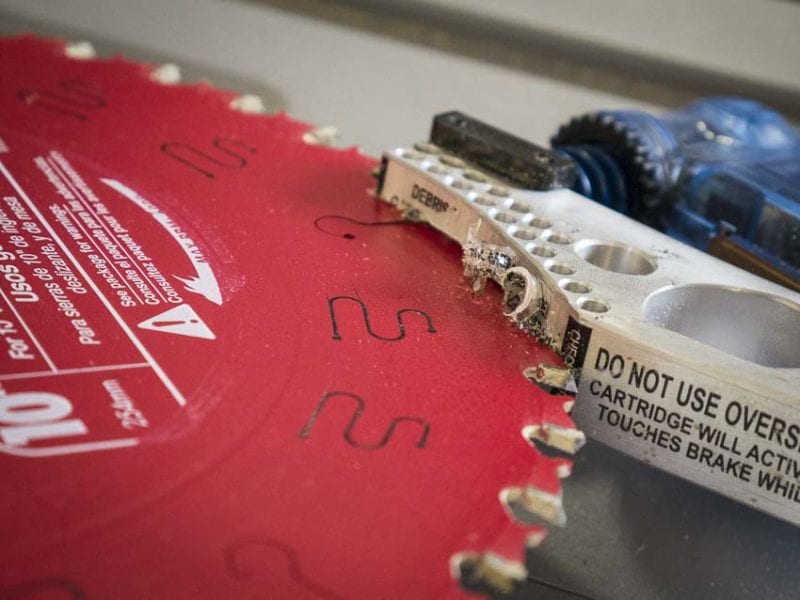
There are significant differences in the way the two companies handle table saw safety. The Bosch Reaxx uses an airbag-style cartridge to punch the blade below the table surface. This occurs once conductance (flesh) is detected. The blade is able to keep spinning on its way down and doesn’t damage it. You can see the results of our testing on a top strike and front strike where I put my hand in the blade on our YouTube channel.
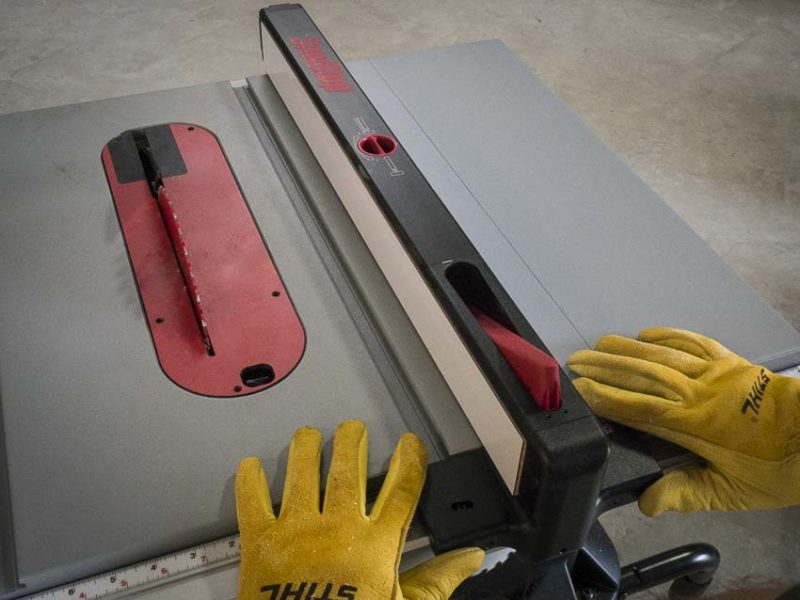
SawStop Technology is a safety feature found on table saws that is able to detect when it comes into contact with flesh and immediately stops the blade. This happens so quickly that the user is left with only a small nick where the skin touched the blade. SawStop uses a different mechanism to drop the blade, but also employs an aluminum brake. In our testing on both top and front strikes, the blade on the Sawstop Jobsite saw stopped with less damage to the user’s hand than the Bosch Reaxx table saw.
At tradeshows, SawStop reps used a hot dog to represent a finger and showed how the saw would cut through wood and immediately stop when it contacts the hot dog.
Watch Kenny stop a spinning table saw blade with his finger!
The Judge’s Decision
Despite the obvious differences in application and results between the two saws, Judge Pender believes that there are similarities underneath the surface that are indicative of an infringement.
“Based on the foregoing, it is my Initial Determination that there is a violation of Section 337 of the Tariff Act of 1930, as amended, 19 U.S.C. § 1337, in the importation into the United States, the sale for importation, or the sale within the United States after importation of certain table saws incorporating active injury mitigation technology and components thereof, in connection with the asserted claims of U.S. Patent Nos. 7,895,927 and 8,011,279.”
U.S. I.T.C., Inv. No. 337-TA-965
SawStop’s Reaction
As you’d expect, Dr. Stephen Gass is pleased with the outcome. He had this to say following the ruling.
“The technology in SawStop saws wouldn’t have made it to market except for the protection offered by the United States patent system. We have invested millions of dollars in research and development to protect woodworkers from serious injury. Our inventions have been awarded numerous patents. Bosch chose to introduce the Reaxx saw in disregard of our patents, and we were left with no alternative but to defend our patent rights in court. We are very pleased Judge Pender confirmed that Bosch infringes our patents.”
Dr. Stephen Gass, SawStop’s President
Robert Bosch North America Lawsuit Reaxxion
“Although Bosch does not normally discuss details of litigation because we feel it is best handled in the context of the legal proceedings, we have seen statements about litigation concerning the Bosch REAXX™ Jobsite Table Saw that give a misleading impression of what has occurred.
At this time legal proceedings are still underway. The International Trade Commission (ITC) will review the initial determination provided by the Administrative Law Judge on Sept. 9, 2016, as well as additional arguments from the parties, before it makes any decision in the matter. The commission’s decision is not expected until early January 2017. Contrary to any other implication, the patent legal proceedings are ongoing and not final.
The Bosch REAXX Jobsite Table Saw is based on patented technology developed by the Power Tool Institute and the engineering team at Robert Bosch Tool Corp. in Mount Prospect, Ill. We believe that advanced REAXX safety technology does not violate any competitor’s intellectual property rights.
Robert Bosch North America, Sept 2016
Stopping the Sale of Reaxx Technology
It is disappointing that a competitor is continuing its campaign to stop the sale of patented REAXX technology to consumers. The patents asserted against REAXX are based on applications filed more than 15 years ago; Bosch does not believe they apply to REAXX technology. In addition, Bosch believes that if the U.S. Patent and Trademark Office had complete information it would not have issued certain patents in the first place.
Bosch has vigorously defended, and will continue to defend, its ability to make REAXX table saws available in the United States. In addition, Bosch will continue to pursue its own claim of patent infringement against the competitor filed in the U.S. District Court for the Northern District of Illinois.
The ongoing litigation has no effect on distributors’ ability to buy or sell Bosch REAXX table saws. REAXX cartridges, accessories, and service parts are available. The Bosch commitment to provide safe products to users is critical today and in the future.”
Robert Bosch North America
SawStop vs Bosch Reaxx lawsuit Potential Consequences
In this particular SawStop Vs Bosch Reaxx lawsuit, the victory could have serious consequences for Reaxx owners. Not only is SawStop looking to block the import and sale of the Reaxx, but also the sale of the cartridges. That would mean Reaxx owners would be unable to replace cartridges. This is a component required for use. Certainly, Bosch will work hard to ensure that doesn’t happen, but it will ultimately be up to the courts or a settlement between the two to decide.
Patent Infringement
So is the Bosch team a bunch of bad guys hiding in secret, reverse engineering a SawStop table saw to develop the Reaxx?
Not likely. The physics involved in detecting electrical conductance on the blade are fairly straightforward. While there are numerous ways to design a system that can detect a flesh strike, electrical conductance is one of the easiest. Since the shortest distance between two points is a straight line, you can bet that Bosch’s engineering took a similar path that SawStop did when it first developed the technology.
Think of it like an equation. One person starts with a theoretical equation and solves it (can a table saw detect flesh and react?). Once the theory is proven fact, others follow. People are likely to follow the same paths once they know it can be done. “If a table saw can detect flesh, how do I make it work?”
While that’s a natural process, it’s also why our inventions can be protected under U.S. patent laws. It’s not necessary that someone copy what we produce (although that does happen). However, if their processes result in too many similarities, it’s an infringement. We can bet that this isn’t going to be the last SawStop Vs Bosch Reaxx lawsuit. We’ll keep our eyes open for more news as it comes out.
The Bottom Line
The latest SawStop vs Bosch Reaxx ruling has fallen in favor of SawStop. The end game is stop the import and sale of Reaxx saws and parts. More litigation will have to take place before making any firm conclusions. The results will determine the future of Bosch’s safety table saw.
For more details on SawStop Vs Bosch Reaxx, Clint DeBoer and I break them down in a video following our testing of both saws.
Updated: 1/27/2017 – Final Nail in the Coffin for Bosch Reaxx?
The U.S. International Trade Commission (ITC) issued a limited exclusion order against Robert Bosch Tool Corporation and Robert Bosch GmbH. This more or less prevents them from selling either the Reaxx saw or parts for the Reaxx saw in the United States. Further, they issued a cease and desist order against Robert Bosch Tool Corporation. They’ve also terminated (closed) the investigation with respect to the ’836 and ’450 patents. SawStop withdrew its allegations on those patents.
Not all of Sawstop’s claims proved valid. On September 9, 2016, the ALJ issued his final initial determination. They found a violation of section 337 with respect to the ’927 and ’279 patents. They found no violation of section 337 with respect to the ’712 and ’455 patents.
But two patent violations remain. That’s enough for the ITC to issue a final decision essentially barring Reaxx (the saw, parts, and cartridges) from the U.S. under a cease and desist order.
Here’s the final nail in the coffin per the ITC’s own ruling:
The Commission has determined that the appropriate remedy is a limited exclusion order prohibiting the entry of table saws incorporating active injury mitigation technology and components thereof that infringe claims 8 and 12 of the ’927 patent and claims 1, 6, 16, and 17 of the ’279 patent, and an order that Robert Bosch Tool Corp. cease and desist from importing, selling, marketing, advertising, distributing, offering for sale, transferring (except for exportation), or soliciting U.S. agents or distributors of 2 imported table saws incorporating active injury mitigation technology and components thereof that infringe claims 8 and 12 of U.S. Patent the ’927 patent and claims 1, 6, 16, and 17 of the ’279 patent.
The Commission has determined that the public interest factors enumerated in section 337(d) and (f), 19 U.S.C. § 1337(d) and (f), do not preclude the issuance of the limited exclusion order or cease and desist order. The Commission has determined that bonding at zero percent of entered value is required during the period of Presidential review, 19 U.S.C. § 1337(j). Commissioner Kieff dissents as to the bond determination, and writes separately to explain his views both concerning the basis for issuing the cease and desist order and for making the bond determination. The investigation is terminated.
The Commission delivered their order and opinion to the President and the United States Trade Representative on the day of their issuance.
Updated: 2/07/2017
More information has come available in the SawStop Vs Bosch Reaxx lawsuit offering Bosch fans and owners some hope. First – and this is a critical point – the ruling has entered a 60-day review period. During this time, nothing changes with the sale, delivery, and repair of the Reaxx. Lawyers on both sides will have the opportunity to digest the results and pursue a way forward before the ruling goes into effect.
Second, Reaxx owners can breathe a sigh of relief. The ruling does not affect the ability for Bosch to manufacture and sell the activation cartridges in the US. This represents another major point of emphasis. Bosch owners may still maintain the safety status of their saws even after their current cartridges expire.
While the ruling does state that Bosch cannot Bosch can’t sell parts for the Reaxx, note that it’s specific to two patents. Namely, ones that involve the detection system. That means all the other parts that make the saw work can still be produced and sold. It’s not as if the failure of a single gear means your saw is now shot.
Official Response from Robert Bosch Corporation
“Robert Bosch Tool Corp. is disappointed with the ITC’s decision. We are now in the 60-day presidential review period, in which we hope the president will review the facts of the case and then veto this exclusion order.
Bosch maintains that the development of its professional table saw product respects other companies’ patents and represents a new and unique technology in the construction market. It is disappointing that a competitor is continuing its campaign to stop the sale of REAXX technology to consumers.
We believe that advanced REAXX safety technology does not violate any competitor’s intellectual property rights. The patents asserted against REAXX are based on applications filed more than 15 years ago; Bosch does not believe they apply to REAXX technology. In addition, Bosch believes that if the U.S. Patent and Trademark Office had complete information, it would not have issued certain patents in the first place.
It is our firm belief that the development, marketing, and distribution of the REAXX Jobsite Table Saw is completely separate and distinct from anything other brands or manufacturers are doing.
At Bosch, safety is a priority. We will work to defend consumers’ rights to buy our products.”
Robert Bosch North America
Official Response from SawStop
“When Bosch chose to introduce the Reaxx saw in disregard of our patents, they left us with no alternative but to take action in court. We have defended our innovation, our hard work, and our investments in developing SawStop technology, and we are pleased that the ITC ordered the exclusion of products that use our patented inventions without a license and confirmed the strength of those patents. We are grateful for the U.S. patent system for encouraging and protecting innovations and we look forward to continuing to supply the market with safer saws.”
Dr. Stephen Gass, SawStop President
Final Update: 3/23/2017
As the 60-day waiting period draws to a close, Bosch offered this reassurance to their customers:
“Bosch maintains that the development of its professional table saw product respects other companies’ patents and represents a new and unique technology in the construction market. However, based on the current legal proceedings at the U.S. International Trade Commission (ITC), Robert Bosch Tool Corporation will be required to stop sales of the REAXX Table Saw on March 27, 2017, unless the ITC ruling is overturned. This sales hold will be in place until Bosch can clarify next steps through the ITC appeal process.
Distributors who have previously purchased REAXX table saws from Bosch are not impacted by the ITC order and can continue to market and sell REAXX table saws to end users.
Bosch will continue to provide distributors and end users with service/repair and support for REAXX table saws previously purchased, including the availability of replacement cartridges manufactured in the U.S., which are not subject to the ITC import ban.
We will continue to fight for our ability to sell REAXX in the future by appealing to the U.S. Court of Appeals for the Federal Circuit.
Background: On January 27, 2017, the ITC instituted a ban prohibiting the import of REAXX table saws into the U.S. There was a 60-day window in which the ruling could be overturned, but that window will soon close.”
Robert Bosch North America