
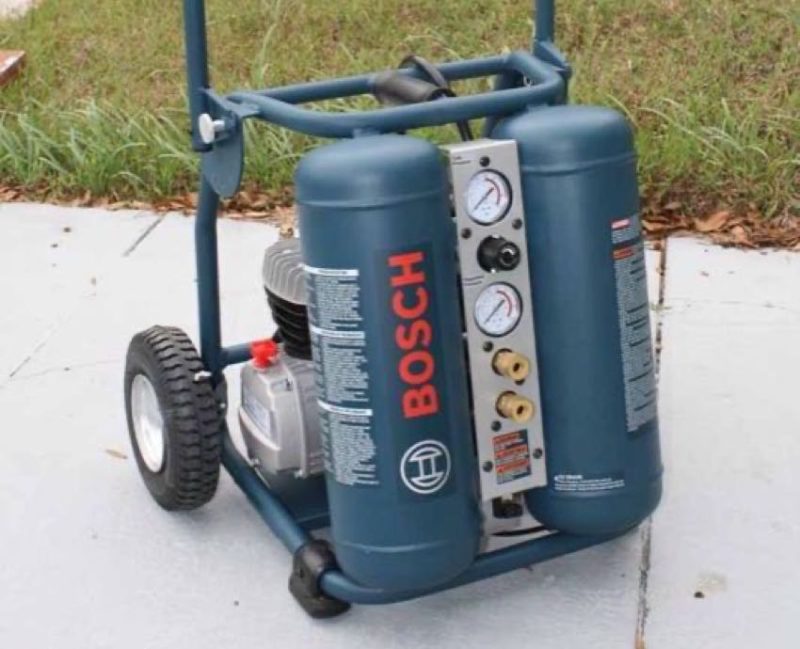
When you’re on the job framing a house, there’s nothing worse than having to wait for your compressor to play catch-up. Those days are likely over with the Bosch CET4-20W 4 Gallon Compressor. Not only is this a convenient wheeled tool to carry around, but it’s also got volume and fast recovery time. You can keep working, uninterrupted, no matter what the job. We used the CET4-20W air compressor on a variety of jobs. It held its own each time, earning it the nickname “Jack”—as in “be nimble and quick.”
We’ve used many different air compressors over the years, from hot dog style to pancake and even 8-gallon wheeled models. The latter provides a large volume of air. Nothing, in our opinion, beats a nice compact twin-stack for all-around usefulness. While not exactly compact, the Bosch CET4-20W twin stack is convenient. It presents itself as an easily portable solution that packs a punch. Bosch’s take on this design improves it further by offering 4 gallons of air capacity and wheels for easy transport.
They also mount the tanks vertically, something unique that allows both tanks to drain simultaneously. Because this is a heavier-duty model, be aware that it weighs in at around 85 pounds. That makes it one of the heavier units (by roughly ten pounds) we’ve tested. This is no simple trim compressor!
Bosch CET4-20W Build Quality
The Bosch CET4-20W 4-gallon compressor comes in the expected Bosch Blue. The tanks are welded steel and are oriented vertically, which makes draining easy. The electric 2 horsepower engine sits within a steel roll cage, which protects it from the hazards of jobsite use. The air compressor is oil-lubricated to keep the parts from premature wear. You literally have tubular steel surrounding all of the sensitive parts. It ships filled with oil, and the cap includes an integrated dipstick for checking levels every 200 hours of use.
The system comes with the wheels detached. The first thing we did was attach them using the included bolt washers and nuts. The entire compressor weighs nearly 85 pounds, making it quite heavy to lift. The wheels, however, make it easy to port this tool around. They all but eliminate the need to pick it up, save unloading it from your truck or work van.
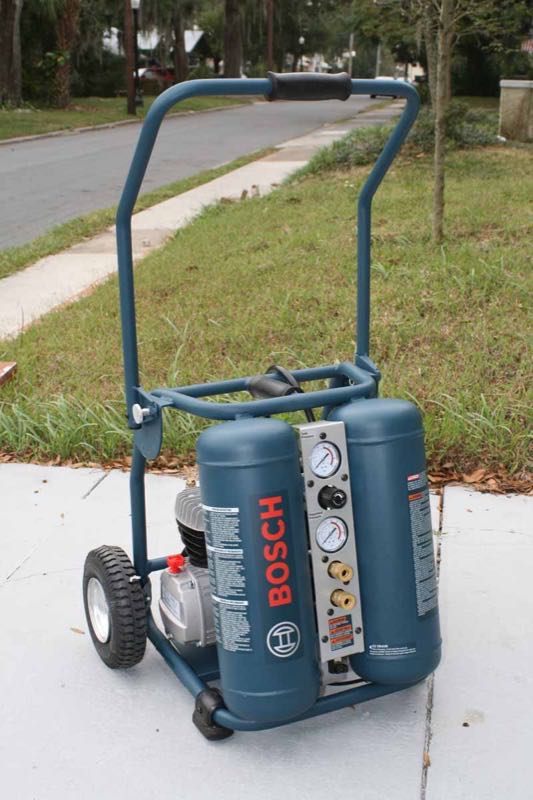
Portability and Weight
The wheels go on such that the inflation stems are located on the inside. You can (barely) reach them using the backside of a standard tire inflation adapter. They should be located on the outside of the wheels. We found this out the hard way when a friend rolled all 85 pounds off the side of an 8″ tall deck. One of the wheels lost its seal, and we had to reinflate it. Other than inserting the oil dipstick/cap there is no further assembly required to get the CET4-20W up and running.
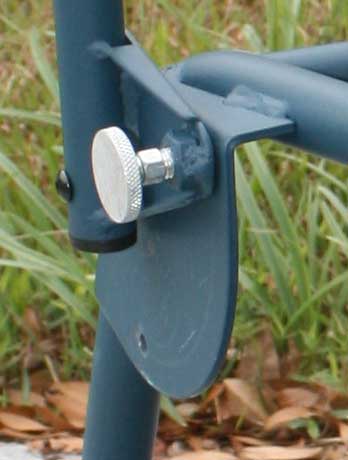
The integrated handle swings up and locks in place to allow you to easily cart the compressor around the jobsite. What we noticed, however, was that the locking pin was very shallow. In addition, there was only one, whereas we would expect there to be one on each side of the handle. This made the handle a bit unsteady in its upright position. You don’t want that in a tool that is otherwise very ruggedly built. After inquiring with Bosch, we found that the locking mechanism hadn’t been fully threaded into the steel plate. Once we bottomed it out, the pin inserted fully into the hole.
Gauges and Attaching Air Tools
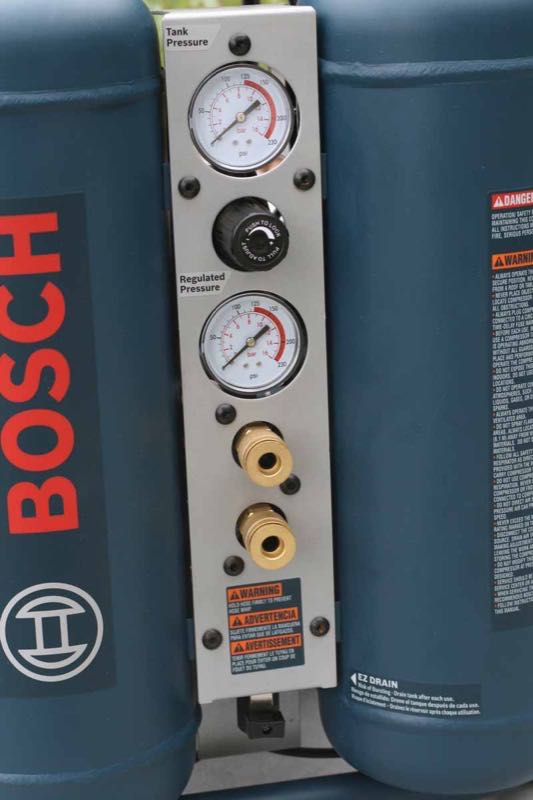
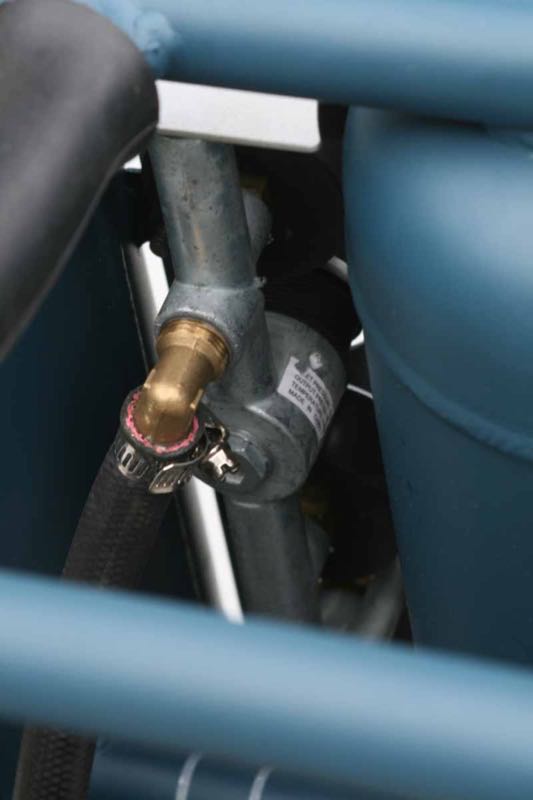
Between the tanks lie the twin pressure gauges, one for the tank PSI and the other for the outlet PSI. The pressure regulator control is between and below this assembly are the twin outlet fittings. The pressure regulator was tough to turn at first, but once we broke it free, it worked as expected. Having two outlet fittings means you can connect and use two pneumatic tools at once. We were also pleased to find these sensitive controls and couplers partially recessed within the tanks. That provided them ample protection during use and meant that we were unlikely to accidentally damage them on the job.
At the very bottom of the regulator assembly, you’ll find the tank drain valve. It’s very well designed and easy to use. After pulling the safety release valve to drop the tank pressure down to 20 PSI or below, this drain valve easily allows air and condensation to drain from both of the vertically-positioned tanks at the same time. I try to drain my tanks daily here in Florida.
Recovery Time and Noise Output
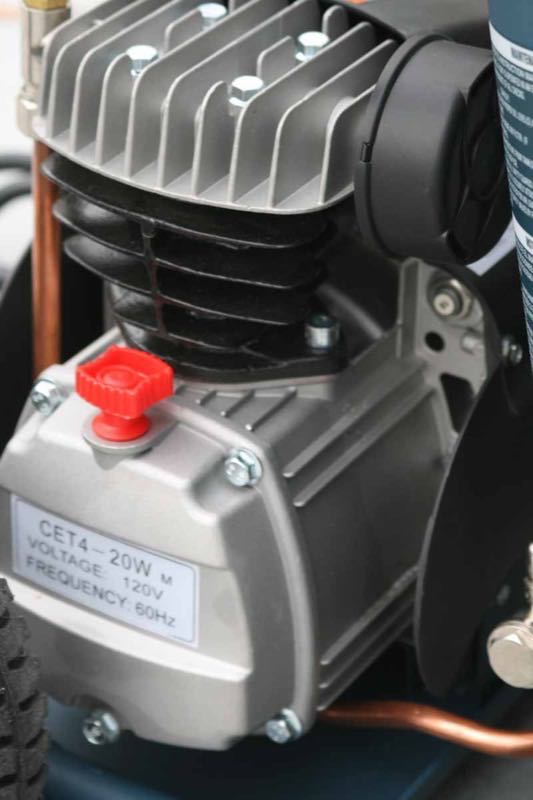
The air compressor pump looks to be ruggedly built. The oiled system ensured a quieter operation than typical Teflon coated or other oil-free systems. The major heat-prone areas of the motor are covered with ABS plastic. It protects you from getting accidental burns should you venture too close. The pressure switch cover was easily removed. You can set the limits of when the compressor will start to refill as well as the maximum pressure to which it will charge the tanks.
The hoses used to route air from the tanks to the regulator and outlet fittings are rugged. They have thick walls that aren’t likely to give you any problems over time. In fact, I’d have to say that in comparing this Bosch CET4-20 compressor with other models we’ve used, it’s one of the more well-built products. This isn’t a casual-use tool. With a 12-second recovery time, 4.9 CFM rate, and 4 gallons of air storage, the CET4-20W is a tool that can go all day long in framing applications without breaking much of a sweat. Those looking for a constant-use flow of air will, of course, want to either check out one of Bosch’s Wheelbarrow compressors or a larger capacity vertical air compressor.
Bosch CET4-20W In the Field
We used the Bosch CET4-20W air compressor hard. From framing a deck to putting up walls for a Habitat for Humanity home, we ran it through its paces. We used it in almost every conceivable way we could. In our Habitat for Humanity project, we paired it with the Bosch SN350-20F Angled Framing Nailer. We found we could dial in perfectly for both framing and sheathing. The consistency of the pressure meant that the depth adjustment dial could be used—as designed—to perfectly set the nail. But what we really appreciated was the infrequent recoveries and consistency that the CET4-20W offered.
It was also nice for us to be able to simply lower the compressor off our work truck and quickly roll it into position without having to break our backs lugging the tool to our staging position. Hose connections were quick and easy and the cord was long enough that it gave us some flexibility in moving it around without yanking on all our other tools that were connected to the same breakout box.
Using Two Nailers at Once
In using two nailers at once, the Bosch CET4-20W compressor had to recover more often, but the 4 gallons definitely made a difference and we found that we could all but disregard the compressor and just get to work. It was nice not having to slow down or worry about it catching up to us. Every nail fired smoothly, and the supply seemed consistent with what our tools were expecting.
You can actually dial the pressure switch in to alter the recovery cycles, allowing for more leniency (lower pressure) between when the pump kicks in, or holding the compressor to a tighter standard where your tools maintain higher PSI. We configured it close to its defaults, where the CET4-20W would find itself turning on at around 95 PSI and charging up to 120 PSI.
Bosch CET4-20W Conclusions
The Bosch CET4-20W air compressor works great for professionals. What makes it especially good, aside from its excellent portability and wheeled frame, is the ruggedness of the tool and its ability to quickly recover air. Twelve seconds is a fast recovery time for a tool of this size and the balance of fast recovery to tank size is an important one. Bosch seems to knock it out of the park with the CET4-20W.
Those looking to use this in a daily contractor’s role will appreciate the attention to detail, low noise, integrated protection provided by the recessing of the controls, and the all-steel cage that virtually surrounds the motor. At a street price of less than $350, this tool is a great value. If you can’t already tell, its performance blew us away and we only dinged it for what we feel are some minor quality control issues. Heartily recommended!