
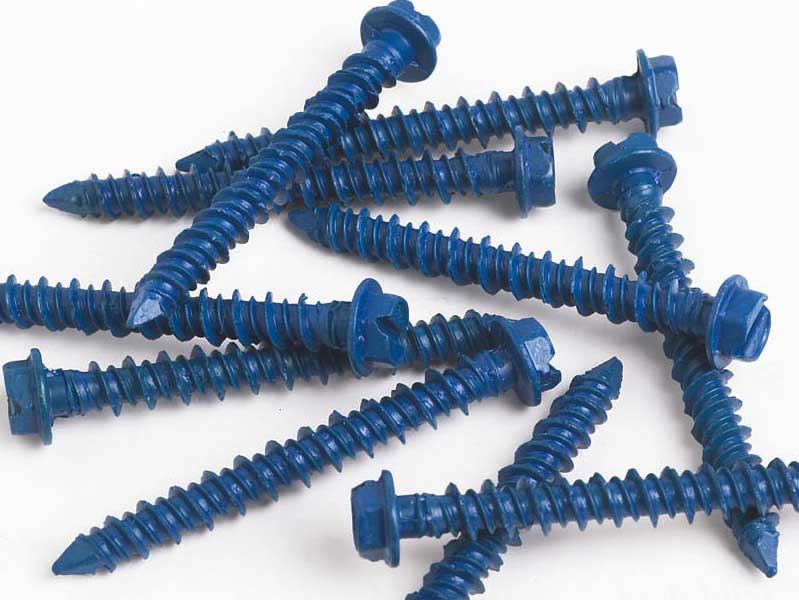
What makes Tapcons so popular is that you simply drill a hole using a hammer drill (if you don’t have one, see our best cordless hammer drill article to find out which we recommend) and then drive the Tapcon concrete screws into place. There are no inserts, so the anchors themselves are the very thing that bites into concrete, brick, stone, or masonry materials, providing a secure connection. Tapcon concrete screws provide a straightforward solution to a range of common issues encountered by both homeowners and professionals.
If you’re drilling a lot of holes, you may want to invest in a rotary hammer vs hammer drill to get better performance and faster drilling. The actual Tapcon concrete screws and anchors themselves are typically blue, and the thread pattern is an alternating design that is made to draw the thread in and allow it to have an extremely strong hold.
Tapcon Concrete Screws – Sizes and Options
Tapcons are available in various lengths in both 3/16″ and 1/4″ diameters. They are also available as either hex washer heads or Philips flat heads. You can purchase them in small, medium, or large clamshell cases.
There are actually several styles of Tapcon. The 410 Stainless Steel Tapcon provides the ease of use and performance of a typical Tapcon, but with the 410 stainless steel composition. These are most commonly used on exposed areas like exterior shutters, screened enclosures, and decorative railing. The Tapcon SG (Storm Guard) is a modified design that is meant to be permanently attached and used to anchor metal or plywood panels to wood, block, or concrete. The Tapcon XL series is an oversized 5/16″ diameter anchor used for jobs that require additional strength.
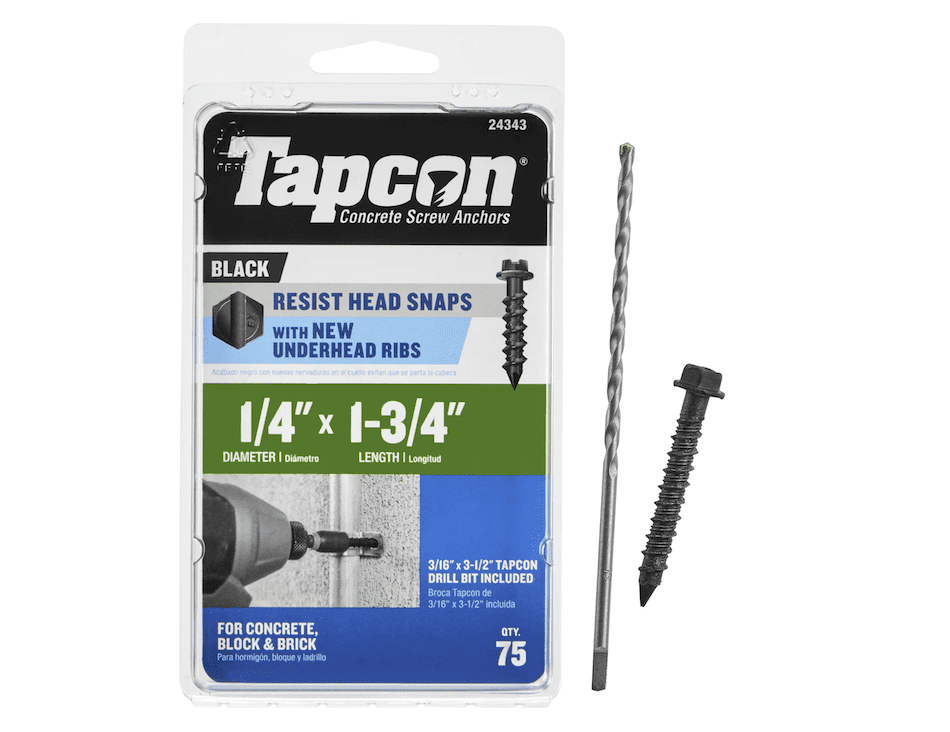
We’ve used the standard blue Tapcons for years, but thought it would be good to take a closer look at what makes them so unique and demonstrate just how well they do in a pinch. What was our “pinch?” A plumbing leak required us to mount a replacement spigot to a block wall. To do this, we’d need something that could anchor a piece of pressure-treated (PT) lumber to the wall securely so that the new spigot would never torque or twist under use. Taking into consideration the 1×4 material we were using for our backing material, we grabbed a small box of 1/4″ x 2-1/4″ Tapcons for the job. With the 1/4″ Tapcons, they recommend a 3/16″ Tapcon drill bit. You can use that or a 3/16″ concrete hammer drill bit – which is what we utilized.
Installing Tapcons
Using a DeWalt hammer drill, we made quick work of the four holes, which we drilled to a surface depth of 1-3/4″. This gave us enough depth for the Tapcon to mount flush into the piece of pressure-treated wood and also sink a full 1-1/2″ into the concrete with an additional 1/4″ (as recommended) air gap after the end of the anchor. Once the holes were drilled out, we mounted our material and used a 9.6V DeWalt cordless drill gun to sink the Tapcons.
Even with such a relatively low-powered drill, we were able to sink them without any difficulty. The Tapcon anchors simply bit into the wall and pulled themselves and the pressure-treated wood snug against the cinderblock, letting us know that a secure and stable connection had been made.
Conclusion
There is a lot of competition in the marketplace for Tapcon-type fasteners. You’ll see similar products marketed under the names of RuffNex, Kwik-Con, Caliburn (GRK Fasteners), and others. The basic thing you’ll want to look for is the material the fastener is made of, what kind of bit is used to drive it, and the pullout value (how securely it is rated to stay fastened). If you shop around, you can find Tapcons for $0.10/ea in quantity – far less than what you’ll find in your local home improvement store. If you’re planning a larger job or you intend to make frequent use of these anchors, be sure to buy them at the lowest cost possible.
Tapcon anchors are certainly one of the more popular (ie. well-marketed) products you can purchase, despite their premium cost. They are also a very unique (and of course proprietary) product that allows for extremely fast and reliable anchoring of materials to masonry products. If you drill the hole correctly – deep enough and with the correct diameter bit – these fasteners will simply work every time.