
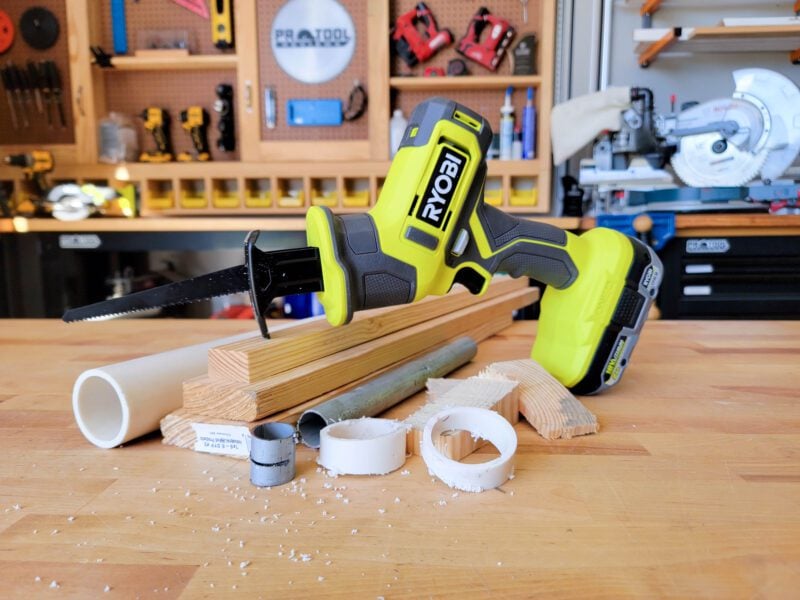
Compact one-handed reciprocating saws are a staple in many tool collections, and Ryobi is no stranger to this class. The most recent iteration is the PCL510 that shifts the focus to a more approachable price point. I’ll share what I’ve learned from using this saw and help you see how it compares to Ryobi’s HP Brushless version so you can decide if it’s the right tool for you.
Read
Best Cordless Reciprocating Saw Head-to-Head Review
How We Test Reciprocating Saws
Ryobi PCL510 One-Hand Reciprocating Saw Performance
- No-Load Speed: 3000 SPM
- Stroke Length: 5/8 in.
- Motor Type: Brushed
Cutting Power
At its heart, the Ryobi PCL510 is powered by a brushed motor that churns out up to 3,000 SPM with a 5/8-inch stroke length. This is a slight departure from the brushless tools we ordinarily cover, but remember that brushed tools often hit a lower price threshold.
To get a feel for this saw, I set up a series of cuts, including a 2×4 pine stud, 1-inch EMT, 1×4 pine trim, and 2-inch Schedule 40 PVC. Overall, it handled most of these cuts with ease, however, it was a little slow getting through the 2x material.
This isn’t a major surprise, considering A) this type of saw isn’t designed for large-scale demo work, and B) we don’t expect a value-focused model to keep up with premium models twice as expensive. If you’re stuck cutting something tougher than a 2×4 stud, a full-size reciprocating saw is a better choice.
For making quick cuts in tight spaces or even working overhead, the PCL510’s compact, lightweight form factor is much easier to maneuver than its full-sized counterpart, the Ryobi PBLRS02. With this compact model on your side, electrical and HVAC tasks are much easier since you won’t have to lug around a bulky tool when space is limited.
Vibration Level
Given the aggressive nature of reciprocating saws, vibration control is something that we like to consider while we’re testing. We’re especially grateful when it’s done well. Just like Ryobi’s compact HP Brushless model, the PSBRS02, the PCL510 displayed fairly low vibration levels and didn’t cause excess hand fatigue during our testing.

The only thing I’d like to see on future iterations is a pivoting shoe to help the saw maintain contact with the material. It’s a common feature for one-hand models to skip, but I do think it would enhance the overall cutting experience.
Ryobi PCL510 One-Hand Reciprocating Saw Design Notes

- Model: Ryobi PCL510
- Power Source: Ryobi 18V battery
- Weight: 2.2 lbs (bare tool), 3.1 lbs (with 2.0Ah High Performance battery)
- Tool Length: 11 in.
Ergonomics
The Ryobi PCL510 weighs 2.2 pounds as a bare tool, 3.1 pounds with the kitted 2.0Ah battery, and measures 11 inches from tip to tail. Overall, this saw is well-balanced and easy to maneuver with that battery pack. You can use a larger battery to increase your runtime, but that will shift the balance toward the rear.

As you’d expect, Ryobi was quite generous with the rubber overmolding on the grip area, including two bumper pads on the side of the motor housing for added protection.
Additional Features
- Ambidextrous Trigger Lock: Helps prevent accidental activation
- Part of the 18V One+ System: One battery runs more than 300 power tools and lifestyle products
Quick Model Comparison
Here’s an idea of how this model stacks up against Ryobi’s HP Brushless one-hand saw and a couple of our favorite Pro models. Note how much different the weight and price are.
| Ryobi 18V PCL510 | Ryobi 18V HP Brushless PSBRS02 | Milwaukee M12 Fuel 2520 | Metabo HPT 18V CR18DAQ4 | |
|---|---|---|---|---|
| Stroke Length | 5/8 in. | 7/8 in. | 5/8 in. | 1/2 in. |
| No-Load Speed | 3,000 SPM | 3,200 SPM | 3,000 SPM | 2,800 SPM |
| Motor Type | Brushed | Brushless | Brushless | Brushless |
| Working Weight | 3.1 lbs | 4.9 lbs | 4.1 lbs | 3.6 lbs |
| Price | $79 (kit) | $169 (kit) | $159 (kit) | $129 (bare tool) |
Don’t just consider the numbers, though. While Ryobi’s brushless model is faster on paper, the motor itself is also stronger. When you’re cutting material like a 2×4, you can push into the cut more with the brushless version. On those tougher cuts, it makes a difference.
Ryobi PCL510 Price
The Ryobi PCL510 retails for $79 as a kit that includes a charger and a 2.0Ah High Performance battery. Ryobi backs this saw with a 3-year warranty.
The price is a big deal. It’s a little less than half the price of Ryobi’s high-performance brushless version, and of course, much less than professional models as well.
The Bottom Line
After some hands-on time with the PCL510, it’s clear that Ryobi created a capable one-hand reciprocating saw. It managed to muscle through our tests, but we could tell the HP Brushless version is a step up in cutting speed and confidence. So then, where is the appeal?
Well, as you can see from the chart above, the Ryobi PCL510 comes in at nearly half the price of similar brushless models. That’s a big deal, especially for value-minded buyers who don’t mind giving up some performance if it means big savings on the front end. Not to mention, it’s noticeably lighter too!
Overall, the Ryobi PCL510 represents an incredible value proposition for avid DIYers. Sure, it’s not the fastest or most powerful saw in Ryobi’s lineup, but if you’re on the hunt for a lightweight, compact one-handed reciprocating saw on a budget, this is a hard one to pass up.
On the other hand, if high performance is a higher priority for you, go with Ryobi’s HP Brushless version.