
Ryobi has spent the better part of the last decade building one of the largest battery-powered outdoor power equipment ecosystems on the market. Everything from string trimmers to chainsaws, and the star of today’s show—the all-new ZR3 80V HP Brushless Zero-Turn Mower. This new mower represents another big step in Ryobi’s evolution in the OPE space, and we’re curious to find out what sets this mower apart from the rest.
On paper, it checks many of the boxes homeowners are looking for in a modern residential ZT. The question is whether its performance and feature set are enough to justify the jump from an entry-level gas-powered zero-turn. I got some time in the seat to find out.
Pros
- Excellent cutting power
- Great cut quality
- Efficient bagging, mulching, and side-discharging
- Long runtime
- Solid kit value
Cons
- The stock seat is a little stiff
READ
Best Riding Lawn Mower Reviews
Ryobi ZR3 80V HP Brushless Zero-Turn Mower Performance
Under The Hood
At the heart of the ZR3 are four brushless motors working together to drive the rear wheels and the two blades. Ryobi claims the setup produces the power output equivalent to a 25 HP gas engine. This puts it squarely in competition with many residential and prosumer gas-powered zero turns you’ll find at your local big box store.
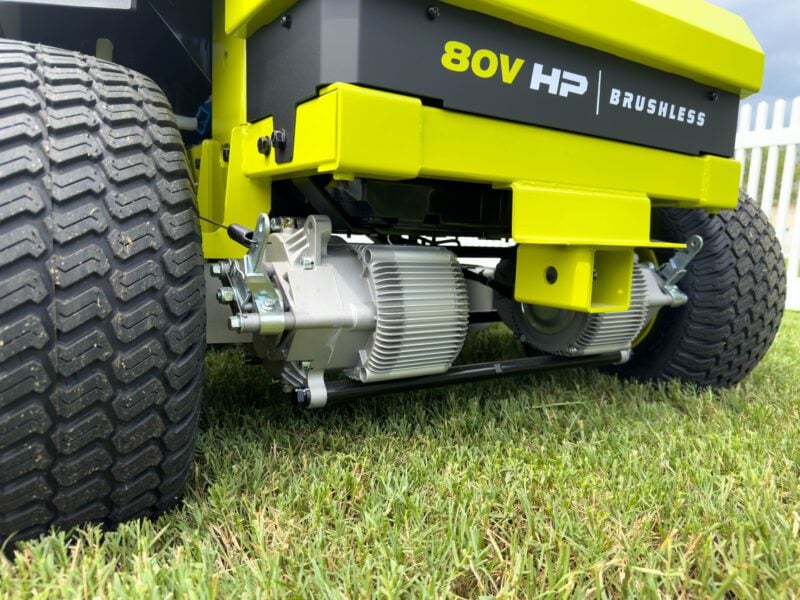
Ryobi designed this mower for versatility. It features two drive modes and two mowing modes. Under normal operation, this mower tops out at 7 mph, but engaging the Low Drive Speed mode drops that down to 4.5 mph. I found the normal drive mode most useful for making passes in wide-open spaces, whereas the reduced speed mode offers more control around fence lines and landscape features.
Mirroring the drive speed, Ryobi offers an Eco mode, which lowers the blade speed and helps extend runtime. The Eco mode is perfect for the off-season, when the grass isn’t as lush, or for those regular weekly cuts where you’re simply taking a little off the top.
Runtime
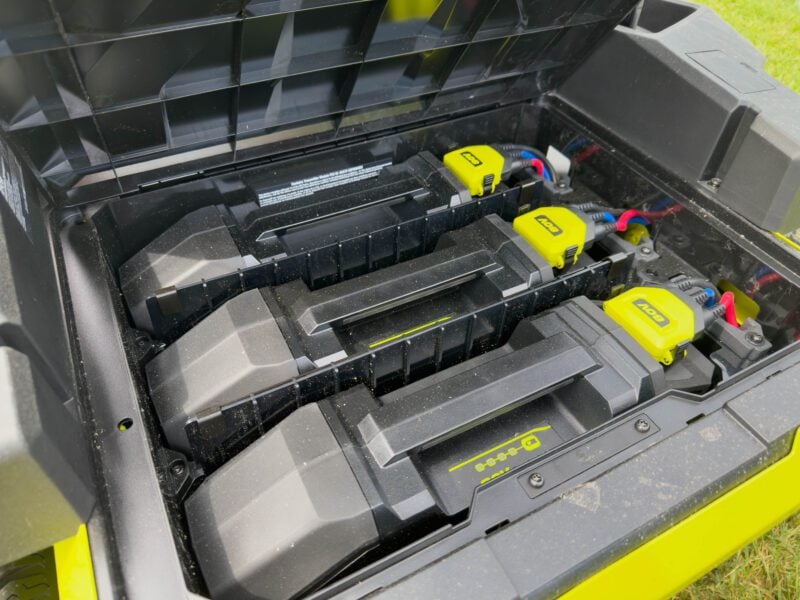
Runtime is an area where Ryobi is making a strong statement. The mower includes a pair of 80V 14Ah batteries with the kit and claims up to 2 acres of coverage under normal mowing conditions. As always, actual runtime depends heavily on grass height, terrain, blade speed settings, and mowing speed. With that said, this puts the ZR3 in line with what most folks need for weekly maintenance mowing. There’s a third slot in the battery bay if you need to extend the runtime by another 50%.
Bagging and Mulching
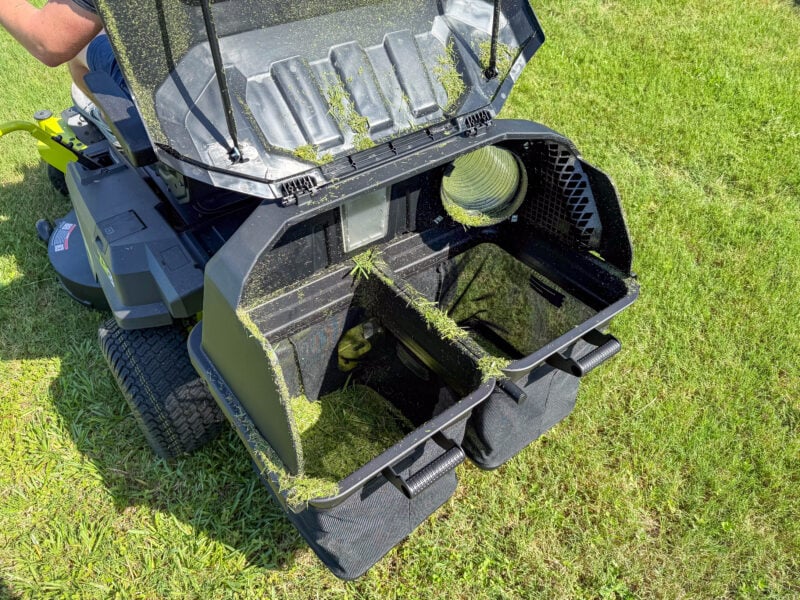
One of the coolest features about this mower is that you can configure it for mulching and bagging applications with a few add-ons.
Ryobi’s bagging setup includes a set of stacked high-lift blades and an additional deck plate that improves airflow and suction under the deck. We’ll dive deeper into this during our hands-on testing discussion.
The mulching setup is pretty straightforward. It utilizes two panels that block the side discharge chute, allowing the deck to restrict outgoing airflow. It’s a pretty innovative solution, especially for a zero-turn mower, and I think Ryobi absolutely nailed it.
Mowing with the Ryobi ZR3 80V HP Brushless Zero-Turn Mower
Fortunately for us, mower season is in full swing, thanks to our afternoon rainstorms here in Central Florida. The lawn at our shop is comprised of two common species—Bahiagrass and St. Augustine. Both present their own unique challenges, so we were happy to see the mower’s cutting characteristics in both.
Starting out, I kept the mower with the stock single-blade configuration to see how well it would throw the clippings. Unsurprisingly, this mower cut flawlessly and ejected the clippings in an even 4 to 5-foot dispersion. It performed well even with Eco mode engaged, but if you’re mowing taller grass, I’d keep it in standard mode.
Next, I installed the bagging attachment and got to work. But, I had a serious question that I needed to answer: Do I actually need to swap out the blades and add the deck plate? We’ll answer that in a minute.
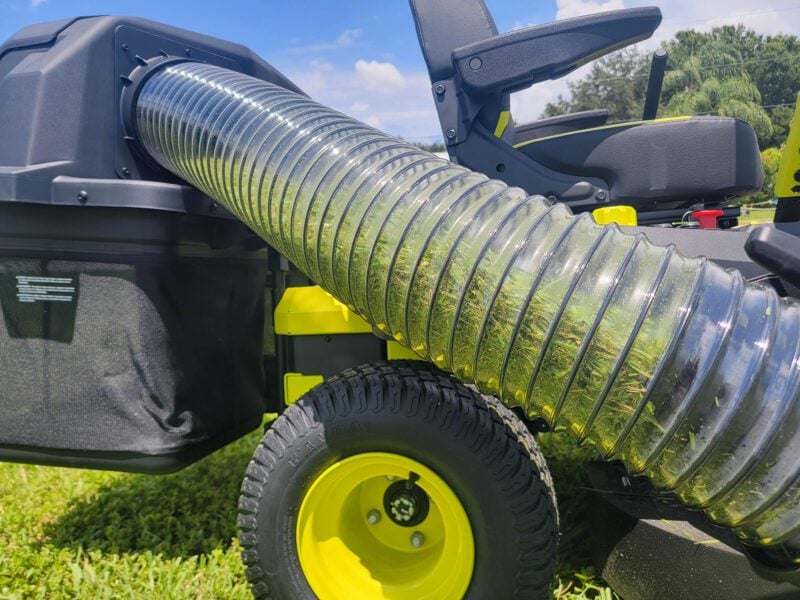
For the most part, grass traveled through the clear tube, but I could see a visible buildup when I passed over thicker patches. At one point, the tube became so overwhelmed with grass that it was completely clogged. So, I decided to bite the bullet and completed the full install. The difference was night and day.
Swapping the blades took about 15 minutes and requires removing the deck entirely… and it’s worth it. Start by disconnecting the power cables going to the blade motors, then press upward on the deck latch and secure it in place with the spring-loaded deck pin. Once the deck is released on both sides, simply lift up and slide it forward to release the final hook on the front of the deck. I did this by myself, but I’d recommend doing this with two people.
From there, swapping out blades is a piece of cake…just be sure not to overtighten the spindle nut.
The stacked high-lift blades propelled the finely processed grass clippings into the collection bag so fast they were hard to see. If you’re considering this attachment, it is crucial that you install all components to achieve the best results.
Out of curiosity, I removed the bagging tube and set the mower to side discharge. I wanted to know if the high-lift blades would improve the grass throw compared to the stock single-blade. Once again, worth it. I could see air moving over the grass 10 feet away, and more importantly, I was consistently sending grass clippings 6-8 feet away with a very even distribution.
As for the mulching guard, the installation process follows a similar route to the bagging attachment. You still need to remove the deck in order to ensure a proper fit, but the end results are worth it.
Once again, the stacked blades made quick work of our thick St. Augustine grass and produced fine, processed clippings that blended in perfectly. I didn’t notice any clumping or excess build-up as I made my passes.
All in, this is a big win for Ryobi, especially when you compare the ZR3 to their previous model. This mower is refined, easy to operate, and versatile enough to handle a variety of mowing tasks and terrains.
Ryobi ZR3 80V HP Brushless Zero-Turn Mower Design Notes
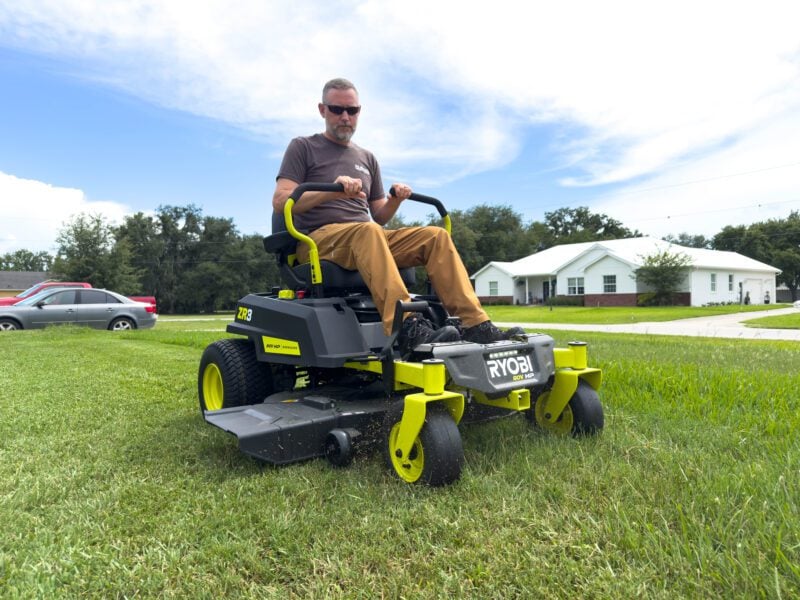
Deck Construction
Ryobi opted for a fabricated 12-gauge steel deck with reinforced edges. This is a significant upgrade over stamped steel decks commonly found on more budget-friendly residential models. This design provides an extra level of durability when mowing rough terrain or occasionally clipping a hidden root or rock.
Deck Height Adjustment
Ryobi took a unique approach to their deck height adjustment system. Rather than an adjustment lever or pin detent system, they employ a foot pedal and a rotating adjustment knob. This setup is very intuitive and unlike anything we’ve encountered before.
Setting the height is easy. Start by pressing the foot pedal and then rotating the knob until your desired height is in the small display window. The beauty of this setup is that you don’t need to lean down to make adjustments, and you can quickly raise the deck as you pass over driveways and sidewalks.
Creature Comforts
Ryobi includes a few handy creature comforts on this mower. First, you have a large cupholder that’s big enough to accommodate your favorite insulated tumbler, and a dedicated slot for your phone.
Unlike some battery-powered riding mowers, you won’t find any USB charging ports on this mower. So, be sure to get your phone fully charged so you can keep your favorite tunes going as you work!
Seat Upgrades
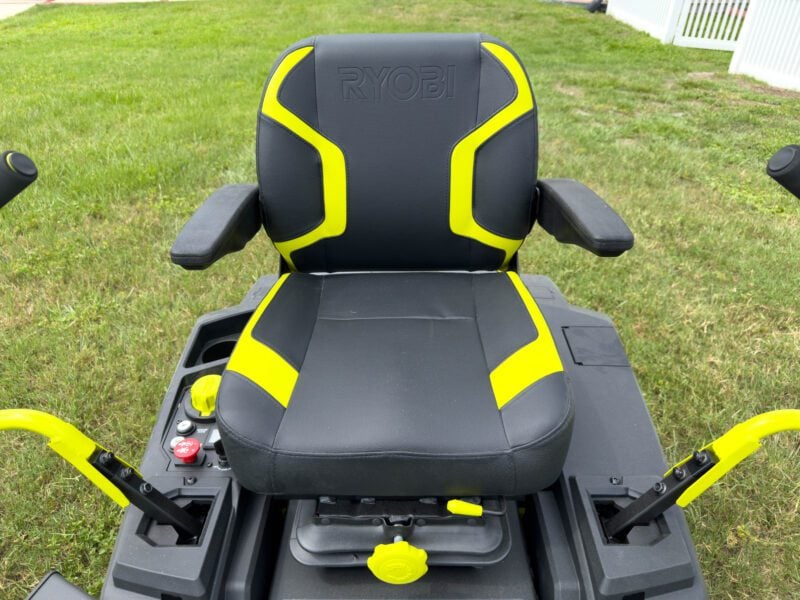
The biggest upgrades on this particular ZR3 package revolve around comfort.
With the base configuration, Ryobi includes a standard spring seat suspension system. This is a very traditional approach that’s been the industry standard for decades. However, our team was a little unsatisfied with the overall comfort level, especially when mowing over bumpy terrain. Thankfully, Ryobi has a solution.
For a few extra bucks, you can get this mower with an upgraded seat package, which includes a more advanced base and padded armrests. The seat base allows you to dial in the ride cushioning based on your weight. This is becoming more common across the industry, so we’re glad to see it here.
Granted, the upgraded seat won’t help you finish faster, but it makes a noticeable difference over the course of a long mowing session.
Additional Features
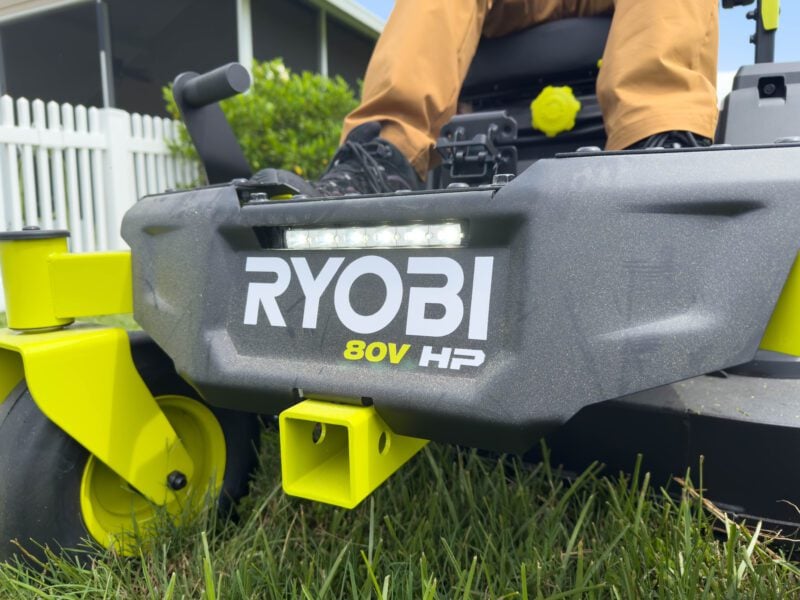
- LED Headlight: Perfect for mowing in low light conditions and avoiding obstacles
- Universal Hitch Receivers: 2-Inch receivers on the front and rear integrate with additional accessories (250 lbs capacity)
Ryobi ZR3 80V HP Brushless Zero-Turn Mower Price
As battery-powered riding mowers go, Ryobi priced this model competitively. The base model retails for $3,999 and comes with two 14Ah 80V batteries and a charger.
The next level up costs $4,498 and includes the same batteries and charger, but adds the upgraded seat package. Last, $4,698 gets you the same batteries, standard seat, and the bagging kit.
Any way you slice it, Ryobi backs this mower with a 5-year limited tool and battery warranty.
Should You Buy It?
After getting into the details of this mower and putting it to work here at our shop, I have to say, I’m genuinely impressed. This mower is a massive improvement over Ryobi’s past models and proves that battery-powered mowers are here to compete.
The big issue with battery-powered riding mowers always seems to boil down to price and runtime. In this case, Ryobi’s price tag is only slightly higher than comparable gas-powered models, and with three available battery slots, most folks are in the clear. Of course, if you’re regularly mowing some serious acreage, this probably isn’t a good fit for you.
However, if you’re considering switching away from gas, or maybe you’re just on the fence about which model is right for you, this mower is certainly worth considering.
Specs
- Model: Ryobi RY80HPRM04
- Power Source: Ryobi 80V batteries
- Gas Equivalent: 25 HP
- Runtime: 2 acres (with 2x 80V 14Ah batteries)
- Max Drive Speed: 7 mph
- Cutting Height: 1 – 4.5 in.
- Deck: Fabricated steel
- Deck Width: 42 in.


I have the first generation Ryobi 42″ ZT and wanted to upgrade to the second generation when my batteries gave out, but I installed Lithium batteries instead and have gotten several more years out of it. Didn’t I understand that the second generation had Joystick steering instead of the lap bars? What happened to that, it looked like a good idea? Most skid steers and other construction equipment have gone that route.
Yes, three iDrive models had joystick steering, and it worked well in our testing. They’ve since been discontinued, though. My guess is that it didn’t take off among the target user base.