
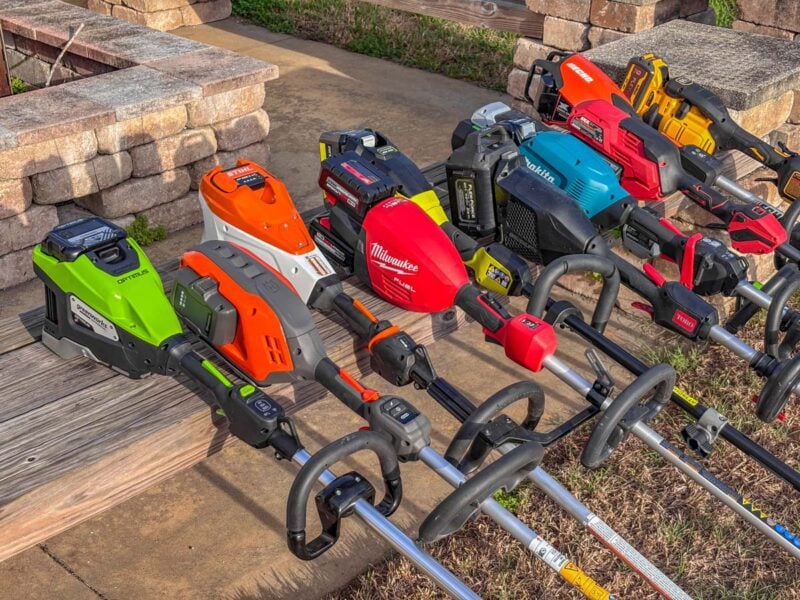
Whether you’re a Pro or a homeowner, one of the biggest challenges in swapping your gas string trimmer for a battery-powered one is power. Marketing teams make plenty of claims, but can they really keep up with gas models?
We’ve tested dozens of battery-powered string trimmers, and the answer is a resounding… sometimes.
It depends on what you’re used to using. There’s a big difference between an entry-level homeowner model and the 25cc – 30cc string trimmers you find professional lawn care crews using. So, in this article, I’m going to highlight three battery-powered string trimmers that we’ve tested and are confident in their ability to replace gas.
If you want to see even more options we recommend, check out our Best Battery-Powered String Trimmers feature.
How We Test String Trimmer Power
There are a couple of ways we test string trimmer power. One is subjective as we handle our normal lawn care chores. We’ve used a ton of string trimmers over the years, and with our entire testing crew having to keep up with Florida’s non-stop growing season, plus the formal review evaluations we run, we’re able to feel variations in power and cutting performance.
For a more objective approach, we also built a test rig. It uses 3 layers of Vigoro reed fencing (item number 325538 at Home Depot) that we run for 8 feet. Because it’s a hard, stalky material, it’s tougher than most grass. In fact, it’s very similar to the base of some of our field grass species when they get overgrown and creep toward our properties.
The material can bog a trimmer down if we try to go too fast, so we have to make sure we’re giving the line enough time to cut. We make several runs and use the fastest time we’re able to achieve.
Between real-world use and timing in our test rig, we’re highly confident in recommending the following three battery-powered string trimmers as gas replacements.
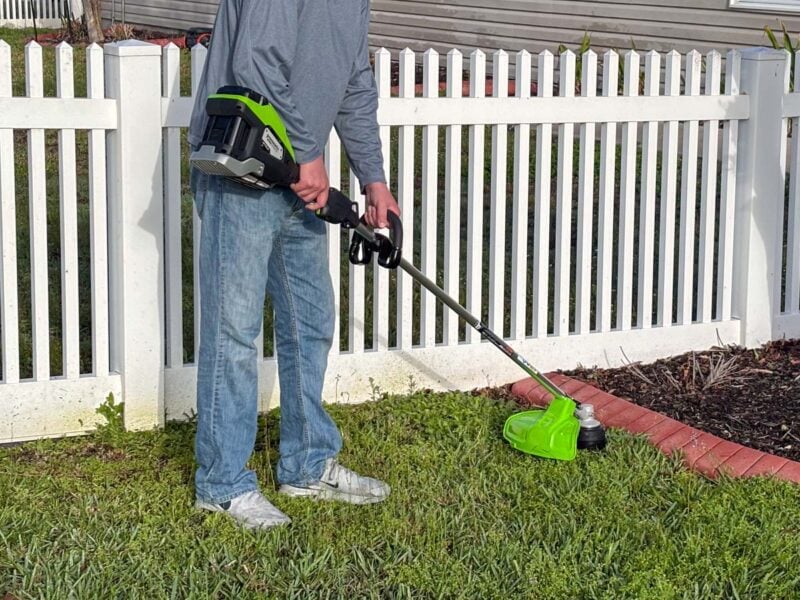
For Pros: Greenworks Commercial 82V Optimus String Trimmer ST161
Pros
- Large cutting swath
- Outstanding cutting speed and power
- Reverse rotation mode
- 36cc gas equivalent power
- Good runtime
- Includes a rapid load head
Cons
- Expensive
- Heavy
Most professional OPE brands have battery-powered string trimmers that meet or exceed the performance of gas. For Pros, it’s less a question of if you can get a gas replacement and more one of how much power you want.
If you’re looking to go full send in the power category, then check out the Greenworks 82 Optimus ST161. It has the distinction of being the fastest cutter on our test rig, and it wasn’t even close.
Boasting 36cc gas equivalent power, it’s designed to compete with the strongest gas models available, and steps squarely into a power category we often see in professional brush cutters.
Being so powerful, its most noticeable downside is its weight. We tested with a 4.0Ah battery, and the total working weight was just north of 16 pounds. However, that’s on par with the other high-performance battery-powered string trimmers we’ve tested.
Price: $599.99 bare, $649.99 kit with 4.0Ah battery and charger
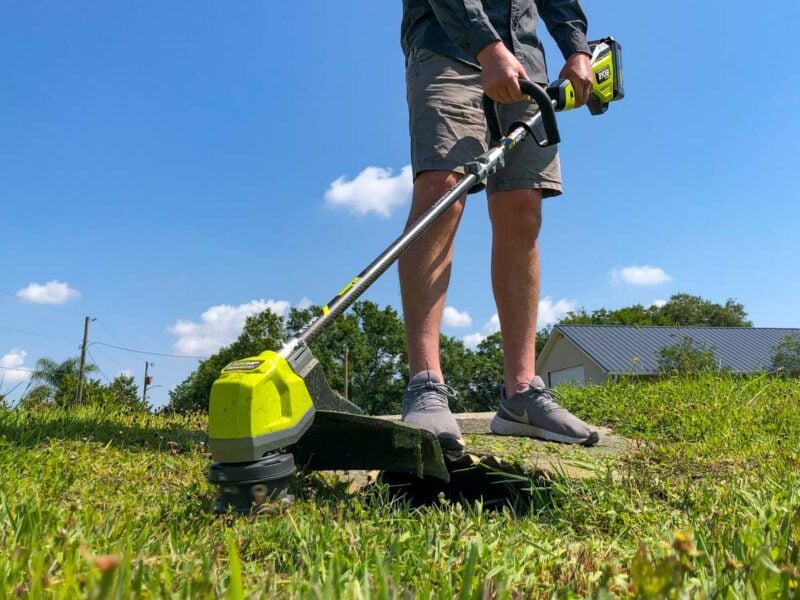
For Homeowners: Ryobi 40V HP Brushless String Trimmer RY402110
Pros
- Large cutting swath
- Excellent power
- 0.105-in. line capable
- Good runtime
- Rapid load head
- Carbon fiber shaft
Cons
- Most vibration in the group
- No tether point for a shoulder strap
For homeowners, you’ll have a hard time beating Ryobi’s 40V HP Brushless RY402110 string trimmer. When you look at gas options for homeowners, entry-level models are around 21cc, and 25cc gets you more of a Pro feel. However, Ryobi steps up even further, claiming 30cc gas equivalent power.
That showed in our tests, where it was the fastest-cutting among the homeowner models. But that didn’t actually show off its true potential. You can increase the line size up to 0.105-inch and get even better cutting.
Stepping away from our rig and doing some standard grass trimming, it was immediately clear how much more power Ryobi’s brushless motor puts out compared to other residential models we’re used to. If clearing heavy overgrowth is a concern around your home or property, the RY402110 can handle it.
Price: $249 bare, $329 kit w/4.0Ah battery and charger
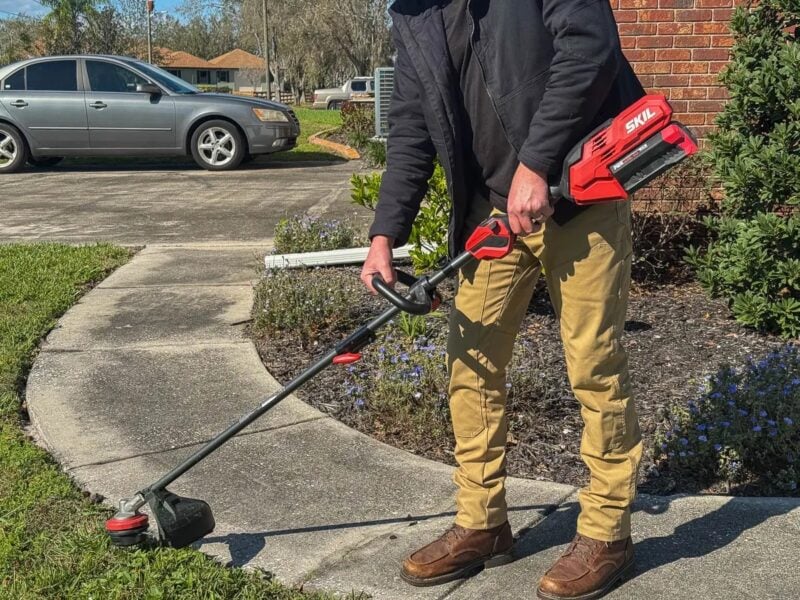
For Value Seekers: Skil PWRCore 40 String Trimmer PLT1500C-10
Pros
- High cutting speed
- Universal attachment ready
- Excellent value
Cons
- Not as strong as other models
If you have a lower lawn care budget but crave higher performance, you’re not stuck choosing between corded and gas. However, it’s best to move away from the less expensive 18V/20V Max options and step up to higher voltage.
Skil has traditionally offered better performance for the price than other brands (something we’ve noticed from their power tools as well). In stepping up to their PWRCore 40 line, you’ll find the best balance of performance and price.
The Skil PWRCore 40 PLT1500C-10 is a solid replacement for entry-level homeowner gas trimmers. While it’s not going to compete against models like the Ryobi above, it makes up for it in a couple of key ways.
One, it’s lighter weight. At 12.2 pounds with the battery, it’s more than a pound lighter than the Ryobi.
This model is also part of Skil’s multi-head attachment system. You’re able to remove the trimmer attachment and add an edger, hedge trimmer, pole saw, and more. It’s a universal attachment design, so you can even add attachments from other brands that use the same connection.
Price: $219 kit w/4.0Ah battery and charger
Tips For Improving Your String Trimmer Performance
Step Up the Line Diameter
Thicker line has more mass, which helps you cut through grass more easily, especially overgrowth. Use the heaviest line recommended for your trimmer to get the best performance.
There is a downside, though. You’ll notice shorter runtime from your battery.
Upgrade to a Premium Line
Most string trimmers come with a round line. While it’s effective, premium lines can improve your performance. I’ve been using ECHO’s Black Diamond trimmer line for years, and I highly recommend it.
It uses a twisted square design that allows the entire length to cut grass rather than only the line tip. It’s a difference you’ll notice immediately.
While this is the number one way to improve your string trimmer’s performance, it also has a downside. It cuts everything easier, including the paint on the side of your house, vinyl fence coatings, and landscaping plants. So, be careful around delicate areas.
Check the Cutter Position
Most battery-powered string trimmers have a reversible cutter. You can flip it in to use a shorter line and extend your runtime.
However, when you want the best performance, you want it set to the outer position where the line is longer. The head is going to turn at the exact same RPMs, but with the longer line, the edge speed will be significantly higher, which makes cutting grass more effective.