
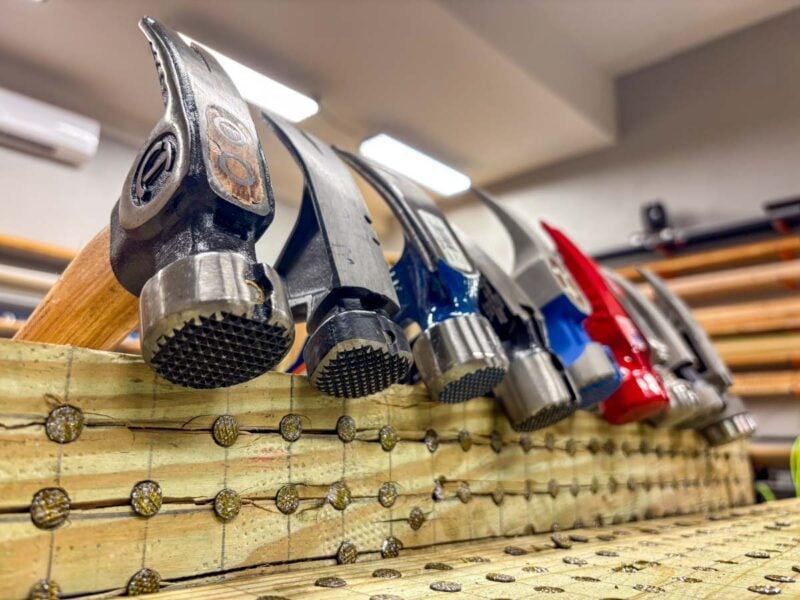
There are plenty of contenders and opinions on which is the best framing hammer. When it’s your hard-earned money making the purchase, we prefer to offer something deeper than marketing claims and social media posts.
For this head-to-head review, we’ve gathered the most popular framing hammers from several retailers, plus the ones we believe will prove themselves to be among the best. After pounding well over 800 nails in a series of tests designed to evaluate driving force, vibration, fatigue, and more, we’re ready to share some answers.
More importantly, we’re hoping our work will help you make the right choice when it’s time to buy a new framing hammer.
Best Framing Hammers
Scoring
Note that the scoring is different from our normal rating system. The scores are based on how each framing hammer performed and compared in this specific group and this set of tests only. Our typical rating system offers a comparison of the tool to the entire range of what is available. Here’s how to interpret the scores from this test:
- 90 – 100: Outstanding. You’ll love using this framing hammer.
- 80 – 89: Excellent. There may be minor tradeoffs.
- 70 – 79: Very good. There are more significant tradeoffs.
- 60 – 69: Good. Notable tradeoffs, but still earns our recommendation.
- < 60: Not recommended in the Pro framing hammer class.
Best Framing Hammer
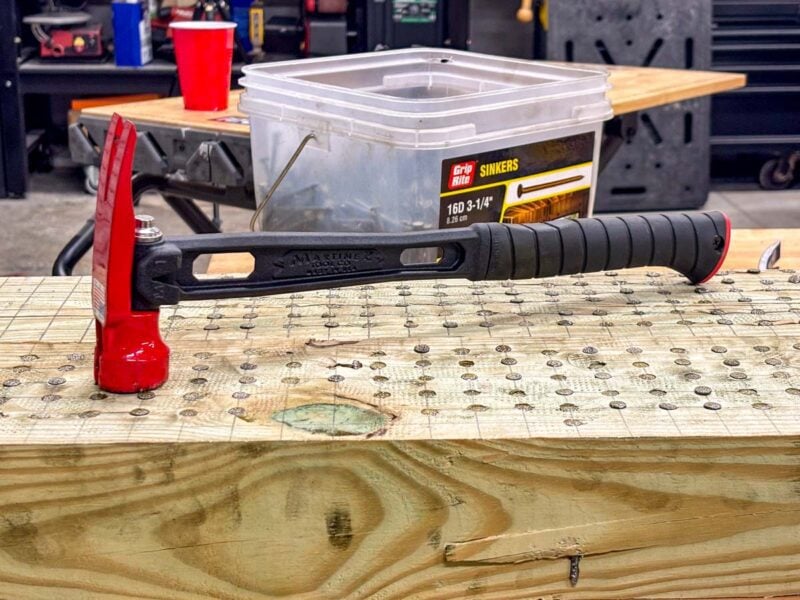
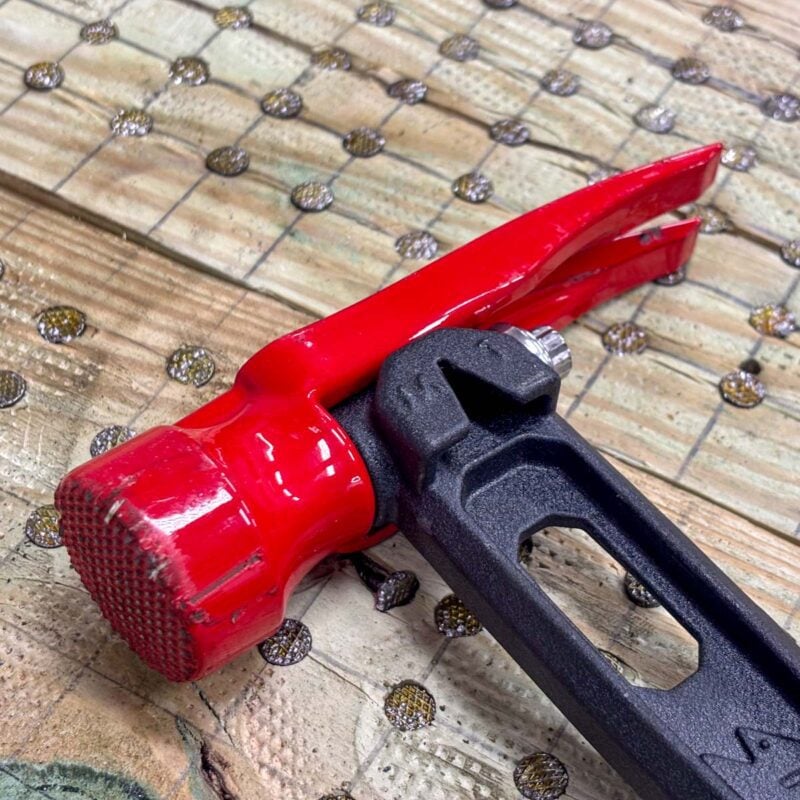
Martinez M1 15-oz Milled Face
Score: 95 points
- Head Material: Steel
- Handle Material: Titanium
- Total Weight: 32.9 oz/934 g
- Total Length: 16.4 in
- Head Diameter: 1.5 in
- Price: $384.84
Highlighted Features
- Replaceable Head: Swap the head instead of buying a whole new hammer if it gets damaged
- Magnetic Nail Starter: Quicker starts on each drive
- Side Nail Puller: Pull nails more easily than with the claw
- Vibration-absorbing Grip: Reduced the amount of vibration that reaches your hand
Pros
- Lightweight
- Easy to swing
- Low fatigue buildup
- Virtually no vibration/strike feel
- Easy nail pulling
- Made in the USA
Cons
- Grip channels can cause discomfort
- Expensive
I’ve heard tons about Martinez’s M1 framing hammer, but I never got to use one extensively until this test. I had high expectations, and it didn’t disappoint. It started strong out of the gate and didn’t slow down.
The two-piece design varies significantly from other premium hammers in that it pairs a titanium handle with a low-profile steel head. About an inch shorter than Stiletto’s TiBone, it’s only 34 grams heavier. That shorter length may have made a difference in our driving power tests, as it scored a little lower than Stiletto.
Don’t let that fool you, though. It’s kind of like that kid who’s disappointed they got a “B” on an assignment and dragged their grade down a couple of points from a 100%. The M1 scored 9’s and 10’s across the board in every other test. It distanced itself from the rest of the group to earn the highest overall score and the win as our best overall framing hammer.
The one thing you might want to look out for is the grip, though. It’s generally comfortable and secure, but the channel edges were digging into my skin a bit by the end.
Test Results
| Test | Score | Ranking out of 9 |
|---|---|---|
| Driving Power | 2.50 swings per nail | 6th place (tie) |
| Toenailing | 9.0 out of 10 | 5th place (tie) |
| Nail Pulling | 10 out of 10 | 1st place (tie) |
| Swing Effort | 9.0 out of 10 | 3rd place (tie) |
| Vibration | 10 out of 10 | 1st place |
| Fatigued Use | 10 out of 10 | 1st place |
| Grip Ergonomics | 9.0 out of 10 | 1st place (tie) |
Best Framing Hammer Runner-Up
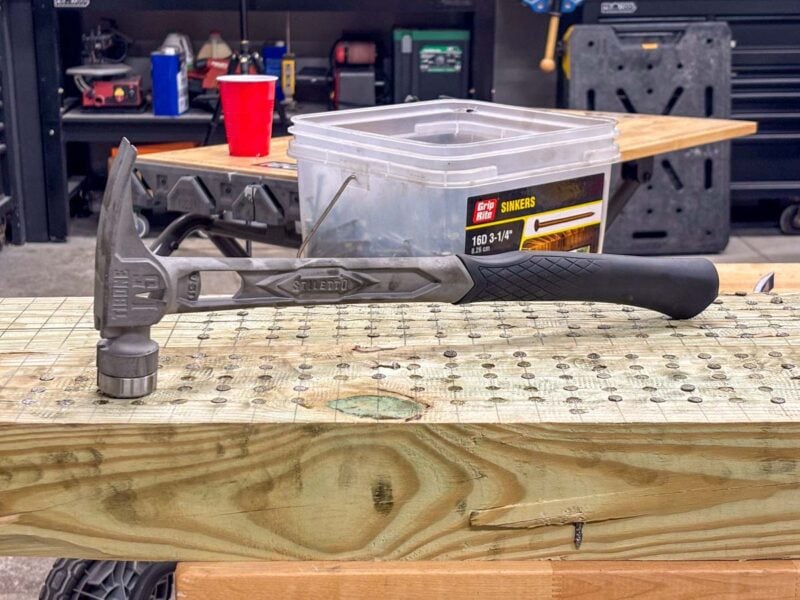
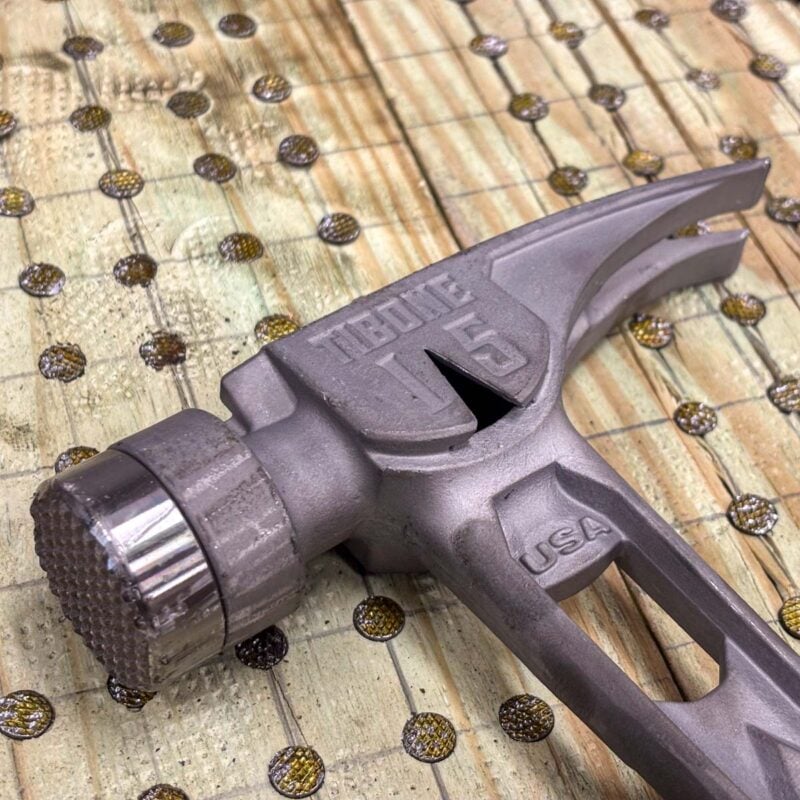
Stiletto 15-oz TiBone Milled Face TIB15MC
Score: 90 points
- Head Material: Titanium
- Handle Material: Titanium
- Total Weight: 31.7 oz/900 g
- Total Length: 17.3 in
- Head Diameter: 1.4 in
- Price: $319.99
Highlighted Features
- Replaceable Face: Easily swap between smooth and milled faces, or replace if damaged
- Replaceable Grips: Find the color that fits the unique look you prefer
- Magnetic Nail Starter: Quicker starts on each drive
- Side Nail Puller: Pull nails more easily than with the claw
- Vibration-absorbing Grip: Reduced the amount of vibration that reaches your hand
Pros
- Lightweight
- Easy to swing
- Easy nail pulling
- Excellent grip ergonomics
- Made in the USA
Cons
- Expensive
Stiletto proved how much of a difference technique makes between people. Take driving power, for example. The 15-ounce TiBone tied for the best driving power for Josh, but it was near the bottom for me. Why? Josh’s natural swing increased its velocity more than mine with the lighter hammer. For the way he works, the full-titanium build had a greater impact than it did for me.
It was a similar story as we evaluated the fatigue factor. After driving hundreds of nails each, Josh’s swing had slowed, and he wasn’t getting as much velocity benefit from the lighter build. On the other hand, I felt very little difference between my first nails and my last ones.
Realistically, Stiletto’s TiBone doesn’t have a weak spot. It’s an outstanding all-around design. The big question is whether titanium’s benefits mesh with the way you work. For Josh, we discovered he’s not really a full-titanium guy. For me, the answer was a resounding yes, and it’s my top choice in the group.
I don’t think anyone would be truly disappointed to own Stiletto’s TiBone framing hammer. If you’re on the fence, though, it’s worth taking some swings with someone else’s to see if it’s worth the investment for you.
Test Results
| Test | Score | Ranking out of 9 |
|---|---|---|
| Driving Power | 2.45 swings per nail | 5th place |
| Toenailing | 8.0 out of 10 | 8th place |
| Nail Pulling | 10 out of 10 | 1st place (tie) |
| Swing Effort | 9.5 out of 10 | 2nd place |
| Vibration | 9.0 out of 10 | 4th place |
| Fatigued Use | 8.5 out of 10 | 4th place (tie) |
| Grip Ergonomics | 9.0 out of 10 | 1st place (tie) |
Third Place Framing Hammer
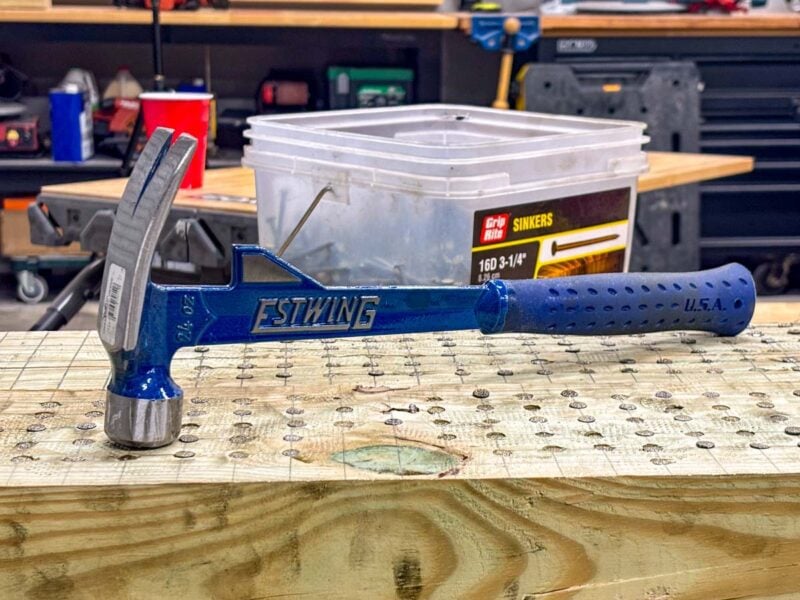
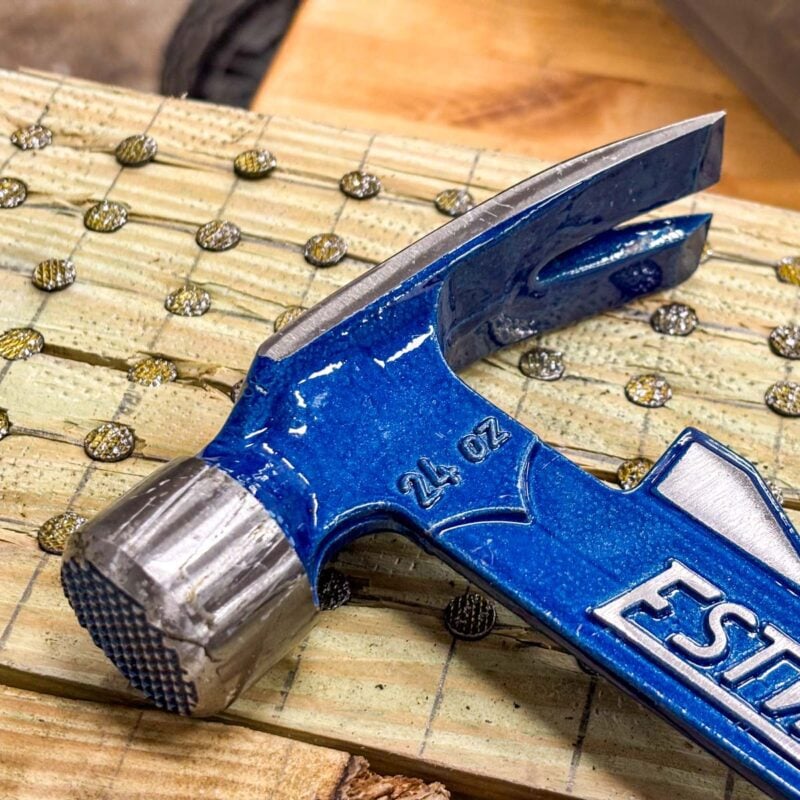
Estwing 24-oz Milled Face E6-24TM
Score: 89 points
- Head Material: Steel
- Handle Material: Steel
- Total Weight: 34.8 oz/986 g
- Total Length: 16.1 in
- Head Diameter: 1.3 in
- Price: $42.98
Highlighted Features
- Hammer Tooth: Helps straighten 2x boards during installation
- Vibration-absorbing Grip: Reduced the amount of vibration that reaches your hand
- Board-straightening Tooth: Straighten warped or twisted boards with one hand while nailing it place with the other
Pros
- Durable one-piece construction
- Excellent driving power
- Low fatigue buildup
- Excellent toenailer
- Made in the USA
- Lifetime Warranty
Cons
- No magnetic nail starter
- No side nail puller
Estwing’s E6-24TM is the top-selling framing hammer at Lowe’s. It had the highest head weight in our test group at 24 ounces, but was only the third-heaviest in our test group. Estwing paired it with a handle that makes it just over 16 inches in total length. The extra head weight made a difference, and among competitors with a similar length, it easily had higher driving power. Against the whole group, it was tied for second in driving power.
The weight and length combination gave it excellent toenailing performance as well, despite having a larger face diameter.
In fact, our testing didn’t reveal any true weaknesses. Among the sub-$50 framing hammers we tested, Estwing has the best all-around design. It can serve as your primary hammer and works very well as a supplement to your framing or roofing nailer.
The only reason you might want to steer in a different direction is if you’re looking for something truly lightweight, or you want to move into the ultra-premium titanium class.
Test Results
| Test | Score out of 10 | Ranking out of 9 |
|---|---|---|
| Driving Power | 2.3 swings per nail | 2nd place (tie) |
| Toenailing | 9.5 out of 10 | 2nd place (tie) |
| Nail Pulling | 8.5 out of 10 | 5th place (tie) |
| Swing Effort | 8.5 out of 10 | 5th place |
| Vibration | 8.5 out of 10 | 5th place (tie) |
| Fatigued Use | 9.0 out of 10 | 2nd place (tie) |
| Grip Ergonomics | 8.0 out of 10 | 7th place (tie) |
More Framing Hammers We Tested
DeWalt 22-oz Milled Face Framing Hammer DWHT51005
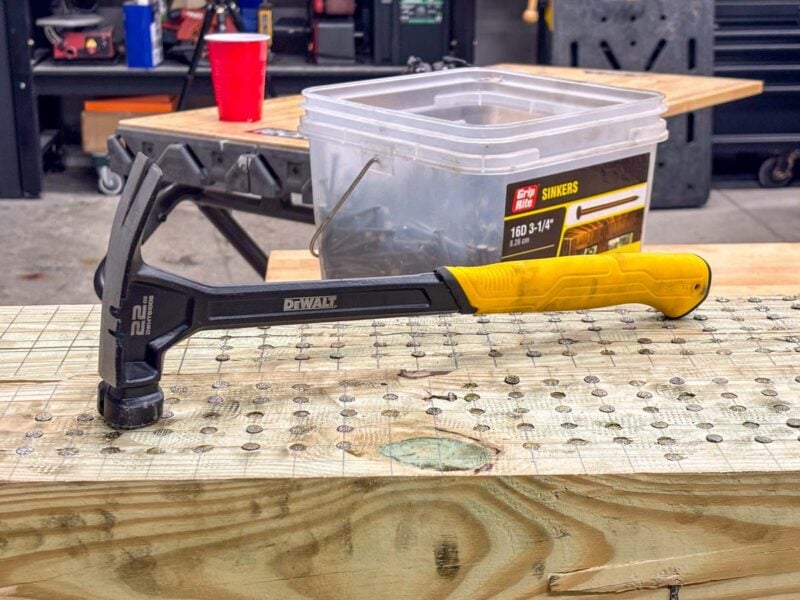
Score: 88 points
- Head Material: Steel
- Handle Material: Steel
- Total Weight: 31.1 oz/881 g
- Total Length: 15.9 in
- Head Diameter: 1.4 in
- Price: $32.99
Highlighted Features
- Magnetic Nail Starter: Quicker starts on each drive
- Side Tri Puller: Pull staples, framing nails, and finish nails more easily than with the claw
- Vibration-absorbing Grip: Reduced the amount of vibration that reaches your hand
Pros
- Lightweight
- Low fatigue buildup
- Outstanding toenailer
- Excellent nail pulling
- Excellent grip ergonomics
- Durable one-piece construction
- Affordable
Cons
- Low driving power
- More vibration/strike feel
Despite its one-piece steel construction, DeWalt was the lightest framing in our test group. Part of that is due to its sub-16-inch overall length. Those characteristics have some trade-offs.
On one hand, it’s easy to swing and is still very effective with fatigued arms. Paired with its 22-ounce head, it’s an outstanding toenailer. On the other hand, its driving power is lower.
DeWalt’s side puller is worth pointing out. With notches cut into the side of the head rather than the keyhole design Stiletto and Martinez use, it was slightly less effective at pulling nails, but well ahead of any model’s claw. What makes it compelling is that you can pull staples, which opens up additional possibilities.
I like this model as a toenailing specialist to supplement your primary framing hammer, or to keep on your belt when you’re using a framing or roofing nailer. The bonus is that it’s an excellent choice for electricians, fencing, or other applications that involve setting staples.
Test Results
| Test | Score | Ranking out of 9 |
|---|---|---|
| Driving Power | 2.70 swings per nail | Last place |
| Toenailing | 10 out of 10 | 1st place (tie) |
| Nail Pulling | 9.5 out of 10 | 3rd place |
| Swing Effort | 9.0 out of 10 | 3rd place (tie) |
| Vibration | 7.5 out of 10 | Last place (tie) |
| Fatigued Use | 9.0 out of 10 | 2nd place (tie) |
| Grip Ergonomics | 9.0 out of 10 | 1st place (tie) |
Kobalt 20-oz Milled Face KB-P087220
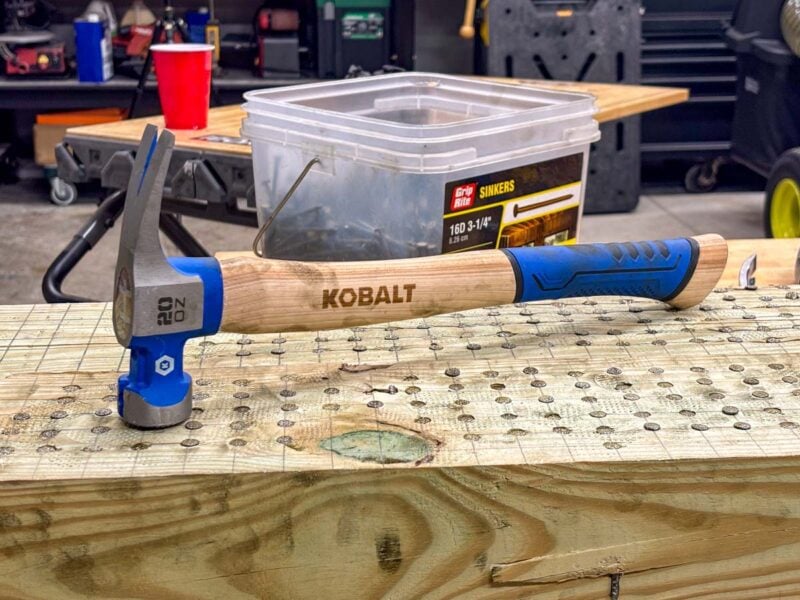
Score: 88 points
- Head Material: Steel
- Handle Material: Hickory
- Total Weight: 31.6 oz/897 g
- Total Length: 16.6 in
- Head Diameter: 1.5 in
- Price: $27.97
Highlighted Features
- Magnetic Nail Starter: Quicker starts on each drive
- Vibration-absorbing Grip: Reduced the amount of vibration that reaches your hand
Pros
- Easy to swing
- Excellent driving power
- Very low vibration/strike feel
- Affordable
Cons
- No side nail puller
I think both Josh and I were a bit surprised by how much we liked Kobalt’s framing hammer. With just a 20-ounce head and a lightweight hickory handle, we expected it to be easy to swing, but assumed it would suffer in driving power. That wasn’t the case, and Kobalt tied for second place in that test.
While it dropped in rankings a bit by the time we tested it under high arm fatigue, it was still comfortable, especially with the wood handle absorbing the shock of each strike and the handle cover providing better grip for our sweaty hands. However, the driving power dropped a noticeable amount.
Keep an eye on that handle cover. One of the reasons many wood-handled hammers don’t include one is that it will start to peel away sooner than the thicker grips you find on metal handles. Still, this hammer is less than $30, so it’s not as big of a ding on your budget if you have to replace it.
This one is pretty solid as an all-around framing hammer, but I think it’s best if light overall weight and low vibration are your top priorities. There are other options that maintain their driving power better when you’re fatigued and can toenail more effectively. But then again, that price tag is awfully compelling.
Test Results
| Test | Score | Ranking out of 9 |
|---|---|---|
| Driving Power | 2.30 strikes per nail | 2nd place (tie) |
| Toenailing | 8.5 out of 10 | 7th place |
| Nail Pulling | 8.5 out of 10 | 5th place (tie) |
| Swing Effort | 10 out of 10 | 1st place |
| Vibration | 9.5 out of 10 | 2nd place (tie) |
| Fatigued Use | 8.0 out of 10 | 6th place |
| Grip Ergonomics | 9.0 out of 10 | 1st place (tie) |
Milwaukee 22-oz Milled Face Framing Hammer 48-22-9022
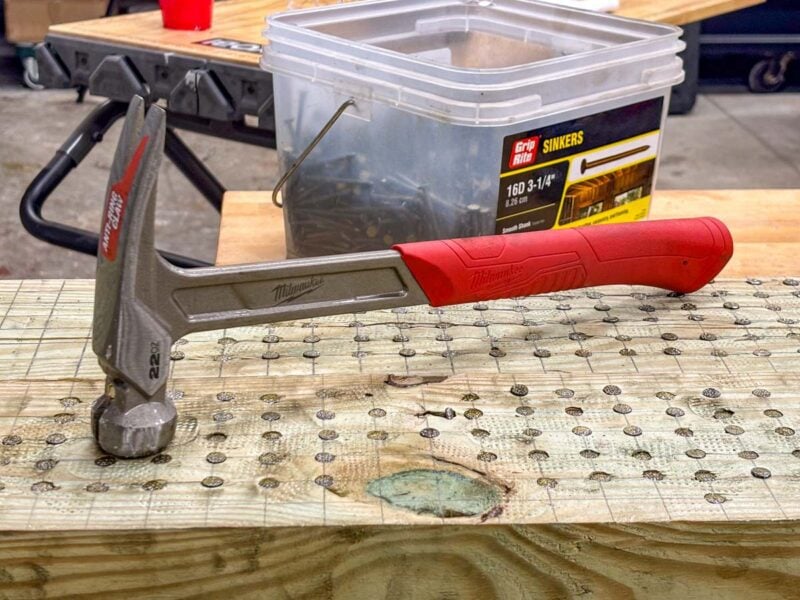
Score: 84 points
- Head Material: Steel
- Handle Material: Steel
- Total Weight: 35.3 oz/1002 g
- Total Length: 15.2 in
- Head Diameter: 1.4 in
- Price: $32.97
Highlighted Features
- Magnetic Nail Starter: Quicker starts on each drive
- Vibration-absorbing Grip: Reduced the amount of vibration that reaches your hand
Pros
- Durable one-piece construction
- Excellent toenailer
- Affordable
- Lifetime Warranty
Cons
- No side nail puller
- Heaviest in the group
At just over 1000 grams, Milwaukee’s framing hammer was the heaviest in our testing. For that reason, I didn’t think I’d care for it much compared to the others, but I liked it more than I thought I would. Perhaps that’s one reason it’s the top-selling framing hammer at Home Depot.
Part of why I liked it is that it has the shortest overall length in our test group. That gave it solid driving power, though it would have been higher with a longer handle. But the shorter handle kept it from being as fatiguing as we expected.
Thanks to its moderately-sized face, it was also one of the best toenailers we tested. Plus, for a one-piece design, it did an excellent job of keeping the impact vibration in check.
I like this as a supplementary framing hammer in a couple of scenarios. First, it’s a toenailing specialist that can thrive next to a longer-handled primary model. Second, it’s a solid partner to your framing or roofing nailer when you need to occasionally finish driving a nail or pull one. With its affordable price tag, it won’t hurt your budget too much to bring it on board.
Test Results
| Test | Score | Ranking out of 9 |
|---|---|---|
| Driving Power | 2.5 swings per nail | 6th place (tie) |
| Toenailing | 9.5 out of 10 | 2nd place (tie) |
| Nail Pulling | 7.5 out of 10 | Last place (tie) |
| Swing Effort | 8.0 out of 10 | 6th place (tie) |
| Vibration | 8.5 out of 10 | 5th place (tie) |
| Fatigued Use | 8.5 out of 10 | 4th place (tie) |
| Grip Ergonomics | 8.5 out of 10 | 5th place (tie) |
Spec Ops 22-oz Milled Face Framing Hammer SPEC-M22CF
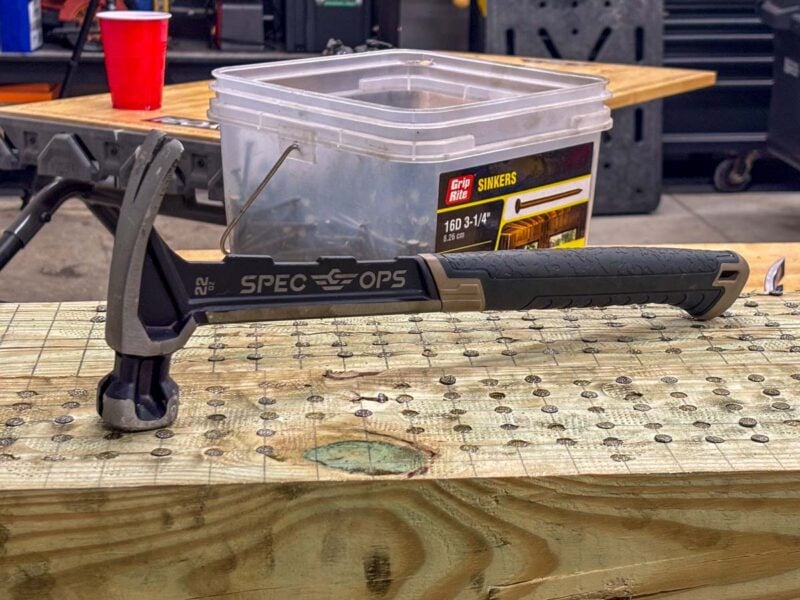
Score: 78 points
- Head Material: Steel
- Handle Material: Steel
- Total Weight: 34.3 oz/973 g
- Total Length: 15.9 in
- Head Diameter: 1.4 in
- Price: $31.99
Highlighted Features
- Optional Mallet Cover: Covers the face to double the hammer as a mallet
- Magnetic Nail Starter: Quicker starts on each drive
- Vibration-absorbing Grip: Reduced the amount of vibration that reaches your hand
- Tether Hole: Easily connect a lanyard for working at height
Pros
- Durable one-piece construction
- Affordable
- Lifetime warranty
- Purchases support veteran and first responder causes
Cons
- Low driving power
- Builds fatigue faster than most
- More vibration/strike feel
- No side nail puller
Spec Ops came in as one of the most affordable framing hammers in the group and is the top-selling model on Amazon. With its one-piece design, it’s super-durable, but on the heavy side of the group. As we got to the end of our fatigue testing, the weight became more noticeable.
However, it’s a bit shorter than some of the other competitors, and that had two primary consequences. On the positive side, the head weight was closer to our hands, so the weight didn’t add to the fatigue as quickly as it would have with a longer handle. On the negative, it limits the driving power a bit compared to similarly weighted models with longer handles.
One bright spot is the slightly oblong face. Its increased surface area gave us more confidence and fewer glancing strikes. Since it’s taller than it is wide, it was also highly effective at toenailing.
I like this one if you’re looking for high durability and affordability, or as a supplement to keep on hand if your primary framing hammer isn’t good at toenailing. There’s also a built-in bonus if you like the idea of your purchase supporting veteran and first responder causes.
Test Results
| Test | Score | Ranking out of 9 |
|---|---|---|
| Driving Power | 2.6 swings per nail | 8th place |
| Toenailing | 9.0 out of 10 | 5th place (tie) |
| Nail Pulling | 7.5 out of 10 | Last place (tie) |
| Swing Effort | 8.0 out of 10 | 6th place (tie) |
| Vibration | 7.8 out of 10 | 7th place |
| Fatigued Use | 7.0 out of 10 | 8th place |
| Grip Ergonomics | 8.5 out of 10 | 4th place (tie) |
Husky 22-oz Milled Face Framing Hammer N-A22SMHK
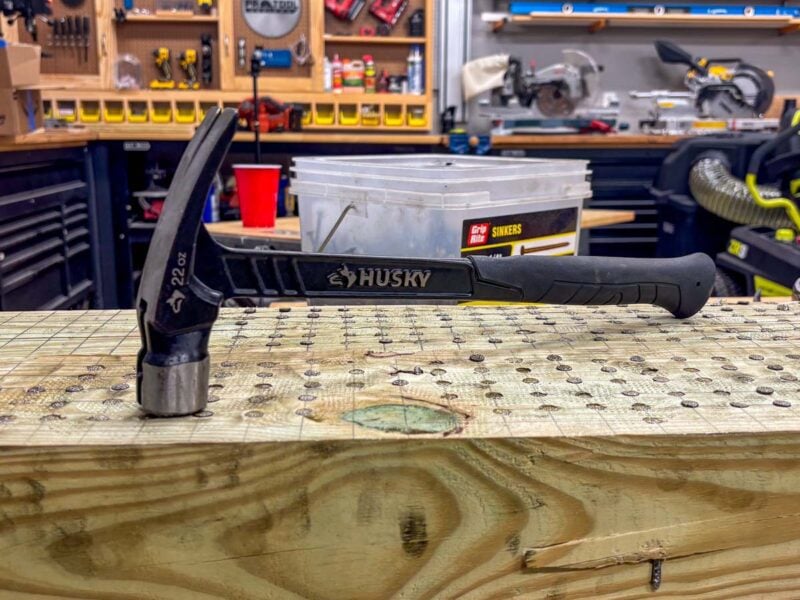
Score: 78 points
- Head Material: Steel
- Handle Material: Steel
- Total Weight: 35.0 oz/993 g
- Total Length: 15.9 in
- Head Diameter: 1.3 in
- Price: $29.97
Highlighted Features
- Magnetic Nail Starter: Quicker starts on each drive
- Vibration-absorbing Grip: Reduced the amount of vibration that reaches your hand
Pros
- Excellent toenailer
- Affordable
- Lifetime warranty
Cons
- Builds fatigue faster than most
- More vibration/strike feel
- No side nail puller
Husky’s framing hammer has an attractive price tag, but as the second-heaviest in the group, its weight worked against it as we got deeper into our testing. Only Crescent had a lower score in our fatigue test.
There are some bright spots, though. It has decent driving power, and with its smaller head diameter, it’s an excellent toenailer.
While the results may be a bit disappointing against this group, it’s not a bad hammer. Compared to some of the full-steel models I’ve used in the past, the vibration and grip ergonomics are an improvement. There just happened to be models we preferred over this one.
As far as recommendations go, this one fits best as an inexpensive sidekick to your framing hammer or nailer, or if you need a solid toenailer.
Test Results
| Test | Score | Ranking out of 9 |
|---|---|---|
| Driving Power | 2.40 swings per nail | 4th place (tie) |
| Toenailing | 9.5 out of 10 | 2nd place (tie) |
| Nail Pulling | 8.5 out of 10 | 5th place (tie) |
| Swing Effort | 7.0 out of 10 | 8th place |
| Vibration | 7.5 out of 10 | Last place (tie) |
| Fatigued Use | 6.5 out of 10 | 8th place |
| Grip Ergonomics | 8.0 out of 10 | 7th place (tie) |
Crescent 22-oz Milled Face Framing Hammer CHFRAM22
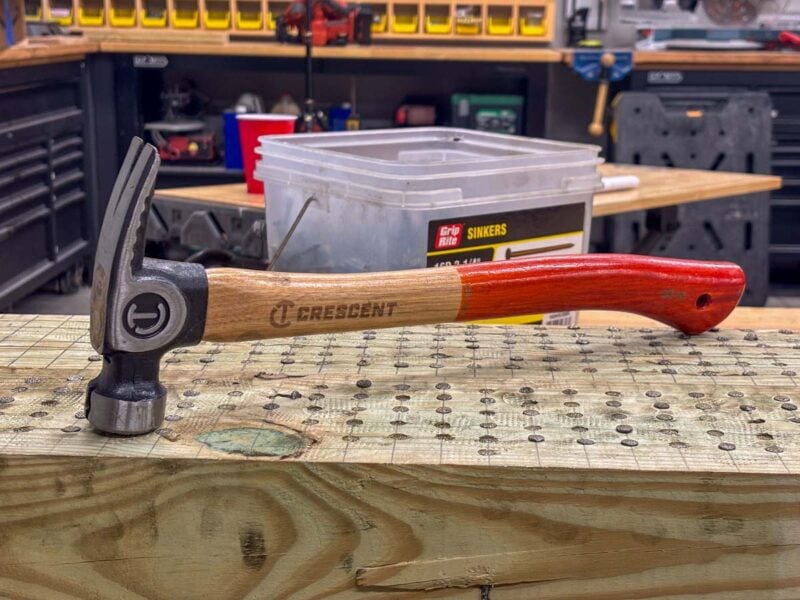
Score: 74 points
- Head Material: Steel
- Handle Material: Hickory
- Total Weight: 34.7 oz/985 g
- Total Length: 17.6 in
- Head Diameter: 1.6 in
- Price: $27.97
Highlighted Features
- Magnetic Nail Starter: Quicker starts on each drive
- Pegged Head Connection: Improves head and handle connection strength
- Tether Hole: Easily connect a lanyard for working at height
Pros
- Best driving power in our test group
- Large head diameter
- Very low vibration/strike feel
- Affordable
- Lifetime warranty
Cons
- Builds fatigue fastest in our test group
- Worst toenailer of our test group
Crescent came in with the longest overall length and the largest diameter face in the group, and it made a significant difference as it crushed the competition in driving power. Plus, its wood handle did a great job of reducing the amount of vibration and strike impact that reached our hands.
However, that handle was its undoing. Its larger diameter became more fatiguing to grip as our testing went on. It’s also coated and slick, so you’ll need to sand it to provide a more secure grip surface. Plus, that larger face made it challenging to toenail.
Another thing that stood out in a negative way is the head’s vibration noise. Every other hammer in our test eliminated it except Crescent. We didn’t feel it thanks to the hickory handle, but we could certainly hear it after each nail strike.
This could be a good framing hammer if you have large hands, but try swinging it in the store before you pull the trigger. If you have smaller or medium-sized hands, I recommend you consider other models.
Test Results
| Test | Score | Ranking out of 9 |
|---|---|---|
| Driving Power | 2.05 swings per nail | 1st place |
| Toenailing | 7.0 out of 10 | Last place |
| Nail Pulling | 9.0 out of 10 | 4th place |
| Swing Effort | 6.5 our of 10 | Last place |
| Vibration | 9.5 out of 10 | 2nd place (tie) |
| Fatigued Use | 5.5 out of 10 | Last place |
| Grip Ergonomics | 6.5 out of 10 | Last place |
How We Test Framing Hammers and Full Results
Basic Measurements
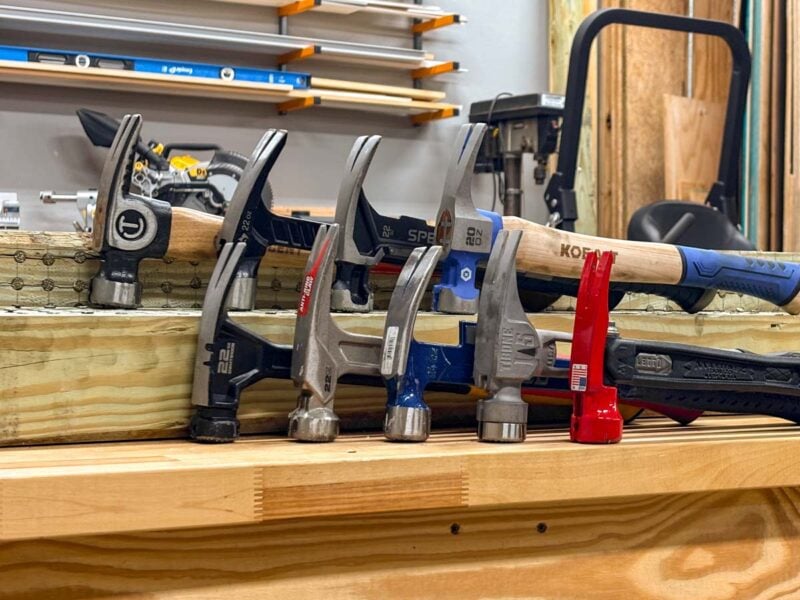
| Framing Hammer | Total Weight | Total Length | Face Diameter |
|---|---|---|---|
| Crescent CHFRAM22 | 34.8 oz/986 g | 17.6 in | 1.6 in |
| DeWalt DWHT51005 | 31.1 oz/881 g | 15.9 in | 1.4 in |
| Estwing E6-24TM | 34.8 oz/986 g | 16.1 in | 1.3 in |
| Husky N-A22SMHK | 35.0 oz/993 g | 15.9 in | 1.3 in |
| Kobalt KB-P087220 | 31.6 oz/897 g | 16.6 in | 1.5 in |
| Martinez M1 | 32.9 oz/934 g | 16.4 in | 1.5 in |
| Milwaukee 48-22-9022 | 35.3 oz/1002 g | 15.2 in | 1.4 in |
| Spec Ops SPEC-M22CF | 34.3 oz/973 g | 15.9 in | 1.4 in |
| Stiletto TIB15MC | 31.7 oz/900 g | 17.3 in | 1.4 in |
Weight Lowest to Highest
| Framing Hammer | Total Weight |
|---|---|
| DeWalt DWHT51005 | 31.1 oz/881 g |
| Kobalt KB-P087220 | 31.6 oz/897 g |
| Stiletto TIB15MC | 31.7 oz/900 g |
| Martinez M1 | 32.9 oz/934 g |
| Spec Ops SPEC-M22CF | 34.3 oz/973 g |
| Crescent CHFRAM22 | 34.7 oz/985 g |
| Estwing E6-24TM | 34.8 oz/986 g |
| Husky N-A22SMHK | 35.0 oz/993 g |
| Milwaukee 48-22-9022 | 35.3 oz/1002 g |
Length Shortest to Longest
| Framing Hammer | Total Length |
|---|---|
| Milwaukee 48-22-9022 | 15.2 in |
| DeWalt DWHT51005 | 15.9 in |
| Spec Ops SPEC-M22CF | 15.9 in |
| Husky N-A22SMHK | 15.9 in |
| Estwing E6-24TM | 16.1 in |
| Martinez M1 | 16.4 in |
| Kobalt KB-P087220 | 16.6 in |
| Stiletto TIB15MC | 17.3 in |
| Crescent CHFRAM22 | 17.6 in |
Face Diameter Smallest to Largest
| Framing Hammer | Face Diameter |
|---|---|
| Estwing E6-24TM | 1.3 in |
| Husky N-A22SMHK | 1.3 in |
| DeWalt DWHT51005 | 1.4 in |
| Milwaukee 48-22-9022 | 1.4 in |
| Spec Ops SPEC-M22CF | 1.4 in |
| Stiletto TIB15MC | 1.4 in |
| Kobalt KB-P087220 | 1.5 in |
| Martinez M1 | 1.5 in |
| Crescent CHFRAM22 | 1.6 in |
Driving Power
- Material: 4 x 6 pressure-treated pine
- Nails: 3 1/4-inch 16D galvanized
To test driving power, we drive five nails with each hammer and count the number of strikes it takes to sink each one. Once we reach the end of the group, we repeat the test in the reverse order.
Since every framing hammer and the person wielding it is different, there’s natural variability in this test. Every reviewer uses a technique that feels the most natural and sustainable for each hammer’s unique characteristics.
Taking the better set of 5 from each reviewer, we calculate the average number of strikes per nail.
Why is driving power such a big deal, especially when the range seems so small? It’s about how it adds up over a long day. If we round off the number of nails Josh and I hammered to an even 800, you’re looking at 1640 swings on the low end compared to 2160 on the high. That’s a difference of 520 extra swings over the course of the day.
| Framing Hammer | Driving Power |
|---|---|
| Crescent CHFRAM22 | 2.05 strikes per nail |
| Estwing E6-24TM | 2.30 strikes per nail |
| Kobalt KB-P087220 | 2.30 strikes per nail |
| Husky N-A22SMHK | 2.40 strikes per nail |
| Stiletto TIB15MC | 2.45 strikes per nail |
| Martinez M1 | 2.50 strikes per nail |
| Milwaukee 48-22-9022 | 2.50 strikes per nail |
| Spec Ops SPEC-M22CF | 2.60 strikes per nail |
| DeWalt DWHT51005 | 2.70 strikes per nail |
Toenailing
- Material: 2 x 4 pine stud
- Nails: 3 1/4-inch 16D galvanized
To test toenailing, we build a frame that’s 2 feet high and 8 feet long with studs at 16 inches. Essentially, it’s a mock-up of a kneeling wall, and it allows us toenail when there’s restricted swing space.
Sinking several nails per hammer, we evaluate how the head size, shape, and milling affect the toenailing ability, along with the handle length and weight. While you can tell a lot from those characteristics, look at the bevel on the sides of the face as well. A shorter bevel gives you more striking surface on the edge when you’re trying to set a nail flush at an angle.
Each reviewer scores the hammer on a scale of 1 – 10, and the result is the average rating.
| Framing Hammer | Toenailing Rating |
|---|---|
| DeWalt DWHT51005 | 10 out of 10 |
| Estwing E6-24TM | 9.5 out of 10 |
| Husky N-A22SMHK | 9.5 out of 10 |
| Milwaukee 48-22-9022 | 9.5 out of 10 |
| Martinez M1 | 9.0 out of 10 |
| Spec Ops SPEC-M22CF | 9.0 out of 10 |
| Kobalt KB-P087220 | 8.5 out of 10 |
| Stiletto TIB15MC | 8.0 out of 10 |
| Crescent CHFRAM22 | 7.0 out of 10 |
Nail Pulling
We remove several nails with each claw and side nail puller (if present). Each reviewer rates the effectiveness on a scale of 1 – 10, and the result is the average rating.
Framing hammers don’t have as much curve in the claw as rip claw hammers, and they greatly benefit from a side nail puller. Still, nail-pulling is secondary to hammering, so we wouldn’t consider this a make-or-break test.
| Framing Hammer | Toenailing Rating |
|---|---|
| Martinez M1 | 10 out of 10 |
| Stiletto TIB15MC | 10 out of 10 |
| DeWalt DWHT51005 | 9.5 out of 10 |
| Crescent CHFRAM22 | 9.0 out of 10 |
| Estwing E6-24TM | 8.5 out of 10 |
| Husky N-A22SMHK | 8.5 out of 10 |
| Kobalt KB-P087220 | 8.5 out of 10 |
| Milwaukee 48-22-9022 | 7.5 out of 10 |
| Spec Ops SPEC-M22CF | 7.5 out of 10 |
Swing Effort
In this subjective test, we use each framing hammer with an eye on how much it feels like an extension of our arms. It’s not just a function of weight and length, though. We specifically consider the effort our hands, wrists, forearms, and elbows experience as we swing, and rate each model on a 1 – 10 scale.
The result is the average rating of all reviewers.
| Framing Hammer | Swing Effort Rating |
|---|---|
| Kobalt KB-P087220 | 10 out of 10 |
| Stiletto TIB15MC | 9.5 out of 10 |
| DeWalt DWHT51005 | 9.0 out of 10 |
| Martinez M1 | 9.0 out of 10 |
| Estwing E6-24TM | 8.5 out of 10 |
| Milwaukee 48-22-9022 | 8.0 out of 10 |
| Spec Ops SPEC-M22CF | 8.0 out of 10 |
| Husky N-A22SMHK | 7.0 out of 10 |
| Crescent CHFRAM22 | 6.5 out of 10 |
Vibration
Following the Driving Power test, we perform an identical run of the same framing hammers in the same order. This time, we compare how much vibration and impact we feel in our hands.
All the hammers in our test group handled vibration very well. A few transferred virtually none to our hands, but even the “worst” were light years ahead of some of the hammers we’ve used in the past.
We rate each hammer on a 1 – 10 scale. The result is the average rating of all reviewers.
| Framing Hammer | Vibration Rating |
|---|---|
| Martinez M1 | 10 out of 10 |
| Crescent CHFRAM22 | 9.5 out of 10 |
| Kobalt KB-P087220 | 9.5 out of 10 |
| Stiletto TIB15MC | 9.0 out of 10 |
| Estwing E6-24TM | 8.5 out of 10 |
| Milwaukee 48-22-9022 | 8.5 out of 10 |
| Spec Ops SPEC-M22CF | 7.8 out of 10 |
| DeWalt DWHT51005 | 7.5 out of 10 |
| Husky N-A22SMHK | 7.5 out of 10 |
Fatigued Use
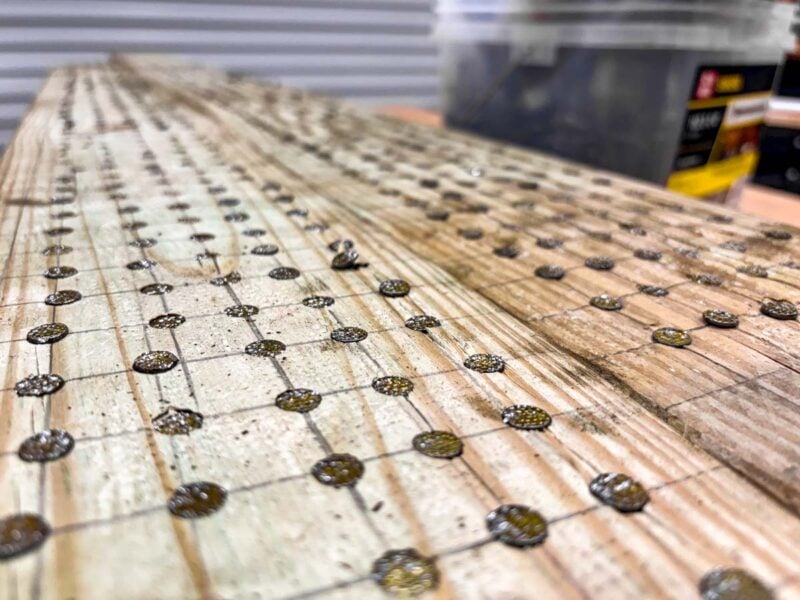
We continue the same nailing run as the Driving Power test for the third and fourth times. During the last set, we rate each framing hammer on a 1 – 10 scale based on how comfortable and effective it still feels after driving hundreds of nails and experiencing a significant amount of hand and arm fatigue.
The result is the average rating of all reviewers.
This is arguably the most important test we run. Most people can swing any framing hammer effectively at the beginning of the day when they’re fresh. At the end of the day, when your muscles are tired, the hammer that can get you to the finish line with the greatest combination of comfort and performance is your winner.
| Framing Hammer | Fatigued Use Rating |
|---|---|
| Martinez M1 | 10 out of 10 |
| DeWalt DWHT51005 | 9.0 out of 10 |
| Estwing E6-24TM | 9.0 out of 10 |
| Milwaukee 48-22-9022 | 8.5 out of 10 |
| Stiletto TIB15MC | 8.5 out of 10 |
| Kobalt KB-P087220 | 8.0 out of 10 |
| Spec Ops SPEC-M22CF | 7.0 out of 10 |
| Husky N-A22SMHK | 6.5 out of 10 |
| Crescent CHFRAM22 | 5.5 out of 10 |
Grip Ergonomics
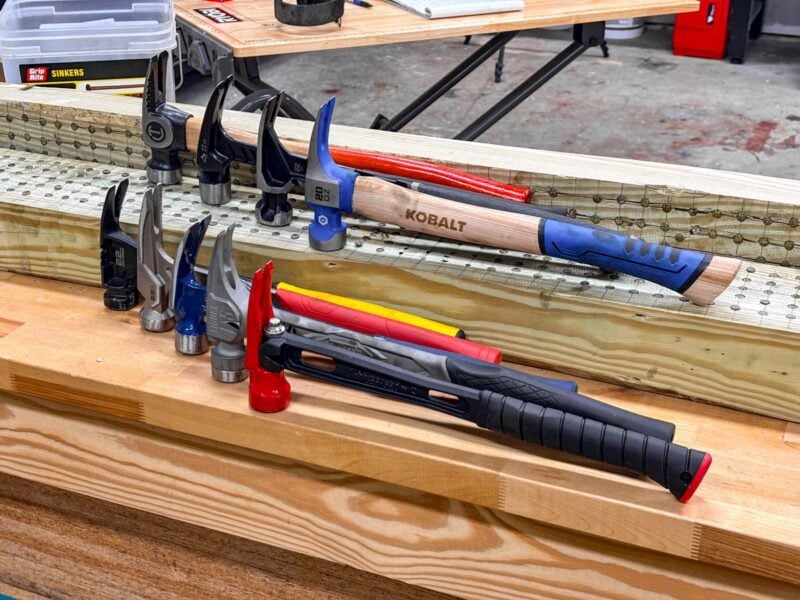
During testing runs three and four, each reviewer rates the grip ergonomics on a 1 – 10 scale. We evaluate not only the shape, cushioning, and how any texture feels against our skin, but also how secure the grip is.
The result is the average rating of all reviewers.
This might seem like a minor characteristic to consider, but it’s actually very important. If the grip is slick, digs into your skin, or the shape doesn’t fit your hand well, it can create a lot of extra hand fatigue as you compensate.
| Framing Hammer | Grip Comfort Rating |
|---|---|
| DeWalt DWHT51005 | 9.0 out of 10 |
| Kobalt KB-P087220 | 9.0 out of 10 |
| Martinez M1 | 9.0 out of 10 |
| Stiletto TIB15MC | 9.0 out of 10 |
| Milwaukee 48-22-9022 | 8.5 out of 10 |
| Spec Ops SPEC-M22CF | 8.5 out of 10 |
| Estwing E6-24TM | 8.0 out of 10 |
| Husky N-A22SMHK | 8.0 out of 10 |
| Crescent CHFRAM22 | 6.5 out of 10 |
But What if…
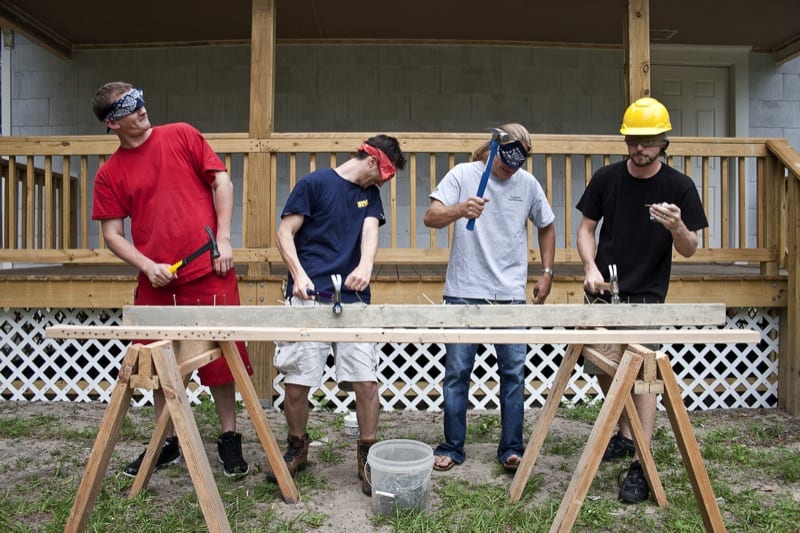
Maybe the best hammer test would have all participants blindfolded and handed a random hammer to see what they think. While they wouldn’t be swayed by brands, colors, materials, and logos, it might end up being a rather painful test!
What to Look for When You’re Buying a Framing Hammer
To better understand some hammer technology (yes, there actually is technology involved), it makes sense to have a quick science lesson on the physics of a hammer.
Don’t worry, this won’t hurt… much.
The Role of Mass and Velocity (WARNING: Math Ahead!)
A hammer is a force amplifier that converts mechanical work into kinetic energy and back again. When swinging a hammer, kinetic energy is stored in the hammer’s head. The kinetic energy equals the length of the swing times the force produced by your muscles (and gravity). When the hammer strikes the nail, the nail stops the head with an equal and opposite force.
Where this gets tricky is when you start to take into consideration the effect of the mass of the hammer’s head. The amount of energy delivered to the nail by the hammer is equal to one-half the mass of the head times the square of the head’s speed at the time of impact. The key here is that the energy delivered to the nail increases linearly with mass, but it increases fourfold with the speed.
KE = 1/2 mv2
This forms one of the key arguments in the titanium hammers vs steel hammers debate. It’s true that if you hit a nail with both at the exact same velocity, the higher mass steel head always wins. But since an increase in velocity creates greater impact on kinetic energy, the lighter titanium head often wins in a driving power contest.
Weight
Every framing hammer comes with a head weight rating, and it’s key because of what we just discussed above. Some Pros swear by a 28-ounce steel hammer while others want a featherweight titanium model. There’s no one-size-fits-all in this category. Instead, it’s primarily personal preference driven largely by your strength, endurance, and technique.
Those weights usually don’t include the handle, but pay attention to the weight total. A standard 22-ounce head feels very different on a wood handle vs a steel one.
Length
Do you know the difference between a framing hammer and almost a framing hammer?
It’s about 2 inches of handle length. Since the hammering motion is an arc, the extra two inches means the head swings at a higher speed, and we’re right back to our kinetic energy equation again.
If you do a search for “framing hammer” online, many of the best-selling ones that pop up are 20-ounce models. But if you look more closely, they don’t have the length of a framing hammer. They’re good enough for work around the house, but not what you want as a professional tradesman.
Head Diameter
Head diameter isn’t something a lot of people talk about, but it’s pretty important. A smaller head often means a lower weight, which may be what you’re looking for. However, smaller heads are harder to toenail with and more prone to glancing off the nail in that application.
Milled vs Smooth Face
For rough framing, buy a milled face framing hammer first. Its characteristic waffle pattern helps grip nails, which is helpful in general, but especially when you’re toenailing.
You can always add a smooth face model later if you need one for surfaces that a milled face would damage. In many cases, you can get the same hammer with a smooth or milled face, so you can stick with what you know you like.
Handle Material
The handle material you choose affects several areas: total weight, vibration, and durability.
Steel tends to be the heaviest with the highest vibration, but has incredible durability. These handles are often shaved down to a thinner blade shape that reduces weight without compromising strength.
Aluminum shaves some weight and adds some vibration dampening, but isn’t as strong as steel. These handles are usually tubular to add structural strength.
Wood handles offer the lightest weight and best vibration dampening, but they’re prone to breaking. Don’t discount them for the durability, though. The lighter weight and vibration absorption make them the only handles many seasoned Pros will use, and they’re not afraid of replacing the handle if it breaks.
Additional Framing Hammer Features
- Magnetic Nail Starter: Great for nailing with fewer overall strikes when you don’t need perfectly precise placement
- Side Nail Puller: Helps remove tough nails more easily that typical claws
- Replaceable Parts: Helps premium hammers last longer by allowing for replacement handles, grip, and faces
Related Content
Why You Can Trust Pro Tool Reviews
There are plenty of publications and authors out there trying to convince you that they know what the best framing hammer is. Let’s give credit where credit is due—they use good SEO writers and may have even used a few popular tools in the process.
But do they have more than a decade of experience using framing hammers with an eye on comparative evaluation, understand the key features to look for, and have they really experienced differences in the quality of the components? Have they been around to see advances in design, the development of innovative new features, and how they affect Pros in the field?
We have. We’ve been testing and reviewing framing hammers since we started Pro Tool Reviews back in 2008.
You can trust Pro Tool Reviews because tools are what we do. When we recommend a framing hammer for you, it’s because it’s the one we would buy. Our primary motivation is to recommend what we genuinely believe is the best in each category based on our collective decades of experience and being involved in the tool and industry every day. If you choose to buy something we recommend, we hope that it works exactly the way you expected when the time comes.


Great thorough review, and definitely a good resource for future reference. While I can’t imagine spending $300 on a single hammer since I have picked up a Ridgid 6 gallon air compressor (reconditioned) and Senco framing nailer within the past year for half that cost, the Estwing seems to be the best of both worlds when it comes to price and test results. I was just surprised to see such a drastic price gap.
I feel like some important hammers were left out of this comparison. Kinetic customs is a great contender to the Martinez. Boss as well. Oh and the Estwing aluminum models. Also, comparing the Martinez to any 22oz hammer is a bit like comparing apples and oranges. The Dewalt MIG welded hammer would have been a better choice for this test imo.
All very fair points, Mike. The purpose of this group was to bring the most popular models from each brand in and see how they really compare when there’s a mix of weights, materials, lengths, etc.
Unfortunately, we weren’t able to get a Boss model in for this round, but hopefully we’ll be able to connect for the next. Kinetic Customs is a new brand to me; I’ll have to check them out if I get a chance.
I have the Estwing AL-Pro model, and you’re right, it’s a solid contender. I’m also curious about their titanium model.
Estwing has a Ti offering now. I highly recommend you check it out. A great hammer, I mean an AWESOME hammer, and far less expensive than Martinez and Stiletto. Full disclosure, I have been an Esting user for 30+ years so I am a bit biased but nonetheless I think you will be very impressed.
We’ll have to see if we can get our hands on one. They’re a solid brand across the board, so I’m sure it’s excellent. I still use the AL-Pro they launched 9 years ago and don’t plan on replacing it anytime soon.
What about Boss?
We were unable to include them for this round of testing.
That is a bummer, Clint. Dan does not give his hammers out easily. I hope he makes the next round, as they are part of the top 4 without a doubt.
I loved your Hammer article. Today (2/26) I found out that where the hammer mates with the handle it’s called the “cheek”
Anyway 30+ years banging a hammer.
Ultimately Estwing 20oz. However…my preferred was my Vaughn wood handle.
Everytime I picked it up I felt that I had an old friend in my hand. Kind of like an old baseball bat it was imbued with all of your sweat, oils blood cotfee stain Always an old friend
The problem trying to remove a bent nail.
9x out of 10 – broken handle. I actually kept 2/3 spares. The Vaughn and Bushnell Hickory handle appears to be wrapped in something – if so it eliminates the tactile feel of a Real wood handle
BTW – retired I use a H/F 18oz which is a bit heavy handed for a homeowner but after growing up with my Dad’s 12oz. Maine, wood handle that built my forts with I am happy 😊. rob
Thanks for sharing that, Robert! I agree with you—there’s nothing like the feel of a quality wood handle. It’s like there’s an authenticity and heritage about it that other materials don’t confer.