
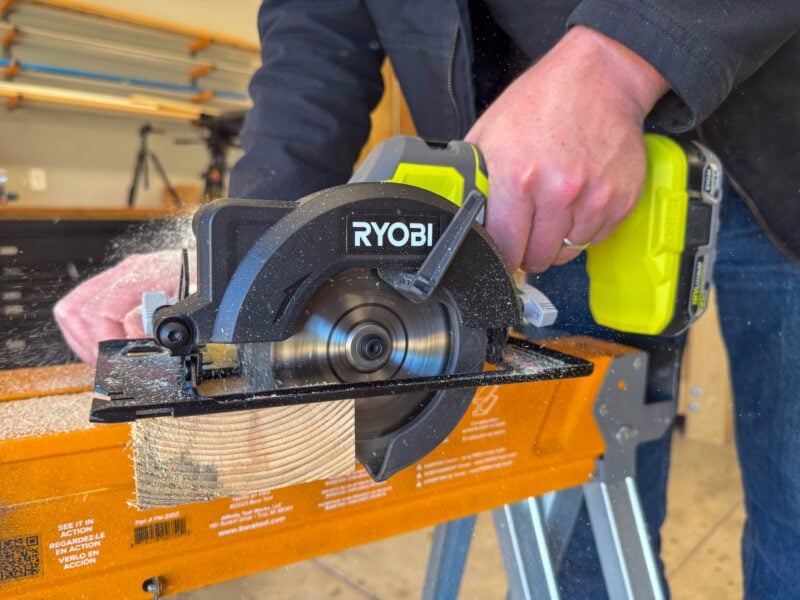
Sometimes, it’s the simplest tools that end up getting the most use—the kind you grab without thinking because they’re quick, convenient, and just get the job done. Does the Ryobi 18V One+ 4 1/2-inch Circular Saw fit that bill? It certainly looks like it could. I’ll walk you through what it’s like to use this non-traditional design, how it compares to standard circular saws, and help you decide if it’s the right model for you.
Want to see more options? Check out our top picks for the Best Cordless Circular Saw!
Ryobi 18V One+ 4 1/2-Inch Circular Saw Performance
- No-Load Speed: 5200 RPM
- Max Cut Depth: 1-9/16 in.
- Bevel Range: 0-45°
- Runtime: Up to 150 cuts per charge (with 2.0Ah High Performance battery)
Cutting Characteristics
The brushed motor spins the blade at 5,200 RPM, delivering fast, efficient cuts while still maintaining good control. Don’t let the smaller 4 1/2-inch blade fool you—this saw is capable of tackling common materials without issue.
With a maximum depth of cut of 1-9/16 inches, it can slice cleanly through standard 2x lumber in a single pass. You also get a max bevel of 45°, giving you the flexibility to handle angled cuts for trim, corners, and other detail work. That puts it right in the sweet spot for typical dimensional lumber, plywood, OSB, and even laminate flooring.
Granted, it doesn’t have the same power level as your average sidewinder, so you may have to cut a little slower to maintain RPMs.
Runtime
Using the included 2.0Ah High Performance battery, Ryobi estimates you’ll get around 150 cuts per charge in 2x lumber, which is more than enough for most DIY tasks. Of course, you can always step up to a higher-capacity battery, and you’ll stretch that runtime even further.
Ryobi 18V One+ 4 1/2-Inch Circular saw Design Notes
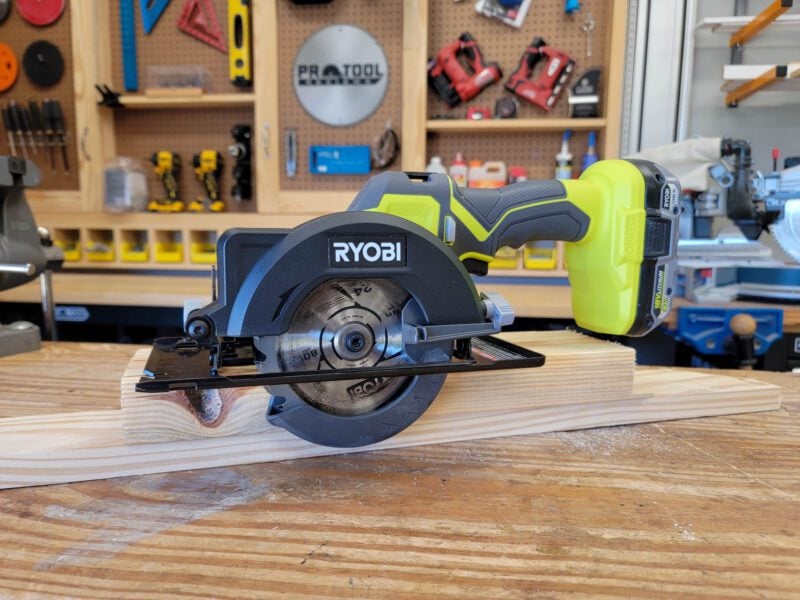
- Model: Ryobi PCL400
- Power Source: Ryobi 18V battery
- Weight: 3.6 lbs (bare tool), 4.6 lbs (with 2.0Ah High Performance battery)
- Tool Length: 13.25 in.
- Arbor: 3/8 in.
Ergonomics
The Ryobi PCL400 weighs in at 3.6 pounds as a bare tool, 4.6 pounds with the kitted 2.0Ah battery, and measures 13.25 inches from tip to tail. This is significantly lighter than your traditional circular saw, making it a great option for small DIY projects.
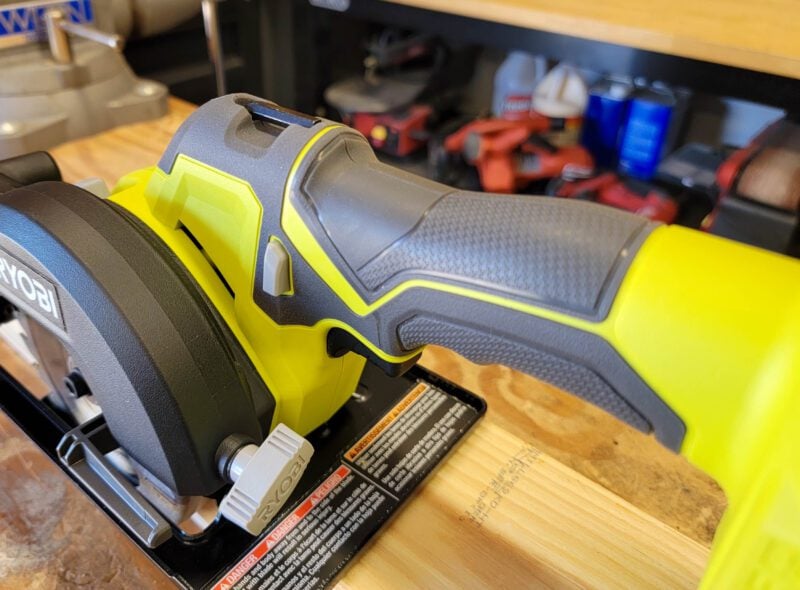
The compact size and lightweight design make this saw especially comfortable for one-handed use, overhead cuts, or making cuts in tight spaces where a larger saw simply won’t fit. It’s clearly designed for control rather than brute force, and it excels in that role. One feature this saw lacks is a front pommel for two-hand use, however, this isn’t uncommon when you look at the other models in this class.
If you’re someone who prefers a front pommel for better control but still desire a compact saw, I suggest stepping up to the Ryobi 18V 6 1/2-inch circular saw (PSBCS01).
As you would expect, the grip is draped with a textured rubber overmold, and there’s an ambidextrous thumb safety for left or right-handed use.
For added convenience, the grip also houses the onboard hex wrench for quick and easy blade changes.
Depth and Bevel Adjustments
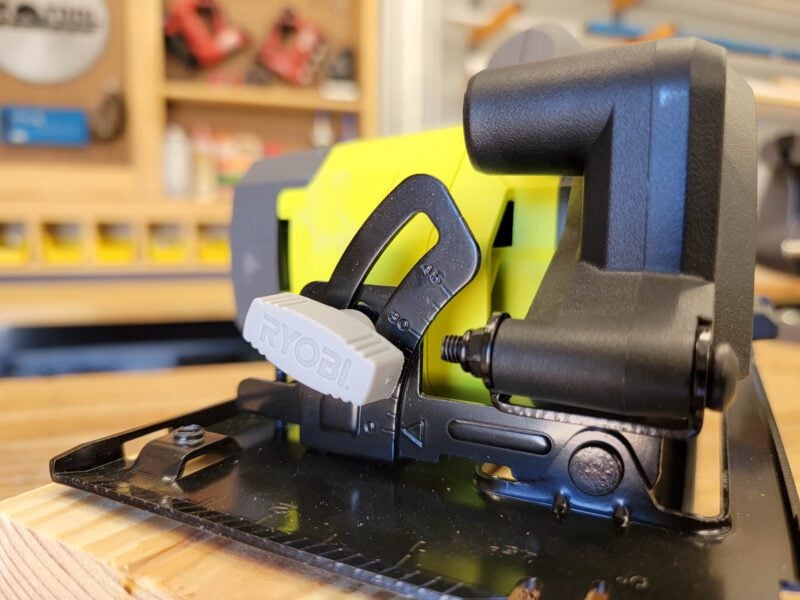
Despite having a non-traditional look, the bevel and height adjustments function in a similar way to the saw’s big brothers. The big difference is that they use a thumbscrew-style knob rather than a clamping lever.
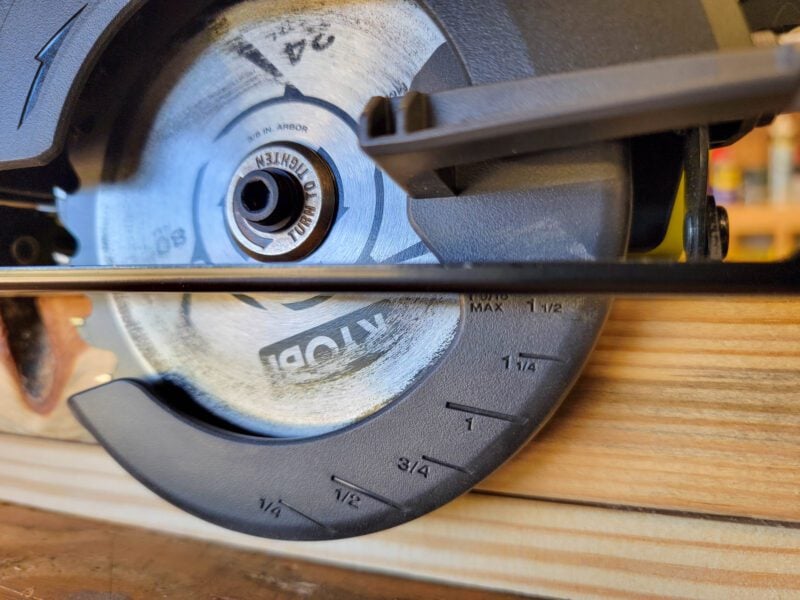
To make either adjustment, start by loosening the knob on the bevel or height gauge, and then pivot the shoe to your desired angle or depth. Tighten the thumbscrew back down to lock in your adjustments.
The depth gauge has measurements molded into the side of the lower blade guard to help you set the correct blade height.
Additionally, the bevel gauge has markings at 15°, 22.5°, 30°, and 45°. However, there are no positive detents along the way, so be mindful while making your adjustments.
Blade Changes
Swapping blades follows the same basic steps as you would encounter on a full-sized circular saw. First, remove the hex wrench located on top of the grip. Next, engage the spindle lock button on the motor housing and spin the blade by hand until you feel it lock in place. Last, remove the arbor bolt. Remember, this bolt is reverse threaded, so it’s “righty loosey” this time!
Once you’ve replaced the blade, simply follow these steps in reverse order.
Additional Features
- Edge Guide Compatibility: Purchase the optional edge guide to help make straighter cuts when you’re following an edge
- Part of the 18V One+ System: One battery runs more than 300 power tools and lifestyle products
Quick Model Comparison
| Ryobi PCL400 | Worx WX531L | Skil CR5435B-10 | |
|---|---|---|---|
| No-Load Speed | 5200 RPM | 6900 RPM | 6000 RPM |
| Cut Depth | 1 9/16 in. | 1 1/2 in. | 1 1/2 in. |
| Bare Weight | 3.6 lbs | 4.6 lbs | 4.2 lbs |
| Price | $99 (kit) | $169.99 (kit) | $123.95 (kit) |
Should You Buy It?
Overall, I think Ryobi nailed the design and performance of the PCL400. It confidently handled cut after cut and delivered excellent results. Granted, it’s certainly not as powerful as its big brothers, but it’s a great companion on those smaller projects.
Now, the Ryobi 18V One+ 4 1/2-inch Circular Saw by no means attempting to replace your full-size circular saw—and that’s exactly why it works so well. It’s compact, lightweight, and easy to use, making it an excellent choice for DIYers, homeowners, and anyone who values convenience and control over raw cutting power.
While this saw can certainly handle cutting 2x material, that’s not really it’s bread and butter. Rather, the PCL400 is perfect for cutting thin sheet goods, trim, and other 1x lumber. Additionally, if you regularly break down pallets for DIY projects, this is a great option. However, if you’re looking for a true workhorse for your weekend projects, I have to recommend stepping up to one of Ryobi’s larger saws if you want the best results.
Like what you see? You can grab the Ryobi PCL400 at Home Depot for $59.97 as a bare tool or $99 as a kit that includes a 2.0Ah High Performance battery. That’s an attractive price for a brushless circular saw, and it’s backed by Ryobi’s 3-year warranty.


I have Ryobi tools for specific occaissional jobs and to have handy at a job I didn’t want to leave my Makitas at. I’ve had several of their cordless saws including the bigger newer brushless ones. Although I’m impressed by their drills and reciprocal saws for the money I find the circulars do not last long or perform well with 2x lumber. In my experience it’s their one tool I’d suggest people consider another business brand for if they need to do serious cutting.
Great feedback. Ryobi has made a lot of different saws over the years. More recently, their brushless HP tools are a step above what they’ve done in the past. I wonder if they might perform a bit better than others you may have tried.