
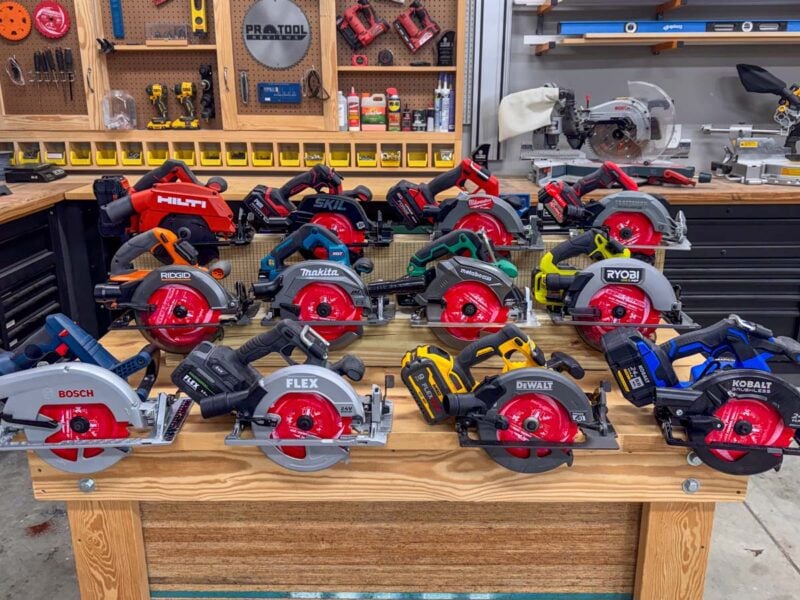
I gathered twelve of the best cordless circular saws from some of the biggest names in the industry, including DeWalt, Makita, Hilti, Metabo HPT, Milwaukee, Bosch, Kobalt, Ridgid, Flex, Ryobi, Craftsman, and Skil.
For this review, I focused on sidewinder-style models and tested them head-to-head to find out which one deserves the top spot. To do that, I built a custom circular saw testing rig complete with digital timers to measure speed and performance. Along the way, I also evaluated other details, like guard action, dust collection, and shoe friction.
So, which circular saw comes out on top? Here’s what I discovered.
Best Cordless Circular Saws
Scoring
Note that the scoring is different from our normal rating system. The scores are based on how each circular saw performed and compared in this specific group and this set of tests only. Our typical rating system offers a comparison of the tool to the entire range of what is available. Here’s how to interpret the scores from this test:
- 90 – 100: Outstanding. You’ll love using this cordless circular saw.
- 80 – 89: Excellent. There may be minor tradeoffs.
- 70 – 79: Very good. There are more significant tradeoffs.
- 60 – 69: Good. Notable tradeoffs, but still earns our recommendation.
- < 60: Not recommended in the Pro cordless circular saw class.
Best Cordless Circular Saw
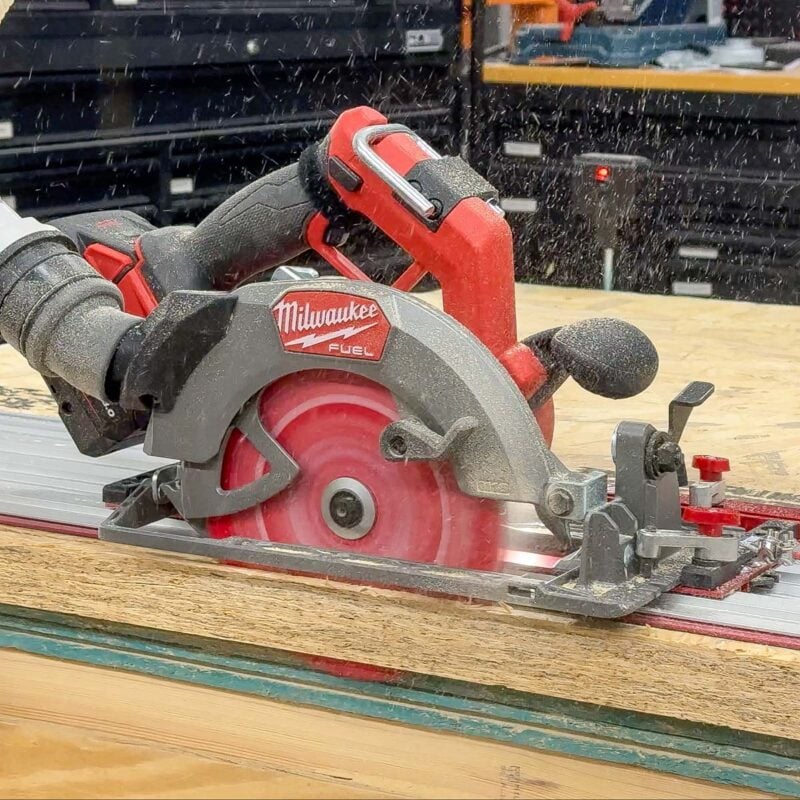
Milwaukee M18 Fuel 2834
Score: 95 points
- Blade Size: 7 1/4 in
- Blade Speed: 6000 RPM
- Max Cut Depth: 2 5/8 in
- Max Bevel: 57°
- Shoe Material: Magnesium
- Bare Weight: 8.43 lbs
- Tested Weight: 10.81 lbs w/ 8.0Ah Forge battery
- Warranty: 5 years
- Price: $279 bare, $449 kit
Highlighted Features
- Bevel Detents: Stops at 22.5° and 45° for quick adjustments to common angles
- Depth Detents: Stops at 1/2, 3/4, and 1 1/2 inches for quick adjustments to common depths
- Included Vac Adapter: Connect a vacuum to keep your workspace cleaner
- Magnesium Shoe: Reduces weight without sacrificing strength
- Electric Brake: Quickly stops the blade once you release the trigger
- Rafter Hook: Easily hang the saw by its hook instead of setting it down
Pros
- Great sight lines
- Fantastic dust collection
- No lower guard hang ups
Cons
- No significant drawbacks
Some of the competition has changed since we last tested cordless circular saws head-to-head, but the results is the same for Milwaukee – first place overall. Last time, it was with model 2732, and this year, the 2834 proves the upgrades are keeping Milwaukee ahead of their competition. It’s a design with virtually no flaws and has top-tier performance.
About the only charge that could be levelled against it is a lack of electronic upgrades. However, even that falls by the wayside now that One-Key version is available (model 2835). In addition to One-Key’s management and tracking features, it adds VacLink wireless vacuum activation and AutoStop kickback control.
When all the sawdust settled, Milwaukee retains its crown as having the best cordless circular saw on the market, and it was the only one in our test group to score above 90 points.
Head-to-Head Testing Results
| Test | Result |
|---|---|
| Rip Cut | 9.76 sec (1st place) |
| Full Depth Cut | 17.41 sec (2nd place) |
| Stake Cutting | 3 of 3 |
| Dust Collection | 3 of 3 |
| Guard Action | 9 of 9 |
| Sight Lines | 6 of 6 |
| Shoe Friction | 3 of 3 |
Best Cordless Circular Saw Runner Up
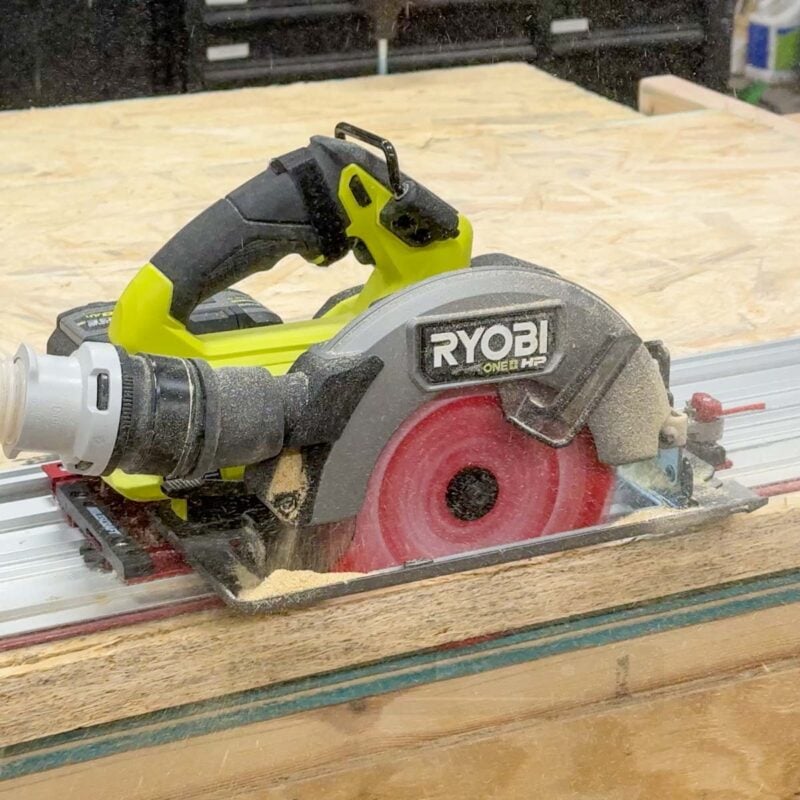
Ryobi 18V HP Brushless PBLCS302
Score: 88 points
- Blade Size: 7 1/4 in
- Blade Speed: 5000 RPM
- Max Cut Depth: 2 9/16 in
- Max Bevel: 56°
- Shoe Material: Steel
- Bare Weight: 8.26 lbs
- Tested Weight: 10.78 lbs w/8.0Ah Edge battery
- Warranty: 3 years
- Price: $139 bare, $199 kit
Highlighted Features
- Bevel Detents: Stops at 15°, 22.5°, 30°, 45°, and 56° for quick adjustments to common angles
- Included Vac Adapter: Connect a vacuum to keep your workspace cleaner
- Rafter Hook: Easily hang the saw by its hook instead of setting it down
- Electric Brake: Quickly stops the blade once you release the trigger
Pros
- Slick base finish
- No lower guard hang ups
Cons
- Poor dust collection
Ryobi’s HP Brushless power tools have been pushing higher performance levels that are starting to legitimately blur the line between the Prosumer and Pro classes. In our circular saw tests, the PBLCS302 put in some solid cutting speed that put it ahead of some big names.
The design has also made progress compared to previous versions, giving it more of a Pro feel than before. It’s not perfect, though. The dust collection was poor compared to most of the group, and there’s still a little room for improvement on the 45° sight line and left compound cut guard action.
The plastic lower blade guard also helps set the context that it’s still a saw that primarily targets serious DIYers/Prosumers. It just happens to have to outperformed quite a few Pro models in our tests.
Head-to-Head Testing Results
| Test | Result |
|---|---|
| Rip Cut | 14.10 sec (6th place) |
| Full Depth Cut | 17.85 sec (3rd place) |
| Stake Cutting | 3 of 3 |
| Dust Collection | 1 of 3 |
| Guard Action | 8 of 9 |
| Sight Lines | 5 of 6 |
| Shoe Friction | 3 of 3 |
Third Place Cordless Circular Saw
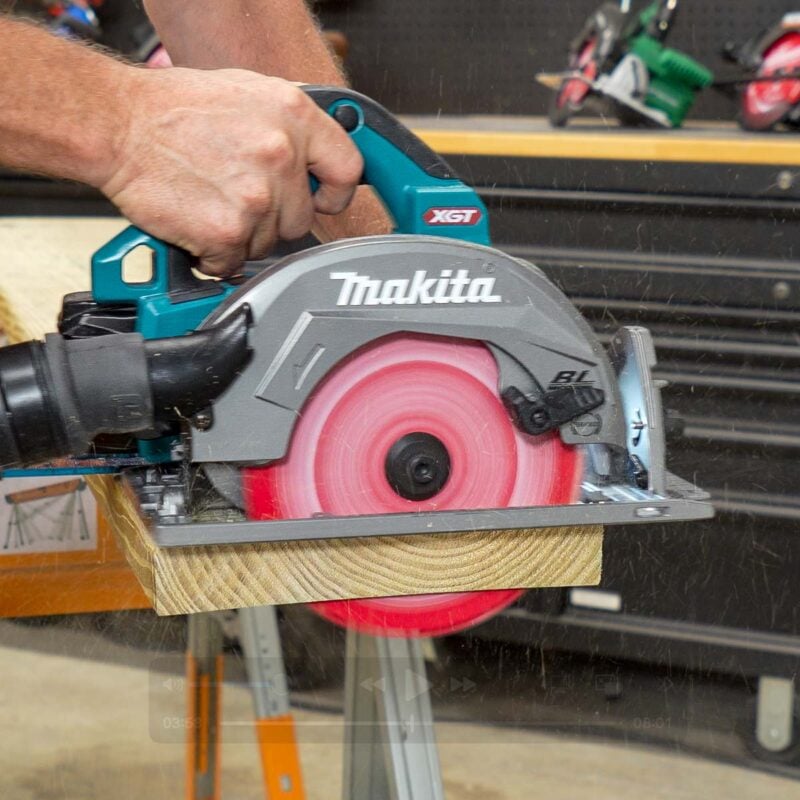
Makita 40V max XGT GSH01
Score: 83 points
- Blade Size: 7 1/4 in
- Blade Speed: 6000 RPM
- Max Cut Depth: 2 5/8 in
- Max Bevel: 56°
- Shoe Material: Magnesium
- Bare Weight: 8.00 lbs
- Tested Weight: 10.09 lbs w/4.0Ah High Power battery
- Warranty: 3 years
- Price: $289 bare, $469 kit
Highlighted Features
- AWS Capable: Add Makita’s AWS Chip to enable wireless vacuum activation
- Bevel Detents: Stops at 22.5°, 45°, and 56° for quick adjustments to common angles
- Magnesium Blade Guard, Cover, and Shoe: Reduces weight without sacrificing strength
- Electric Brake: Quickly stops the blade once you release the trigger
Pros
- Great dust collection
- Compact footprint
- Lightweight
Cons
- No rafter hook included
Makita’s results were mixed, but solid in the categories that mattered most. The biggest thing to consider is that the sight lines were a little obscured at both 90° and 45°, so keep that in mind if you’re used to watching the blade against your cutline instead of the notches.
Note the weight of this saw – just over 10 pounds with a battery. That’s impressive, considering it includes Makita’s advanced 40V max power source. Even though weight isn’t a huge concern during the cut, bringing it down does make it easier to set up your cuts and carry the saw.
What the numbers won’t tell you is how smooth this saw cuts. As we’ve become accustomed to from Makita’s cordless tools, this model is a step up in the refinements of its design and performance compared to most other brands. It’s one reason why Pros who use Makita tools tend to stick with them year after year.
Head-to-Head Testing Results
| Test | Result |
|---|---|
| Rip Cut | 13.53 sec (4th place) |
| Full Depth Cut | 24.74 sec (9th place) |
| Stake Cutting | 2 of 3 |
| Dust Collection | 3 of 3 |
| Guard Action | 9 of 9 |
| Sight Lines | 4 of 6 |
| Shoe Friction | 3 of 3 |
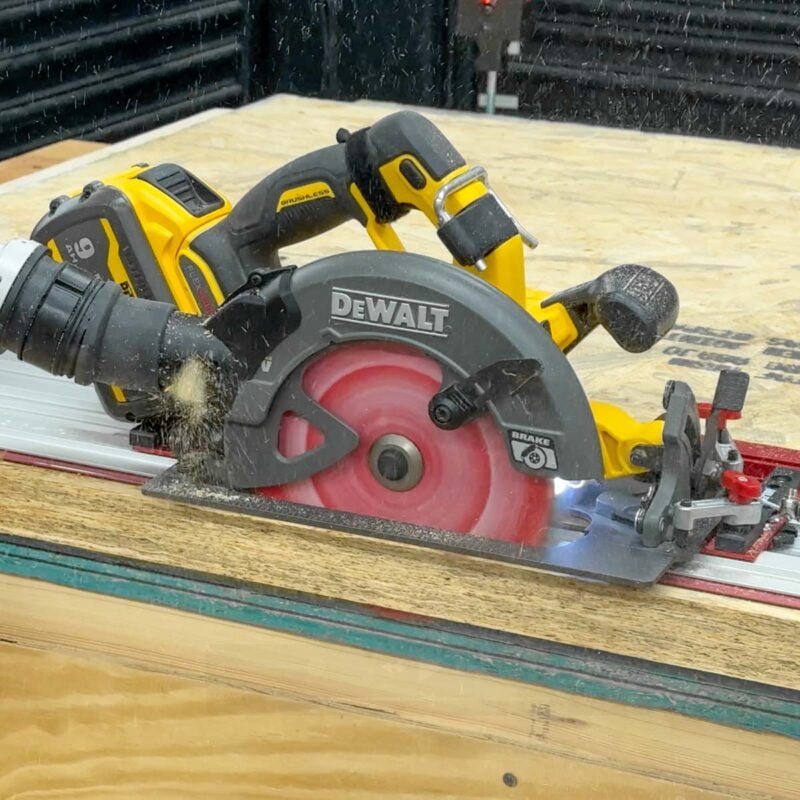
DeWalt FlexVolt 60V Max Circular Saw DCS578
Score: 82 points
- Blade Size: 7 1/4 in
- Blade Speed: 5800 RPM
- Max Cut Depth: 2 9/16 in
- Max Bevel: 57°
- Shoe Material: Aluminum
- Bare Weight: 8.33 lbs
- Tested Weight: 11.53 lbs w/9.0Ah FlexVolt battery
- Warranty: 3 years
- Price: $299 bare, $399 – $549 kit
Highlighted Features
- Bevel Detents: Stops at 22.5° and 45° for quick adjustments to common angles
- Electric Brake: Quickly stops the blade once you release the trigger
- Rafter Hook: Easily hang the saw by its hook instead of setting it down
Pros
- Huge bevel capacity
- No lower guard hang ups
Cons
- Vac adapter sold separately
- Shoe finish has higher friction
DeWalt’s flagship sidewinder circular saw has plenty of miles on it now that it’s been on the market for 6 years, That’s more than enough time to prove itself in the field, and our tests show that the 60V Max brushless motor still cranks out ample power compared to the competition.
Our biggest complaint is the show friction. The coating on DeWalt’s circular saws doesn’t glide nearly as well as others, including some of the DIY brands. This model is on the heavy side of the group, which doesn’t help matters. However, plenty of people use and love this and other DeWalt circular saws, so it tends to be something you learn to manage through muscle memory more than something you feel like you’re fighting all the time.
For Pros who want the best performance from a DeWalt sidewinder, this is your saw. However, keep an eye on the 20V Max system. Now that there are tabless batteries available, the product engineers are able to produce more power without having to step up to the larger FlexVolt batteries. The next flagship 20V Max saw may be closer in performance to this one than you would have thought before.
Head-to-Head Testing Results
| Test | Result |
|---|---|
| Rip Cut | 15.53 sec (8th place) |
| Full Depth Cut | 19.52 sec (4th place) |
| Stake Cutting | 3 of 3 |
| Dust Collection | 2 of 3 |
| Guard Action | 9 of 9 |
| Sight Lines | 5 of 6 |
| Shoe Friction | 1 of 3 |
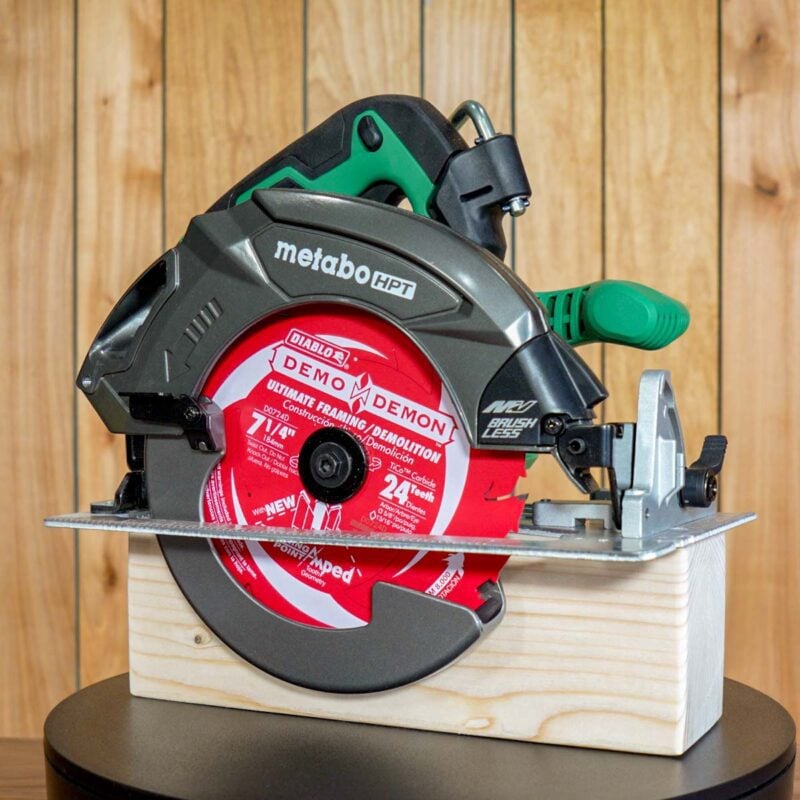
Metabo HPT 36V MultiVolt Circular Saw C3607DB
Score: 81 points
- Blade Size: 7 1/4 in
- Blade Speed: 6000 RPM
- Max Cut Depth: 2 7/16 in
- Max Bevel: 55°
- Shoe Material: Aluminum
- Bare Weight: 8.35 lbs
- Tested Weight: 10.44 lbs w/4.0 Ah T-PWR battery
- Warranty: Lifetime
- Price: $209 bare, $379 kit
Highlighted Features
- Torque Boost: Drops the RPMs and diverts more torque to the motor for efficient cutting in tough materials
- Electric Brake: Quickly stops the blade once you release the trigger
- Rafter Hook: Easily hang the saw by its hook instead of setting it down
- Available AC Adapter: Run the saw with AC power for unlimited runtime
Pros
- Torque Boost function
- Lifetime warranty
Cons
- No vac adapter
Metabo HPT went back and forth with Milwaukee at the top of our cutting performance tests. Normally, that would be enough to land you a podium spot, but there are a couple of hang-ups in the design. For one, we weren’t able to test the dust collection since it doesn’t come with a vac adapter, and I couldn’t find it anywhere online to buy. We didn’t count that in the score, but it’s worth noting if you cut inside often.
The bigger issue was how much trouble the guard gave me with right compound cuts. If you use your circular saw to stick-frame hip roofs and dormers, it’s a real issue.
That said, this saw displays genuinely impressive cutting speed and power. Now that it’s been upgraded with the TorqueBoost feature, you’re able to maximize runtime when you’re making deep cuts in dense material. It slows the blade down tow 4000 RPM while diverting more power to torque. The results is a slower cut than you might be able to achieve in the regular cutting mode, but the RPMs maintain better consistency, and we found it it nearly impossible to stall.
If you’re not worried about compound cuts or dust collection, this saw should rank higher on your list.
Head-to-Head Testing Results
| Test | Result |
|---|---|
| Rip Cut | 10.10 sec (1st place) |
| Full Depth Cut | 16.37 sec (2nd place) |
| Stake Cutting | 3 of 3 |
| Dust Collection | 0 of 3 |
| Guard Action | 7 of 9 |
| Sight Lines | 5 of 6 |
| Shoe Friction | 2 of 3 |
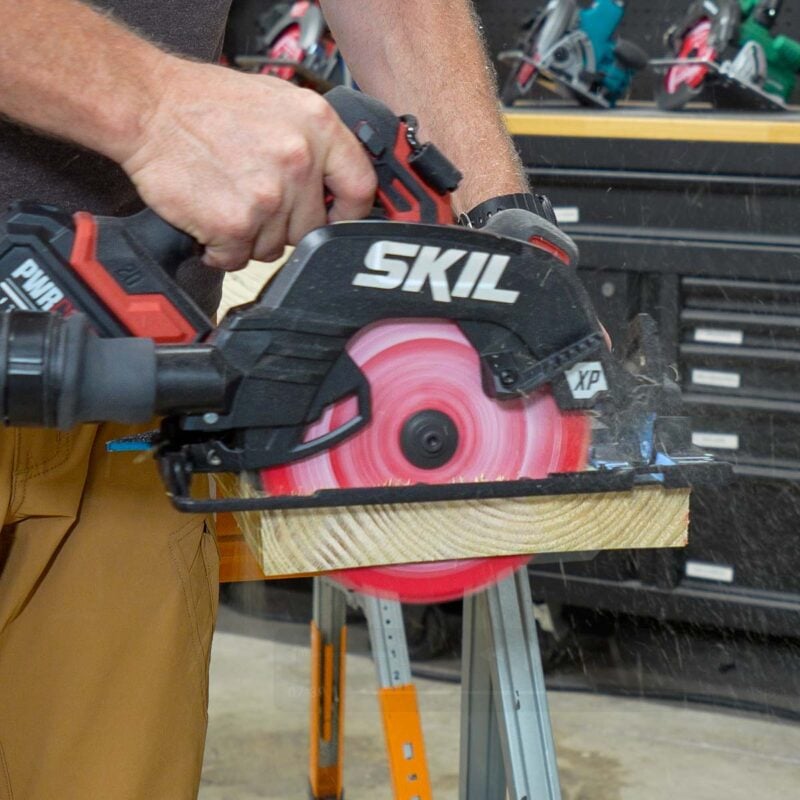
Skil 20V XP Brushless Circular Saw CR5440B
Score: 77 points
- Blade Size: 7 1/4 in
- Blade Speed: 5300 RPM
- Max Cut Depth: 2 5/8 in
- Max Bevel: 56°
- Shoe Material: Aluminum
- Bare Weight: 7.29 lbs
- Tested Weight: 8.90 lbs w/5.0Ah battery
- Warranty: 5 years
- Price: $139 bare, $169 kit
Highlighted Features
- USB-C Battery Charging: Conveniently charge anywhere you can connect a USB-C cable
- USB-C Power Source: Use the battery as a USB power source for charging devices
- Included Vac Adapter: Connect a vacuum to keep your workspace cleaner
- Electric Brake: Quickly stops the blade once you release the trigger
- Rafter Hook: Easily hang the saw by its hook instead of setting it down
Pros
- Lightweight
- Track-ready shoe
- Large cut depth
Cons
- Slow on long rip cuts
With Skilsaw branded circular saws being the name Pros associate with top-tier corded circular saws, Skil’s cordless models sometimes fly under the radar for DIYers and Prosumers. However, their flagship saws deserve real credit.
We didn’t expect Skil to keep up with the premium flagship models in cutting speed, and it didn’t. However, it rose to a higher finish than you might think thanks to a sound overall design, including a perfect score for its sight lines. Plus, its sub-9-pound weight is well under most of the saws in our test group and close to the premium lightweight corded models we prefer.
Pick this one up if you’re a serious DIYer or handyman who doesn’t have a Pro budget but wants decent performance and a durable, Pro-inspired design.
Head-to-Head Testing Results
| Test | Result |
|---|---|
| Rip Cut | 16.70 sec (9th place) |
| Full Depth Cut | 28.05 sec (last place) |
| Stake Cutting | 2 of 3 |
| Dust Collection | 2 of 3 |
| Guard Action | 7 of 9 |
| Sight Lines | 6 of 6 |
| Shoe Friction | 2 of 3 |
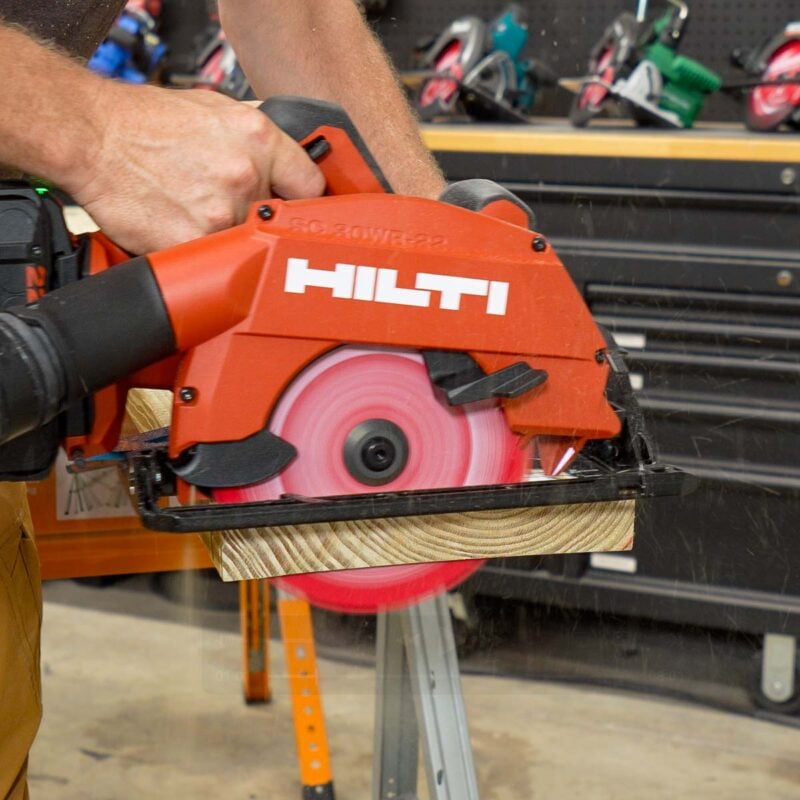
Hilti Nuron 22V Circular Saw SC 30WR-22
Score: 76 points
- Blade Size: 7 1/4 in
- Blade Speed: 4700 RPM
- Max Cut Depth: 2 5/8 in
- Max Bevel: 50°
- Shoe Material: Aluminum
- Bare Weight: 8.36 lbs
- Tested Weight: 11.29 lbs w/7.9Ah battery
- Warranty: 20 years
- Price: $419 bare
Highlighted Features
- Integrated Vac Adapter: Pivots and locks the hose in for a more secure connection
- Electric Brake: Quickly stops the blade once you release the trigger
- Rafter Hook: Easily hang the saw by its hook instead of setting it down
Pros
- High cutting power
- No lower guard hang ups
- Pivoting dust port
- 20-year warranty
Cons
- Poor dust collection
Hilti had solid results in our cutting speed tests, which wasn’t a big surprise. This is an upgrade of a previous model that shared the same model number, and boasts 22% faster cutting speed, which showed in our tests. What interesting its high ranking compared to its relatively low 4700 RPM blade speed. It proves that the brushless motor and Nuron batteries are delivering enough power to ensure those RPMs don’t drop dramatically, even in really tough cuts.
On the positive side, the SC 30WR-22 earned perfect scores for stake cutting and its guard action. The biggest issues were low performance in dust collection and sight lines that were tough to read.
What the score doesn’t reflect is Hilti’s strong build quality, intelligent Nuron battery system, sales/service network, and 20-year tool warranty. Add in a fleet pricing structure, and you have several valuable advantages Pro construction crews rely on that other brands don’t offer.
Head-to-Head Testing Results
| Test | Result |
|---|---|
| Rip Cut | 13.75 sec (5th place) |
| Full Depth Cut | 20.49 sec (5th place) |
| Stake Cutting | 3 of 3 |
| Dust Collection | 1 of 3 |
| Guard Action | 9 of 9 |
| Sight Lines | 3 of 6 |
| Shoe Friction | 2 of 3 |
Craftsman V20 Brushless RP Circular Saw CMCS551
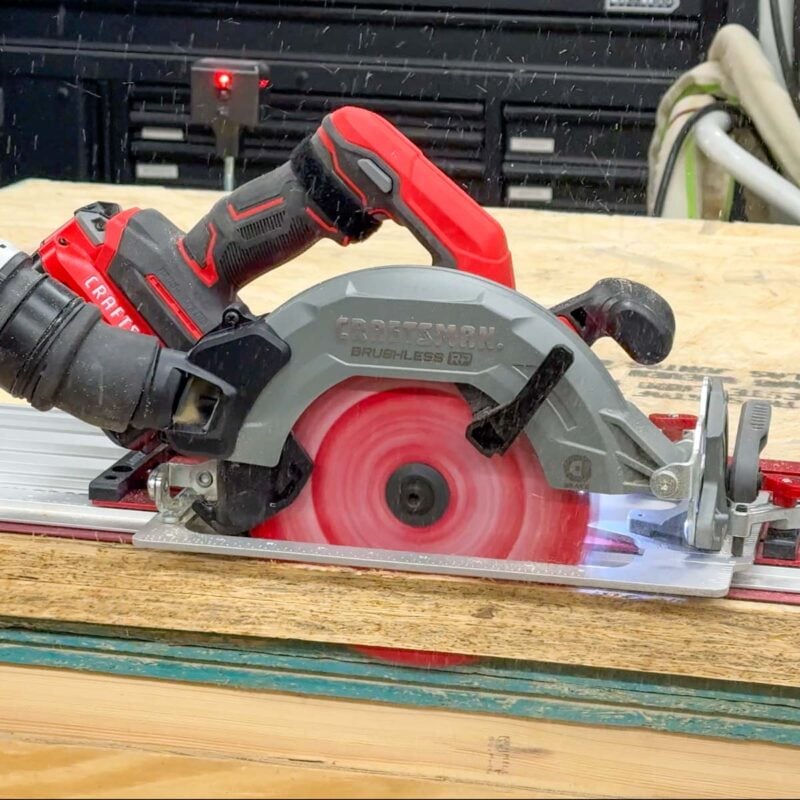
Score: 75 points
- Blade Size: 7 1/4 in
- Blade Speed: 5000 RPM
- Max Cut Depth: 2 9/16 in
- Max Bevel: 56°
- Shoe Material: Aluminum
- Bare Weight: 7.26 lbs
- Tested Weight: 8.81 lbs w/6.0Ah Advanced battery
- Warranty: 3 years
- Price: $189 bare
Highlighted Features
- Bevel Detents: Stops at 22.5° and 45° for quick adjustments to common angles
- Electric Brake: Quickly stops the blade once you release the trigger
- VersaTrack Compatible: Use clips to hang on Craftsman’s wall mount system
Pros
- Great sight lines
- Lightweight
- High bevel capacity
Cons
- Vac adapter sold separately
- No rafter hook
As we expected for this DIY/Prosumer saw, Craftsman’s cutting speed was lower than the premium-priced Pro brands, but it’s still so much better than the previous models we’ve tested. The combination of the Brushless RP motor and new Advanced V20 battery offer DIYers a much more capable saw than previous generations.
The overall design proved it capable of doing all the tasks we asked of it, but the shoe friction is a weak spot. Like its Pro cousin, DeWalt, the shoe doesn’t glide as easily across material as it closest competitors. It’s something you can learn to manage, so get some practice cuts in to get used to it and don’t worry about it after that.
This is the lightest saw in our test group. If that’s a high priority for you and you don’t mind sacrificing some cutting power to get it, it can be a really easy saw to pull out for those weekend projects.
Head-to-Head Testing Results
| Test | Result |
|---|---|
| Rip Cut | 17.67 sec (10th place) |
| Full Depth Cut | 23.41 sec (8th place) |
| Stake Cutting | 2 of 3 |
| Dust Collection | 2 of 3 |
| Guard Action | 8 of 9 |
| Sight Lines | 6 of 6 |
| Shoe Friction | 1 of 3 |
Ridgid 18V Brushless Circular Saw R8657
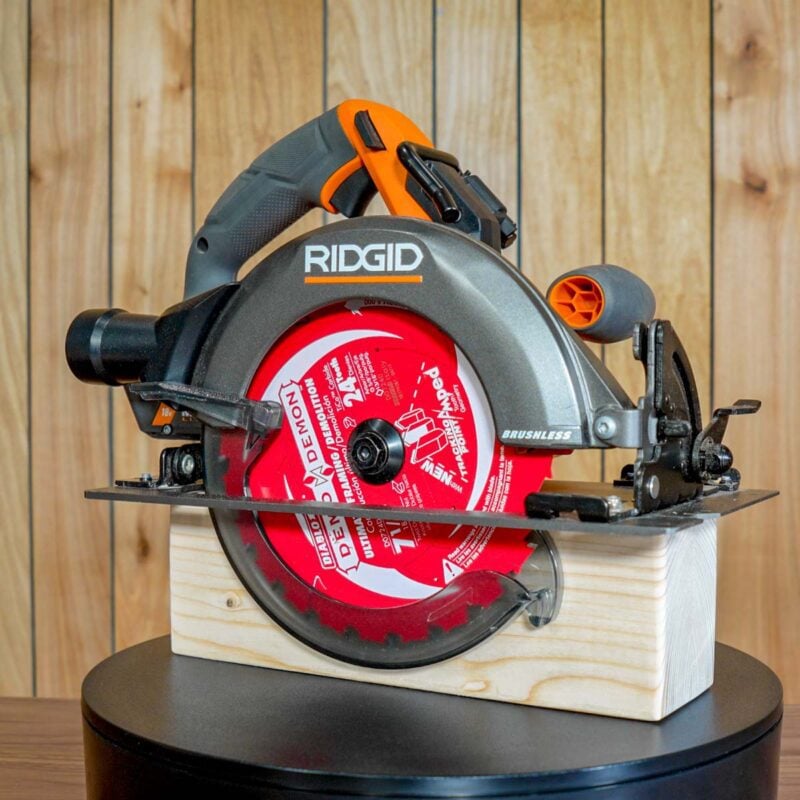
Score: 72 points
- Blade Size: 7 1/4 in
- Blade Speed: 5400 RPM
- Max Cut Depth: 2 9/16 in
- Max Bevel: 56°
- Shoe Material: Aluminum
- Bare Weight: 8.80 lbs
- Tested Weight: 11.08 lbs w/8.0Ah EXP battery
- Warranty: 3 years
- Price: $179 bare
Highlighted Features
- Included Vac Adapter: Connect a vacuum to keep your workspace cleaner
- Electric Brake: Quickly stops the blade once you release the trigger
- Rafter Hook: Easily hang the saw by its hook instead of setting it down
Pros
- Great sight lines
- Lifetime service agreement with registration
Cons
- Slow on long rip cuts
Ridgid’s performance was a bit of a mixed bag, with a low finish on the rip cut and only rising to mid-pack on the full depth cut. It’s a saw that’s been out since 2022, so it may be due for a refresh, but I don’t know that one is imminent. Still, looking at the competition in the value Pro class, its cutting performance doesn’t hinder you from making the same cuts as higher-priced Pro saws.
That said, the guard action can be a hinderance. It had trouble with the right compound cuts, so keep that in mind if. you cut stakes or use your circular saw cuts in roofing, you’ve been warned.
Head-to-Head Testing Results
| Test | Result |
|---|---|
| Rip Cut | 18.72 sec (11th place) |
| Full Depth Cut | 22.87 sec (7th place) |
| Stake Cutting | 2 of 3 |
| Dust Collection | 2 of 3 |
| Guard Action | 6 of 9 |
| Sight Lines | 6 of 6 |
| Shoe Friction | 3 of 3 |
Flex 24V Brushless Circular Saw FX2141
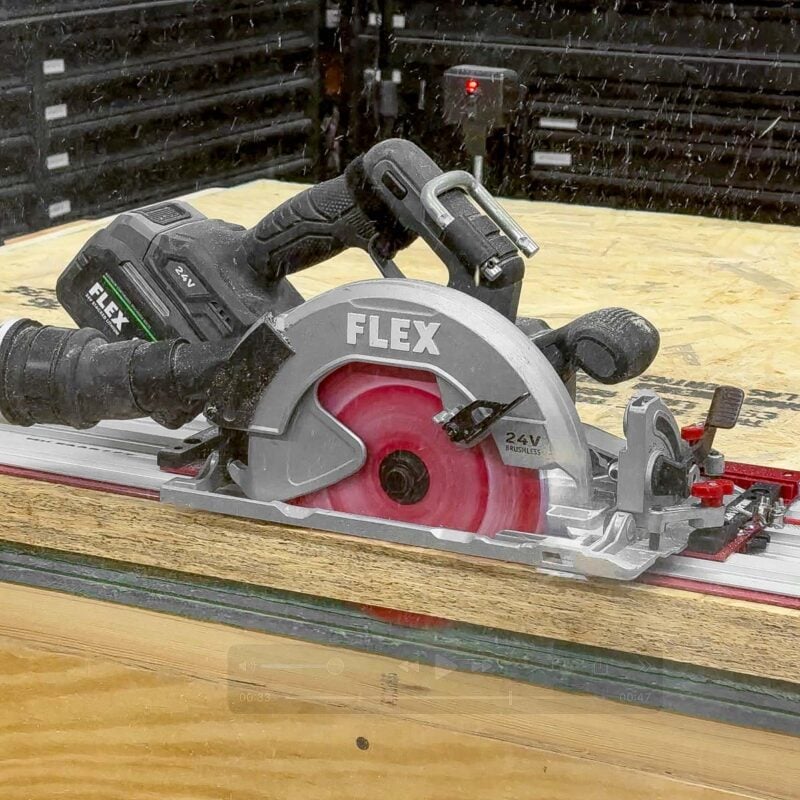
Score: 71 points
- Blade Size: 7 1/4 in
- Blade Speed: 5800 RPM
- Max Cut Depth: 2 5/8 in
- Max Bevel: 56°
- Shoe Material: Magnesium
- Bare Weight: 9.38 lbs
- Tested Weight: 11.66 lbs w/6.0Ah Stacked Lithium battery
- Warranty: 5 years
- Price: $219 bare, $439 kit
Highlighted Features
- Magnesium Blade Guard, Cover, and Shoe: Reduces weight without sacrificing strength
- Included Vac Adapter: Connect a vacuum to keep your workspace cleaner
- Electric Brake: Quickly stops the blade once you release the trigger
- Rafter Hook: Easily hang the saw by its hook instead of setting it down
Pros
- High bevel capacity
Cons
- Heavy
Based on cutting speed alone, Flex performed very well. Its clearly highly competitive and has plenty of power to make even the most demanding cuts we use circular saws for.
However, it didn’t earn a perfect score in any of our other tests, with the sight lines being among the worst in the group. That chipped away at its final score, and dropped its overall ranking further than its cutting performance alone might suggest.
It’s not a bad saw, though. If it’s the only saw you have, you’ll be able to work around the imperfections and still get quality work done. Its characteristics may just take a little longer to learn than other models.
Head-to-Head Testing Results
| Test | Result |
|---|---|
| Rip Cut | 13.35 sec (3rd place) |
| Full Depth Cut | 20.94 sec (6th place) |
| Stake Cutting | 2 of 3 |
| Dust Collection | 2 of 3 |
| Guard Action | 7 of 9 |
| Sight Lines | 3 of 6 |
| Shoe Friction | 2 of 3 |
Kobalt XTR 24V Circular Saw KXCS 124B-03
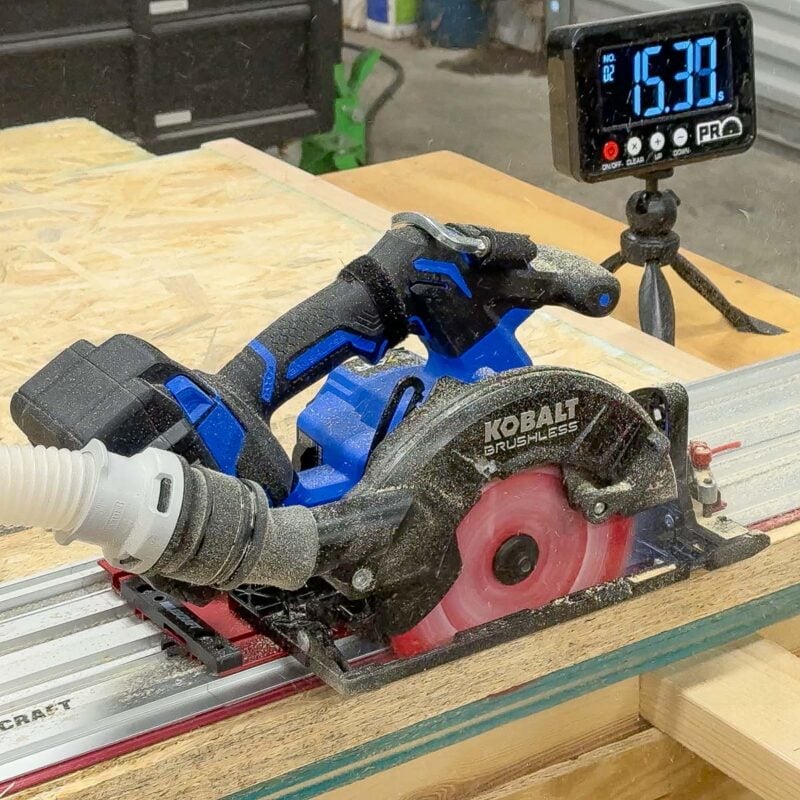
Score: 70 points
- Blade Size: 7 1/4 in
- Blade Speed: 5500 RPM
- Max Cut Depth: 2 1/2 in
- Max Bevel: 56°
- Shoe Material: Aluminum
- Bare Weight: 9.48 lbs
- Tested Weight: 12.16 lbs w/8.0Ah Ultimate Output battery
- Warranty: 5 years
- Price: $179 bare
Highlighted Features
- Bevel Detents: Stops at 22.5° and 45° for quick adjustments to common angles
- Included Vac Adapter: Connect a vacuum to keep your workspace cleaner
- Electric Brake: Quickly stops the blade once you release the trigger
- Rafter Hook: Easily hang the saw by its hook instead of setting it down
Pros
- Slick shoe friction
Cons
- Heaviest saw we tested
Launching back in 2020, Kobalt’s XTR circular saws in one of the oldest circular saws in our test group. When it first hit the market, it wasn’t challenging premium brands’ flagship saws, and we certainly didn’t expect it to 6 years later with even newer models on the market. Still, it proved itself capable of completing the cuts we asked of it, and we feel we could have pushed even harder.
While it’s a capable saw, there are a couple of things to consider before you pull the trigger. Its sight lines can be tough to keep your eye on as you cut, especially at 45°, and the guard action is a little sticky on compound cuts. That said, if you’re looking for something that’s a real performance upgrade from DIY models or you want decent performance without the premium Pro price, it can handle the most common cuts well.
Head-to-Head Testing Results
| Test | Result |
|---|---|
| Rip Cut | 14.87 sec (7th place) |
| Full Depth Cut | 24.87 sec (10th place) |
| Stake Cutting | 3 of 3 |
| Dust Collection | 2 of 3 |
| Guard Action | 7 of 9 |
| Sight Lines | 3 of 6 |
| Shoe Friction | 3 of 3 |
Bosch 18V Profactor Circular Saw GKS18V-25N
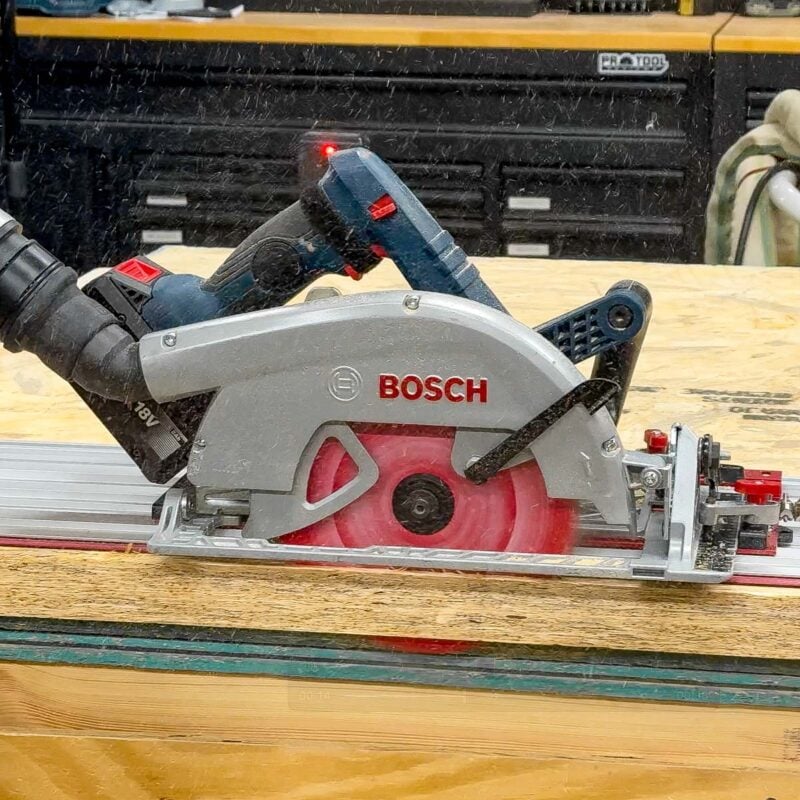
Score: 66 points
- Blade Size: 7 1/4 in
- Blade Speed: 5000 RPM
- Max Cut Depth: 2 1/2 in
- Max Bevel: 50°
- Shoe Material: Aluminum
- Bare Weight: 8.99 lbs
- Tested Weight: 11.28 lbs w/8.0Ah Expert battery
- Warranty: 5 years
- Price: $285 bare, $419 kit
Highlighted Features
- Integrated Pivoting Vac Adapter: Connect a vacuum to keep your workspace cleaner
- Electric Brake: Quickly stops the blade once you release the trigger
- AMPShare: Bosch 18V batteries are compatible with other AMPShare cordless tool brands
Pros
- Pivoting dust port
- Slick shoe finish
Cons
- Underpowered
- Lower blade guard hangs up
- No rafter hook
Bosch had a rough time in our tests. Its lower 5000 RPM speed seemed to limit it in the cutting speed tests, despite its Profactor designation and using the new advanced Expert battery. The motor feels like it has more to give, though, so perhaps raising the RPMs on the next generation will help it rise through the ranks.
Unfortunately, the cutting speed wasn’t its only woe. The guard action made it tough to make right compound cuts and cut stakes, which are tasks we’d expect a brand with Bosch’s reputation to perform well.
On the positive side, you can tell Bosch maintained the jobsite-tough durability we’ve come to expect. It’s certainly not a bad saw, but compared to the best from competing brands, it has plenty of room for improvement.
Head-to-Head Testing Results
| Test | Result |
|---|---|
| Rip Cut | 19.64 sec (last place) |
| Full Depth Cut | 25.53 sec (11th place) |
| Stake Cutting | 1 of 3 |
| Dust Collection | 2 of 3 |
| Guard Action | 7 of 9 |
| Sight Lines | 5 of 6 |
| Shoe Friction | 3 of 3 |
How We Tested and Full Results
Before I jump in with the test results, there are a few things you should know about how I prepared for and conducted each test.
I started by weighing every saw both with and without its battery installed. For consistency, I used the largest battery that made sense for each saw’s intended purpose, and whenever possible, I chose each manufacturer’s premium battery pack.
Next, I replaced every factory blade with a brand-new Diablo Demo Demon 24-Tooth Ultimate Framing & Demolition blade. When you compare and test saws, you want to ensure every tool is cutting using the same blade, not the one it ships with.
Whenever possible, I connected a vacuum for dust collection testing. For the lumber tests, I used carefully selected #2 Southern Yellow Pine 2x10s to minimize knots and grain variation, and every battery was fully charged before testing began.
Those steps help keep the testing as fair and consistent as possible.
Battery Selection
| Circular Saw | Tested Battery |
|---|---|
| Bosch GKS18V-25N | 8.0Ah Expert |
| Craftsman CMCS551 | 6.0Ah Advanced |
| DeWalt DCS578 | 9.0Ah FlexVolt |
| Flex FX2141 | 6.0Ah Stacked Lithium |
| Hilti SC 30WR-22 | 7.9Ah Nuron |
| Kobalt KXCS 124B-03 | 8.0Ah Ultimate Output |
| Makita GSH01 | 4.0Ah High Power |
| Metabo HPT C3607DB | 4.0Ah T-PWR |
| Milwaukee 2834 | 8.0Ah Forge |
| Ridgid R8657 | 8.0Ah EXP |
| Ryobi PBLCS302 | 8.0Ah Edge |
| Skil CR5440B-00 | 5.0Ah |
Cutting Specifications
| Circular Saw | No-Load Speed | Max Cutting Depth | Max Bevel Angle |
|---|---|---|---|
| Bosch GKS18V-25N | 5000 RPM | 2 9/16 in | 50° |
| Craftsman CMCS551 | 5000 RPM | 2 1/2 in | 56° |
| DeWalt DCS578 | 5800 RPM | 2 1/2 in | 57° |
| Flex FX2141 | 5800 RPM | 2 1/2 in | 56° |
| Hilti SC 30WR-22 | 4700 RPM | 2 9/16 in | 50° |
| Kobalt KXCS 124B-03 | 5500 RPM | 2 3/8 in | 56° |
| Makita GSH01 | 6000 RPM | 2 9/16 in | 56° |
| Metabo HPT C3607DB | 6000 RPM | 2 7/16 in | 55° |
| Milwaukee 2834 | 6000 RPM | 2 9/16 in | 53° |
| Ridgid R8657 | 5400 RPM | 2 9/16 in | 50° |
| Ryobi PBLCS302 | 5000 RPM | 2 9/16 in | 56° |
| Skil CR5440B-00 | 5300 RPM | 2 5/8 in | 56° |
Weight
| Circular Saw | Bare Weight | Tested Weight |
|---|---|---|
| Craftsman CMCS551 | 7.26 lbs | 8.81 lbs |
| Skil CR5440B-00 | 7.29 lbs | 8.90 lbs |
| Makita GSH01 | 8.00 lbs | 10.09 lbs |
| Metabo HPT C3607DB | 8.35 lbs | 10.44 lbs |
| Ryobi PBLCS302 | 8.26 lbs | 10.78 lbs |
| Milwaukee 2834 | 8.43 lbs | 10.81 lbs |
| Ridgid R8657 | 8.80 lbs | 11.08 lbs |
| Bosch GKS18V-25N | 8.99 lbs | 11.28 lbs |
| Hilti SC 30WR-22 | 8.36 lbs | 11.29 lbs |
| DeWalt DCS578 | 8.33 lbs | 11.53 lbs |
| Flex FX2141 | 9.38 lbs | 11.66 lbs |
| Kobalt KXCS 124B-03 | 9.48 lbs | 12.16 lbs |
Double-Stacked OSB Rip Cut Test
This first test is all about raw cutting speed in a long rip cut. Using two layers of 3/4-inch OSB subfloor mounted to our circular saw test track, I used a 10-pound weight to pull the sled down the track. Each saw got two attempts, and I recorded its fastest run.
Looking at the results, Milwaukee posted the fastest time at just 9.76 seconds. Metabo HPT finished second at 10.10 seconds, while Flex rounded out the top three with a time of 13.35 seconds. Bosch finished last at 19.64 seconds, but it’s worth pointing out that every saw successfully completed the cut. From first to last, the spread was less than ten seconds, which speaks to just how competitive this group of tools really is.
| Circular Saw | Fastest Time |
|---|---|
| Milwaukee 2834 | 9.76 seconds |
| Metabo HPT C3607DB | 10.10 seconds |
| Flex FX2141 | 13.35 seconds |
| Makita GSH01 | 13.53 seconds |
| Hilti SC 30WR-22 | 13.75 seconds |
| Ryobi PBLCS302 | 14.10 seconds |
| Kobalt KXCS 124B-03 | 14.87 seconds |
| DeWalt DCS578 | 15.53 seconds |
| Skil CR5440B-00 | 16.70 seconds |
| Craftsman CMCS551 | 17.67 seconds |
| Ridgid R8657 | 18.72 seconds |
| Bosch GKS18V-25N | 19.64 seconds |
Full-Depth Rip Cut Test
For this test, I stacked four layers of 3/4-inch OSB, set each saw to its maximum cutting depth, and used 10 pounds of weight to pull the saws. This isn’t a common cut, but it does a great job of showing how much power and endurance each saw has over a full-depth, eight-foot-long rip. Each saw gets one attempt, and I recorded the total time.
You’ll notice some of the rankings change. One reason is that the maximum cutting depth varies between these saws. Models capable of cutting deeper are actually removing more material, which naturally requires more work and can affect their times.
This time, Metabo HPT moves into first place with a time of 16.37 seconds, followed closely by Milwaukee at 17.41 seconds. One of the biggest surprises is Ryobi, which jumps into third place at 17.85 seconds. Skil finishes last with a time of 28.05 seconds, but like every other saw in this test, it successfully completed the full cut. The important takeaway is that every saw completed the test successfully.
| Circular Saw | Time |
|---|---|
| Metabo HPT C3607DB | 16.37 seconds |
| Milwaukee 2834 | 17.41 seconds |
| Ryobi PBLCS302 | 17.85 seconds |
| DeWalt DCS578 | 19.52 seconds |
| Hilti SC 30WR-22 | 20.49 seconds |
| Flex FX2141 | 20.94 seconds |
| Ridgid R8657 | 22.87 seconds |
| Craftsman CMCS551 | 23.41 seconds |
| Makita GSH01 | 24.74 seconds |
| Kobalt KXCS 124B-03 | 24.87 seconds |
| Bosch GKS18V-25N | 25.53 seconds |
| Skil CR5440B-00 | 28.05 seconds |
Cross Cutting
This test is a basic crosscut test. While not designed to separate the field on speed, it gave me a good feel for each saw’s handling, balance with the test battery installed, sight lines, and lower blade guard performance. Every saw completed both 90-degree and 45-degree bevel cuts without any issues related to the lower blade guard operation. In this test, every saw earned a perfect score.
Guard Action
This next test is designed for all you framers who have to stick-frame hip roofs and dormers. I started with a right-hand compound miter test. I set each saw to max depth, a 45-degree bevel, and made several right-hand compound miter cuts while paying close attention to how smoothly the lower blade guard retracted.
This is where some clear differences began to emerge. I again used a simple three-point scale.
1 means the lower blade guard hangs up or interferes with the cut. A 2 means that I noticed some resistance, but could still complete the cut. A 3 means the blade guard retracts smoothly and never gets in the way. The top performers in this test were DeWalt, Hilti, Makita, Milwaukee, and Ryobi.
Since framers also have to make left-hand compound miter cuts, I repeated the same test in the opposite direction. Based on what I saw during the right-hand cuts, I expected a few of these saws to struggle.
On this test, not a single saw earned a score of 1, and 8 of the 12 models received top marks. Overall, the lower blade guards behave much better during left-hand compound cuts.
| Circular Saw | Cross Cut | Right Compound | Left Compound |
|---|---|---|---|
| DeWalt DCS578 | 3 of 3 | 3 of 3 | 3 of 3 |
| Hilti SC 30WR-22 | 3 of 3 | 3 of 3 | 3 of 3 |
| Makita GSH01 | 3 of 3 | 3 of 3 | 3 of 3 |
| Milwaukee 2834 | 3 of 3 | 3 of 3 | 3 of 3 |
| Craftsman CMCS551 | 3 of 3 | 2 of 3 | 3 of 3 |
| Ryobi PBLCS302 | 3 of 3 | 3 of 3 | 2 of 3 |
| Kobalt KXCS 124B-03 | 3 of 3 | 2 of 3 | 2 of 3 |
| Skil CR5440B-00 | 3 of 3 | 2 of 3 | 2 of 3 |
| Bosch GKS18V-25N | 3 of 3 | 1 of 3 | 3 of 3 |
| Flex FX2141 | 3 of 3 | 1 of 3 | 3 of 3 |
| Metabo HPT C3607DB | 3 of 3 | 1 of 3 | 3 of 3 |
| Ridgid R8657 | 3 of 3 | 1 of 3 | 2 of 3 |
Stake Cutting
The stake-cutting test is a practical evaluation of control rather than precision. For this test, I used each saw one-handed to freehand-cut a point onto the end of a standard 2×4. This highlights overall balance, weight, and how smoothly the lower blade guard operates during more awkward cuts.
Every saw completed the test successfully, but several required me to fight the blade guard to finish the cut. The standout performers are DeWalt, Hilti, Kobalt, Metabo HPT, Milwaukee, and Ryobi. Generally, the saws that had trouble with this test were the same ones that also struggled with the right compound miter cut.
Lower blade guards are a big deal! They obviously help with safety, but some are better at getting out of the way than others. Here’s why. When adjusting the saw’s shoe from a straight cut to a beveled angle, some models push the guard back automatically, allowing easier engagement of the blade with the material being cut.
| Circular Saw | Score |
|---|---|
| DeWalt DCS578 | 3 of 3 |
| Hilti SC 30WR-22 | 3 of 3 |
| Kobalt KXCS 124B-03 | 3 of 3 |
| Metabo HPT C3607DB | 3 of 3 |
| Milwaukee 2834 | 3 of 3 |
| Ryobi PBLCS302 | 3 of 3 |
| Craftsman CMCS551 | 2 of 3 |
| Flex FX2141 | 2 of 3 |
| Makita GSH01 | 2 of 3 |
| Ridgid R8657 | 2 of 3 |
| Skil CR5440B-00 | 2 of 3 |
| Bosch GKS18V-25N | 1 of 3 |
Dust Collection
To evaluate the effectiveness of a saw’s dust collection, I made three identical crosscuts with each saw while it was connected to a vacuum. Underneath the cut, I placed a black plastic-covered board that made it easy to see how much dust escaped the collection process. Every saw except one can easily use a vacuum adapter for dust collection. Most are included in the box, although I had to purchase the adapters separately for the DeWalt and Craftsman models for just a few dollars.
Metabo HPT is the one exception. The saw includes a threaded mounting point for a vacuum adapter, and the owner’s manual says the attachment is available separately. Unfortunately, I couldn’t find one anywhere online that sells it—including Metabo HPT.
For scoring dust collection, I used a simple 3-point scale. 1 indicates poor dust collection. 2 is acceptable, and 3 represents excellent performance. Only two saws truly stood out in this test: Makita and Milwaukee. Most fell in the middle, and Ryobi and Hilti had disappointing results. While dust collection is definitely important in certain use cases, I didn’t take it into account for my final scores.
| Circular Saw | Score |
|---|---|
| Makita GSH01 | 3 of 3 |
| Milwaukee 2834 | 3 of 3 |
| Bosch GKS18V-25N | 2 of 3 |
| Craftsman CMCS551 | 2 of 3 |
| DeWalt DCS578 | 2 of 3 |
| Flex FX2141 | 2 of 3 |
| Kobalt KXCS 124B-03 | 2 of 3 |
| Ridgid R8657 | 2 of 3 |
| Skil CR5440B-00 | 2 of 3 |
| Hilti SC 30WR-22 | 1 of 3 |
| Ryobi PBLCS302 | 1 of 3 |
| Metabo HPT C3607DB | 0 of 3 |
Sight Lines
The first meaningful differences began to show up in the sight-line test. Here, I evaluated how clearly I could see the cut line in front of the blade during both straight and 45-degree bevel cuts. While each saw has markings and notches on the shoe for cut-line guidance, there are times – like on shorter cuts – where you need to see exactly where the blade is cutting.
Like most of my untimed tests, I used a simple three-point scoring system. A score of 1 means visibility is poor. A score of 2 is average. A score of 3 indicates excellent visibility. Most of the saws provided very good visibility during straight cuts, with each model earning a score of 2 or 3.
Once I moved into 45-degree bevel cuts, the ability to see the blade in relation to the cut line became more challenging with some of the tools, particularly Flex, Hilti, and Kobalt.
The standout performers in both categories were Craftsman, Metabo HPT, Milwaukee, and Skil.
| Circular Saw | 90° Sight Line | 45° Sight Line |
|---|---|---|
| Craftsman CMCS551 | 3 of 3 | 3 of 3 |
| Milwaukee 2834 | 3 of 3 | 3 of 3 |
| Ridgid R8657 | 3 of 3 | 3 of 3 |
| Skil CR5440B-00 | 3 of 3 | 3 of 3 |
| Bosch GKS18V-25N | 3 of 3 | 2 of 3 |
| DeWalt DCS578 | 3 of 3 | 2 of 3 |
| Metabo HPT C3607DB | 3 of 3 | 2 of 3 |
| Ryobi PBLCS302 | 3 of 3 | 2 of 3 |
| Makita GSH01 | 2 of 3 | 2 of 3 |
| Flex FX2141 | 2 of 3 | 1 of 3 |
| Hilti SC 30WR-22 | 2 of 3 | 1 of 3 |
| Kobalt KXCS 124B-03 | 2 of 3 | 1 of 3 |
Shoe Friction
Another area I evaluated was the shoe, or base plate, itself. These saws use several different materials and surface finishes, and those differences affect both durability and how easily the saw slides across the workpiece. Some use a raw brushed finish, while others have powder-coated or anodized surfaces.
To compare them, I simply evaluated how much friction I felt while guiding each saw across my test lumber. 7 of the 12 saws glided smoothly across the material with very little resistance. 4 fell into the middle of the pack with average performance. The Craftsman and Dewalt created noticeably more drag than the other saws, making it harder to push them smoothly through the cut.
| Circular Saw | Score |
|---|---|
| Bosch GKS18V-25N | 3 of 3 |
| Kobalt KXCS 124B-03 | 3 of 3 |
| Makita GSH01 | 3 of 3 |
| Milwaukee 2834 | 3 of 3 |
| Ridgid R8657 | 3 of 3 |
| Ryobi PBLCS302 | 3 of 3 |
| Flex FX2141 | 2 of 3 |
| Hilti SC 30WR-22 | 2 of 3 |
| Metabo HPT C3607DB | 2 of 3 |
| Skil CR5440B-00 | 2 of 3 |
| Craftsman CMCS551 | 1 of 3 |
| DeWalt DCS578 | 1 of 3 |
What to Look for When You’re Buying a Cordless Circular Saw
Cutting Power
It wasn’t that long ago we had to feather cordless circular saws compared to the way we cut with corded models. Today’s battery-powered options are much better and many brands easily outperform 15-amp corded saws with their flagship brushless models.
If cutting power is your number one priority, expect to pay for a more expensive saw. However, if you don’t mind taking your time, some excellent high-value cordless options can help you get the job done for less.
Tracking
Tracking isn’t about having an arbor that’s off—that would be a defect and you should return the saw if that’s the problem. Sometimes the handle design can encourage you to push to one side or the other, especially with saws that have the front and rear handles close together. Most of the time, you can adjust to the handle design pretty quickly.
Guard Action
The lip of a circular saw guard can catch in some cases. Even when it’s smooth on a typical cut, thin, miter, bevel, or compound cuts can expose issues. Make a series of test cuts on scrap material to see if your guard catches on a particular type of cut so you know when to manually lift it without dragging it away from your cutline.
Dust and Chip Removal
Many of the best cordless circular saws have vacuum ports and those do a better job of clearing chips and dust away than those without. However, the majority of our team never connects a vac for normal cutting. We prefer a vacuum adapter that’s either removable or pivots to direct the chips where we want them.
In general, most circular saws do a good job of clearing dust and chips. As RPMs drop because of a lower top-end speed or bogging down, the clearing suffers. Look for models with at least 4500 RPM (5000 is even better) and a brushless motor to maintain effective clearing.
Handle Ergonomics
Handle comfort is largely an individual choice with the size of your hand driving a lot of what feels best. While rear handles are rarely an issue, our crew is drawn towards front handle designs that aren’t too thin, too close to the rear handle, or angled in a direction that becomes uncomfortable. See if you can put your hands on the saw in the store before you take it home. If you hate the grip in the store, it’s unlikely to get better once you’re cutting.
Weight
Because you nearly always cut on top of your material, the weight comes into play primarily when you’re carrying your circular saw from one place to another. However, heavy saws can contribute to “stickier” cutting if the shoe isn’t low-friction enough. There’s no reason to carry more weight than you have to, though, and it’s possible to get a Pro-level saw under 10 pounds with the battery.
Price and Value
We’re big on value and love figuring out what the best saw for our budget is. Start with what you know you’re willing to spend and build your priorities from there. Here are things we consider as part of our value calculation:
- Performance
- Design and features
- Depth of compatible tools on the same battery system
- Service after the sale and warranty
Sidewinder or Rear-Handle?
The spread between sidewinder and rear-handle cordless circular saw styles is largely regional. The West Coast tends to prefer rear-handle while the East Coast generally goes sidewinder.
Most cordless rear-handle saws aren’t true worm drives. The exceptions are Skilsaw’s 48V cordless worm drives. The rest use a direct drive gearing system and go with a rear-handle design to accommodate the preference for that style.
Like their corded counterparts, cordless rear-handle saws are heavier than the more compact sidewinder style.
Both styles use brushless motors and a direct drive (aside from Skilsaw’s worm drive), so there isn’t necessarily the same higher torque in the rear-handle style as there is with corded models.
When it comes to these high-end cordless circular saws, it’s more a matter of preference.
Voltage
There’s some confusion between 18V and 20V cordless circular saws. Many folks believe that 20V is more powerful, but they’re the same voltage.
More brands are using 6-cell sets instead of the 5-cell sets we see on 18V/20V max tools. Those run at a higher voltage. Marked 24V Max or 22V, they run at 21.6V nominal. With 20% more cells, they do have the potential to produce more power or runtime.
36V/40V Max batteries are one way to get more power. Makita and Skil both have 2-battery systems that take 18V/20V max batteries and combine them in series on the tool to reach a higher voltage. Makita also has a 40V max XGT line and Metabo HPT has a 36V MultiVolt system.
Skilsaw has a couple of options for its 48V TrueHVL system while DeWalt’s FlexVolt system runs a 60V max (54V) platform.
However, the advent of advanced batteries using 21700 lithium-ion cells and more recently pouch cell batteries makes it possible to deliver more power to lower voltage systems without needing bulkier high-voltage battery packs.
Blade Left or Blade Right?
Very few Pros and DIYers we come across don’t care what side the blade is on. Nearly everyone has a preference and won’t buy a saw with a blade that sits on the “wrong” side. Your best bet is to try both and see which one is easier for you to track your cutline.
As a right-handed user, I prefer a blade-left design. Then again, PTR’s Editor-in-Chief, Clint DeBoer, is also a righty and prefers blade-right. Read more about the considerations here.
Features To Look For
- Brushless motor: offers better performance, runtime, and longer life
- Electronic brake: stops the blade quickly as a safety feature
- Rafter hook: great for hanging on a variety of objects instead of setting the saw on the ground
- Trigger safety design: some people prefer a push-in style, others a push-down
- Dust port: offers a connection to a vacuum for better cleanup
- Rail compatibility: gives the saw the ability to attach to a track for highly accurate cuts
- LED light: adds light to the visible blade area to help you see your cutline
- Cutline blower: uses exhaust airflow to push sawdust away from your cutline
- Magnesium components: reduces the weight without sacrificing strength


Great Review! Love all of testing categories! If you are a framer, it’s always blade left. I’m a little confused as to the saws tested. Usually, testing saws in their category will help pros or DIYers choose a saw. Blade right saws are usually for straight edges fro cutting off doors and finish plywood for cabinets. Framing saws for carpenters/framers need to be more powerful, 36v, 40v, 60v, so compare Metabo 36v, Makita 36v, Makita 40v, DeWalt 60v, etc, all blade left for a future test. Blade right saws provide a more stable contact, so the cut is more square, but for framing, it’s all about speed and you can hold it square enough, and you let the weight of the saw move through the cut. I’d love to see framing cordless saws compared to a corded framing saw, like the Mag77.