
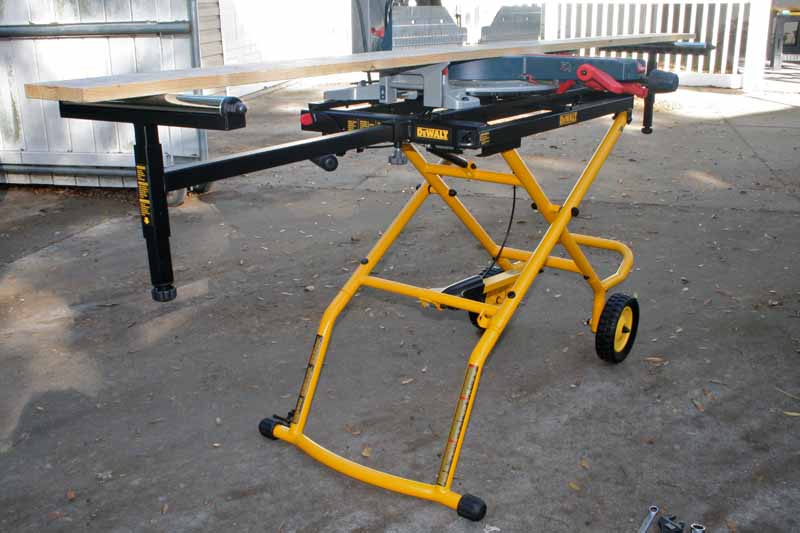
While the thought of a “portable” miter saw is appealing, carrying one around by hand is not my favorite pastime. I’d rather use a dedicated miter saw stand. We’ve used a bunch of these over the years. When the gas-assisted DeWalt DWX726 miter saw stand hit the market, we thought we’d give it a try.
First and foremost, a good miter saw stand supports the saw while also providing a consistent feed and support for the work material. There are two basic types of miter saw stands: the compact fixed stand (with or without roller feeds) and the heavier-duty rolling stand, which is made to be a more permanent yet portable solution. The DeWalt DWX726 Rolling Miter Saw Stand promises to be both robust and highly portable.
DeWalt DWX726 Rolling Miter Saw Stand Build Quality
The DeWalt DWX726 comes disassembled. For us, this presented a fun project. For you, it may be a great excuse to break in that new apprentice and see what he’s made of. In our opinion, the instructions were fairly straightforward. While the manual didn’t maintain a consistent frame of reference for the close-up drawings, we muddled through. At times, though, it was challenging to figure out the proper orientation of a part.
The only required tools were the included hex wrench and a few wrenches. We used these to grab hold of the bolts for the wheel assembly. The tubular steel appeared to be strong—a good feature for a heavy 12-inch miter saw. The way everything fit together led us to believe that the miter stand could handle large miter saws once assembled. We wanted it to maintain a good footing on uneven jobsites. Overall, it took us around 30 minutes to put it together.
Mounting Our DeWalt Miter Saw
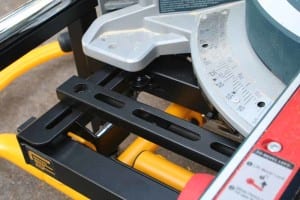
Once assembled, we needed to mount our DeWalt DWS780 miter saw to the DeWalt DWX726. We also tested it with a Bosch Axial Glide 12-inch miter saw to test compatibility. This ended up being fairly easy. At one point, we learned that moving the horizontal rails all the way back inhibits the long bolts from passing through the captured nuts.
This would be no big deal except for the fact that each rail has a centrally-located fastening point, which the miter saw obscures. If you want to readjust either of the rails, you need to remove the miter saw or planer completely. But you know what? You’re only going to do this once. Having read this, you can avoid our mistakes and get the job done even more quickly.
Testing with Other Miter Saws
For this exercise, we used a non-DeWalt miter saw, and the stand easily adapted to fit. In fact, having learned how the rail system worked, it was easy to see how just about any saw on the market should fit onto the DWX726 stand.
The stand also comes with integrated cord wrap posts that need to be installed. However, there’s no way to secure the plug. If your cord doesn’t include a cord-pinch, you may want to invest in a hook-and-loop cable tie or something similar.

DeWalt DWX726 Miter Saw Stand Testing
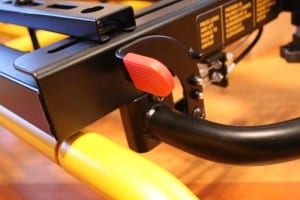
After mounting the miter saw, we grasped the handle, put our foot on the extension leg for support, and pushed downward. This relatively simple effort smoothly dropped the weight of our 12-inch miter saw, and it was just as easy to lift the saw to its proper working height.
The lifting and lowering mechanism sometimes gets stuck. We figured out its quirks after moving it up and down several times.
Cutting and Stability
We cut different materials on this stand with a heavy Makita 12-inch cordless miter saw. In fact, this was quite the test. This saw weighs 69 lbs—one of the heaviest saws likely to land on the DeWalt DWX726 Rolling Miter Stand. Even with the weight of the saw, the stand rose and fell properly. When cutting dimensional lumber and 1x trim, it never felt flimsy or unbalanced. The table didn’t move around too much during cuts—even when using the outfeed supports.
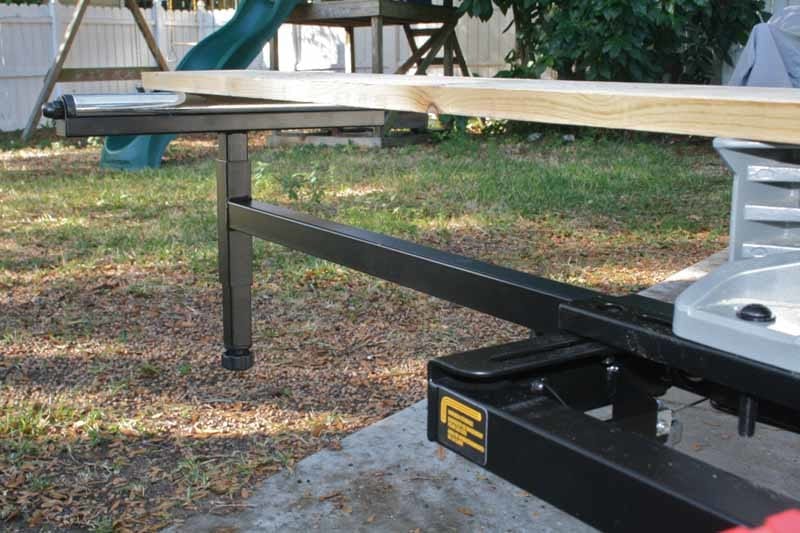
The glide rollers did a great job of feeding us the working material. The dual extensions allowed us to feed the material from either side. This is very convenient if you plan to cut a lot of vertical crown. We also really liked the way the height and width of the roller supports could be very easily modified to fit any type of miter saw or length of material. The total max-width is around 8 feet. The ~3ft. long square tubes fit into each other when fully retracted. When placing heavier lumber across the miter saw, the weight also didn’t cause the roller arms to strain or drop.
Folding for Storage
When we were finished, we locked the miter on the saw and collapsed the stand. It easily lifted up onto its wheels for storage. The compactness of the stand was impressive. It goes from a spread-out 8-foot wide stance to a compact frame in just seconds. Plus, it’s easy to move about from jobsite to jobsite. That’s a convenience worth paying for.

Conclusion
If your miter saw gets a lot of use, the DeWalt DWX726 is a great solution. It works with just about anything on the market and caters to the professional tradesman moving from one jobsite to another. At just under $300, it’s a great add-on to make your tool more portable and more usable. I could even see this being used in the woodworker’s shop, simply because it lets you move your miter saw around quickly and easily. The vertical storage just makes the DWX726 that much more appealing.
We’ve used a lot of miter saw stands. While the DeWalt DWX726 isn’t breaking a ton of new ground, it’s an improved alternative to the DeWalt DW7440RS stand. At $299, it’s over $100 less than the popular Bosch T4B Gravity Rise miter saw stand. Maybe you can take that extra $100 and buy your significant other something nice.