
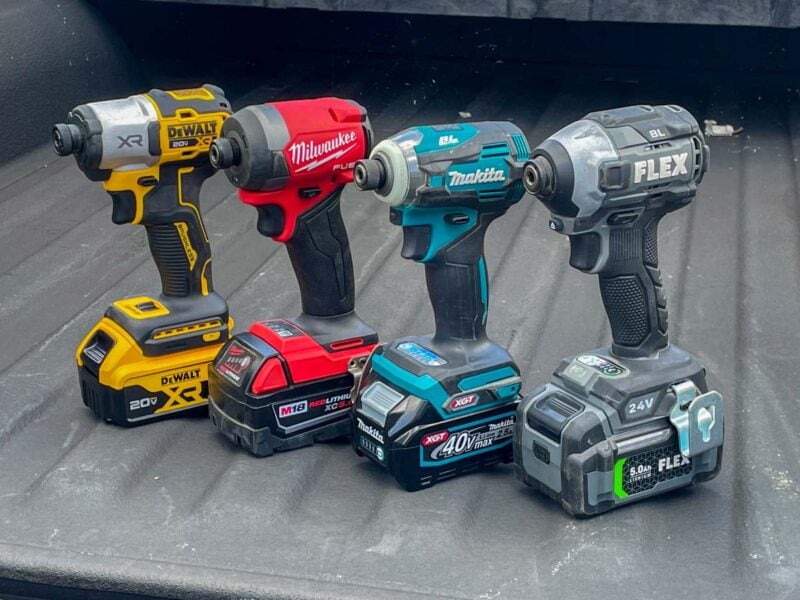
Impact drivers are the go-to screw driving tool for many Pros, and they cross into almost every trade. A walkthrough of today’s designs reveals impressive performance in some, seemingly impossible compactness in others, and plenty that balance the two. With so many options to choose from, is high performance or compact size more important?
I’ll help you think through that question so you can decide.
The Case for High-Performance Impact Drivers

For several years, I wasn’t really on board with high-torque impact drivers. We would consistently break bits and adapters with torque levels over 1600 in-lbs or so. Plus, there was little to no advantage in driving drywall or deck screws.
But that was on hard-stop, metal-fastening applications. If you’re driving structural screws (ledger screws, RSS screws) into lumber, it’s a totally different ballgame. They’re designed to hold with as much strength as lag screws, but they have a smaller diameter, threads that feed better, and coatings that reduce friction. That combination makes them easier to drive. Better still, they’re specifically designed to drive with an impact driver.
Because the lumber has some give (soft stop), the power doesn’t all transfer into the bit and snap it like it does in a hard-top application. In fact, since the lumber absorbs some of the power from your impact driver throughout the drive, the higher the power level, the better.
At least, to a point. While we haven’t found the upper limit yet, we have used models with power levels up to 2500 in-lbs without a hint of an issue.
Testing the Theory
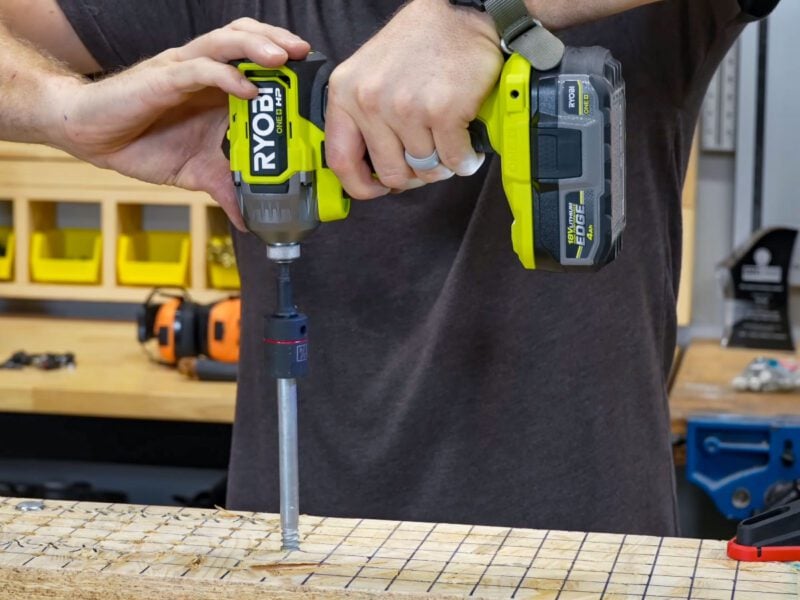
Impacts with torque levels well over 2000 in-lbs can legitimately improve your productivity. And if you can pair high torque with high speed, you can zip through at an impressive pace. It’s a difference we’ve seen in our own testing. Here are a few examples:
| Model | Max Torque | Max Speed | Average Speed Driving RSS Screws |
|---|---|---|---|
| Bosch GDR18V-215 | 1900 in-lbs | 3300 RPM | 9.76 sec |
| Metabo HPT WH36DC | 1903 in-lbs | 3400 RPM | 9.54 sec |
| DeWalt DCF860 | 2500 in-lbs | 3800 RPM | 7.54 sec |
| Milwaukee 2953 | 2000 in-lbs | 3900 RPM | 5.96 sec |
*Full test details and results are available in our Best Cordless Impact Driver Head-to-Head Review.
Note how the combination of 2000 in-lbs of torque or more and higher speed makes a significant difference in how fast the times were.
Here are the same models, this time on an even more challenging lag screw driving test:
| Model | Max Torque | Max Speed | Remaining Length After 30 Seconds |
|---|---|---|---|
| Bosch GDR18V-215 | 1900 in-lbs | 3300 RPM | 3.25 in |
| Metabo HPT WH36DC | 1903 in-lbs | 3400 RPM | 4.38 in |
| DeWalt DCF860 | 2500 in-lbs | 3800 RPM | 0.00 in |
| Milwaukee 2953 | 2000 in-lbs | 3900 RPM | 1.06 in |
Notice how the extra torque made an even bigger difference. DeWalt was the only one able to drive the lag flush because it has more muscle.
The Case for Compact Impact Drivers

It’s common to think that you don’t really need to consider how compact an impact driver is, considering they’re already so much smaller than cordless drills. But size really does matter.
Consider the needs of a mechanic. Today’s engine bays are more crowded than ever, and there are plenty of fasteners that don’t require the power of an impact wrench to remove or install.
Some of the most compact impact drivers available have even shorter heads than stubby impact wrenches, giving mechanics the ability to get into tighter spaces before having to switch to hand tools.
Plus, intentionally choosing a model with a lower power level can reduce the risk of damage that a stubby or right-angle impact wrench could cause.
That’s just one example. HVAC techs, refrigeration specialists, plumbers, electricians, and other tradesmen often have to work in tight spaces where the need for access is more critical than high performance.
Real-World Evidence
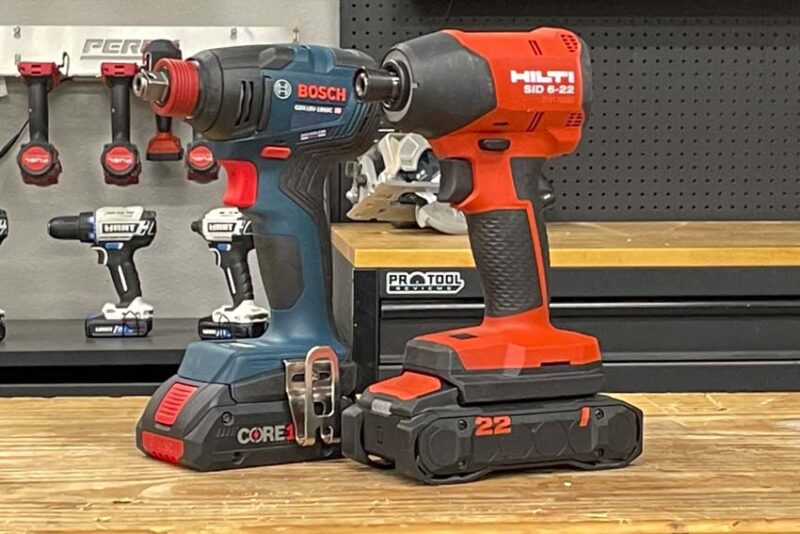
If we take another sample from our test group that includes the most and least compact models, take a look at the spread:
| Model | Head Length |
|---|---|
| Hilti SID6-22 | 5.44 in |
| Ridgid R862312 | 5.00 in |
| DeWalt DCF860 | 4.75 in |
| Milwaukee 2953 | 4.44 in |
There’s a full inch of difference between the best and worst lengths. And that’s just from our test group. If we branch out from there, DeWalt’s DCF850 is just 3.97 inches long. If you’re working in tight spaces, a tool that’s an inch and a half shorter makes a huge difference.
Generally speaking, more compact tools also tend to be lighter. Anytime you can work with a lighter tool, it’s going to decrease the amount of fatigue you feel over the course of a day, and can make an even bigger difference when you’re working overhead. However, that’s not necessarily the case with premium impact drivers.
Consider the same tools from above:
| Model | Head Length | Bare Weight |
|---|---|---|
| Hilti SID6-22 | 5.44 in | 2.12 lbs |
| Ridgid R862312 | 5.00 in | 2.28 lbs |
| DeWalt DCF860 | 4.75 in | 2.45 lbs |
| Milwaukee 2953 | 4.44 in | 2.20 lbs |
Among these four, the largest tool is also the lightest. However, battery selection matters, and every brand is different. Still, paired with a 1P (single-layer) battery, any of these tools has a very reasonable working weight.
Cost Considerations
The examples above include flagship models from top brands that we’ve tested head-to-head. However, you can often find the most compact impact drivers by looking at entry-level and mid-range models.
Models labelled “compact” or “sub-compact” (or in DeWalt’s case, Atomic) indicate a specific intent to make a smaller and often lighter tool. In shrinking down the size, they often use smaller motors that deliver lower performance as a tradeoff.
A huge benefit is that they cost less than buying a brand’s top-of-the-line impact driver. Many brands also offer them with a matching drill/hammer drill and a couple of batteries. In some cases, a compact 2-tool combo can be less expensive than buying a high-end impact driver kit.
Consider these two options from Milwaukee’s M18 system:
| Milwaukee M18 Fuel 2953 | Milwaukee M18 Compact Brushless 3650 | |
|---|---|---|
| Max Speed | 3900 RPM | 3600 RPM |
| Max Impact Rate | 4400 IPM | 4900 IPM |
| Max Torque | 2000 in’lbs | 1700 in-lbs |
| Head Length | 4.44 in | 4.40 in |
| Bare Weight | 2.2 lbs | 1.7 lbs |
| Bare Price | $179 | $149 |
| Kit Price | $319 w/two 5.0Ah batteries | $199 w/two 2.0Ah batteries |
| 2-Tool Combo Price | $399 w/two 5.0Ah batteries | $249 w/two 2.0Ah batteries |
As you can see from the chart, you can buy into a high-quality battery system and get a more compact, lighter, and much less expensive impact driver kit if you don’t need the best performance Milwaukee offers.
Control Issues
There’s one more variable to throw into the equation before you make your decision, though. Many people buy compact impact drivers because the lower performance helps them maintain better control, especially with small fasteners.
However, when you buy a legit high-performance impact driver that is the flagship in its line, it nearly always includes assist modes.
The most common assist mode is designed for self-tapping screws. It starts fast to get the screw going and then slows down or stops after a certain number of impacts to avoid shearing the head off the screw.
There are other variations depending on what brand you buy, but they all have the goal of delivering greater control in situations where the highest speed and torque may work against you, and dropping to a lower power mode isn’t ideal.
By buying a high-performance impact diver with assist modes, you can have the best of both performance and control.
The Bottom Line
I realize I just presented a lot of information. If it seems like too much to digest at once, here’s a quick summary:
Prioritize High-Performance Impact Drivers if…
- You don’t have access concerns
- You often drive large fasteners in wood
- You want the best possible performance
- You want the best available features
Prioritize Compact Impact Drivers if…
- You often work in tight spaces
- You want to save money
- You prefer lower performance to limit the risk of damage
Which type of impact driver works best for you? Let us know in the comments below!