
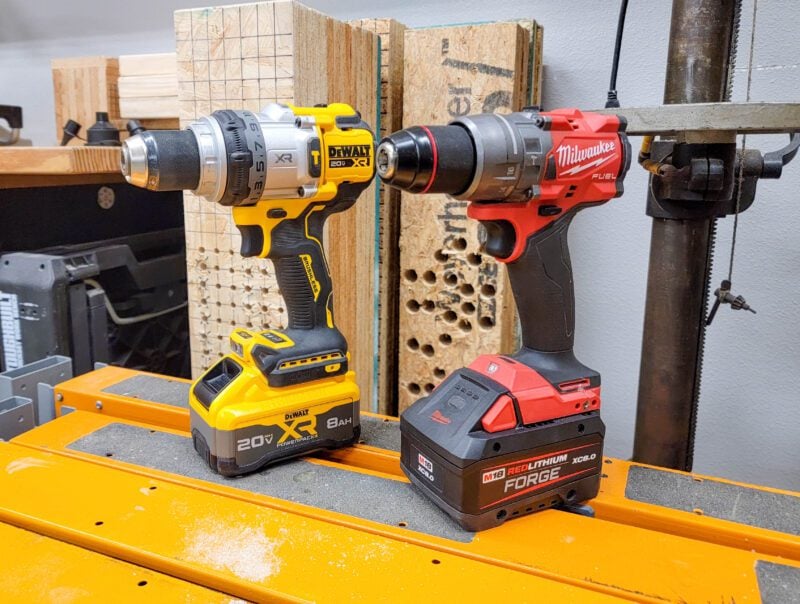
This week, we have two of the most popular brands in the game going up against each other with their best cordless hammer drills. Representing the professional class and with features and performance that go way beyond basic, we have a DeWalt vs Milwaukee hammer drill head-to-head review for you!
READ
Best Cordless Drill Head-to-Head Review
Hammer Drill Model Selection
DeWalt DCD1007
For DeWalt, it’s the DCD1007—DeWalt’s newest high-performance 20V Max XR 1/2-Inch Hammer Drill. It’s a step up to a whole new level, featuring a three-speed motor and plenty of torque to power through tough applications. Plus, it’s built on the foundation of a DeWalt drill that’s been field-proven for years.
Milwaukee M18 Fuel Hammer Drill 2904
On the Milwaukee side, we’re using the 4th-generation M18 Fuel Hammer Drill 2904. There’s also a 2906 One-Key model if you’d like smart features. Upgrading both performance and features from the 3rd generation model, it was our #1 overall recommendation in our Best Cordless Drill article when it first launched. However, it has slipped in the rankings slightly since then.
We set up four performance tests for these drills to complete. While performance is certainly the biggest consideration for drills at this level, it’s not everything. We’ll take a look at size, weight, features, and price. Once you have all of those numbers in front of you, you can decide for yourself whether DeWalt or Milwaukee deserves the win.
Read
DeWalt Vs Milwaukee Impact Driver Review
Are We Testing the Top Drills?
The short answer is, yes, these are the top drills DeWalt and Milwaukee offer as of this update. Both brands have a solid portfolio, including entry and mid-level options, though DeWalt has more active models that can make it a little confusing.
DeWalt actually has several drills you might consider “flagship” models, because at one time, they all were. Yet, most of these are still available today. Here’s a quick overview:
- DCD996: DeWalt’s original modern high-performance drill
- DCD997: Added Tool Connect smart controls to the DCD996, but now discontinued
- DCD998: Power Detect steps up performance when you use a 20V Max 8.0Ah battery or larger
- DCD999: FlexVolt Advantage steps up even higher when you use a FlexVolt battery
- DCD1007: Settles in as the highest performing option built around the advanced PowerPack battery
Milwaukee is much easier to get a handle on. The M18 Fuel designation tells us it’s the top of the lineup. When the 2904 launched, they stopped production of the 2804, and retailers sold the remaining stock until it was gone.
READ
Best DeWalt Drills
Best Milwaukee Drills
DeWalt vs Milwaukee Hammer Drill on Paper
Before we jump into the performance tests, here’s how these two drill line up on paper.
| DeWalt 20V Max XR DCD1007 | Milwaukee M18 Fuel 2904 | |
|---|---|---|
| Top Speeds | 450/1200/2000 RPM | 500/2100 RPM |
| Max Torque | 1530 UWO* | 1400 in-lbs |
| Max Hammer Rate | 38,250 BPM | 33,000 RPM |
| Head Length | 7.5 in | 7.0 in |
| Bare Weight | 4.16 lbs | 3.23 lbs |
| Weight w/Tested Battery | 6.31 lbs (8.0Ah PowerPack Battery) | 5.63 lbs (8.0Ah Forge battery) |
Looking at the specs, it’s clear that these tools are well matched in terms of speed and power, but Milwaukee is arguably smaller and lighter than the DCD1007. With that in mind, we’re curious to see how these tools perform in head-to-head testing.
Performance Testing
We ran a series of four tests to compare the performance of both hammer drills. To make sure it’s fair, we recharged the battery before each test.
8-Inch RSS Screw
To kick off our testing, we drove three 8-inch GRK RSS Screws into stacked and glued OSB subflooring. This test is designed to see how each drill responds while driving large structural fasteners into dense material, such as you might experience with decking or large timber framing applications. Even OSB isn’t the material of choice for those builds, it’s much more consistent than lumber, so we use it to even out the variables.
| DeWalt 20V Max XR DCD1007 | Milwaukee M18 Fuel 2904 | |
|---|---|---|
| Average Time | 2.42 seconds | 2.49 seconds |
Spade Bit
For our medium-load test, we used a 1-inch spade bit with a self-feeding tip to drill through 4 inches of stacked and glued 1/2-inch OSB. The result is the average of three tests. Any outlier results were thrown out, and the run repeated.
| DeWalt 20V Max XR DCD1007 | Milwaukee M18 Fuel 2904 | |
|---|---|---|
| Average Time | 2.54 seconds | 2.62 seconds |
Self-Feed Bit
To get an idea of how these hammer drills perform under a heavy rough-in load, we used a 2 9/16-inch self-feed bit to drill through a 2×4 pine stud, while being careful to avoid knots. We tried each drill in high speed first, and if it was unable to complete the test, dropped into low gear. The result is the average of three tests. Like before, we eliminated any outlier results and repeated the test.
| DeWalt 20V Max XR DCD1007 | Milwaukee M18 Fuel 2904 | |
|---|---|---|
| Average Time | 1.73 seconds | 1.89 seconds |
Concrete Bit
The final test was drilling through concrete. Using a 3/8-inch concrete twist bit, we drilled 3 inches deep in fully-cured 4000 PSI concrete. We took the average of three tests to get our results. Again, in the event of any outliers, we threw out the result and repeated the test.
| DeWalt 20V Max XR DCD1007 | Milwaukee M18 Fuel 2904 | |
|---|---|---|
| Average Time | 6.39 seconds | 6.84 seconds |
Performance Analysis
Looking at the results, it’s clear that DeWalt has a slight edge over the Milwaukee 2904. Granted, this isn’t a complete blowout, but the DeWalt DCD1007 is faster overall.
In terms of RPMs, these two are pretty evenly matched. However, DeWalt’s higher BPM rating gave it a noticeable lead during our concrete test, whereas the two models were basically neck and neck through every other test with Milwaukee falling just 0.19 seconds behind on average.
Since they are so evenly matched, I think it’s prudent to compare their overall feature sets before making a final judgement.
Comparing Features
As the flagship drills for their respective platforms, these some of the best features available from these two top brands. Here’s a quick breakdown of the major highlights:
DeWalt 20V Max XR DCD1007
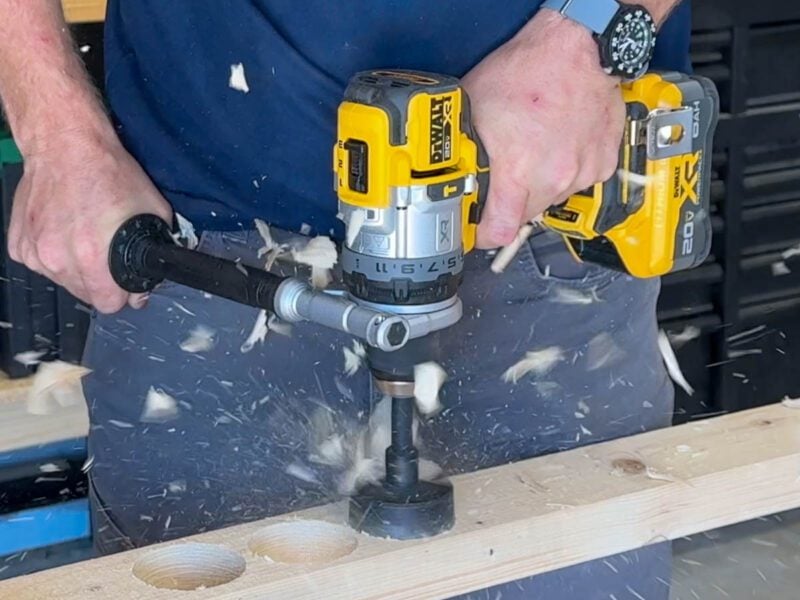
- Brushless motor
- Significant performance boost verses FlexVolt DCD999
- 3 speeds
- Kickback control
- Higher top speed in hammer drilling mode
- Pivoting LED light with multiple settings, including a 20-minute work light mode
- Tool Connect Chip ready
Milwaukee M18 Fuel 2904
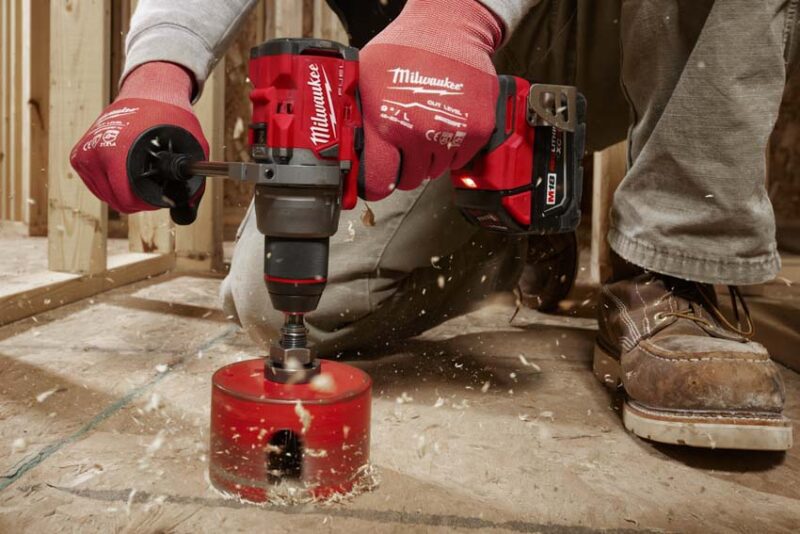
- Brushless motor
- Kickback control
- 2 speeds
- Available One-Key customizable controls, tracking, inventory, and security (2906 model only)
READ
Cordless Drill Kickback Control: Why it’s (Mostly) Non-Negotiable
Feature Analysis
The most interesting part of this comparison is that DeWalt is extremely feature-heavy, while the Milwaukee 2904 is much more basic. This doesn’t mean that Milwaukee is inferior; rather, I believe it just shows that the 2904 is more focused on performance without extra bells and whistles.
However, the DCD1007 does have a few helpful features, such as the pivoting LED light and a slight power boost when the hammer mode is engaged. These extra features give DeWalt a slight edge from a design standpoint.
Price Comparison
The last piece of the puzzle is price. As top-tier tools from premium brands, it’s not a surprise to find that these drills are on the expensive side of what’s available. That doesn’t mean they’re a bad value, though. When you need the best performance or the most innovative features, these drills can make a real difference in how productive you are, and that can make for an excellent value. It’s all about how you work.
One more quick note—you can get Milwaukee’s drill with or without One-Key, so we included both.
| DeWalt DCD1007 | Milwaukee M18 Fuel 2904 | Milwaukee M18 Fuel 2906 (One-Key) | |
|---|---|---|---|
| Bare Tool | $249 | $229 | $279 |
| Kit | $349 8.0Ah PowerPack Battery | $329 2 x XC5.0Ah batteries | N/A |
| 2-Tool Combo | $399 DCD1007 Hammer Drill DCF845 Impact Driver 2 x 4.0Ah PowerPack Batteries | $399 2904 Hammer Drill 2953 Impact Driver 2 x XC5.0Ah batteries | $449 2906 Hammer Drill 2957 Impact Driver 2 x XC5.0Ah Battery |
Final Thoughts
To be perfectly honest, these two hammer drills are more evenly matched than we first thought they would be. They both displayed excellent Pro-grade performance and remained within a small margin of each other during our testing.
On one hand, the Milwaukee is smaller, lighter, and the 2904 kit comes with two batteries and a charger. On the other, DeWalt is faster, stronger, has some bonus features, and comes with a more advanced tabless PowerPack battery.
But they’re close enough that this one really boils down to preference. Both of these tools are formidable Pro-grade options and have a lot to offer on the jobsite.
In the end, I’m inclined to side with Milwaukee on this one. I prefer the lighter, more compact design. And while I’d love to see a kit option with the M18 Forge battery, there’s no denying the value of a two-battery kit, especially when it’s still coming in at a lower price than DeWalt. I’m willing to give up the extra features and slight performance boost for those benefits… but that’s just me.
What do you think? Let us know in the comments below!


I agree with Milwaukee for the win with better combo kit.
Milwaukee offers 6Ah batteries vs DeWalt 5Ah batteries and smaller overall.