
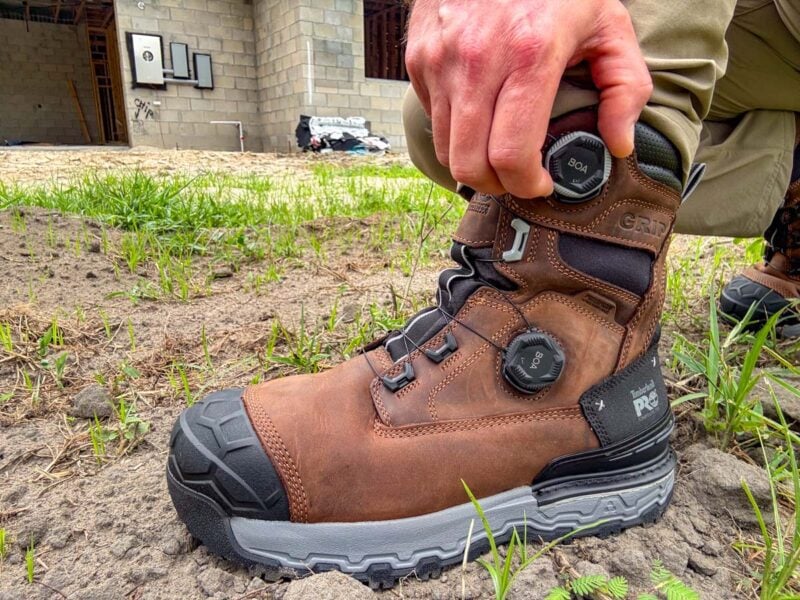
The Timberland Pro Boondock work boot is a popular line with quite a few styles: 26 in all. Among them are the new Ultralight models, two of which are offered with the dual-dial BOA Fit System. How much of a difference does the Ultralight design make? Is paying more for the BOA Fit System worth it? Are two really better than one?
I pulled on the 8-inch dual-dial BOA model to find out and see how comfortable the Boondock design really is.
READ
Best Work Boots: Most Comfortable Boots for Tradesmen
Pros
- Excellent comfort
- Dual-dial BOA Fit System
- True-to-size fit
- Much lighter than the original Boondock models
- Low break-in period
Cons
- Premium price for the BOA Fit System
- No 90° heel option in the Ultralight line
What Timberland Says About the Boondock Ultralight Work Boot
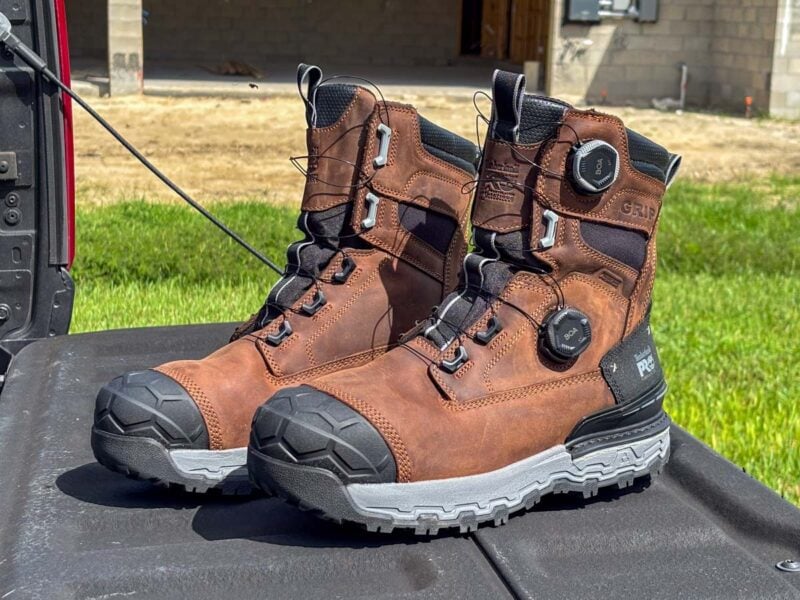
According to Timberland, the Boondock Ultralight is “designed to combine lightweight performance with a dialed-in fit so that you can lock into the job all day long.” Here’s a look at what the design team built into these boots to accomplish that goal:
Key Features
- Premium Full-Grain Leather Upper: Waterproof and abrasion-resistant
- Dual-Dial BOA Fit System: Micro-adjustable, zonal, precision fit
- Molded Toe Reinforcement: Improves abrasion resistance and durability
- Safety Toe: Asymmetrical composite design offers a better fit, lighter weight, low temperature conductance, and no electrical conductance
- Breathable Membrane: Offers waterproof protection and resists blood-borne pathogens
- Hover Spring Foam: Provides high-rebound performance and underfoot comfort
- Ventilated Anti-Fatigue Technology: Absorbs impact shock, provides energy return, and improves climate control
- TPU Outsole: Enhances abrasion resistance and with a lug pattern that provides lightweight all-weather, slip resistant performance
- Electrical Protection: Provides underfoot protection from electrical currents under 600 volts (meets ASTM standards)
- Microban Technology: Protects footwear fabrics against unpleasant odors, stains, and deterioration
- Combination Construction: Hybrid Goodyear welt and cement construction balances durability with flexibility
- Available Sizes: 7 – 15, regular or wide
Those are some impressive accolades, but what’s it actually like to wear them?
What I Say About the Timberland Pro Boondock Ultralight Work Boot
Is Ultralight Just Marketing Hype?
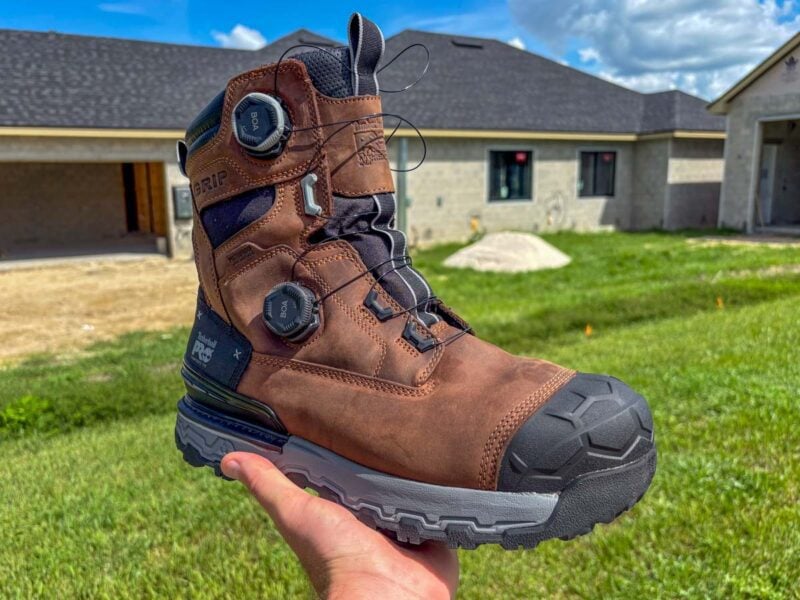
Before I even put these boots on my feet, I keyed in on the “Ultralight” designation. As a big guy and endurance athlete, I’m well aware of how any additional weight can drive leg fatigue. When you’re talking about all-day shifts on the jobsite, it can compound even more.
I’ve been wearing the 8-inch model, so lightweight is always relative compared to mid- or low-height boots. Even so, I was impressed with how light they felt when I first picked them up. Based on the size 9 spec most brands use, each boot weighs 33.5 ounces. That will vary, depending on what size you wear. For example, my size 13s weigh 36.6 ounces each.
By way of comparison, the standard version of these boots weighs 44.4 ounces. That’s 2/3 of a pound of weight savings on the Ultralight model, which is a massive improvement. Now, the standard Boondock has insulation and a puncture plate, which the Ultralight versions don’t, so that’s where some of the weight savings are coming from.
Weight is helpful, but what about the rest of the boot?
Concrete Impressions
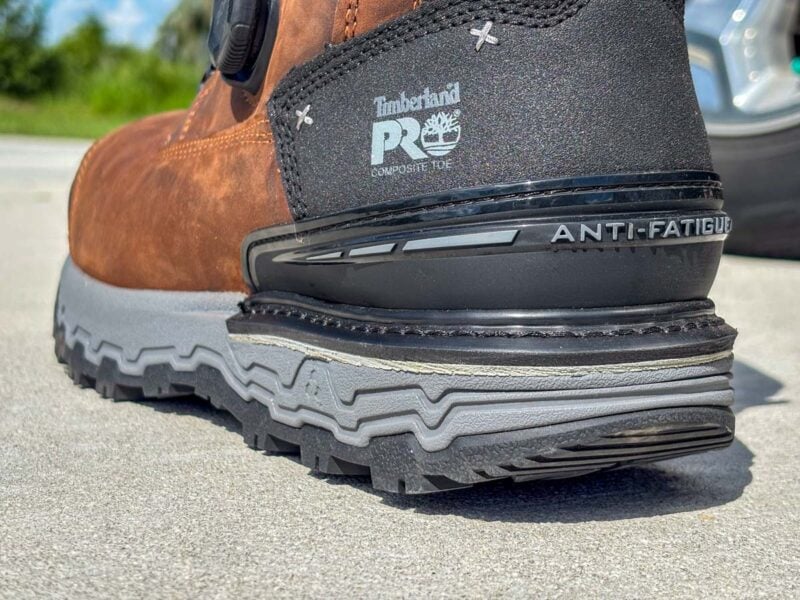
When I put these boots on for the first time, the midsole certainly felt comfortable. Then I stepped onto concrete, and I’m pretty sure my eyes literally widened. Of all the work boots I’ve worn, Timberland’s Hover Spring foam is the cushiest. I could feel my foot sink into it with each step, and my knees were crying with joy from relief. That or I was sweating profusely… I was testing in August in Florida after all.
Seriously, though, the midsoles on the Boondock Ultralight are ridiculously comfortable.
That level of comfort has a downside, though. The more cushioning the midsole provides, the quicker the foam tends to break down. I haven’t worn them long enough to know for sure, but my experience with ultra-plush work boots is that they’ll maintain that comfort for 6 months to a year. That’s not a knock on the material; it’s just the reality of the trade-off. At my age and size, it’s a trade-off I’m willing to make.
Are Two BOAs Better Than One?
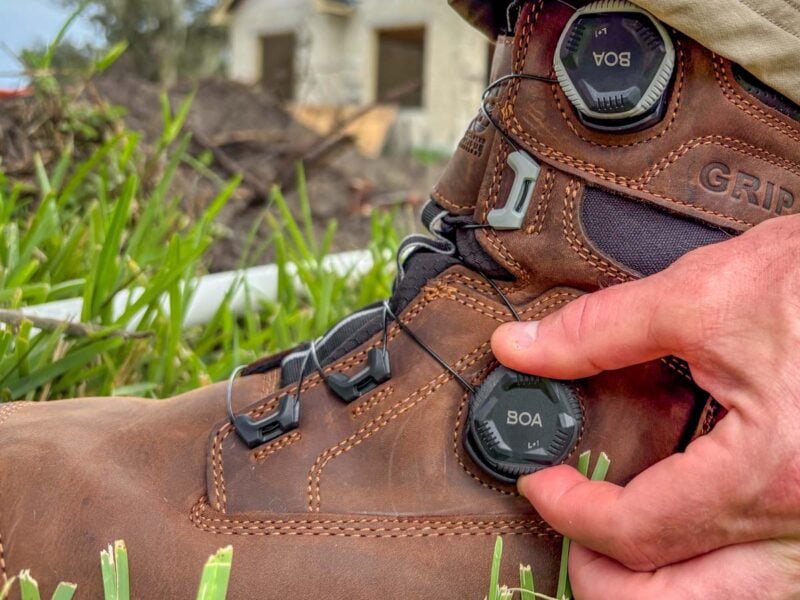
I’m a fan of the BOA Fit System. Not only do my work boots have it, but so do some of the shoes I have for other sports and recreation. The quick on/off of my boots and the ability to micro-adjust the fit quickly throughout the day have made them a winner in my book for years.
But are two better than one?
Yes, and it’s especially noticeable on the 8-inch boot. Pretty much the only time I wear this height is when I’m working on slopes because the extra couple of inches offers better support and stability around my ankle.
Normally, I’d have to tie my laces pretty tight to get the fit I want. As I work, they tend to loosen up as they even out, and I lose the ankle stability I’m looking for. If I plan for that and yank them tight all the way down, my metatarsals start to suffer before long.
A single-dial BOA Fit System helps. The fit is more even from the start, and I can quickly adjust as needed as I go.
However, the dual-dial system is much better. I can dial in the tighter ankle support I want and find a more comfortable setting for my metatarsals. Even though it’s more expensive to have the dual-dial system, if you can afford it, I say go for it.
Additional Review Notes
Here are some additional observations I made while wearing my Boondock Ultralight work boots.
- Fit: True-to-size. I recommend ordering your normal work boot size.
- Break-in: Minimal. The hybrid welt/cement connection style makes these flexible enough to wear to work from day one.
- Traction: Excellent. The lug pattern grips well from any direction, even on slopes.
- Durability: Solid out of the box. It will take time to discover whether the cement portion of the connection comes loose before the boot reaches the end of its useful life.
Should You Buy It?
I’m genuinely impressed by how comfortable Timberland Boondock Ultralight work boots are on my feet. Better still, I think they have a wide appeal for professional tradesmen.
The 8-inch model I reviewed is excellent for both hard and soft surfaces, and I really like its stability on slopes.
However, if heavily sloped ground isn’t a concern for you, I’d go with the 6-inch version and shave a little more weight unless you really like the feel and/or look of an 8-inch boot.
For those of you who climb ladders frequently, I’d steer you towards the models that have a 90° heel instead. At the moment, none of the Ultralight models have that design, so you’ll have to decide if the heel is worth the extra weight.
Finally, if you can afford it, get the BOA Fit System. It’s so much more convenient, and once you get used to making those quick fit adjustments, you’ll be more likely to adjust throughout the day than to tolerate the discomfort of standard laces.
Even if the BOA versions are more than your boot budget allows, the Boondock Ultralight is a solid, comfortable boot on its own.
Like what you see? Put the 8-inch Boondock Ultralight BOA on your feet for $270, or check out other styles that run $190 – $270.