
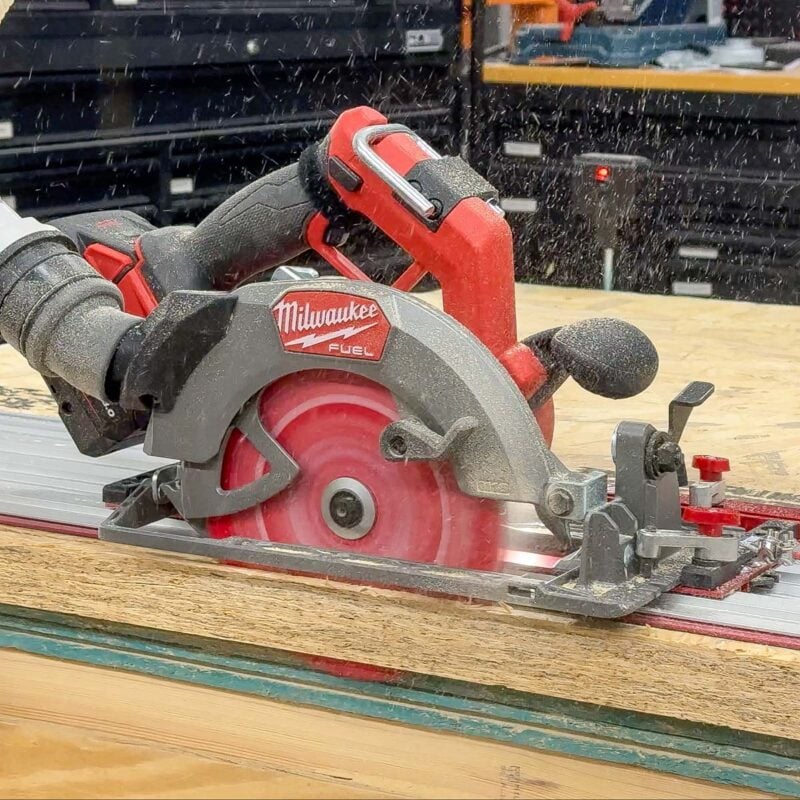
Tom recently put some of the most popular cordless circular saws through a series of tests to determine which ones rise above the rest. As I looked through the data, I noticed there was a pretty wide range of no-load RPM speeds. That made me ask… how much do the RPMs really matter when it comes to cutting performance?
READ
Best Cordless Circular Saw Head-to-Head Review
How RPMs Relate to Cutting Speed
Before we dive into the results, let’s set some context. Obviously, RPMs matter on some level. After all, if the blade isn’t spinning, it can’t cut. To use a rather ridiculous example, if a saw could cut at just 1 RPM, it wouldn’t make much progress.
So, there comes a point where a blade really is spinning at too low of a speed. But then wouldn’t it stand to reason that higher blade speed is always better?
The math seems to say “yes” to that question.
A standard 24-tooth framing blade engages 24 teeth for every turn of the blade. If a circular saw spins the blade at 5000 RPM, the teeth from that blade would cut your material 120,000 times every minute (5000 RPM x 24 teeth).
If we consider a circular saw with a speed of 5800 RPM, the teeth would cut 139,200 times every minute (5800 RPM x 24 teeth). That’s an increase of 16%. Theoretically, if the teeth engage more frequently, the saw should cut faster.
Let’s see what our testing data actually says.
Testing Circular Saw Cutting Speed
The test we’re highlighting is a 7-foot rip cut. The rig Tom engineered allows us to mount each circular saw on the same sled and track, pulled forward by a 10-pound weight.
The material is two stacked sheets of 3/4-inch OSB subfloor. This represents a cut we’ve performed in the field that puts some stress on the motor but is well within the scope of the saw’s design and doesn’t fully bury the blade.
We use a laser-triggered timing system to eliminate human error that comes from pressing buttons on a stopwatch. Incidentally, the way we have to set up the timers is why the cut is only 7 feet instead of the full 8-foot board length.
You can see the full details of the test methods and results in the review.
Here are the results, along with the rated no-load speeds:
| Circular Saw | Fastest Time | No-Load RPM |
|---|---|---|
| Milwaukee 2834 | 9.76 seconds | 6000 RPM |
| Metabo HPT C3607DB | 10.10 seconds | 6000 RPM |
| Flex FX2141 | 13.35 seconds | 5800 RPM |
| Makita GSH01 | 13.53 seconds | 6000 RPM |
| Hilti SC 30WR-22 | 13.75 seconds | 4700 RPM |
| Ryobi PBLCS302 | 14.10 seconds | 5000 RPM |
| Kobalt KXCS 124B-03 | 14.87 seconds | 5500 RPM |
| DeWalt DCS578 | 15.53 seconds | 5800 RPM |
| Skil CR5440B-00 | 16.70 seconds | 5300 RPM |
| Craftsman CMCS551 | 17.67 seconds | 5000 RPM |
| Ridgid R8657 | 18.72 seconds | 5400 RPM |
| Bosch GKS18V-25N | 19.64 seconds | 5000 RPM |
Analysis
Speed + Torque
In general, the higher no-load speeds tended to result in faster cutting speeds. It wasn’t universal, though. Hilti had the slowest no-load speed but came in 5th place out of 12 saws. Kobalt and DeWalt both had high no-load speed, but didn’t cut as fast as other models with similar ratings.
That begs the question… why?
Just like we see with other power tools, such as cordless drills and impact drivers, speed isn’t everything. Torque is the other side of the equation. Torque is what helps the saw maintain blade speed as you put it under heavier loads.
In light, thin materials, it doesn’t take much torque for a saw to maintain high RPMs, so the ones with higher ratings tend to cut the fastest. When the load gets high enough, the RPMs start to drop and that’s where saws with higher torque begin to shine.
The reason a circular saw rated at 5800 RPM can end up cutting slower than one with a lower rated speed is that there isn’t enough torque to keep the blade speed from dropping.
While no-load speed gives us an idea of how a saw can perform, actual blade speed under load is what determines how fast a saw cuts.
The Spec Problem
With drills, impact drivers, and impact wrenches, manufacturers report torque to help you make a more informed decision about your tool purchases. But that’s not the same for circular saws, so it’s hard to tell how well any of them will maintain their no-load speed from the spec sheet alone.
I’m not knocking the manufacturers here. I’m not sure there’s a good method to test the torque of a circular saw in a reliable, repeatable way. Some brands, like DeWalt, have published power ratings in watts. That’s helpful, but since it’s not an industry-wide practice, it doesn’t make for a good comparison.
The Bottom Line
As a professional tradesman, how do you choose if the one performance metric every manufacturer lists doesn’t give you enough information?
First of all, buy into a battery platform based on the entire system, not just a single tool. It’s more important for the system you’re on to provide all of the tools you need than to have the highest performing tool in every category.
Second, buy at the high end of your brand’s offerings. These are the highest-priced circular saws, but they’re also the highest performing. You may still have a few features to sort through, such as a standard shoe vs a rail-compatible one. In general, though, most brands have a flagship model that caters to Pros looking for the best performance.
Finally, and this might be the most important takeaway for today’s Pros, understand that almost every Pro brand’s flagship cordless circular saw now outperforms the top 15-amp corded models. If you’re a DeWalt guy, sure, their saw was slower than Milwaukee in our tests. But you’re still getting very real productivity gains over a corded circular saw.
What has your experience taught you? Let us know in the comments below!