
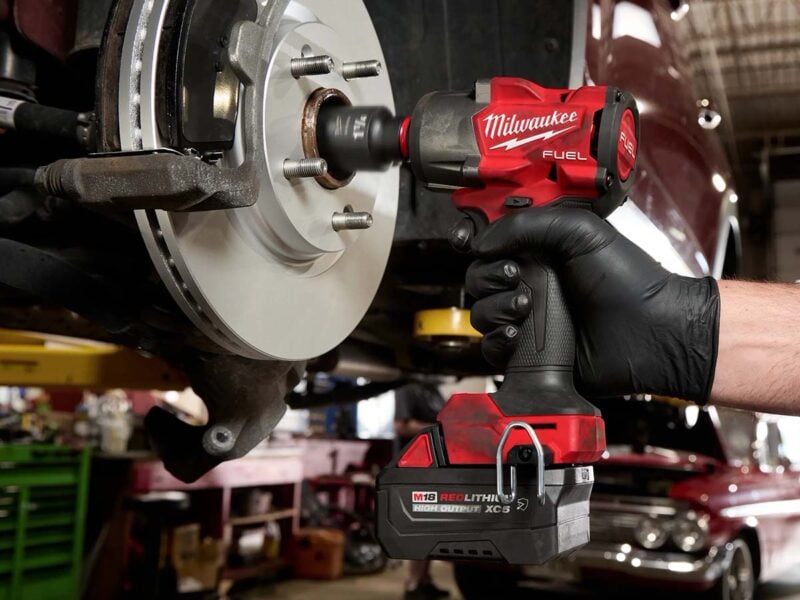
Our crew just returned from SEMA 2026, and I have automotive tools on my mind. One that struck me hard is Milwaukee’s upcoming 3962: an M18 Fuel 1/2-inch impact wrench that’s questioning what it means to be classified as mid-torque and promises to be one of the most disruptive launches we’ve seen in a while. Let’s walk through how it compares to what’s currently on the market and discuss some of the implications.
READ
Best Cordless Impact Wrench Head-to-Head Review
Milwaukee 3962 M18 Fuel 1/2-inch Impact Wrench Basics
Specifications
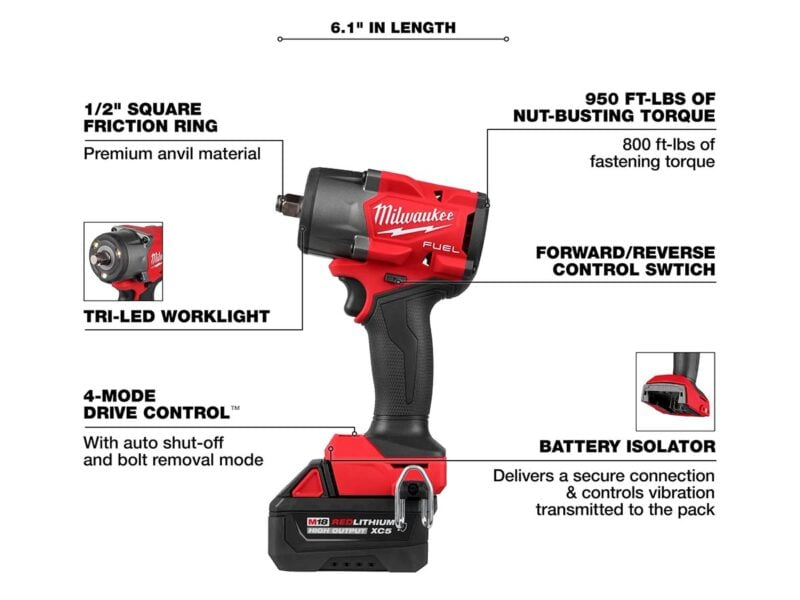
- Motor: PowerState Brushless
- Drive: 1/2-inch square w/ friction ring (also available with a pin detent: model 3962P)
- Speeds: TBA
- Impact Rate: TBA
- Fastening Torque: 800 ft-lbs
- Breakaway Torque: 950 ft-lbs
- Head Length: 6.1 in
- Bare Weight: 4.0 lbs
- Weight w/ 5.0Ah Battery: 5.7 lbs
- Price: TBA
- Warranty: 5 years
Features
- 4-Mode Drive Control: 3 standard speeds plus assist modes for additional control
- Bolt Removal Mode: Breaks loose bolts with maximum power before slowing down for controlled removal
- Auto-Shutoff Mode: Applies a maximum of 50 ft-lbs to prevent overtightening
- Battery Isolation System: Reduces how much vibration reaches the battery and keeps the connection secure
- Tri-LED Lights: Reduce shadows by placing lights around the square drive instead of on the foot
Milwaukee 3962 M18 Fuel 1/2-inch Impact Wrench Discussion
I’m a fairly organized guy, and I like most things in my life to fit into nice, neat categories with solid barriers between them. However, Milwaukee is threatening that balance with its 3962.
From a physical design standpoint, it fits in the mid-torque class, and it’s on the compact side of that group. But 800 ft-lbs of fastening and 950 ft-lbs of breakaway torque aren’t mid-torque specs. This blurs the line between mid-torque size and high-torque strength. Milwaukee’s own 2966 high-torque impact wrench is a key example. It has 900 ft-lbs of fastening and 1100 ft-lbs of breakaway torque, while measuring 7.3 inches long.
Consider how much of a change that is compared to the current 2962 model. That one has 550 ft-lbs of fastening torque and 650 ft-lbs of breakaway torque. That’s more than a 45% increase in breakaway torque!
The closest competitor to Milwaukee’s 3962 is DeWalt’s 20V Max XR DCF891. That model boasts 600 ft-lbs of fastening and 800 ft-lbs of breakaway torque. Makita’s 40V max XGT GWT07 is another contender, but it also falls well short of Milwaukee’s new benchmark. Let’s consider this group of three a little more closely.
Torque
| Milwaukee 3962 | DeWalt DCF891 | Makita GWT07 | |
|---|---|---|---|
| Fastening Torque | 800 ft-lbs | 600 ft-lbs | 560 ft-lbs |
| Breakaway Torque | 950 ft-lbs | 800 ft-lbs | 810 ft-lbs |
As I’m looking at this chart, I’m sitting here shaking my head in near-disbelief. Milwaukee’s power levels are so much higher than DeWalt’s and Makita’s that it’s hardly a fair comparison. Milwaukee has 33% more fastening torque than DeWalt and 43% more than Makita. The gap shrinks when comparing breakaway torque, but it’s still significant, with Milwaukee boasting 19% more torque than DeWalt and 17% more than Makita.
It’s not like Yellow and Teal are JV players; they were the rated breakaway torque leaders in the mid-torque class.
Speed
| Milwaukee 3962 | DeWalt DCF891 | Makita GWT07 | |
|---|---|---|---|
| Max Speed | TBA | 2000 RPM | 2300 RPM |
| Max Impact Rate | TBA | 3250 IPM | 2900 IPM |
At the moment, speed and impact rate are unknown. The 2962 ran up to 2575 RPM and 3100 IPM, but we’ll have to wait and see what the next-gen model is capable of. I reached out to Milwaukee for more information, and I’ll update the numbers if they share them.
This is the one area where DeWalt may still have a chance to retain its crown. In our tests, Makita’s lower impact rate kept it from finishing higher, despite having higher rated torque than most of our test group. So, if Milwaukee’s RPM and IPM are low enough, DeWalt’s higher impact rate may still drive and loosen fasteners more quickly. However, Milwaukee is claiming up to 60% faster removal speeds than the previous model, so DeWalt’s days on the PTR head-to-head throne may be numbered.
Size and Weight
| Milwaukee 3962 | DeWalt DCF891 | Makita GWT07 | |
|---|---|---|---|
| Head Length | 6.1 in | 6.9 in | 6.7 in |
| Bare Weight | 4.0 lbs | 3.8 lbs | 4.4 lbs |
Milwaukee wasn’t content to simply set a new benchmark for mid-torque class power, and the design team wanted to provide greater access than the competition as well. With more than 1/2 an inch advantage in head length over both DeWalt and Makita, the head length will make a difference when you’re reaching around a vehicle or machinery. However, it is about 0.1 inches longer than the M18 Fuel 2962.
The bare weight is also very reasonable considering the torque level. It’s a little heavier than DeWalt and 0.4 pounds lighter than Makita. Compared to the 2962, there’s a slight 0.1-pound weight gain.
Milwaukee is kitting the 3962 with 5.0Ah batteries, so that weight should remain competitive. We’ll most likely run our tests using the 8.0Ah Forge, so we’ll be sure to see which pack balances the weight best.
Full Testing Results Are Coming
We’re expecting the next-gen M18 Fuel 1/2-inch impact wrench to launch in the second quarter of 2027. So, it’s going to be a while before we have one in our hands to run head-to-head against the rest of the class. Although we might have to rename the group “mid-size” instead of “mid-torque” with how high Milwaukee is pushing the performance level.
Here’s the thing: the Milwaukee 3962 isn’t an incremental step forward. It blows away the M18 Fuel 2962 we’ve been using for the past 5 years and makes today’s strongest models look somewhat ordinary.
Of course, that’s based on what we see on the spec sheet, not our own hands-on tests. That said, Milwaukee hasn’t been one to exaggerate its spec data in my experience. From what I can see, I expect the 3962 to completely dominate the cordless mid-torque class, but its performance in our test will prove whether it actually does.
What do you think? Join the conversation in the comments below!