
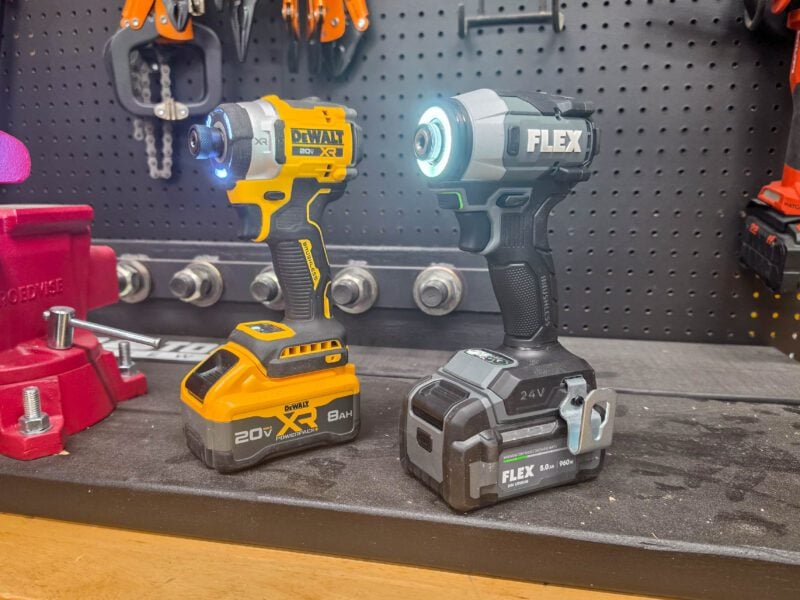
When it comes to high-performance impact drivers, DeWalt and Flex both have compelling options for Pros who need speed, power, and control on the jobsite. The DeWalt DCF860 and Flex FX1372 bring competitive specs and feature sets to the table, making this a worthwhile head-to-head comparison. We put both of these tools through some hands-on testing to see how they handle real-world fastening tasks and whether the numbers on the spec sheet translate into a meaningful difference on the job.
DeWalt vs Flex Impact Driver Specifications
Here’s a quick look at the key specs to know before we jump into testing:
| DeWalt DCF860 | Flex FX1372 | |
|---|---|---|
| No-Load Speed | 1800/2500/3800 RPM | 1500/2000/4100 RPM |
| Max Impact Rate | 4500 IPM | 4550 IPM |
| Max Torque | 2500 in-lbs | 2500 in-lbs |
| Head Length | 4.8 in. | 4.4 in. |
| Bare Weight | 2.7 lbs | 2.4 lbs |
| Tested Weight | 4.6 lbs (with kitted 8.0Ah PowerPack battery) | 4.6 lbs (with 5.0Ah battery) |
On paper, these tools appear to be fairly evenly matched, although Flex does have a slight advantage when it comes to speed. We’ll see if this comes into play when we get into our head-to-head testing results.
DeWalt vs Flex Impact Driver: How We Tested
RSS Screw Speed Test

To kick off our testing, we drove three 8-inch GRK Fasteners RSS screws into our stacked OSB test block and averaged the time it took to sink them fully. This medium-load test falls comfortably within the expected capabilities of these tools, giving us a consistent baseline for comparing their driving speed under realistic conditions.
Bolt Break Test
Now it’s time to kick up the intensity. We tightened eight 1 1/2-inch hardened steel nuts to 150 ft-lbs (1,800 in-lbs) and timed how long each tool took to loosen them. We recorded the total time to remove all eight nuts and calculated the average removal time per nut for a consistent comparison.
Testing Results
| DeWalt DCF860 | Flex FX1372 | |
|---|---|---|
| RSS Screw Average | 7.54 sec | 5.84 sec |
| Bolt Break Average | 2.56 sec per bolt | 1.74 sec per bolt |
As you can see from our results, Flex clearly took the upper hand. It turns out that extra speed really came in handy, allowing the FX1372 to accelerate through our tests with authority.
With that said, the DCF860 is no slouch. It came in 5th place in the RSS Screw test and 6th place in our breakaway test during our last batch of impact driver tests. This put it right in the middle of the pack in terms of performance, behind some of our Pro-grade heavy hitters but far exceeding the more DIY-focused models.
DeWalt vs Flex Impact Driver Key Highlights
DeWalt DCF860

- Brushless Motor
- One-handed bit insertion
- One-handed bit ejection
Work Light Mode
The DeWalt DCF860 features a 20-minute work light mode that lets you use its tri-LED lighting without running the motor. This is handy when you need extra illumination for inspecting your work or navigating dimly lit spaces without holding the trigger.
Speed Modes
The DCF860 sports three speed modes that let you adjust the tool’s RPMs to suit the task at hand. Lower speeds offer more control for delicate fastening, while higher speeds help drive larger fasteners more quickly.
Flex FX1372
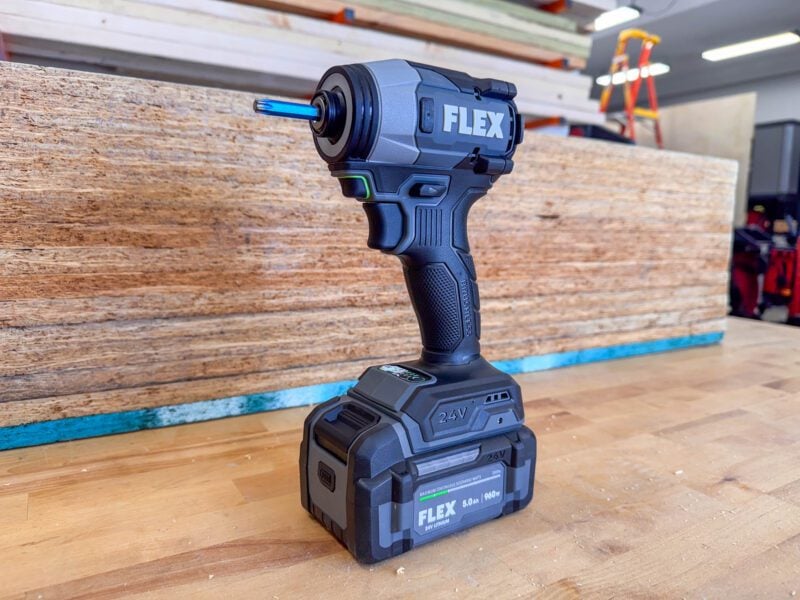
- Brushless Motor
- Diffused LED light ring with 5 brightness settings
- Excellent ergonomics
- External bit holder
Speed Modes
The Flex FX1372 offers three standard speed modes to match output to the task, plus two dedicated self-tapping modes designed to help drive self-tapping screws with better control and reduce the risk of stripping or damaging fasteners.
One-Touch Bit Ejection
The Flex FX1372’s One-Touch Bit Ejection system lets you release a bit with the push of a button, eliminating the need to manually pull it from the collet. It’s a convenient feature that speeds up bit changes and makes one-handed operation easier.
Pricing and Final Thoughts
| DeWalt DCF860 | Flex FX1372 | |
|---|---|---|
| Bare Tool | $219 | N/A |
| Kit | $269 with 4.0Ah PowerPack battery | $299 with two 5.0Ah batteries |
| Kit #2 | $319 with 8.0Ah PowerPack battery | N/A |
| Warranty | 3-year | 3-year (standard) 5-year (w/registration) |
After spending time with both tools, both prove they bring the performance and features we expect from a Pro-level option. But when it comes down to choosing a winner in this head-to-head comparison, it’s clear that Flex comes out on top.
The FX1372 is lighter, more compact, and delivered better results across the board during our tests. Its competitive kit configuration also makes it an appealing option for Pros looking to get the most performance for their money. We’d still like to see Flex offer it with a 24V Stacked Lithium battery in the future, perhaps even in a combo kit with the FX1272 hammer drill. Even so, at $299, the FX1372 is a strong high-performance option.