
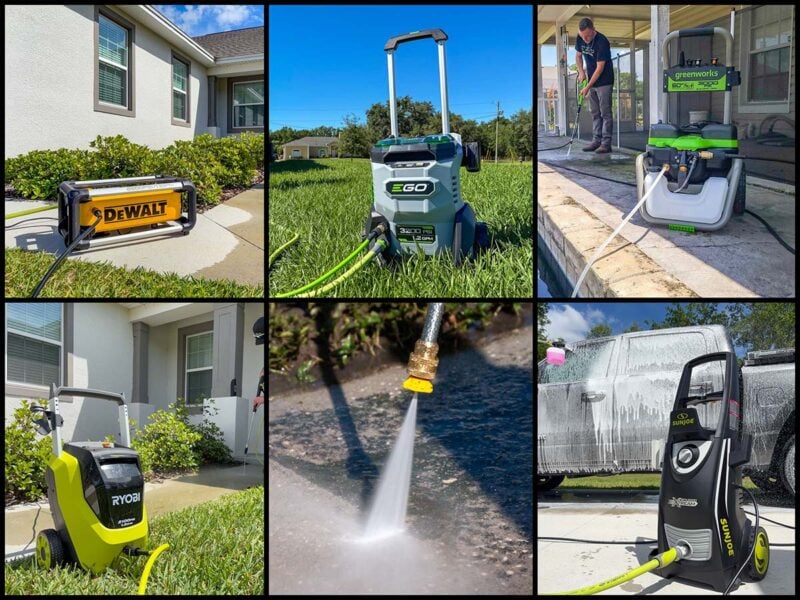
Today’s best electric pressure washers have come a long way. Some have the power to legitimately compete with gas, while cordless options are becoming more viable than ever. Just in time for the spring cleaning season, I’m sharing the electric models that stood out from the crowd in our testing, and the most important things to consider while you’re shopping.
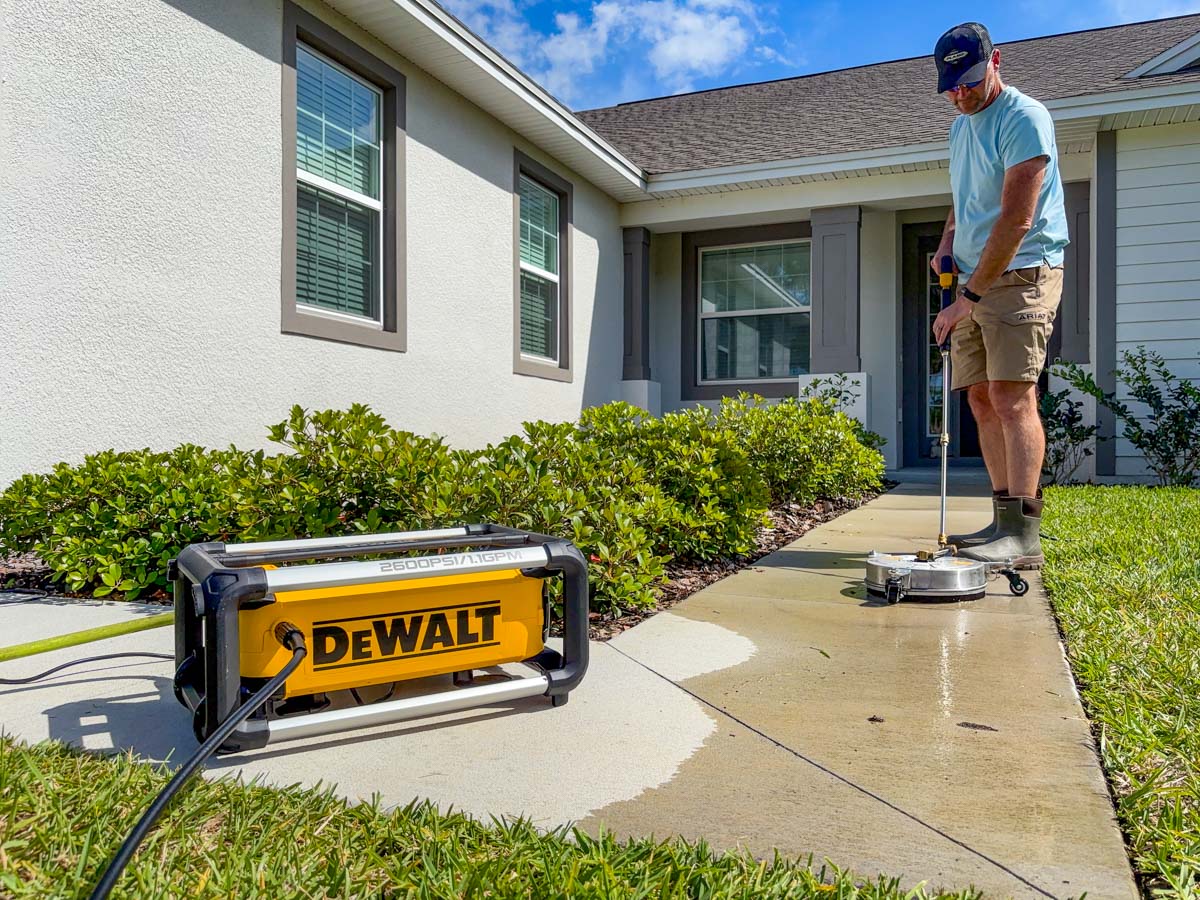
Best Corded Electric Pressure Washer: DeWalt DWPW2600
- Motor: 13A
- Pump: Axial cam
- Maximum Pressure: 2600 PSI
- Flow Rate at Max PSI: 1.1 GPM
- Certification: CETA
- Price: $399
- Warranty: 3 years
Highlighted Features
- Space-Saving Design: Roll cage design is easier to store, transport, and stack multiple units
- Inline GFCI: Built-in protection for use with any standard outlet
- Internal Storage: All accessories store neatly on board
- On-wand Nozzle Storage: Keeps nozzles close at hand for quicker swaps
- Included Foam Cannon: Easily foam and disperse detergents
- Nozzles: 15°, 25°, 40°, Turbo
Pros
- Stackable design is easy to store and transport
- Excellent onboard accessory storage design
- Light enough to carry
- CETA-certified performance
- Also available as 2100 PSI and 3000 PSI models
Cons
- Small wheels don’t roll on grass or bare ground well
- Expensive
DeWalt shook things up a few years ago with a compact roll cage frame form factor. There’s some give-and-take in the design, but overall, it’s my favorite among the electric pressure washers we’ve reviewed.
You can actually choose from three different performance levels. The 2100 PSI was the OG, and the line has since expanded with 2600 PSI and 3000 PSI models. Of the three, I prefer the 2600 PSI. The performance is noticeably higher than the 2100 PSI, and paired well with a 13-inch surface cleaner as I was cleaning sidewalks.
At the same time, its size and weight are still manageable. That’s important considering the small wheels don’t handle bare ground and grass all that well. Jumping up to the 3000 PSI model brings higher cleaning power, but it also bulks up in size quite a bit, and I find the 2600 PSI to strike a better balance.
When the job is done, all the accessories store neatly inside the unit’s housing. There’s a cord wrap on the back, and the hose tucks inside the roll cage on the front. It’s easily the best storage system I’ve used, and the cubical design makes storage and transport easier than traditional designs.
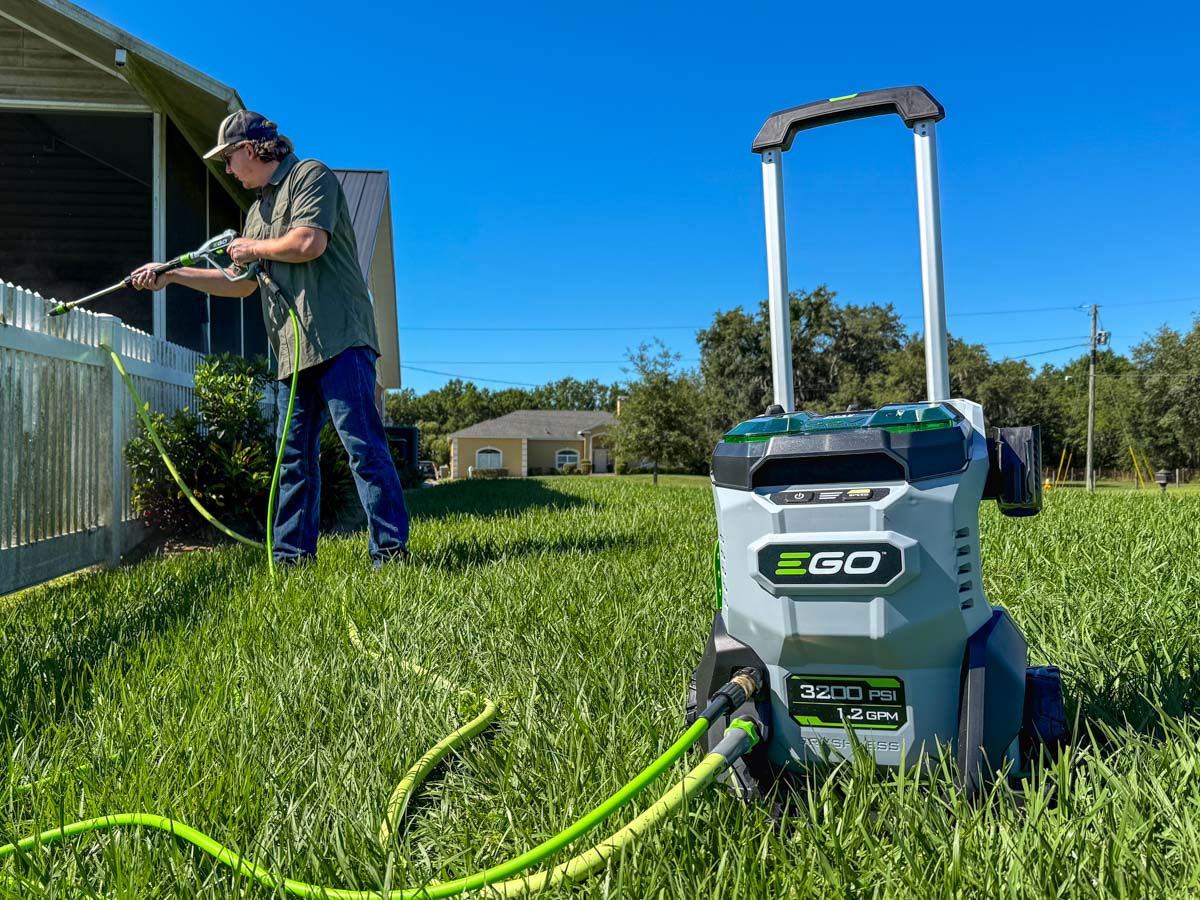
Best Cordless Electric Pressure Washer: EGO HPW3200
- Motor: 56V brushless
- Pump: Axial cam
- Maximum Pressure: 3200 PSI
- Flow Rate at Max PSI: 1.2 GPM
- Certification: None
- Price: $499 bare, $779 kit
- Warranty: 5 years
Highlighted Features
- Cordless Operation: No need to find an outlet or bring along a generator
- 3 Pressure Settings: Adjust wand-mounted settings to balance performance and runtime
- Siphon-friendly Pump: Pull water from a bucket or other freshwater source when pressurized water isn’t available
- Included Foam Cannon: Easily foam and disperse detergents
- Nozzles: 15°, 25°, 40°, Turbo, Rinse
Pros
- Higher performance than other 120V and cordless pressure washers
- Batteries are compatible with all EGO 56V lawn care and lifestyle products
- Longer warranty than most
Cons
- Expensive
- Limited runtime
- Smaller wheels
- Performance hasn’t been certified by CETA or PWMA (yet)
If the best performance available in an electric pressure washer, your best bet is to cut the cord completely and pull the trigger on EGO’s 3200 PSI/1.2 GPM model. Full disclosure: you can go even bigger, but you have to lean on super-expensive 240V units. Those aren’t usually on the radar of most homeowners, though.
There are a few things you need to know before you buy. For one, the performance is dependent on your battery selection. You need to run two batteries to access Turbo mode, and the higher the capacity, the better. I see EGO’s kitted 6.0Ah batteries as a solid starting point, but plan to step up to higher capacity for bigger jobs.
You can manage your runtime with three power levels that you adjust right on the wand. In ECO mode, you can run up to an hour using two 6.0Ah batteries. That’s fine for light-duty cleaning, but High and Turbo modes are where you should plan to do most of your work. As we used it, we found that the Turbo nozzle is your best friend. You can use it to clean effectively in High (~2000 PSI), then only kick it up to Turbo when you hit stubborn build-up.
There’s more than enough cleaning power to use a surface cleaner, but you’ll need to pick your battles. Turbo mode is easily the most effective, and high-capacity batteries are the way to go. Still, it’s tough to get enough runtime for a standard 4-car driveway, even with 12Ah batteries. If you’re willing to go slower and use a smaller surface cleaner, High will net you more runtime. So, while you can do it, the infinite runtime of a corded model is a more effective option if concrete cleaning is your primary goal.
The bigger hesitation for most folks may be the price tag. Not everyone has the budget to afford this level of performance and technology. EGO sweetens the value a bit by including a siphon hose and foam cannon, though.
Best Hybrid Electric Pressure Washer: Greenworks PW3000HYB

- Motor: 60V brushless
- Pump: Axial cam
- Maximum Pressure: 3000 PSI
- Flow Rate at Max PSI: 1.1 GPM
- Certification: PWMA
- Price: $679 kit
- Warranty: 4 years (10 years on the motor)
Highlighted Features
- Hybrid Power: Use 120V AC or Greenworks 60V batteries for power
- TrueBrushless Motor: Intelligently adapts to optimize performance based on the tip you use
- ECO Mode: Extends runtime by running at 2200 PSI
- Siphon-friendly Pump: Pull water from a bucket or other freshwater source when pressurized water isn’t available
- Inline GFCI: Built-in protection for use with any standard outlet
- Nozzles: 15°, 25°, 40°, Turbo, Soap
Pros
- Top-tier performance
- Rolls easily on grass and soft ground
- PWMA-certified performance
- Longer warranty than most
- Batteries work with all Greenworks 60V tools and lifestyle products
- Also available for the 80V battery system
Cons
- Expensive
- Limited runtime when using batteries
- Takes ~ 1 second to fully ramp up
If you want the best of both worlds, Greenworks’ 60V hybrid electric pressure washer is the way to go. Capable of using either 60V batteries or corded AC for power, you can choose between cordless convenience and unlimited runtime.
With 1.1 GPM at 3000 PSI, it shares the performance lead among 120V corded models and has an ECO mode that steps down to 2200 PSI when you want to conserve battery power. You can also use a siphon hose if there’s no pressurized water source available.
The hybrid design isn’t just hype—it really does make a difference. You can run corded when on bigger jobs, like concrete cleaning. Plus, 3000 PSI is a very effective power level to pair with a surface cleaner. For smaller jobs like hitting the soffit, washing your truck, or cleaning your grill, enjoy the convenience of cordless operation.
There aren’t any surprises in the design. Greenworks maintains an open-frame style with this one, so it’s very familiar if you’re already used to electric pressure washers.
Price is the biggest concern for most shoppers. At $679 for the kit, this model has a premium price tag to go with its premium technology and performance. However, it does have a lengthy warranty to back it up.
More Electric Pressure Washers We’ve Tested and Recommend
Greenworks Industrial 2500 PSI Electric Pressure Washer GPW2500C
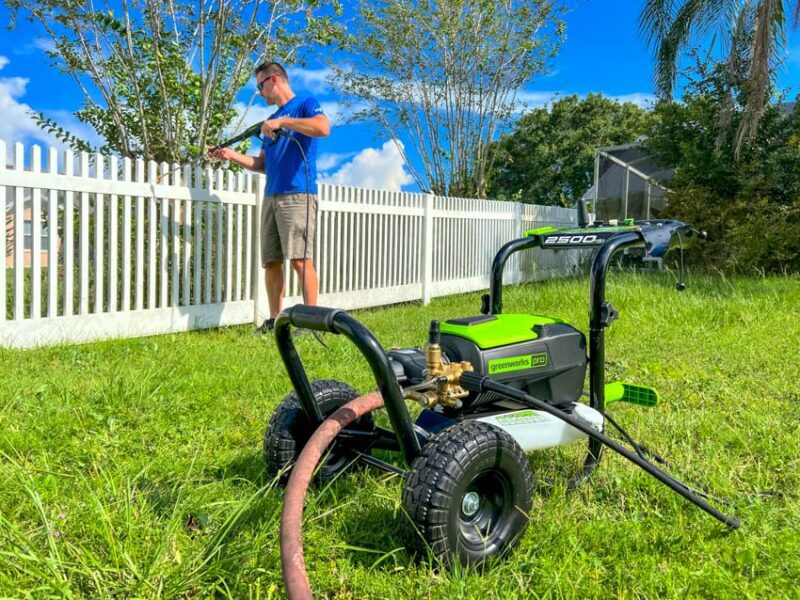
- Motor: 14A brushless
- Pump: Triplex
- Maximum Pressure: 2500 PSI
- Flow Rate at Max PSI: 1.2 GPM
- Certification: PWMA
- Price: $699.99
- Warranty: 3 years
Highlighted Features
- 1-gallon Detergent Tank: Holds an entire bottle of your favorite detergent
- Triplex Pump: Built for the long hours of professional use
- Inline GFCI: Built-in protection for use with any standard outlet
- All-terrain Wheels: Rolls over any ground type more easily than most pressure washers
- Vertical Storage: Flip the unit up to reduce the storage footprint
- Nozzles: 15°, 25°, 40°, Turbo, Soap
Pros
- High Performance
- Legit Pro-quality build
- Easily rolls over all ground surfaces
Cons
- Expensive
Greenworks’ GPW2500C is the only true Pro-grade electric pressure washer to make the list. Part of the appeal is the high 2500 PSI performance level paired with a triplex pump that can stand up to the longer hours commercial crews put on their machines.
Wrapping around that is a frame design that feels very familiar if you’re used to gas models. The robust tubing, stable frame orientation, and wide wheels are reminiscent of our favorite gas pressure washers.
After using it for a while, I can recommend it for light to medium-duty cleaning. Obviously, it’s not going to keep up with gas models running higher PSI and GPM levels. However, you can run this where you can’t run gas models. Think industrial settings, hangars, and shops. Plus, it’s a solid option if you provide pressure washing services where small gas engines are restricted.
The power level is high enough to run a small surface cleaner, and with a generous 1-gallon detergent tank, it’s an excellent choice for soft washing.
Ryobi 2100 PSI Electric Pressure Washer RY142012
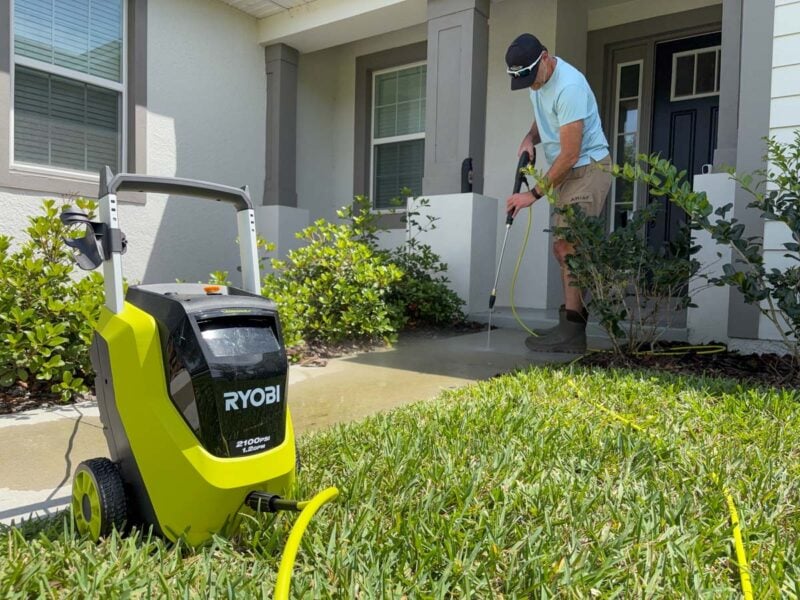
- Motor: 13A
- Pump: Axial cam
- Maximum Pressure: 2100 PSI
- Flow Rate at Max PSI: 1.2 GPM
- Certification: PWMA
- Price: $199
- Warranty: 3 years
Highlighted Features
- Space-Saving Design: compact design takes up less room than traditional models
- Inline GFCI: Built-in protection for use with any standard outlet
- Included Foam Cannon: Easily foam and disperse detergents
- Nozzles: 15°, Turbo
Pros
- Compact profile
- Light enough to easily carry
- Sleek accessory storage design
- PWMA-certified performance
Cons
- Smaller wheels
- Only two nozzles included
The 2100 PSI electric pressure washer class is the sweet spot for homeowners looking to balance cleaning power and price. If that’s appealing to you, Ryobi’s RY142012 is the one you should pick up.
Launched in late 2025, it takes the performance Ryobi has had for several generations and slims it down into a more user-friendly package. Overall, it’s impressively compact that takes up less room than traditional designs.
But what I was really happy with was the weight. At around 27 pounds, it was noticeably lighter than other models I carried around to various testing spots. While the wheels are small enough that it wasn’t easy to roll in my thick St. Augustine grass, carrying it didn’t seem like much of a burden.
Even though it’s not as powerful as more expensive models, you can still get quality work done. Pairing this model with Ryobi’s 12-inch surface cleaner makes concrete jobs much faster, and the turbo nozzle maximizes the available power for cleaning other materials like fencing and siding.
Note that this model only comes with 15° and turbo nozzles. If you find you really need the 0°, 25°, or 40°, you can always pick those up separately.
Sun Joe SPX3000 XTREAM Electric Pressure Washer
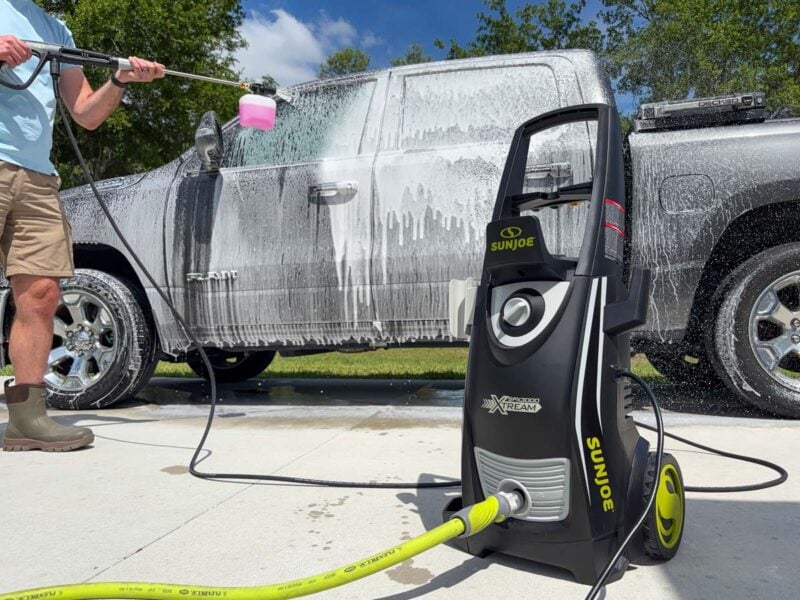
- Motor: 14.9A
- Pump: Axial cam
- Maximum Pressure: 2200 PSI
- Flow Rate at Max PSI: 1.1 GPM
- Certification: PWMA
- Price: $239
- Warranty: 3 years
Highlighted Features
- Inline GFCI: Built-in protection for use with any standard outlet
- Included Foam Cannon: Easily foam and disperse detergents
- Nozzles: 0°, 15°, 25°, 40°
Pros
- Light enough to carry
- Minimal floorspace required for storage
Cons
- Smaller wheels
- Hose is shorter than most
Now that SunJoe is rating their pressure washers based on PWMA standards, it’s much easier to compare them to other brands and have a good understanding of the kind of work they’re capable of. I got my hands on their top performer: the SPX3000 XTREAM to see how it stands up to other popular models.
It bumps the power up a notch from the 2100 PSI class, and I found that it’s a little more confident with a surface cleaner or turbo nozzle because of it. You’ll have to pick up a turbo nozzle separately since this model doesn’t include one.
One of the really nice things about the design is that it’s packed into a taller package with a relatively small base. While it needs more headroom than something like Ryobi’s compact design, that amount of floorspace it takes up is smaller. If you live in a townhouse or are otherwise limited on storage space, it can make a difference.
The wheels are on the small side, but not as small as some of the ones we’ve used. They roll over grass okay, but it’s light enough for most people to pick up if you have to tread across loose sand.
One thing I noticed was the shorter hose. At 20 feet, you only lose 5 feet compared to most, but it meant I had to reposition more often as I worked around my truck and sidewalk.
What to Look for When Buying an Electric Pressure Washer
Certified Performance (Watch Out for PSI Max*)
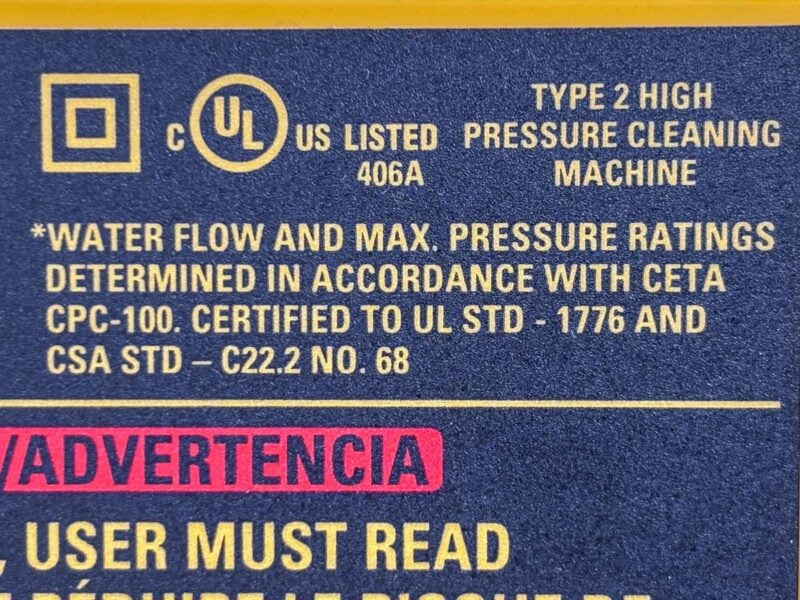
I’m not a fan of playing marketing games that make people think they’re getting something better than they really are. That’s why I really don’t like it when brands market PSI Max* and GPM Max*. Measured inside the machine, you’ll never experience these performance levels at the nozzle, but it lets some brands put a higher PSI and GPM number on their pressure washers.
Instead, look for PWMA or CETA certifications. These are organizations that set specific testing and reporting standards that guarantee we as consumers aren’t being duped.
Not every non-certified brand is guilty, though. One example is EGO. Even though their pressure washers aren’t certified (yet), they have a proven track record of delivering and often exceeding their claims.
DeWalt and Craftsman can be a little confusing. They use the term “PSI Max” in their specifications, but it’s not the same one some brands use that can deceive consumers. They’re specifically referring to the maximum PSI at the nozzle using a 15° nozzle as its reference point. Additionally, they’re both CETA-certified for their pressure washers.
READ
What is PSI Max on a Pressure Washer?
Pressure Washer PSI That’s Too Good to Be True? It Probably Is!
Corded vs Cordless vs Hybrid
While electric pressure washers only came in corded versions for decades, now there are cordless and hybrid models available as well. Here’s a quick breakdown of the pros and cons of each:
Corded Electric Pressure Washers
Pros
- Unlimited runtime
- High performance potential
- Low maintenance
- Lower cost
Cons
- You’re tethered to a cord and two hoses
- You need a pressurized water source
Cordless Electric Pressure Washers
Pros
- Often has multiple modes to manage runtime
- Highest performance potential
- Low maintenance
- No need to find a power outlet
- Often can use a siphon hose
- Batteries are compatible with other lawn care products
Cons
- Limited runtime
- Higher cost
Hybrid Electric Pressure Washers
Pros
- Choose cordless freedom or unlimited runtime
- Often has multiple modes to manage runtime
- Highest performance potential
- Low maintenance
- No need to find a power outlet
- Often can use a siphon hose
- Batteries are compatible with other lawn care products
Cons
- Higher cost
Brushed vs Brushless Motors
The top-performing electric pressure washers all have brushless motors. This design offers higher performance, longer service life, and, in the case of cordless models, longer runtime. It’s not a small boost, either. These are massive benefits over brushed motors.
However, brushed motors are a great choice if your performance needs are more mid-range and you want to save some money. You can expect years of reliable service with very low maintenance requirements.
Axial Cam vs Triplex Pumps
Most electric pressure washers come with axial cam pumps, and there’s nothing wrong with that. Like brushed motors, they’ll give you years of service in most cases.
Triplex pumps are designed for the higher hours professional cleaners and commercial settings require. It’s a nice-to-have feature for anyone, but they typically only come with commercial-grade models with much higher price tags than residential models.
PSI vs GPM
Is PSI or GPM more important? PSI is the power that gets gunk moving, and GPM is the flow that carries it away. For most homeowners, focusing on the PSI you need is the first priority. Having a low GPM can make you slow down a little, but having too little PSI will make your work much slower. In some cases, it can even stop your progress if there’s not enough pressure to remove what you need to.
It can be tough to figure out which option among several pressure washers gives you the best cleaning power. There’s a relatively simple formula to compare them—just multiply the PSI by the GPM. Here are a few examples:
| Model | PSI | GPM | Cleaning Power |
|---|---|---|---|
| Model A | 2000 | 1.2 | 2400 |
| Model B | 2200 | 1.2 | 3640 |
| Model C | 2300 | 1.1 | 2530 |
Learn More
Pressure Washer PSI vs GPM
Pressure Washer vs Power Cleaner
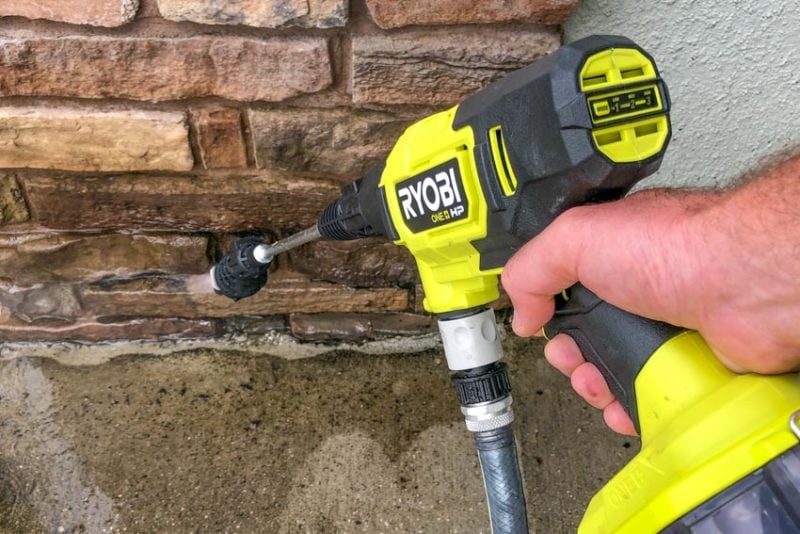
There’s a relatively new class of cleaning tools called power cleaners on the market, such as the Worx Hydroshot and Ryobi EZclean. These are incredibly convenient for cleaning a variety of things, especially considering you can connect a hose directly to them or use a siphon hose and a bucket of water.
The big difference between a pressure washer and a power cleaner is that pressure washers have much higher pressure. A power cleaner is fully contained in a tool not much larger than a pressure washer wand. Consequently, the components have to be smaller.
While pressure washers usually start at around 1500 PSI and go up from there, most power cleaners are 300–600 PSI. On the other hand, a power cleaner’s flow rate can be similar to that of an electric pressure washer.
Wheels
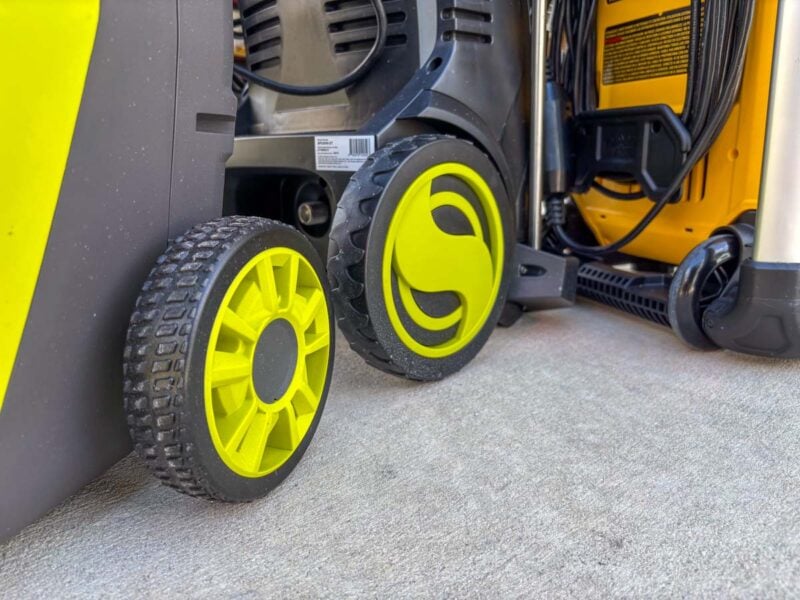
Most people tend to ignore the wheels on a pressure washer but give them a quick look while you’re shopping. Large-diameter or wide wheels roll much more easily over grass or bare ground. Pneumatic tires are also better for going over bumpy, rocky terrain.
If a pressure washer has small wheels, it’s not a deal-breaker. Many are light enough to easily carry if you need to. Others may have enough value in the performance or price to put up with some minor inconvenience.
Why You Can Trust Pro Tool Reviews
Ever check out a “review” site and you can’t tell if they actually tested the product or if they’re just “recommending” the Amazon top sellers? That’s not us. We won’t recommend anything unless we’d use it ourselves, and we don’t care who the primary retailer is. It’s all about giving you a legitimate recommendation and our honest opinion of each product.
Since 2008, Pro Tool Reviews has provided in-depth tool reviews, buying guides, how-to articles, and industry news in the construction and lawn care industries. We focus on professionals in the trades, and our writers have the skills and experience to know whether a tool or accessory will hold up on the jobsite.
Each year, we bring in and review more than 250 individual products. Additionally, our team will put their hands on hundreds more tools at media events and trade shows throughout the year. If I recommend a pressure washer, that means I’d use it myself (and perhaps I or one of our staff already does!)


Any reason the greenworks pro 60 volt industrial 3100 psi pressure washer with the tri plex pump and a 20 amp power draw(15amp adaptor include) hasnt been mentioned anywhere. I cant find a single article on it anywhere on the web. Its the 2500 psi’s big brother but with 20amps. I have it and its got ungodly power !
I think it’s just that Greenworks makes so many different pressure washers, we aren’t able to review them all. Glad you like that one!
Thanks for putting that on our radar! Do you know what the model number is on that one? I’d love to get more details on it and see if we can get it in for review.
Scratch that—I just found it at Lowe’s. It looks like this one hasn’t been released yet. We’re going to be at an event with them later this year, so maybe we’ll get to demo it there.
they released it about a year or 2 ago then took it off the shelves after about 5 months. Mine is still running great, with over 3000 psi reading on my manometer at the wand and at the pump with the included tips being the best ive seen even beating a 2.0 orifice tip. so maybe its a 1.5 orifice they chose. mine is wall mounted with a retractable 100 foot 1/4 or 3/8 inch hose, both perform the same, but the 3.8 doesnt quite fit on the reel. Im so baffled as to why they 86’d it, its a beast! i had the 3000psi axial model and there not the same!
Sounds like an excellent setup for that pressure washer, and a lot more capable than most of the consumer-oriented wall-mount options.