
Over the last few years, we’ve seen an interesting trend developing in the cordless tool market. Rather than simply pushing to new performance highs, some brands are refocusing on reducing size and weight while still maintaining relevant performance to meet Pro demands. Enter Ridgid’s latest offering, the 18V Nuke SubCompact Impact Driver (RNKSID02)—a compact contender that’s looking to make its mark.
Today, I’ll share what I learned from putting it to the test here in our shop so you can see how it compares to past models and decide if it’s a worthy upgrade.
Pros
- Improved speed and power
- Excellent ergonomics
- Auto-eject collet
- Four speed modes
- Compact profile
- Lightweight design
Cons
- No significant drawbacks
Ridgid Nuke SubCompact Impact Driver Performance
Speed and Power
The RNKSID02 is powered by a brushless motor, producing up to 2,000 in-lbs of fastening torque, with a top speed of 3,800 RPM, and an impact rate of 5,000 IPM. The speed and impact rate put it in contention with modern flagship impact drivers, but the torque specs still lag behind the top of the field a little. Still, it wasn’t that long ago that 2,000 in-lbs was the best on the market, and there are still some flagship models hovering around that mark.
READ
How Much Torque Do You Need on an Impact Driver
I’ve Changed My Mind About High-Torque Impact Drivers
With that said, the RNKSID02 delivers a meaningful jump in performance when compared to the previous SubCompact model (R872311). Here’s a quick look at the key specs:
| Ridgid Nuke RNKSID02 New Model | Ridgid R872311 Previous Model | Ridgid R862312 Flagship Model | |
|---|---|---|---|
| Impact Rate | 5,000 IPM | 4,200 IPM | 4,300 IPM |
| Max Torque | 2,000 in-lbs. | 1,850 in-lbs. | 2,400 in-lbs. |
| No-Load Speed | 3,800 RPM | 2,900 RPM | 3,400 RPM |
| Number of Drive Modes | 4 | 4 | 4 |
| Weight (with 2.0Ah battery) | 2.9 lbs. | 2.60 lbs. | 3.4 lbs. |
Just like the previous model, this impact driver features three main speed modes and a self-tapping screw assist mode. This specialty mode is designed to reduce the risks of overdriving or stripping self-tapping screws. It’s become an increasingly common feature on flagship models, and one that’s genuinely useful if your work involves HVAC, metal framing, or electrical work.
Hands-On Impressions
Looking at the data, it’s clear that Ridgid isn’t attempting to displace their flagship model. Rather, the RNKSID02 lands in a nice middle ground for light to medium-duty applications. With that in mind, I was eager to see how it performed in some of our standard impact driver testing.
To put the RNKSID02 to the test, I set up two of our controlled tests to compare it with testing data from the previous model.
RSS Screw Test
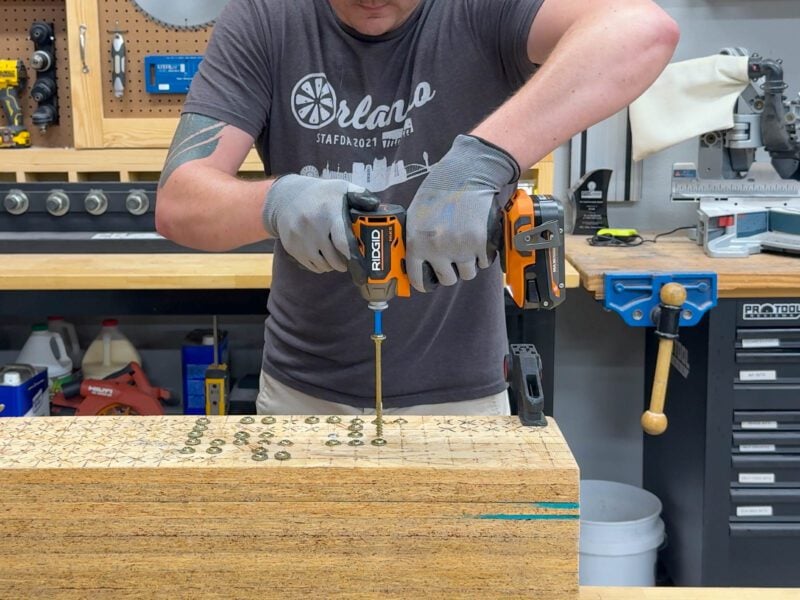
Our first fastening test targets the medium-duty category. For this test, we drive three 3/8-inch x 8-inch GRK Rugged Structural Screws (RSS) flush into stacked and glued OSB subflooring. To keep the test consistent, we drill a 2-inch-deep pilot hole before each run to ensure every fastener starts straight, then average the completion times across all three drives.
While this isn’t the most demanding fastening application in our lineup, it’s a significant step up from driving common deck screws. More importantly, it’s an excellent indicator of real-world performance because it highlights more than just the top speed. To perform well here, impact drivers need to deliver a solid balance of speed, torque, and impact rate to maintain fast, consistent driving without bogging down.
Here, Ridgid sank the screws in 14.51 seconds on average. That’s not too shabby for a compact model, but it does pale significantly when compared to Ridgid’s flagship R862312’s average time of 6.83 seconds.
Again, it’s worth noting that Ridgid isn’t targeting top-tier performance; rather, they’re focusing on light weight and a smaller profile. So for us, 14.51 seconds is more than satisfactory for this test, especially since it completed it without really straining. More importantly, it shows that there is a big difference in performance between these two classes for Ridgid.
Bolt Break Test
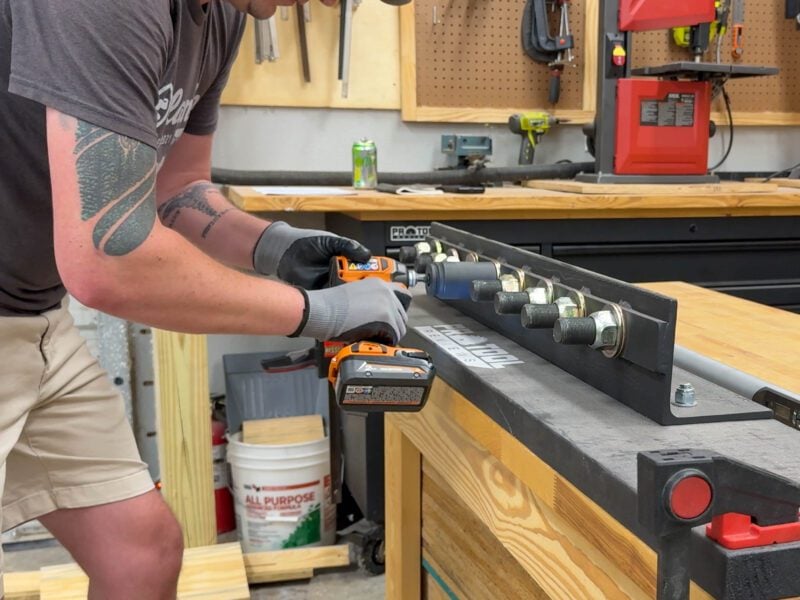
Our second test shifts from driving fasteners to breaking them loose. Using our dedicated test rig, we torque eight 1 1/4-inch lug nuts onto matching 1 1/8-inch semi-truck studs to 150 ft-lbs (1,800 in-lbs) with a digital torque wrench. We then use the impact driver to loosen all eight nuts, record the total time, and average the results.
While these are the same heavy-duty lug nuts we use in our impact wrench testing, we’ve intentionally reduced the torque to better suit the capabilities of impact drivers. At 1,800 in-lbs, every model we test should be able to complete this task (we won’t test impact drivers rated at less than 1,800 in-lbs on this rig). This test highlights how effectively each impact driver delivers its available power under a consistent heavy-load application, giving us a better picture of its real-world power.
In this case, Ridgid had a total time of 1 minute and 18.6 seconds; an average of 9.8 seconds per bolt. Once again, this is noticeably slower than what we saw from Ridgid’s flagship impact driver at 1.9 seconds. But you know what? That’s OKAY! I wanted to answer the question “can it do it?”, and we saw that the answer is yes.
So what does this mean for real-world use, especially since lug nuts aren’t exactly a normal application for impact drivers?
It’s certainly capable when it comes to metal-to-metal fastening. Keep in mind, though, that when you’re working on hard-stop fasteners, once you get into the 1800 in-lbs torque range, you start snapping adapters and nut driver bits more readily. If you do a lot of metal fastening and prefer to work in the fastest mode, you may find the Nuke helps you reduce broken bits compared to the flagship model.
Ridgid Nuke SubCompact Impact Driver Design Notes
Size and Ergonomics
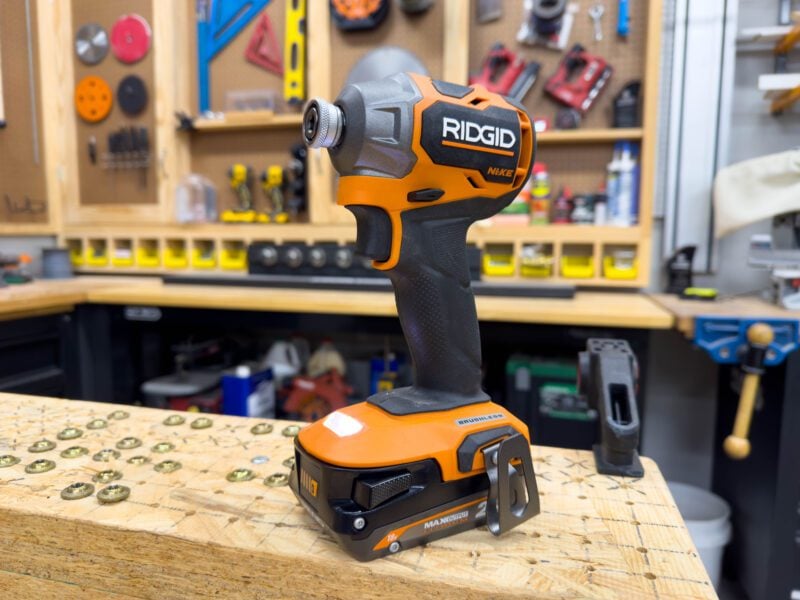
The Ridgid RNKSID02 weighs an even 2 pounds as a bare tool, and 2.9 pounds with the recommended 2.0Ah battery. The head measures 4.5 inches from tip to tail, which is a slight improvement over the previous model, which measured 4.75 inches. This smaller profile is ideal for working in tight spaces, and the lightweight design helps take some weight off your arms.
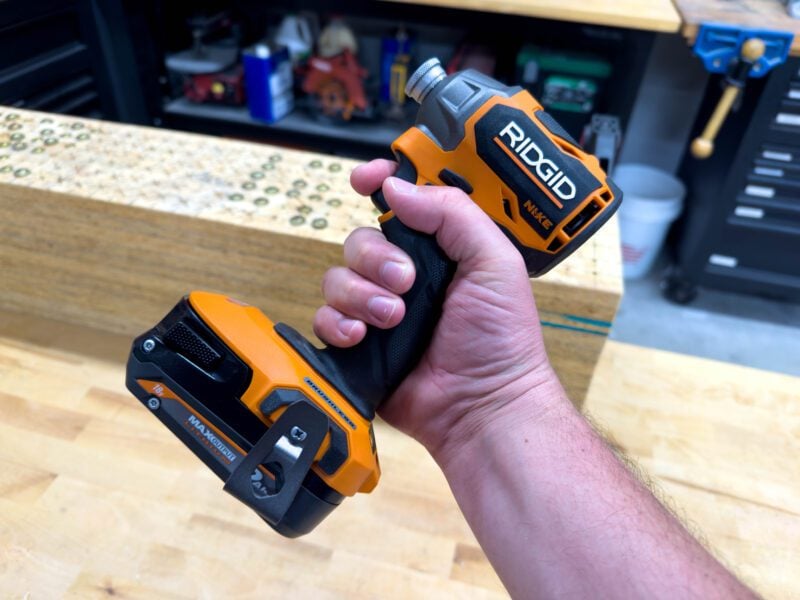
The grip features generous rubber overmolding that feels very comfortable in my medium-sized hands. The overall balance feels centered once paired with the battery, making it easy to maneuver as you work.
Controls
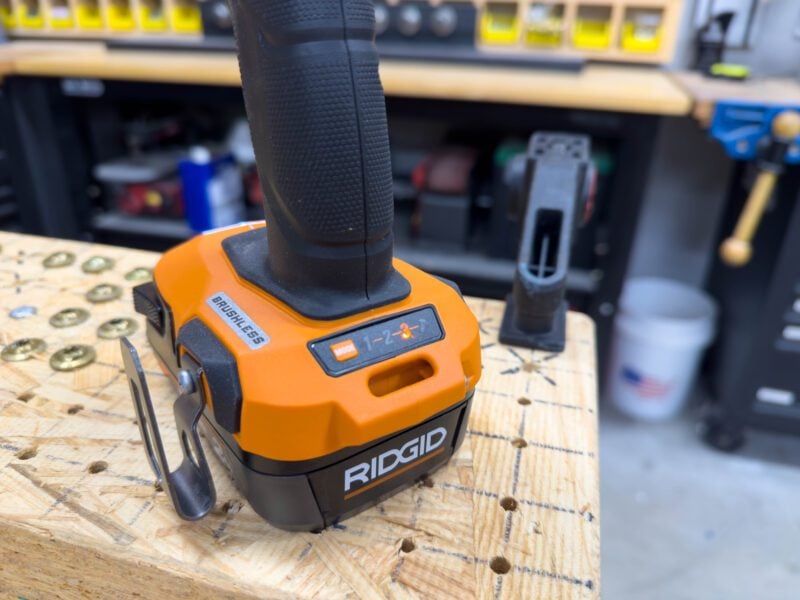
Ridgid didn’t stray too far from the norm with their control panel. It sits right at the base of the grip on the back of the foot, making it easy to see as you work. Most brands put it on the front of the foot, but we’ve seen a couple shift controls to the rear, and it’s genuinely helpful on impact tools.
Additional Features
- LED light: Illuminates bits and fasteners without creating excessive shadows.
- Auto-Eject Collet: Quickly remove hot bits with a single touch
Should You Buy It?
The RNKSID02 doesn’t pretend to be the most powerful impact driver in Ridgid’s 18V lineup, and that’s exactly what makes it so appealing. Instead of chasing flagship performance, Ridgid focused on building a compact, lightweight tool that’s comfortable enough for all-day use. On top of that, it still delivers plenty of muscle for the majority of your common fastening applications.
When we put this impact driver to the test, our results confirmed this approach. The RNKSID02 delivered consistent performance and feels like it’s punching above most competitors in the compact class, and never felt underpowered for the kind of work it’s designed to handle.
With that in mind, this is a solid fit for HVAC Pros, electricians, and serious weekend warriors who are willing to drop to mid-range performance in order to gain a lighter, more compact profile.
On the other hand, if you’re regularly working with larger fasteners, especially structural screws, or the highest performance is your highest priority, step up to the flagship R862312 model.
As of now, the only way to get this model is paired in a combo kit with the new Ridgid Nuke hammer drill for $269. However, there’s a single-speed version (RNKSID01) launching at the same time for $139 with a battery and charger if you only need an impact driver.
Specs
- Model: Ridgid RNKSID02
- Power Source: Ridgid 18V battery
- No-Load Speed: 3,800 RPM
- Impact Rate: 5,000 IPM
- Max Torque: 2,000 in-lbs
- Collet: 1/4 in. hex
- Weight: 2 lbs (bare tool), 2.9 lbs (with 2.0Ah battery)
- Head Length: 4.5 in.


I understand RPMs, IPMs and torque are not linear between tools, but on paper, the numbers suggested the new impact would be within 15% of the top of the line RIDGID impact. Reality is, it was way behind in every performance testing. Being 3X to 4X slower is definitely a drawback as the specs look overrated.
A 4Ah tabless battery might give it the boost it needs, though.