
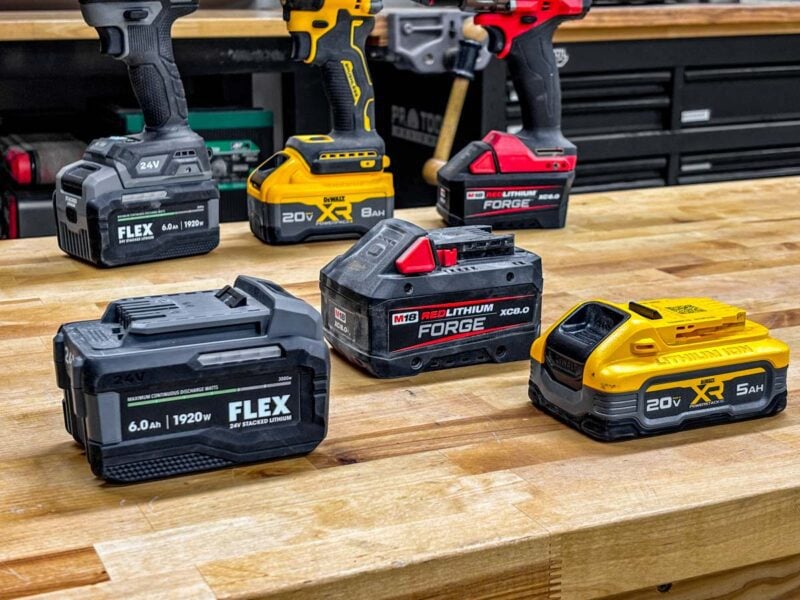
Ah, the good old days before social media, when we were all arguing about the power difference between 18V and 20V Max battery systems in online forums. Though that debate has been soundly resolved, another group emerged touting the benefits of a 24V battery system. When you compare 18V vs 24V power tools, is there a real difference, or is it just another marketing trend?
I’ll walk you through the design differences and share data from three head-to-head reviews we’ve done to see what we can glean from it.
READ
20V Max vs 18V Batteries: Setting the Record Straight
18V vs 24V Power Tools Design Differences
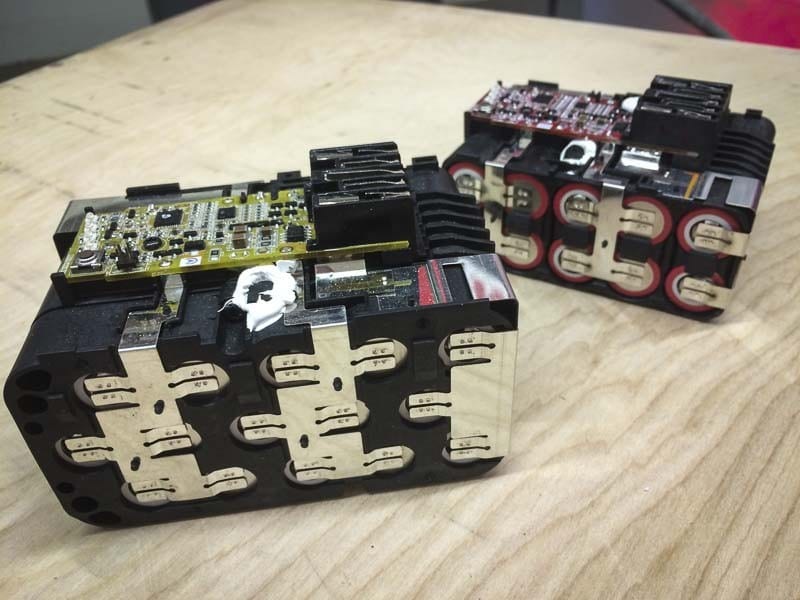
When we compared 18V and 20V Max power tools, the only difference was whether the manufacturer reported their battery’s nominal voltage or maximum voltage. That’s also the case with the 18V vs 24V debate, but there’s more to it.
When you open up an 18V battery, its lithium cells are arranged in sets of 5. Each one provides 3.6 volts, and 3.6V x 5 cells = 18V. That’s based on nominal voltage.
If you’re counting based on maximum voltage, each cell provides 4 volts. 4V x 5 cells = 20V Max.
24V power tools use a 6-cell system, and that’s where the major difference lies. 3.6V x 6 cells = 21.6V nominal.
That’s not a very easy number to market, so most manufacturers use the Max formula: 4V x 6 cells = 24V Max.
Does one extra cell really make that big of a difference?
On paper, there are a couple of ways to think about it. If you were to push the same amount of current through every cell, the 24V system would produce 20% more power. Let’s consider an example, and we’ll use Max voltage to keep it fair. Remember, volts x amps = watts (power).
4V x 5 cells x 50 amps = 1000 watts
4V x 6 cells x 50 amps = 1200 watts
The other way you can look at it is to consider how much current each cell has to provide in order to hit a specific power level for the tool.
4V x 5 cells x 48 amps = 960 watts
4V x 6 cells x 40 amps = 960 watts
Notice there’s still a 20% difference, but this time, each cell in the 20V Max battery has to provide 20% more current than the 24V battery to produce the same power. In other words, the 20V Max cells have to work harder.
If you’ve paid attention to most 24V battery system marketing, they often claim “20% more power than 18V/20V Max.” This is where they get it from, and it’s a legit power measurement.
18V vs 24V Power Tools Tested Head-to-Head
But how do those claims work out in real life? Let’s look at three sets of data from our head-to-head testing and find out.
Our 18V participant is Milwaukee. 20V Max will be represented by DeWalt. Finally, Flex is who I’ve chosen for the 24V system. If you want to see the details of exactly how we tested, check out the main review articles I’ve linked in each section.
Cordless Drills

| Milwaukee M18 Fuel 2904 | DeWalt 20V Max DCD1007 | Flex 24V FX1271 | |
|---|---|---|---|
| Maximum Speed | 2100 RPM | 2250 RPM* | 2500 RPM |
| Maximum Blow Rate | 33,000 BPM | 38,250 BPM | 40,000 BPM |
| Maximum Torque | 1400 in-lbs | 1496 in-lbs** | 1400 in-lbs |
| RSS Screw Test | 2.49 seconds | 2.42 seconds | 2.22 seconds |
| Spade Bit Test | 2.62 seconds | 2.54 seconds | 2.42 seconds |
| Self-Feed Bit Test | 1.89 seconds | 1.73 seconds | 1.84 seconds |
| Concrete Drilling Test | 6.84 seconds | 6.39 seconds | 5.65 seconds |
Notes: *DeWalt’s top speed in hammer mode is 2250 RPM and drops down to 2000 RPM in drilling and driving modes. ** Torque spec taken from DeWalt’s European website. The American site lists the power as 1530 UWO.
Looking at these results, it’s not a runaway for Flex’s 24V battery system. In fact, Flex didn’t beat Milwaukee or DeWalt by 20% in any of the tests we ran, though it did get close in the concrete drilling test. On the other hand, DeWalt squeaked ahead of Flex in the self-feed bit test, despite having a voltage disadvantage.
READ
Best Cordless Drills Head-to-Head Review
Impact Drivers
| Milwaukee M18 Fuel 2953 | DeWalt 20V Max DCF860 | Flex 24V FX1371 | |
|---|---|---|---|
| Maximum Speed | 3900 RPM | 3800 RPM | 4000 RPM |
| Maximum Impact Rate | 4400 IPM | 4500 IPM | 4450 IPM |
| Maximum Torque | 2000 in-lbs | 2500 in-lbs | 2500 in-lbs |
| RSS Screw Test | 5.96 seconds | 7.54 seconds | 5.86 seconds |
| Lag Screw Test* | 1.06 inches remaining | 2.50 inches remaining | 0.63 inches remaining |
| Bolt Break Test | 1.64 seconds | 2.56 seconds | 1.75 seconds |
Notes: *Our lag screw test measures the amount of the screw remaining proud, so a lower number is better.
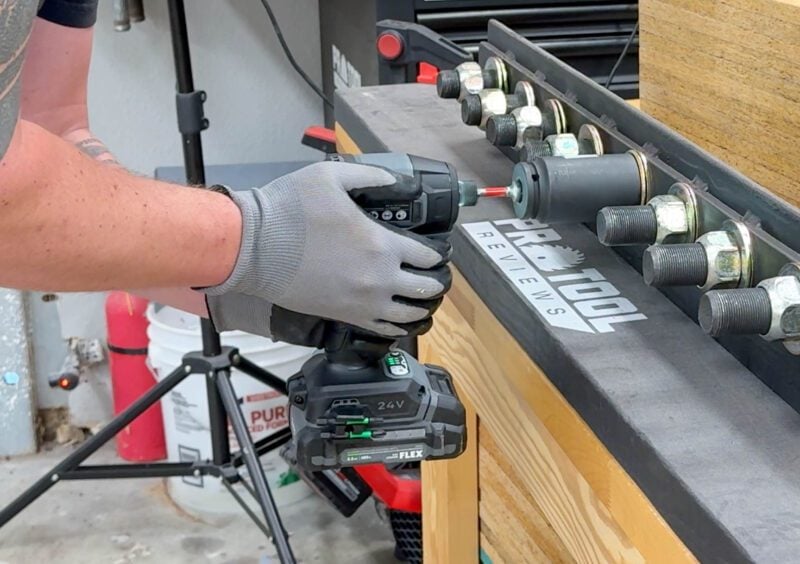
The impact driver results revealed a bit more. In the RSS screw test, Flex beat DeWalt by more than 20%, but it couldn’t hold that lead against Milwaukee.
When driving lag screws, Flex was able to sink it more than 20% lower than both, so perhaps there’s something to that extra cell when it’s working at the edge of the tool’s capabilities.
But then in the bolt break test, we see the trend reverse again. Flex beat DeWalt by more than 20%, but it actually finished behind Milwaukee.
READ
Best Cordless Impact Driver Head-to-Head Review
Impact Wrenches
| Milwaukee M18 Fuel 2962 | DeWalt 20V Max DCF891 | Flex 24V FX1451 | |
|---|---|---|---|
| Maximum Speed | 2575 RPM | 2000 RPM | 2700 RPM |
| Maximum Impact Rate | 3100 IPM | 3250 IPM | 3100 IPM |
| Fastening Torque | 550 ft-lbs | 600 ft-lbs | 600 ft-lbs |
| Breakaway Torque | 650 ft-lbs | 800 ft-lbs | 750 ft-lbs |
| Bolt Break Test | 3.26 seconds | 2.97 seconds | 3.34 seconds |
| Inertia Torque Test | 412.8 ft-lbs | 392.8 ft-lbs | 414.2 ft-lbs |
| Lag Bolt Test* | 0.56 inches remaining | 0.00 inches remaining | 1.13 inches remaining |
Notes: *Our lag screw test measures the amount of the screw remaining proud, so a lower number is better.
When we compared mid-torque impact wrenches, the only test Flex won was when we measured torque on our Inertia Torque L-1000, and it certainly wasn’t by 20% or more. On the other two performance tests, both Milwaukee and DeWalt came out ahead.
READ
Best Cordless Impact Wrench Head-to-Head Review
Final Analysis
If we were to put all this data on a chart, it would be really scattered and leave us scratching our heads, searching for a pattern. Does that mean the marketing is a lie, and having an extra cell doesn’t really give you 20% more power?
I don’t think that’s the case at all.
It’s an issue of having more variables than just the number of lithium cells in the battery. There’s the motor selection, gearing, component design (the hammer and anvil in an impact tool, for example), and how much power the tool is dialed in to draw at the top end.
Even within the battery, there’s the matter of whether it’s a 1P, 2P, or 3P pack, the amount of electrical resistance in the connections and wiring, its ability to cool, and more.
We often take for granted just how complex our power tools really are under the hood, and each decision the design teams make has an impact on performance.
With that in mind, 24V batteries and power tools really do have the potential to produce more power. Whether or not the tools do is a matter of how the product designers choose to apply the power that’s available in the pack.
In my experience, I wouldn’t choose one platform over another based solely on whether the batteries are 24V or 18V/20V Max. Their respective performances are close enough that it’s more about which platform has the tools I need and the durability to hold up.
What do you think? Join the conversation in the comments below!


“… it’s more about which platform has the tools I need and the durability to hold up.” Shazam, exactly! Well said.
Thanks, Mike!
At what point does the total weight of increased battery size make holding the “weighty” tool for extended times become a burden . Or would one prefer a lighter weight tool and give up a bit of time. Or would I use a lighter weight corded tool ( each platform -battery , corded have their own place, yes even the original cordless manual tools🤷♂️)
That’s a great point, Woodie. It really depends on the person. I know a guy who uses a 9.0Ah DeWalt FlexVolt battery on his impact driver just because he can work all week without changing it. To each their own.
That said, I find that the extra cell on its own doesn’t add too much weight. It’s more about how they build the pack and the weight of the tools. For example, Greenworks’ power tools batteries tend to be lighter than Hilti’s or Flex’s, but they’re all on a 24V platform.
Personally, I prefer a lighter tool as long as it can legitimately get the job done well. For core tools, like drills and impacts, I’d still use a cordless model if they were heavier for the convenience of not worrying about a power source and dragging a cord around.