
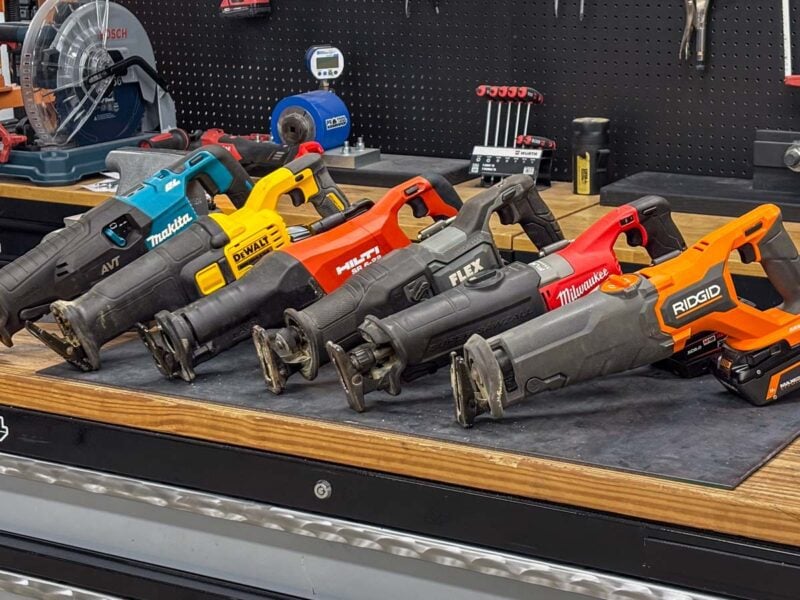
When we evaluate reciprocating saws, we want you to know the details of how and why we do what we do. There’s only so much space in the head-to-head review, and this article dives deeper for those of you who are interested in how Pro Tool Reviews tests reciprocating saws.
READ
Best Cordless Reciprocating Saw Head-to-Head Review
General Guidelines
Even though every test is designed to evaluate a different element of the saw’s performance or design, there are three major consistencies in each performance test.
First, every test begins with a fully-charged battery directly from the charger. This gives every saw the advantage of the max charge boost before the battery settles into its nominal voltage.
Second, every test starts with a new blade. In some materials, and especially with carbide teeth, the blade actually gets faster after the first cut. We want to ensure every saw works through the same blade life progression.
Finally, we keep an eye open for outlier results, inconsistencies in the cut, and user errors. If anything happens during the cut that’s out of the ordinary, we repeat that run.
READ
Sawzall vs Reciprocating Saw: Are They the Same?
PVC Pipe Cutting
The easiest test we run is to cut 4-inch schedule 40 PVC pipe. With how easy this task is for today’s corded and cordless models, it’s fair to ask why we bother. But it’s highly relevant for plumbers, irrigation techs, municipal crews, facility maintenance crews, and others.
A saw that has too much vibration or an always-on orbital action can have trouble making an accurate start and leave you with a rougher edge, even if you use a high tooth count blade. A soft start feature can also be helpful. So, yes, cutting speed is important, but how smoothly the saw operates can be just as important to the discerning Pro.
For the test, we use a 5 lb weight to keep the downforce equal. With the saw set to its highest speed and orbital action turned off, we rest the blade on top of the pipe and fully engage the trigger. The result we report is the average of three runs.
Clean Wood Cutting
Cutting clean wood is common in sections of demolition, and it’s a good way to show differences in cutting speed.
We use 2 x 12 pressure-treated pine as our test material. It’s wider than the studs or joists you often run into on demo and remodeling jobs, but the longer cut helps us build bigger gaps that show differences more clearly.
We stick with the same 5 lb weight for equal downforce, run each saw in high speed mode with orbital action on (if present), and report the average of three successful runs.
Wall Demo
If you’re remodeling, cutting out walls is a very common task, and we developed a mocked-up version to see how each reciprocating saw performs in one of the most direct real-world tests we run. It’s built from three 2 x 4 pine studs with three framing nails embedded in each, a layer of 7/16 OSB sheathing, and a layer of HardieBoard siding.
There are three key differences from what you’ll find on a typical demo job, though.
First, we space the studs closer together. We still leave a gap so the saw has to go through the deceleration it normally would when it hits a stud. This keeps the overall rig compact enough to ensure we can control each saw consistently through.
Secondly, we arrange the studs horizontally, not vertically. With this orientation, we’re able to use equal downforce from a 5 lb weight.
Finally, the nails are spaced evenly and in each stud, so that every saw has to cut through 9 nails total.
For this test, we set each saw to high speed mode and turn orbital action on (if present). The result we report is the average of three cuts.
Cutting Cast Iron Pipe
If you demo an older home, it’s common in some parts of the country to run into cast iron pipe, and it’s one of the toughest, most miserable materials you’ll ever have to cut with a reciprocating saw. For our tests, we hit up our local supplier for 3-inch cast iron pipe.
We attempted to develop a method that would allow us to use equal downforce, but to no avail. So, for this test, we cut freehand and work the saw with whatever technique allows it to cut as fast as possible in high speed with orbital action turned off.
Due to the fatiguing nature of this application, we report the time of only one cut.
Vibration
To objectively quantify vibration, you need expensive equipment. Unfortunately, we don’t have access to it. Fortunately, we have tons of experience using reciprocating saws and can differentiate relative levels of vibration to a degree.
As we cut, we start by identifying which model(s) have the lowest vibration to use as our baseline. We continue to evaluate vibration throughout our tests as the extended use helps us group them accordingly.
The result we report is based on a 1 – 5 scale, with 1 being the best (lowest vibration) and 5 being the worst (highest vibration).
The important thing to note here is that we’re evaluating vibration during active cuts, not under no-load situations. We keep the blade and shoe fully engaged during the evaluation, so we can determine what you’ll actually feel using proper technique.
Testing Reciprocating Saws That Aren’t in Our Head-to-Head Reviews
Reciprocating saws can be grouped into three primary classes: one-hand, mid-range, and high-performance. There’s also a small group of compact models. You can further separate them into Pro, Prosumer, and DIY classes.
Our head-to-head tests evaluate Pro and Prosumer models in the high-performance class.
When we test other reciprocating saws, we use a similar approach. We keep top-performing models on hand to run side-by-side performance tests, though they differ from the more formalized tests in our head-to-head reviews. For example, we may run several one-hand reciprocating saws through cuts in clean 2×4 studs and time them to see the difference.
In those cases, we’ll tell you in the review what materials we cut, what blades we used, and how the results came out. The goal is always to give you a relevant comparison to gauge the relative performance.
The same applies to evaluating vibration. We’ll run benchmark models alongside our test model to determine its relative vibration levels.
Other Considerations
In addition to the performance and vibration tests we run, there are other elements we look for that can affect your experience as a user:
- Motor
- Stroke rate
- Speed selection
- Stroke length
- Selectable orbital action
- Available dust collection
- Blade change mechanism
- Shoe design (adjustable length and pivoting action)
- Rafter hook
- Weight (bare and with battery)
- Length
- Smart connectivity/controls