
Milwaukee and Makita are both top competitors in the premium cordless circular saw market, but they take different approaches to getting the job done. On paper, their flagship saws are very evenly matched in blade speed and cut capacity, but we wanted to know who would take pole position in a head-to-head matchup. We ran these saws through our standard set of circular saw tests so you can decide which is the best option for your tool arsenal.
READ
Best Cordless Circular Saw Head-to-Head Review
Milwaukee M18 Fuel vs Makita 40V max Circular Saw Comparison
Milwaukee M18 Fuel 7 1/4-Inch Circular Saw 2834
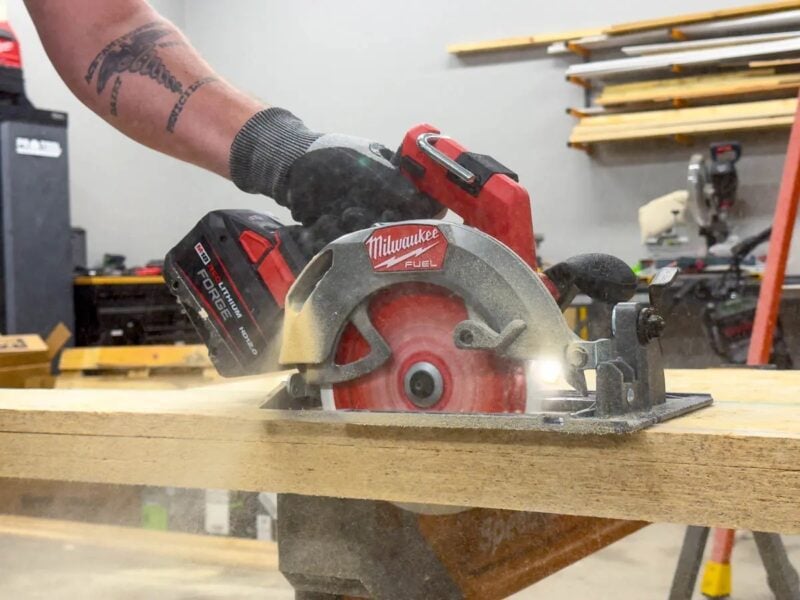
Milwaukee’s 2834 is the latest generation of its M18 Fuel 7-1/4-inch sidewinder-style circular saw. Its brushless motor delivers up to 6,000 RPM, while the saw’s 2 5/8-inch cutting capacity allows it to handle 3X material in a single pass. Milwaukee also increased the maximum bevel angle to 57°, compared to the previous generation, the 2732.
- Blade Size: 7 1/4-inch
- Blade Orientation: Right
- No-Load Speed: 6,000 RPM
- Bevel Capacity: 57º
- Cutting Depth at 90º: 2 5/8 inches
- Cutting Depth at 45º: 2 1/16 inches
Key Features
- Folding Rafter Hook: Easily hang your saw on 2x material in between uses
- Electronic Blade Brake: Quickly brings the blade to a halt once the trigger is released
- LED Work Light and Dust Blower: Helps keep your cut line clear and visible
- Available with One-Key: The M18 Fuel 2835 is One-Key compatible for better tool tracking
Makita 40V max XGT 7 1/4-Inch Circular Saw GSH01

Makita’s GSH01 leverages the power of the 40V max XGT platform. Its brushless motor also tops out at 6,000 RPM and offers a 2 5/8-inch max cutting depth at 90°. Moreover, this saw bevels up to 56° and includes positive-stop positions at 22.5°, 45°, and 56°, so it’s easy to get accurate results with confidence.
- Blade Size: 7 1/4-inch
- Blade Orientation: Right
- No-Load Speed: 6,000 RPM
- Bevel Capacity: 56º
- Cutting Depth at 90º: 2 5/8 inches
- Cutting Depth at 45º: 1 13/16 inches\
- Rafter Hook: No
Key Features
- AWS Compatible: Pair this saw with a Bluetooth transmitter to remotely activate your compatible vacuum or dust extractor
- Integrated Tether Point: Quickly tether your saw when working at height
- Three-Position Bevel Dial: Make accurate bevel adjustments with confidence
Milwaukee vs Makita Circular Saw: How We Tested
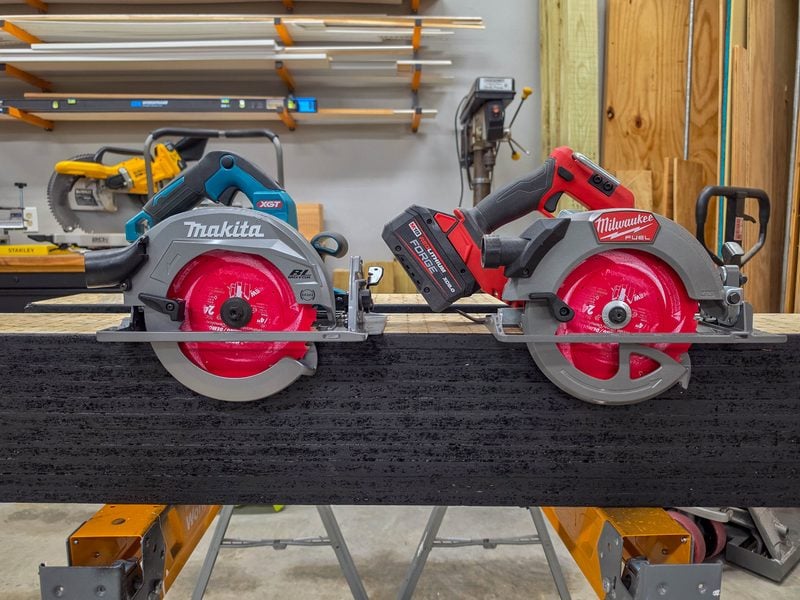
Circular saws make two basic types of cuts: crosscuts and rip cuts. From there, we add bevel, miter, and compound cuts to see how each saw handles more demanding applications. For our testing, we use a variety of 2x materials and OSB subflooring, which helps to minimize some of the variables.
Rip Cutting
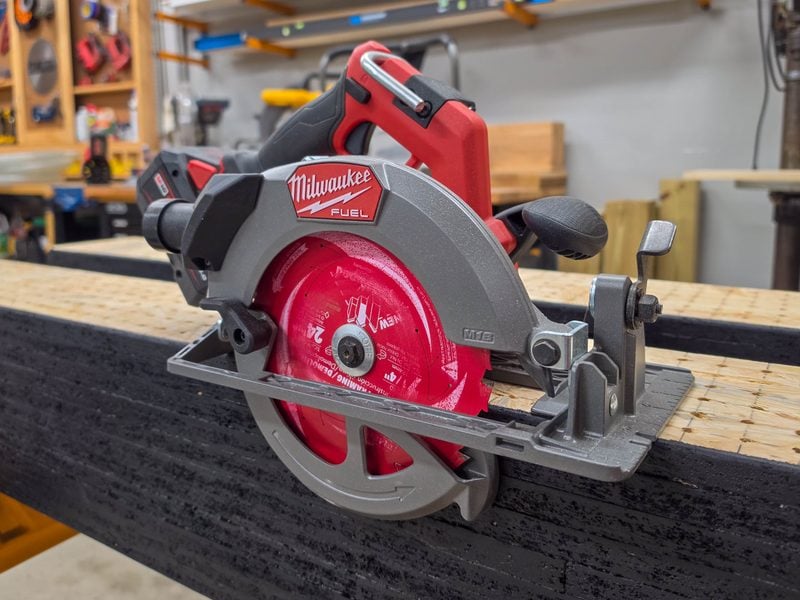
The first thing we wanted to find out was which saw could maintain its cutting performance under load.
Both saws have plenty of power for everyday construction work, but our testing showed a noticeable difference when we pushed them harder. In our double-stacked 3/4-inch OSB rip cut test, each saw was pulled for 7 feet on a custom sled by a 10-pound weight, and we timed the results. The Milwaukee 2834 finished in 9.76 seconds, while the Makita GSH01 took 13.53 seconds.
We saw a similar result when we moved to a full-depth rip cut. For this test, we ran each saw through triple-stacked 3/4-inch OSB at full depth and timed the results. In this case, Milwaukee completed our test in 17.41 seconds, while Makita finished in 24.74 seconds—once again, falling behind its competitor, but not a full-on blowout either.
Makita certainly isn’t lacking power, and the GSH01 maintained RPMs well through these demanding cuts. But when we put the two saws side-by-side, Milwaukee pulled ahead in raw cutting speed.
For these reasons, we have to award Milwaukee the win in this bout.
Cross Cuts
When it comes to basic crosscuts, both saws have more than enough power to make clean, controlled cuts.
The 2834 and GSH01 both have the cutting capacity and blade speed to handle common 2x dimensional lumber without breaking a sweat. Neither saw gave us a reason to question its ability during standard crosscuts.
This is one of those categories where the differences between these two saws aren’t nearly as important as they are when we start pushing them through more challenging cuts. In this go-around, both saws are fairly evenly matched.
Miter Cuts
Like the standard cross cuts, both saws performed well while making miter cuts. The saws tracked smoothly and had enough power to maintain blade speed through the material. Moreover, both models received high praise concerning the lower blade guard action, which is a common pain point for circular saws.
In this case, the guard rose smoothly up and over the edge of the board and didn’t hang up. This led to cleaner and more accurate cuts during our testing. Once again, the 2834 and GSH01 are at a stalemate in terms of performance.
Bevel Cuts
Just like our miter cut tests, both saws handled bevel cuts with ease. The Milwaukee offers a slightly higher maximum bevel angle, while Makita’s three-position stop system makes it quick to move between 22.5°, 45°, and 56°.
Regardless, the lower blade guards literally rose to the occasion, offering no resistance as these saws made passes through our 2×10 pressure-treated board. This keeps these saws pretty evenly matched through the competition.
Personally, I think Milwaukee’s lower guard action is a little smoother than Makita’s based on the design of the leading edge. It’s a small detail, but it made a difference during our tests.
Compound Cuts
Compound cuts are where a circular saw’s overall design starts to matter more. These cuts combine bevel with the rigors of a miter cut, potentially creating a perfect storm for lower blade guard hang-ups.
Fortunately, the Milwaukee 2834 and Makita GSH01 handled our compound cuts without issue. Both models delivered excellent sightlines and worked through the demanding 45° compound miter cuts with ease. Much like during our standard cross-cut tests, these saws earned top praise from our testing team, and for that, we tip our caps to the design teams.
Shoe Friction
Shoe friction is one of those small details that becomes more noticeable the more you cut. A smooth shoe takes less effort to push through long cuts. Fortunately, both of these saws feature die-cast magnesium shoes, which help cut down on overall weight and allow them to glide across the workpiece with ease.
During our testing, both the 2834 and GSH01 scored high praise from our team for their shoe design…once again leaving these competitors at a near stalemate.
Ergonomics
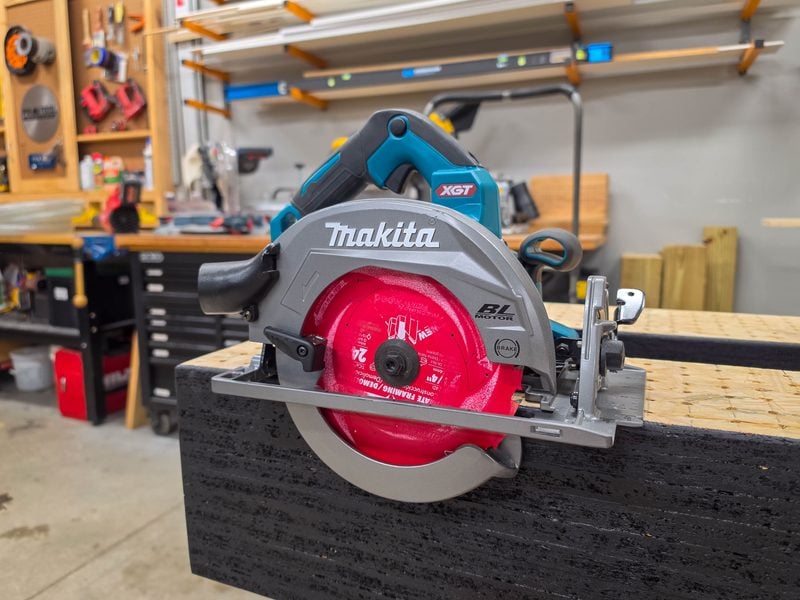
Okay, so we’ve covered performance…but what about design?
Weight isn’t everything with a circular saw because most cuts are made on a level, flat surface. Still, you’re carrying the saw around the jobsite all day, and a lighter tool is generally easier to live with.
The Makita GSH01 has the advantage here. It sports a bare tool weight of 8.0 pounds, while the Milwaukee 2834 comes in around 8.43 pounds. With the batteries used in our testing, the Makita jumps up to 10.09 pounds compared to 10.81 pounds for Milwaukee. This isn’t too shocking when you look at the Pro category as a whole, but lighter typically leads to lower overall fatigue.
One factor that does make a notable difference is size. The Makita GSH01 is noticeably more compact. It measures 12 1/2 inches long, while Milwaukee stretches to about 14 inches. While it doesn’t make a meaningful difference in performance, Makita’s lower weight and smaller profile make it a more favorable option if storage space is at a premium.
Personally speaking, I opt for the Makita due to its smaller form factor. But with that said, Milwaukee’s stretched out frame leaves plenty of room for folks making two-handed cuts to comfortably use both the main grip and forward pommel.
Sightlines
During normal cross cuts and rip cuts, both saws had near-perfect sightlines down to the guide notches on the leading edge of the shoe. Makita’s taller design decreased sight-line quality a little, but Milwaukee’s flatter profile provided an unobstructed view.
Final Results
| Category | Milwaukee 2834 | Makita GSH01 |
|---|---|---|
| Cutting Power | Winner | |
| Cross Cuts | Tie | Tie |
| Miter Cuts | Tie | Tie |
| Bevel Cuts | Tie | Tie |
| Compound Cuts | Tie | Tie |
| Sightline | Tie | Tie |
| Guard Action | Winner | |
| Shoe Friction | Tie | Tie |
| Weight | Winner | |
| Size | Winner | |
| Ergonomics | Winner | |
| Features | Tie | Tie |
| Price | Winner | |
| Warranty | Winner |
Pricing and Final Thoughts
| Milwaukee 2834 | Makita GSH01 | |
|---|---|---|
| Bare Tool | $279 | $289 |
| Kit | $499 (w/12.0Ah M18 Fuel Forge battery) | $469 (W/4.0Ah 40V max XGT battery) |
The Milwaukee 2834 and Makita GSH01 are both capable of handling serious construction work, but they emphasize different strengths. Milwaukee’s biggest advantage is cutting performance, while Makita counters with a lighter, more compact design and a strong feature set.
The interesting part is how close the two are once you move beyond raw cutting speed. Both provide excellent cut capacity, solid ergonomics, accurate tracking, and the kind of features we expect from premium-grade cordless circular saws.
For someone already invested in the M18 battery platform, the 2834 makes a compelling case with its cutting performance. The same goes for the GSH01 if you’re already invested in Makita’s 40V max XGT ecosystem. Plus, its lighter design and advanced safety features make it a strong competitor.
At this level, you’re not choosing between a capable saw and an underpowered one. You’re choosing which combination of performance, weight, features, and battery platform fits your work.
For me, I’m inclined to go with Makita for the simple reason that it’s lighter and more compact than the 2834. If size and weight are key factors in your buying decision, you really can’t go wrong with the GSH01. However, if maximum cutting power is what you’re after, then the Milwaukee 2834 is the obvious choice.