
A few years back, Flex added a fresh batch of 24V tools to their lineup, including an impressive 5-inch Random Orbit Sander (FX3411). Now, they’re at it again with the release of the Flex 24V 1/4-Sheet and Detail Sander—two tools in one! I’m going to dive into the design elements that set this sander apart from the pack and share what I learned from testing it so you can decide if it’s a good fit for you.
Pros
- Four speed modes
- Good vibration control
- Interchangeable sanding pads
- Good heat management
- Excellent dust collection
Cons
- No significant drawbacks
Flex 24V 1/4-Sheet Sander Performance
Sanding Performance
At the heart of the FX3591 is a brushless motor that delivers between 9,000 and 14,000 OPM with a 1/16-inch orbit diameter. Flex gives you three speed settings plus a Turbo mode, allowing you to adjust the sanding speed to fit your particular application. To put that in context, Festool’s RTSC 400 tops out at 10,000 OPM as a dedicated detail sander, and Ridgid’s more recent R87064 1/4-sheet sander hits 12,000 OPM on the high end.
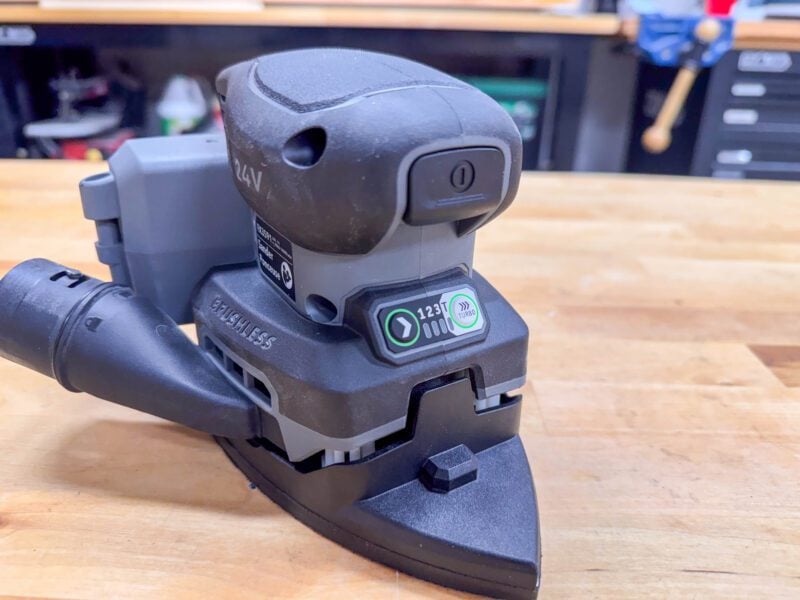
That extra speed goes a long way when you’re trying to remove multiple layers of old paint or if you’re on a tight timeframe. On top of that, it also surpasses Flex’s FX3411 Random Orbit Sander by 1,000 OPM. Albeit the FX3411 has a wider range of speeds, which is advantageous in some circumstances.
The 1/16-inch orbit diameter is fairly typical in this category of sander and grants you more control when working in tight spaces. The variable speed control also gives you the ability to tailor your speed to match your task rather than simply running at one fixed speed.
Vibration Level
Controlling vibration is tricky with sanders, but overall, I think Flex did a good job. On speeds 1, 2, and 3, the vibration level is very similar to what I experienced with the Ridgid R87064, but kicking it into Turbo mode made it a little more intense – not surprising considering the higher speed.
I wouldn’t say it was uncomfortable, but I can see how it could increase hand fatigue over longer sanding sessions. For that reason, I’d reserve Turbo mode for those really stubborn areas.
Heat Management
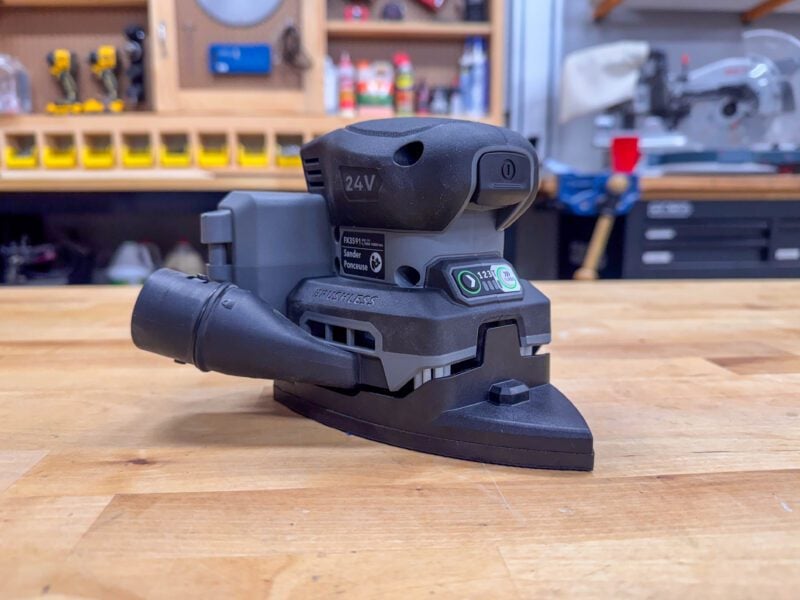
Another area where Flex excelled is in heat management. The motor housing sports two large vents on either side, improving airflow and heat dispersion. I noticed that the top grip remained at a comfortable temperature throughout my hands-on testing and didn’t cause any discomfort, even during extended use.
Material Removal
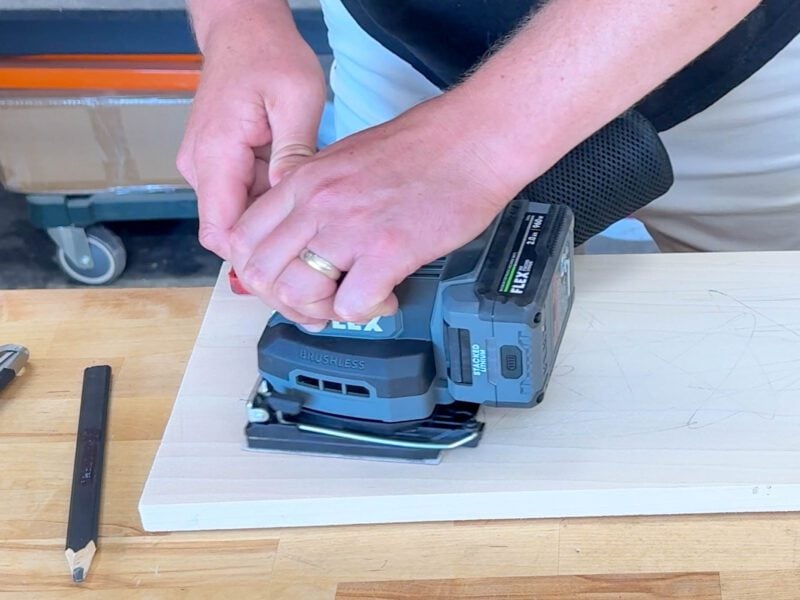
For testing, I clamped a scrap section of 1×10 pine to our workbench, scored it with a utility knife, and made a series of markings with a pencil so I could visually track my progress. I decided to use the 120-grit sandpaper that Flex included rather than opting for a premium sandpaper just to see what you can accomplish with what comes in the box.
As I mentioned earlier, this sander’s performance metrics are higher than some of the Pro models I’ve tested in the past. During our testing, the FX3591 definitely punched above its weight class and removed my markings within minutes. Obviously, a more aggressive grit would work much faster, but the stock 120-grit paper worked well in this application.
The difference in vibration between mode 3 and Turbo mode was certainly noticeable, but it also led to faster material removal when Turbo mode was activated. As I mentioned earlier, felt vibrations are impossible to avoid, but I didn’t feel any true discomfort, even after continuously sanding for about 10 minutes.
I like that Flex carried over its speed selector panel design from the FX3411. The design is easy to manipulate, even while working, and it is consistent with many other tools in Flex’s 24V lineup. That kind of continuity is important because it doesn’t require any new muscle memory.
Dust Collection
Flex gives you a couple of options when it comes to dust collection. First and foremost, you have the removable dust collection bag. During my hands-on testing, this proved to be a very effective solution. I particularly like that the Flex opted for a twist-lock attachment style rather than a simple friction fit. This reduces the chances of it getting lost or falling off in between uses.
Second, you can use the same 1 1/4-inch dust port with compatible vacuums or dust extractors. This will greatly improve jobsite cleanliness and keep the air free of excess dust. With cordless options like Flex’s Stack Pack compatible 2.5-gallon wet/dry vac, you can keep your workspace clean while still leaning on a fully cordless system.
READ
Universal Problem-Solver: Mullet Tools FitsAll Hose Kit
Flex 24V 1/4-Sheet Sander Design Notes
Interchangeable Pads
Without a doubt, the defining feature of the FX3591 is its 2-in-1 design.
In its 1/4-sheet configuration, this sander is ideal for larger flat surfaces such as furniture and tabletops. When you need to work in tighter spaces, you can quickly convert it to the detail sanding configuration for applications such as inside corners, edges, trim, and around spindles.
To swap out the pads, simply remove the four T20 screws on the bottom using the onboard wrench, then gently remove and replace one pad with the other. Just make sure not to overtighten the screws for optimal performance and longevity.
This kind of versatility is great for tackling small remodeling jobs and home projects, especially for folks who don’t frequently need a sander. Rather than switching between multiple tools, the FX3591 gives you two sanders in one cordless package.
The process for swapping out sandpaper is pretty standard, but the swappable pads give you some added versatility that other brands don’t.
The 1/4-sheet pad is compatible with both hook-and-loop sandpaper and traditional sandpaper sheets, so you have options between greater convenience and lower cost.
The detail sanding pad is only compatible with hook-and-loop sandpaper.
Overall, this gives you more flexibility, whether it’s a matter of preference, the job at hand, or limited options at your local hardware store.
Flex also includes a hole punch guide for the 1/4-sheet pad if your sandpaper isn’t pre-punched.
Size and Weight
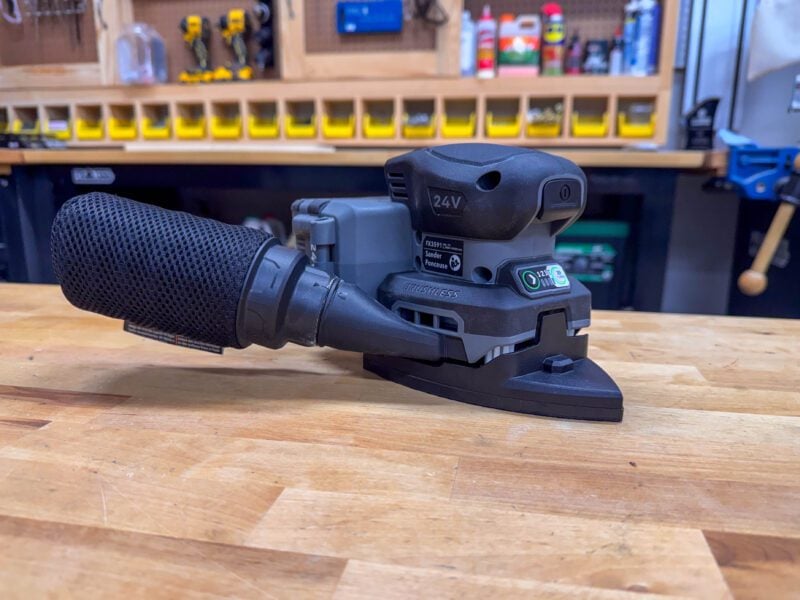
The sander weighs 2.9 pounds as a bare tool and an even 4.0 pounds with the kitted 2.0Ah Stacked Lithium battery. Depending on your configuration, this sander stands between 5.0 and 5.5 inches tall. This is fairly consistent with what I’ve experienced from similar corded and cordless 1/4-sheet sanders.
Keeping in line with Flex’s philosophy, this sander is designed to stand up to the rigors of the jobsite. The top grip and motor housing are draped with a good amount of rubber overmolding, and overall, the tool feels very sturdy.
Should You Buy It?
Flex took a unique approach to the FX3591’s design by combining two common sanders into one. This is something we’ve never seen before, and I think they nailed it. Moreover, the ergonomics are sound, making it easy to use during longer sanding projects.
So, is this the right tool for you? Although we don’t have pricing or availability information just yet, it seems that Flex is really targeting folks seeking value from their tool purchases. If you only use a detail sander from time to time, but still need a sheet sander, this gives you the best of both worlds without the expense of buying a completely new tool. To me, that’s a win-win.
For remodelers, painters, cabinet shops, and serious hobbyists who regularly move between different sanding applications but still need to keep an eye on the budget, this is a combination worth considering.
Specs
- Model: Flex FX3591
- Power Source: Flex 24V battery
- Oscillation Rate: 9,000 – 14,000 OPM
- Speed Settings: 3 + Turbo
- Pad Type: Hook-and-Loop
- Weight: 2.9 lbs (bare tool), 4.0 lbs (with 2.0Ah Stacked Lithium battery)
- Height: 5.5 in.