
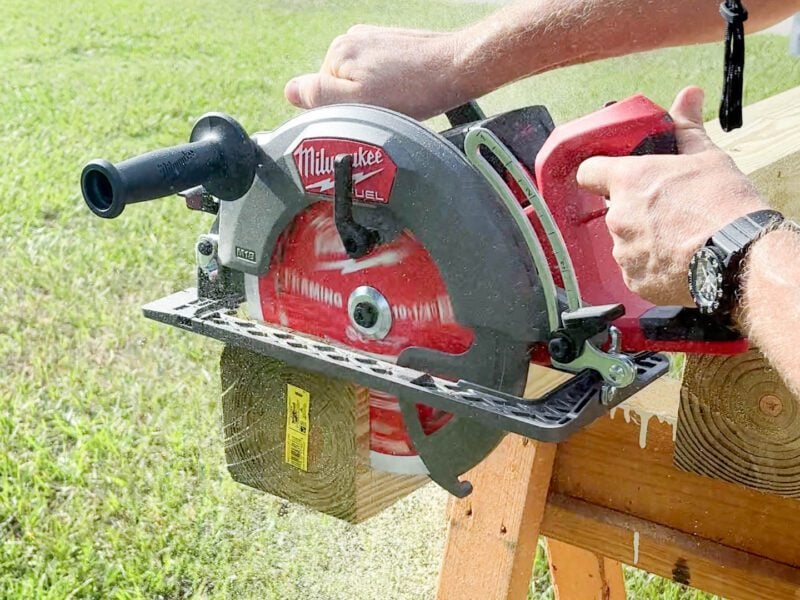
Sometimes a standard 7 1/4-inch circular saw just isn’t enough when you’re dealing with oversized lumber, but that’s exactly where the Milwaukee M18 Fuel 10 1/4-Inch Circular Saw shines. It’s designed for Pros who regularly encounter larger material and need a saw that’s built to handle it without reaching for extra tools.
But stepping up to a larger saw also comes with some compromises. We spent some time with the Milwaukee 3026 to see how it handles the demands of larger cutting applications, and whether it makes sense for the Pros it’s designed to serve.
Pros
- Large cut capacity
- Excellent ergonomics
- Confident cutting power
- Auxiliary side grip
- Familiar form factor
Cons
- A little heavy
- Expensive
READ
Best Cordless Circular Saw Head-to-Head Review 2026
Milwaukee M18 Fuel 10 1/4-Inch Circular Saw Performance
Speed and Cutting Power
The Milwaukee 3026 is powered by a brushless motor that spins the blade up to a top speed of 3,250 RPMs with a max cutting depth of 3-13/16 inches at 90° and 2-3/4 inches at 45°. This is nearly identical to the Makita 40V max XGT GSH04, but Makita has a slight edge when it comes to blade speed.
You might notice the 3026 is noticeably slower than Milwaukee’s corded model, which tops out at 5,200 RPM, but that saw has been around for a while, and the cordless version seems tuned to for higher torque.
When it comes to runtime, Milwaukee claims you can make up to 250 cuts in 4×4 lumber with the kitted 12.0Ah Forge battery, ensuring that you’re set for a full day’s work.
The saw’s impressive cutting depth comes in handy because it allows you to slice through 4X lumber in a single pass. That gives deck, fence, and dock builders a serious advantage when cutting posts to height.
Our in-house expert, Tom Gaige, recently put this saw through its paces while building a pergola with one of his friends. In this case, they were using 6×6 lumber, so it required him to make two passes. But even then, the 3026 sailed through the pressure-treated beams with ease and left a clean cut in its wake.
This brings up a good question: Is the 10 1/4-inch saw still worth using in cuts like that instead of a lighter 7 1/4-inch model?
Yes, for two good reasons. The biggest one is that 6×6 lumber is 5 1/2 inches thick. None of the 7 1/4-inch circular saws we use can make that cut, even with two passes.
But even if you found one that could, the 10 1/4-inch saw is purpose-built and tuned for timber cutting. It’s better-suited for making cuts that require you to fully bury the blade in thick material.
Dust Collection
Milwaukee made a smart move and maintained the same dust collection system that we saw on the latest M18 Fuel Rear Handle Circular Saw. It’s straightforward, effective, and easy to adjust.
I also like that Milwaukee placed it on the front of the upper blade guard so wood chips can be evacuated right as the blade kicks them up. It reminds me of the Flex 24V Inline Circular Saw, which shared a similar aesthetic.
Milwaukee M18 Fuel 10 1/4-Inch Circular Saw Design Notes
Ergonomics
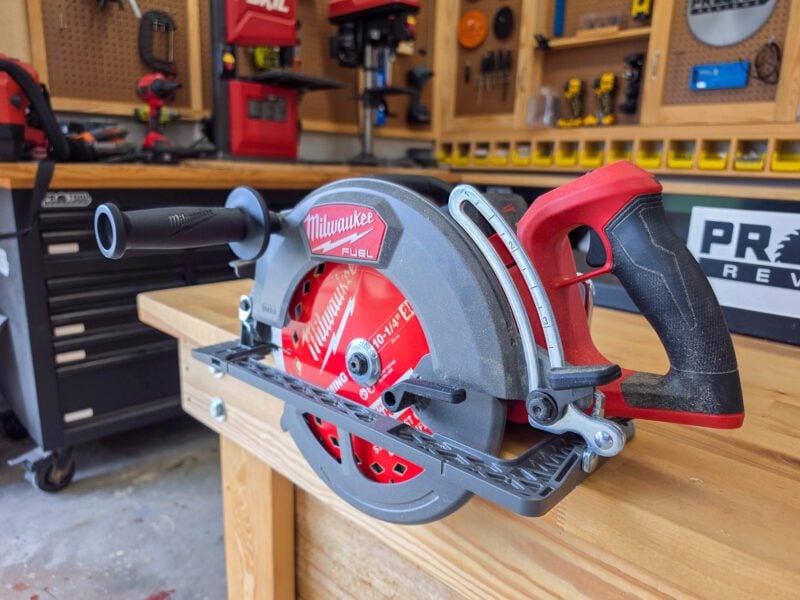
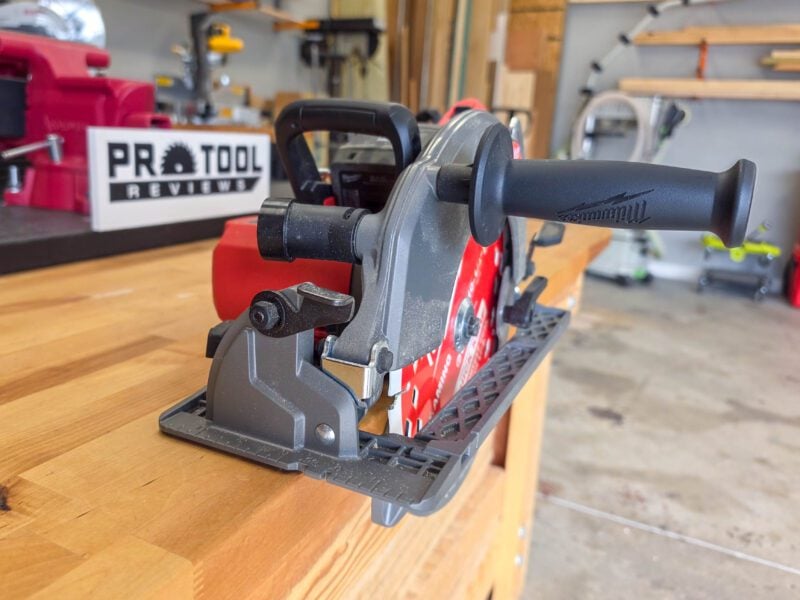
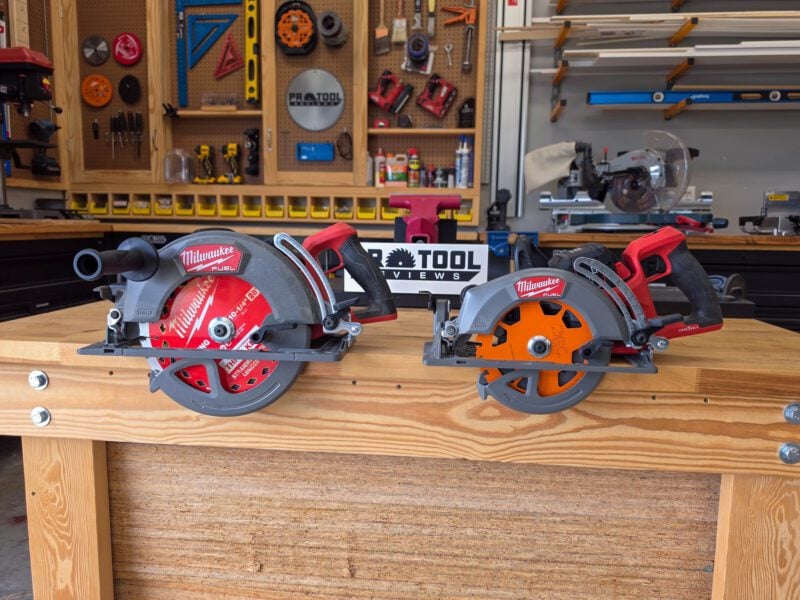
Looking at the overall profile of this saw, I’m reminded of the M18 Fuel 7 1/4-Inch Rear Handle Circular Saw (2931)…just with a much bigger blade. The grip, adjustment levers, and motor housing are identical, but Milwaukee added an auxiliary handle to the side of the upper blade guard to help guide the saw through tougher cuts.
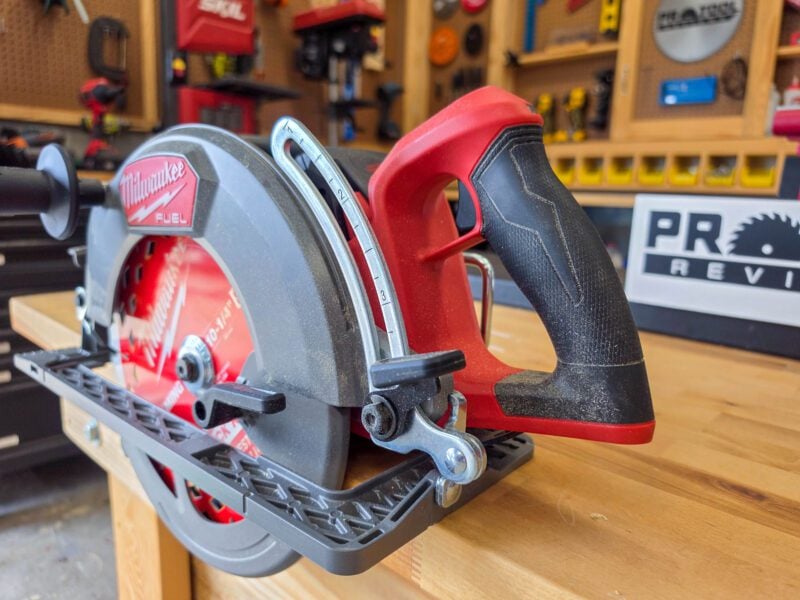
Understandably, this is a heavy saw. It clocks in at 11.90 pounds as a bare tool and 15.25 pounds with the kitted 12.0Ah Forge battery. This is about 3 pounds heavier than the 2931, but even then, it’s still relatively easy to maneuver thanks to the multi-handle design.
Depth and Bevel Adjustment
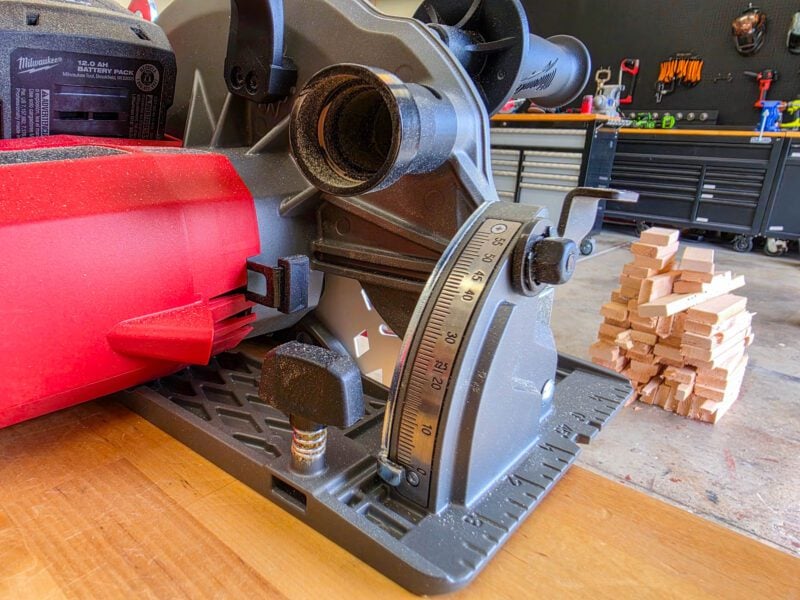
Just like the profile, Milwaukee didn’t make any changes to the depth and bevel adjustment systems. It features a max bevel of 57 degrees with positive stops at 22.5 degrees and 45 degrees, but there are no detents on the depth adjustment, unlike the 2931. However, there are clearly identifiable markings stamped into the depth guide, so you aren’t left second-guessing yourself.
Quick Model Comparison
Although these saws fall into different categories, their profiles are very similar, so I figured a side-by-side comparison was in order.
| M18 Fuel 3026 | M18 Fuel 2931 | |
|---|---|---|
| No-Load Speed | 3,250 RPM | 6,000 RPM |
| Max Cut Depth | 3-13/16 in. | 2-5/8 in. |
| Max Bevel | 57° | 53° |
| Blade Diameter | 10-1/4 in. | 7-1/4 in. |
| Arbor | 5/8 in. | 5/8 in. |
| One-Key Compatible | No | Yes |
| Working Weight | 15.25 lbs | 12.30 lbs |
| Kit Price | $599 w/12.0Ah Forge | $449 w/12.0Ah Forge |
As you can see, there are some clear differences between these saws in terms of speed and max cutting depth, but I don’t see this as a negative. These saws operate in the same materials, but each has its strengths and weaknesses to optimize for the thickness of what you’re cutting.
For instance, the 3026 can successfully cut 4x lumber in a single pass, while the 2931 would need to make two. However, the 2931 is lighter, costs less, and is faster, so really it comes down to choosing the right saw for the job. Realistically, if you buy the 3026 for thick material, you’ll also have a 7 1/4-inch circular saw for cutting thinner material.
If you regularly work with 4x materials, saving those few extra seconds while cutting beams to length might be worth the extra $150. However, if this is only an occasional task for your crew, having a dedicated 10 1/4-inch saw may not seem like a worthwhile purchase. In either case, if you want to ensure a straight cut, making it in one pass is always more precise than matching up two.
That said, these are both very competent saws that excel in their respective roles.
Additional Features
- Onboard Wrench Storage: Quickly swap out blades without making extra trips to the toolbox
- Blade Compatibility: This saw accepts 10-inch table saw blades, so there’s no need to buy dedicated 10-1/4 inch blades unless you require the cut capacity
- AutoStop Technology: Automatically stops the blade rotation if severe kickback is detected
Milwaukee M18 Fuel 10 1/4-Inch Circular Saw Price
The Milwaukee 3026 retails for $429 as a bare tool and $599 as a kit. The kit includes a 12.0Ah Forge battery, a single-bay charger, and a storage bag. Milwaukee backs this saw with a 5-year limited tool warranty and a 3-year limited warranty on the battery and charger.
Should You Buy It?
The Milwaukee 3026 is a specialized saw, and that’s important to keep in mind when deciding whether it belongs in your lineup. Its biggest advantage is straightforward—that massive blade gives you the cutting capacity to handle 4x material in a single pass. For deck, fence, and dock Pros, that can save time and eliminate the need to make multiple cuts.
As I mentioned earlier, purchasing this saw is about having the right tool for the job. While it’s not impossible to cut 4x materials with a 7 1/4-inch saw, it requires multiple passes, takes extra time, and often results in a subpar finished product. For these reasons, I believe the Milwaukee 3026 is the superior option in these applications.
Of course, there’s a tradeoff. The 3026 is considerably heavier and more expensive than Milwaukee’s M18 Fuel 7 1/4-inch rear handle saw. You’re also giving up some blade speed in exchange for the higher torque and added capacity. For standard dimensional lumber, the smaller 2931 remains the more practical option (or the 2834 if you prefer a sidewinder), while the 3026 is your upgrade for larger lumber.
Specs
- Model: Milwaukee 3026
- Power Source: Milwaukee M18 battery
- No-Load Speed: 3,250 RPM
- Cut Capacity: 3 13/16 in. (at 90°), 2 3/4 in. (at 45°)
- Max Bevel: 57°
- Blade Diameter: 10-1/4 in.
- Arbor: 5/8 in.
- Weight: 11.9 lbs (bare tool), 15.25 lbs (with kitted 12.0Ah Forge battery)