
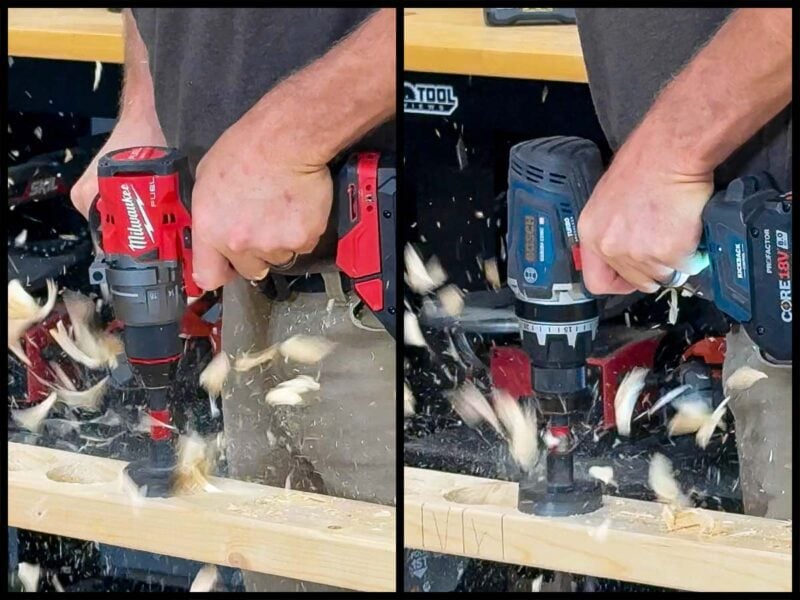
Milwaukee and Bosch are two brands with deep ties to professional tradesmen. Bosch had one of the first truly advanced batteries when it launched Core18V packs, and it was a legitimate game-changer. But now the rest of the industry has caught up, and tool development hasn’t slowed down, either. That got me wondering… with the latest technology available, who wins in a Milwaukee vs Bosch cordless drill head-to-head test?
READ
Best Cordless Drill Head-to-Head Review
Milwaukee vs Bosch Cordless Drill on Paper
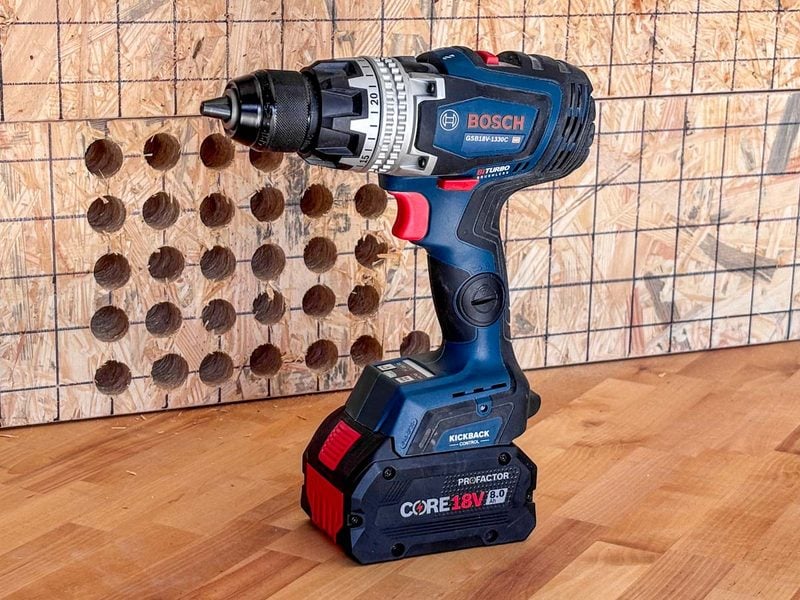
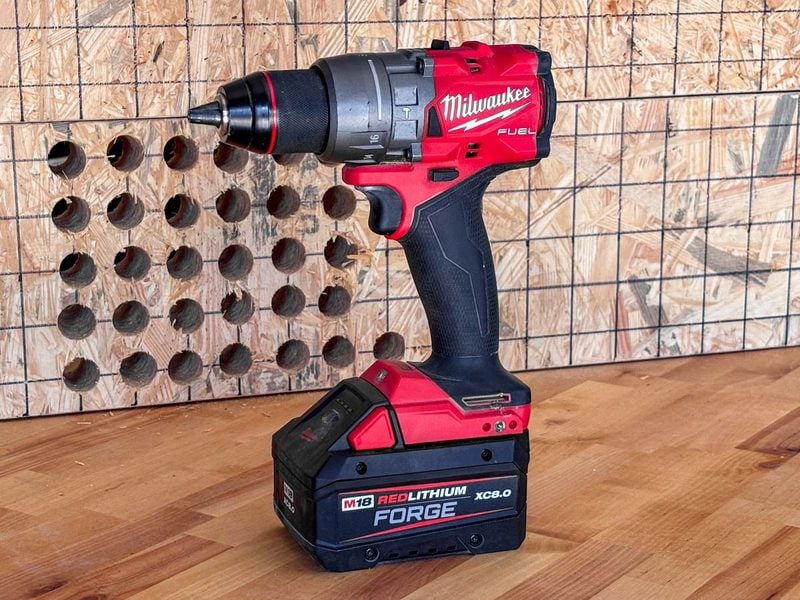
To get an idea of how these two brands stack up, I selected the top-performing cordless hammer drills from each. For Bosch, it’s the GSB18V-1330CN. For Milwaukee, it’s the 4th-generation M18 Fuel 2904. Here’s how they stack up on paper:
| Bosch 18V Brushless GSB18V-1330CN | Milwaukee M18 Fuel 2904 | |
|---|---|---|
| Max Speeds | 550/2,200 RPM | 500/2,100 RPM |
| Max Hammer Rate | 30,000 BPM | 33,000 BPM |
| Max Torque | 1330 in-lbs | 1400 in-lbs |
| Bare Weight | 4.1 lbs | 3.2 lbs |
| Tested Weight | 6.3 lbs | 5.6 lbs |
| Length | 8.1 in | 7.0 in |
Based solely on the specs, we expect some give-and-take in performance. These drill are relatively close, but Bosch has the speed edge, and Milwaukee leads in torque. We’ll also see if the 3,000 BPM difference shows up in concrete drilling.
There’s no question Milwaukee has the advantage in size and weight. With 0.7 lbs and more than an inch of length between them, these are differences you’ll notice.
However, what the spec sheet can’t show you is how the tool feels in your hand. Personally, Bosch’s pistol grip power tools have a handle design that fits my hand beautifully, and I absolutely love the ergonomic feel. The design team did a good job with the balance on Bosch’s drill, so the weight doesn’t feel as fatiguing as it could.
Still, I’d much rather use the lighter, more compact design Milwaukee put together… assuming it can keep up in productivity. So, let’s see what happened in our tests.
Milwaukee vs Bosch Cordless Drill Head-to-Head Test Results
I’ll give you a quick overview of the performance tests we run, but for a deeper dive, we have a separate article detailing how we test cordless drills.
Before we do that, though, let’s talk batteries. For these tests, we wanted to see what each drill was optimally capable of. So, instead of using the batteries that are kitted, we went with high-capacity advanced packs. For Bosch, it was the 8.0Ah Core18V High Power battery. For Milwaukee, it was the 8.0Ah Forge.
Test 1: RSS Screws

- Bit: T25
- Fastener: 8 x 3/8-inch RSS screw
- Material: Stacked and glued OSB subfloor
This test shows how fast each drill can set an RSS screw. To make sure they get a straight start, we drill a 1 1/2-inch deep pilot hole. We use freshly charged batteries and drive at high speed. The results are the average of three runs.
Test 2: Spade Bits

- Bit: 1-inch self-feeding spade bit
- Material: 4 inches of stacked and glued OSB subfloor
This test moves us into the lighter side of rough-in applications to see how well each drill handles spade bits. We use thicker material than you’d normally run into in a rough-in to help us see bigger differences in speed. The batteries are fresh off their chargers, and the drills are set to high speed. The results are the average of three runs.
Test 3: Self-Feed Bits
- Bit: 2 9/16-inch self-feed
- Material: 2 x 4 pine stud
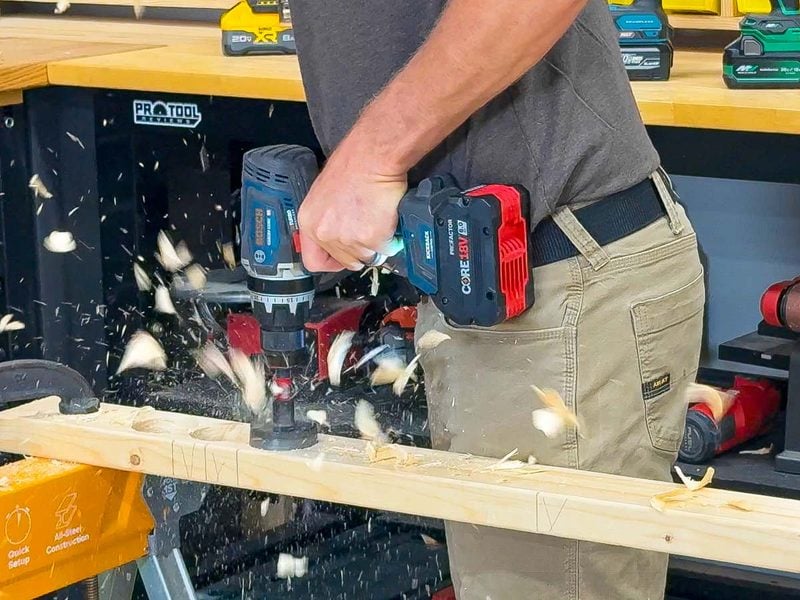
A 2 9/16-inch self-feed bit is about as large as most plumbers prefer to use in rough-ins before switching to a Hole Hawg. Starting with freshly charged batteries, we first attempt to run the test in high speed. If the drill can’t consistently complete the hole, we drop it to low speed. The results are the average of three runs.
Test 4: Concrete Bits

- Bit: 3/8-inch concrete bit
- Material: Fully-cured 4000 PSI concrete
Shifting over to concrete, we switch our drills into hammer mode. For this test, we drill 3 inches deep and flag the bits so we know when we reach the target. This is the only test that doesn’t use a self-feeding bit, so we use the same amount of downforce to the best of our ability. Starting with freshly charged batteries, we average three runs to get our results.
Results
Milwaukee was the winner in all four performance tests. Looking at all four tests together, the 2904 was 17% faster on average. The widest gap was in concrete drilling, so it seems the hammer rate made a difference after all.
| Test | Bosch | Milwaukee |
|---|---|---|
| RSS Screw | 2.88 sec | 2.49 sec |
| Spade Bit | 3.29 sec | 2.62 sec |
| Self-Feed Bit | 2.09 sec | 1.89 sec |
| Concrete Bit | 8.94 sec | 6.84 sec |
Features that Matter
Both Bosch and Milwaukee put their best technologies into these drills. Both have advanced kickback control to stop the motor quickly in the event of a bind-up.
They also both have smart options: Bosch by adding the Connected Module, and Milwaukee with its 2906 One-Key model. Milwaukee’s One-Key system offers more, but it is nice that Bosch only requires an add-on instead of choosing between two models.
Bosch has a bonus, though. Its electronic angle detection is unique among the drills we’ve tested. When you’re driving large structural screws, such as the RSS screws in our tests, it can help you start the drive straight and keep it that way until the fastener is set.
For those of you in niche trades, Bosch batteries also have the advantage of powering other tools in the Ampshare system, allowing you to expand beyond what Bosch has to offer on its 18V platform.
The Bottom Line
Looking at the whole picture, it’s hard to argue with Milwaukee as the winner, considering its performance and size advantages. But it may be getting even better for Team Red; the 5th-generation M18 Fuel hammer drill is expected by the end of the year. It’ll be interesting to see what improvements Milwaukee makes to an already impressive design.
Does that mean Bosch users should switch?
I don’t think so. Even though it was slower in these tests, it did the jobs we asked of it just fine, and we never felt like we were straining its capabilities. It also has some compelling feature upgrades. Plus, the design is solid ergonomically, it’s well-built, and Bosch’s battery technology is excellent.
If Bosch’s 18V system meets your needs for performance, productivity, durability, breadth, and service, it’s awfully hard to tell you to switch, especially based on one set of drill tests. However, if you feel like you’re suffering in one or more of those areas, Milwaukee consistently ranks at or near the top of our head-to-head tests and is worth your consideration.