

In partnership with Toro
Toro’s 60V 900 CFM leaf blower is its highest-performing handheld battery-powered model. As you look through its accolades and features, you’ll notice that Toro lists it as an all-season blower, but what exactly does that mean?
I got on a call with Ben Waldera, Toro Product Marketing Manager, to learn more about how it was designed to be a core tool you use all year long. As we dove into the details, he shared some interesting insights you won’t find on the product page, offering a better understanding of this blower’s versatility.
Built for You, Not the Spec Sheet
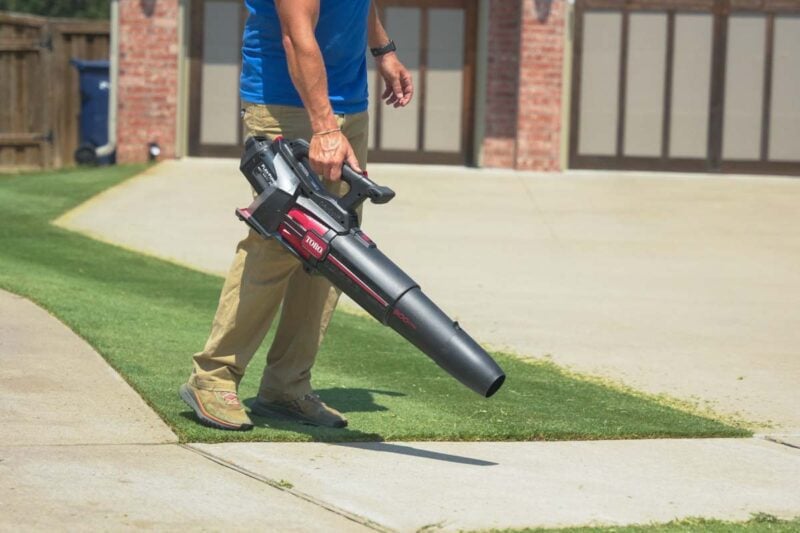
When Toro designs a product, it’s with the end user in mind. They don’t chase higher spec numbers just for the sake of marketing. User needs drive the development, and product teams spend time in the field watching people work and talking to them about what they need from each tool. They bring real human experience into the process to help deliver meaningful innovation.
So, before we look at how Toro’s 900 CFM blower can benefit you through spring, summer, fall, and winter, let’s first consider some of the ways it’s intentionally engineered.
Balancing CFM, MPH, and Newtons

With today’s brushless motors and battery technology, hitting high enough blowing force to replace gas isn’t a problem anymore. What you do with the power that’s available is what really separates one blower from another.
One of the things Toro noticed among users is that they constantly stay on the Turbo button to get the blowing force they want while sacrificing runtime. The 900 CFM blower’s performance at full throttle is dialed in to be high enough to do the job well without having to stay on the Turbo button, so you get more work out of your battery.
Then there’s the relationship between airflow (CFM), air velocity (MPH), and Newton force. Which one is the most important?
Newton force is the best descriptor overall to compare blower power since it measures the actual blowing force coming through the nozzle. However, there’s a real science to balancing airflow and velocity.
Imagine you’re corralling fall leaves on your lawn. As you walk back and forth to push them into a central area for mulching or collection, higher CFM offers better control over a wider area. Too much air velocity can actually make the job harder by creating a narrow airstream that causes leaves to circle around and land close to where they started.
On the other hand, when you want to clear out the caked-up leaves under your hydrangeas after the spring thaw, remove the buildup in crevices, or blow rocks back into the garden bed, you need a more powerful blast of air. That’s when having a higher MPH rating is more helpful.
Toro’s team has discovered that the sweet spot is to favor CFM to deliver the best productivity for an all-season blower. If you compare the specs of the 900 CFM blower to competing models, you’ll notice the air velocity is a little lower, while the airflow is higher.
The Ergonomics of a Battery-Powered Blower
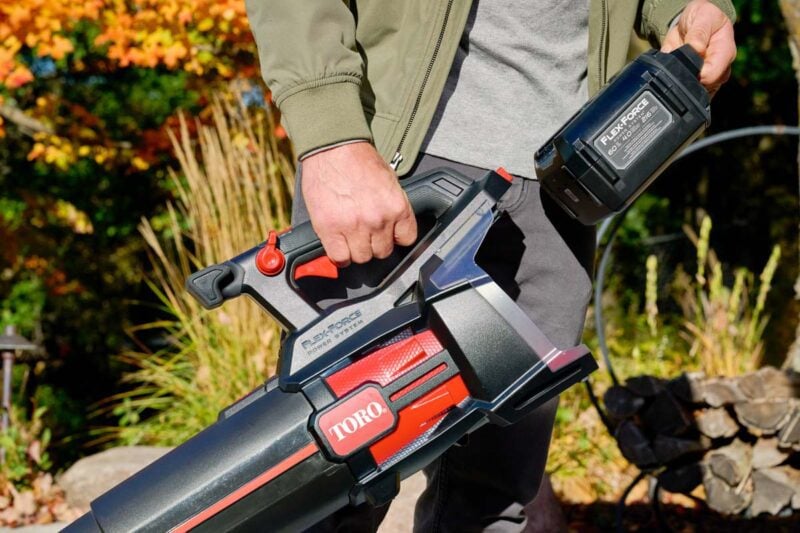
For Toro’s engineering team, one of the big challenges was balancing the need for ultra-high performance with a battery and keeping it ergonomically sound. The battery is placed as close to your wrist as possible so the blower doesn’t feel as heavy when you rotate it.
However, to get the battery where it had the greatest ergonomic advantage, they had to engineer the back to allow enough airflow to hit those high-performance marks. The style looks different from other blowers because it’s intentionally designed to help you feel more comfortable and less fatigued while you’re working.
You’ll also notice Toro included a front handle on this model. For a blower producing this much force, it’s helpful to have two hands to control it. Even when you’re working at lower blowing forces, it can make the job easier to have a second hand for control in awkward positions, like when you’re blowing around electrical boxes or your AC unit outside. So, even though you might use the blower one-handed most of the time, you always have that secondary handle if you need it.
The Challenge of Operating in Winter
Of the four seasons, winter presents a more challenging environment for the tool due to its low temperatures and drier air. To ensure the blower can handle operating in freezing conditions, Toro designed it with a lot of the same materials used in its core winter tools, such as snowblowers, to help you avoid the brittle housing or nozzle issues you might face with other brands. Plus, it has a static dissipative resin to shed some of the static that can build up in cold, dry air.
Just remember to charge and store your batteries inside during the winter so they can perform at their best when it’s time to take them out in the cold.
Performance for All Four Seasons
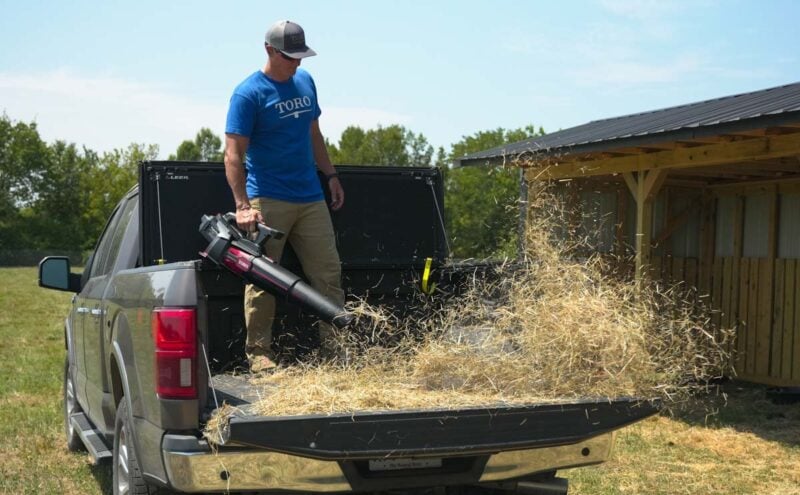
Let’s look at how Toro’s performance and design make this an all-season blower by considering different applications and the performance required to do them.
Spring
You might not think of spring as a leaf-blowing season, but it often is. There may be leaves that fell into your landscaping over the winter and got buried under the snow. Further south, we get a steady stream of oak leaves as the new growth begins to pop, and those little buggers are hard to dislodge from the grass in the yard.
Spring is also a prime time to give your gutters a good cleaning out, since winter likely packed in anything left behind when the snow started falling. Toro even has a gutter cleaner kit that can help you accomplish the task without having to climb up to the roof.
In all of those cases, having the 900 CFM blower’s top-end performance to get those leaves and debris moving is critical to your spring cleanup.
But leaves aren’t the only debris falling into your yard and landscaping. Flowering trees lose their delicate petals, and the wind blows them everywhere. According to Ben, Toro carefully tuned the lowest speed so you can move those petals out of your flower beds without displacing the mulch.
For us, oak pollen pods and pine pollen coat our vehicles as the season rolls on. Using a mid-range throttle setting helps clean them off without jamming them down into vents and other crevices, while full throttle makes quick work of removing them from hard surfaces.
Summer
Summer is peak mowing season, and the 900 CFM blower’s high-performance advantage is clearing clippings off your driveway and sidewalk quickly, along with blowing off your lawn care equipment before you put it away.
That’s not all, though. If you have a back porch on a flatter lot, you’ll likely get grass clippings on it that you need to blow off. Even if it’s screened in like mine, lighter clippings and debris stick to the screen, and you can blow them back out into the yard from the porch side.
Summer is also a great time to clean your garage, and blowing it out is far easier than sweeping. If you go at it full blast, debris in the corners just flies into the air and spreads out to areas you already cleaned, so Toro’s light to medium blowing forces help you clear the entire floor with more control.
If you’re a contractor, this is an excellent blower to have on the jobsite. In addition to general sawdust and dirt cleanup, cutting down overgrowth is common, and you have to blow the larger clippings out of the way. As a bonus, you can easily clear out the dirt and debris that’s been building up in the bed of your truck as well.
Fall
Of course, fall is peak blower season. You’re still mowing, even though it might not be as frequently, and the leaves start coming down. As I mentioned earlier, Toro’s prioritization of higher CFM shines during this season, helping you manage leaf collection efficiently.
Fall is another good time to clean out those gutters. Hit them a few times so they don’t get too filled with leaves or caked up as cold fronts move through. It’ll make your spring chores that much easier.
Winter
When the snow starts falling, Toro’s build and performance keep its 900 CFM blower in the game. For lighter snowfalls, you can keep your snowblower in the garage. Your back deck, driveway, sidewalk, and pool deck are all fair game for this blower. You can even clear a path for your dog if it doesn’t like walking in the snow. Plus, Toro’s front handle makes it easier to blow the snow off your car.
How effectively you can use the blower depends heavily on the density of the snow rather than its depth. Snow that’s wet or has ice in it is heavier and harder to move than when it’s lighter.
Ben also shared a great tip for when there’s some early buildup of ice. Look for cracks in the ice and point the blower straight down at them. Once the air gets into the cracks, pieces of ice will start shedding away from the surface without needing to grab your ice scraper. For surfaces you’re concerned about gouging or damaging, it’s a low-risk way to remove the ice.
Ready to Upgrade to an All-Season Blower?
When Toro set out to develop an all-season blower, it wasn’t about giving the marketing team a clever phrase to put on the website. From the way the product team tuned the performance to the components they selected in the design, it’s purpose-built for year-round versatility.
If you’re ready to upgrade to a blower that’s designed for the way you work year-round, visit your local Toro dealer or order online.
Specifications
- Model: 51827
- Power Source: Toro 60V battery
- Maximum Air Velocity: 165 MPH
- Maximum Air Volume: 900 CFM
- Estimated Runtime w/4.0 Ah Battery: 428 min (low),16 min (high), 10 min (Boost)