

Whether you’re managing a fleet of vehicles, a crib of seasonal equipment, or making sure your fishing boat is ready for the weekend, it’s a challenge to manage multiple batteries. I feel your pain, so I decided to give the NOCO Genius 2×4 battery charger a chance to ease it.
I have two main reasons to keep a multi-battery charger on hand. For starters, my Generac iQ5200 inverter and Snapper T42 lawn tractor are electric start, plus, there’s a variety of other electric-start equipment that comes through our review cycles that require occasional charging and maintenance.
I also run one starting and two deep-cycle batteries on my flats boat that require regular charging to be ready for the weekend.
Keeping an eye on both scenarios, I’ll walk you through what the Genius 4×2 charger has to offer, its limitations, and help you decide whether you should rely on it for your charging needs.
Pros
- Compact design
- Charges lead-acid and lithium batteries
- Charges 6V or 12V batteries
- Automatic charging, maintaining, and desulfating
- Clamps fit a wide range of terminal sizes
- Extendable connectors (extension cables included)
- Four AC connection types included
- Wall mountable
Cons
- Charges at a slow 2A rate
- No jump-starting capability
- Indicators are hard to read in direct sunlight
NOCO Genius 4×2 Battery Charger Basics

Before we jump into what I discovered while using the Genius 4×2, let’s take a look at what it claims to offer.
Specifications
- Battery Connections: 4
- Max Charging Amps: 2 per connection
- Battery Types: Lead-acid (flooded, gel, and AGM), lithium
- Compatible Voltages: 6V or 12V
- AC Cord Length: 75 inches
- Included AC Connection Types: Type A (North America), Type C, Type G, Type I
- Ingress Rating: IP60
Key Features
- Trickle Charger: Charges batteries at a slow rate, improving service life
- Maintainer: Keep seasonal batteries healthy during the off-season
- Desulfator: Automatically detects sulfation and restores performance by reversing buildup
- Thermal Compensation: Avoids under-charging when it’s as cold as -4° F or over-charging when it’s as hot as 104° F
- Status Indicators: Quickly check the charge status with 4-level LED indicators on each bank
- Redesigned Clips: Needle nose jaw design holds stronger on a wider range of terminal sizes than previous versions
- Reach Extensions: Extend the 21-inch clips an additional 10 feet for further reach
Using the NOCO Genius 4×2 Charger
Unboxing
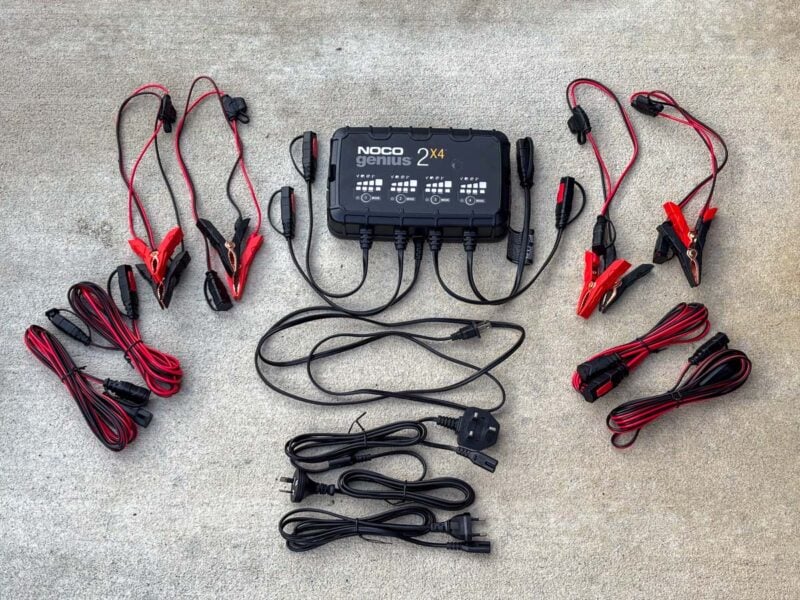
NOCO seems to have prepared the Genius 4×2 for a wide range of applications. The unit itself is compact, has a footprint that’s just 9.4 x 5.7 inches and 2.3 inches thick, so it can fit in places most battery chargers won’t. It also has holes for screw mounting, making it easy to semi-permanently install on a wall in a shop or garage.
For the AC connection, the kit includes what you need for four of the most popular outlet types. For most of us in the North American market, you’ll click the Type A connection in place and never look back. But if you travel between countries, it’s nice that you don’t have to buy additional adapters.
There are also four 10-foot extension cables. The base wires are 21 inches, which works fine in some scenarios. But with the extensions, you can reach nearly 12 feet from the base unit.
Better still, you can mix and match each port and use multiple extensions. Stick with the standard cable in close quarters and then extend to 10 or 20 additional feet as needed. Just keep in mind that long runs will have higher resistance and make your charging times longer. As long as you keep it to 40 feet or less, there’s no meaningful drop in charging times.
You’ll notice the wires are much thinner than the ones you find on many other battery chargers. Since they only need to carry 2 amps, the wire gauge can be thinner. It makes for a much smaller storage footprint, but there are consequences as you’ll see in a minute.
Occasionally Used Batteries
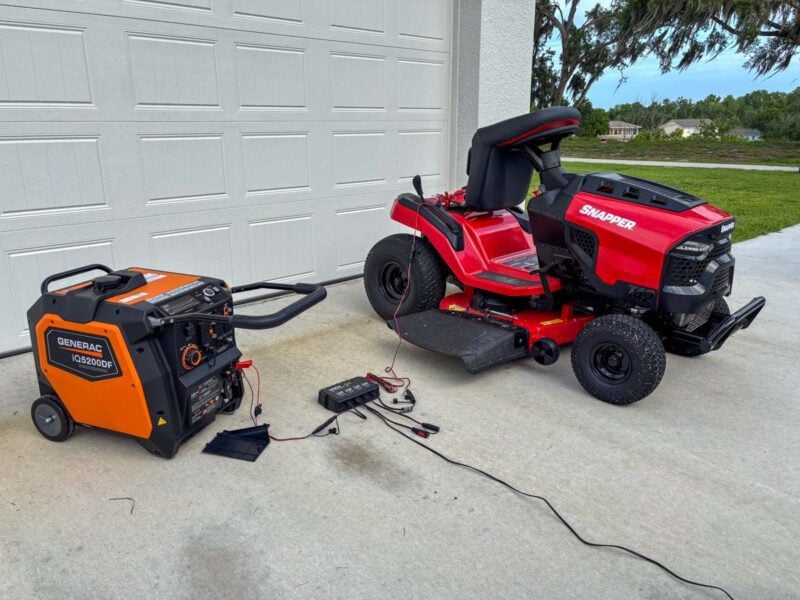
When it comes to maintaining batteries on seasonal equipment and vehicles, the Genius 4×2 is, well, genius. This is where it does its best work.
I pull out my generator every 90 days for a maintenance run and check for issues to make sure it’s ready for hurricane season. My lawn tractor might sit for 4 – 6 weeks during the winter. Other electric start equipment that comes through for review may be on standby for several weeks until we’re ready to start working with it or the weather conditions are right.
By having the Genius 4×2 connected to whatever equipment is on hold, I’m confident that it will be ready to start when I need it. It’s not just that the unit charges, maintains, and desulfates, it’s that it does all these functions automatically. I don’t have to choose the right setting and then switch it back later. I just pick the type of battery and walk away.
By the way, the battery type selector is on each bank. If you’re charging a mix of flooded, gel, AGM, and/or lithium batteries, just match each one on the bank it’s connected to.
It’s a simple, set-and-forget process, so I don’t have to remember to switch my charger from one piece of equipment to another ahead of time.
Regularly Used Batteries
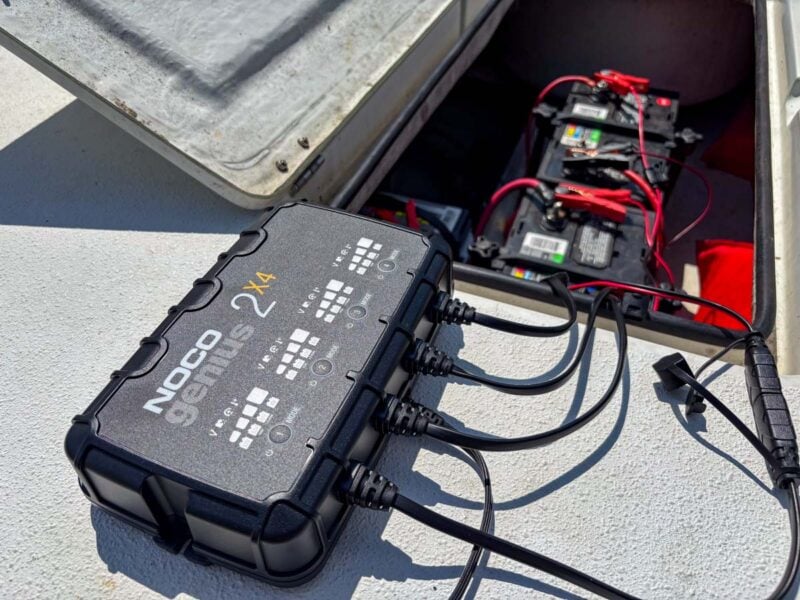
When it comes to batteries you regularly drain down, like my boat batteries, you have to pick your battles. I’m a weekend warrior, so even though I use high-capacity marine and deep-cycle batteries, I generally have 6 days for them to recharge.
That’s important when you consider the estimated charge times of various batteries:
| Battery Size | Time to Charge from 50% |
|---|---|
| 20 Ah (motorcycle) | 7.5 hours |
| 40 Ah (lawn mower) | 15 hours |
| 80 Ah (full-size car) | 30 hours |
| 100 Ah (truck) | 37.5 hours |
| 120 Ah (deisel truck/marine deep cycle) | 45 hours |
Keep in mind these are the charge times from 50% capacity, so it’s much longer if you discharge deeper.
If you’re a tournament angler or take multi-day fishing trips on your vacations, you won’t be able to recover a full charge fast enough to fish multiple days in a row.
If you’re like me, the Genius 2×4 is a more reasonable option, especially when you compare it to the alternatives.
My normal routine is to set my charger up one battery at a time. That’s rubbish, as the British say. The other primary option is an onboard charger. A popular model purpose-built for a 3-battery configuration runs $250, plus I’d have to pay my marine mechanic to install it. It’s the right call if you’re on the water frequently. For me, that’s an expense I don’t need, and the Genius 2×4 is a solid alternative.
Additional Limitations
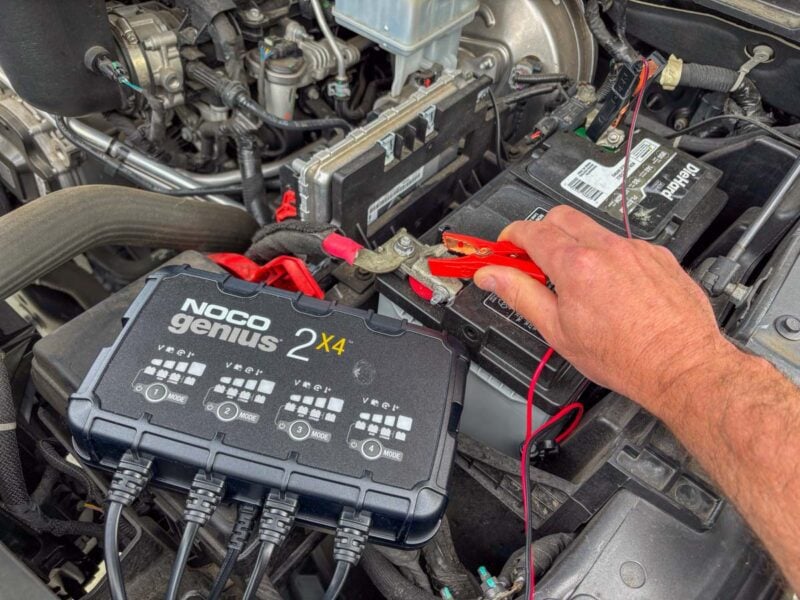
It’s not just the charging times you need to think about when you consider the NOCO Genius 2×4. There are other functions it passes on as a trade-off for its compact size.
The big one is higher-amperage charging. My single bank charger has a 10-amp fast charge function and a 25-amp jump-starting function. The Genius can’t do that.
You can get around the jump-start issue with a lithium jump starter. NOCO has several to choose from, and we’ve reviewed a number with excellent performance.
But the issue of faster charging rates is tougher if you’re dead-set on a multi-bank charger.
One other thing worth mentioning is the indicator brightness. They’re tough to see in direct sunlight. You need to throw some shade over them with your hand to read them well. It’s a minor thing, but one you should be aware of before you buy.
Should You Buy It?
For what it’s designed to do, the NOCO Genius 2×4 is an excellent battery charger. Whether it works for you really boils down to how fast you need your batteries to charge.
For maintaining occasional-use batteries, it’s a no-brainer. Having multiple banks, extended reach, and fully automatic charge, maintenance, and repair functions makes it as foolproof as you can hope for.
For regular-use batteries, it’s a matter of how deep you drain them and how quickly you need them back to 100%. Since it peaks at 2 amps, it’s not the right choice when you need fast charging or emergency starting.
If your charging needs and the Genius 2×4 are a good match, you can pick one up for $199.99. It comes with the charger, four AC connection types, four 10-foot extensions, and four clamps, so you have everything you need to get started.