
The world of battery-powered and electric pressures has certainly come a long way of the years, and Ryobi has played a big part in this evolution. Late last year, Ryobi announced two new electric pressure washer—the 1800 PSI RY141803, and today’s star, the 2100 PSI RY142012. Today, I’m taking a closer look at this new pressure washer to see where it falls in the lineup and to see what it has to offer for the DIY crowd!
Pros
- Compact profile
- Foam cannon storage compartment
- 25-foot non-marring hose
- Medium-duty PSI
- Competitive price tag
- Onboard hose and cord storage
Cons
- No significant drawbacks
Read
Best Pressure Washer
Best Electric Pressure Washer
Ryobi 2100 PSI Pressure Washer Performance
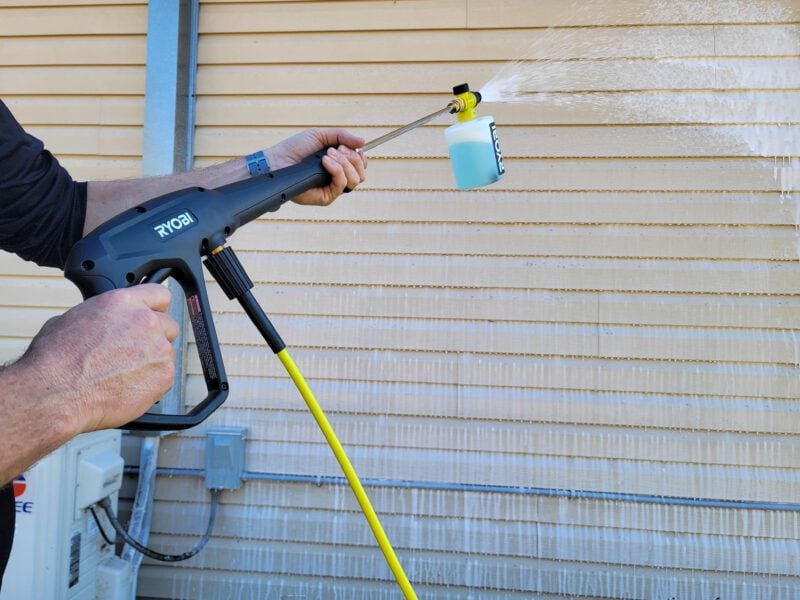
- Max PSI: 2100 PSI
- Max Flow Rate: 1.2 GPM
- Nozzles: 15°, Turbo, Foam Cannon
- Hose Length: 25 ft.
- Cord Length: 35 ft.
- Motor Type: 13-amp brushed
- Pump Type: Axial
Power and Flow
The Ryobi RY142012’s axial pump delivers up to 2100 PSI with a max flow rate of 1.2 GPM and is powered by a 13-amp brushed motor. Axial pumps are fairly common in residential-grade pressure washers and are much more simplistic than Pro-grade triplex pumps. On top of that, there are fewer moving parts, meaning that the maintenance requirements are minimal.
At this pressure level, this is an ideal option for light to medium-duty cleaning applications such as cleaning sidewalks, removing mildew from vinyl fencing and siding. It’s even gentle enough for washing vehicles if you don’t get the nozzle too close to your paint. It’s also worth noting that you can pair this pressure washer with a small surface cleaner, but you may need to work a little slower to allow the 1.2 GPM flow rate to remain effective.
Read
Pressure Washer PSI VS GPM: What’s More Important?
It’s important to note that Ryobi pressure washers are certified based on PWMA procedures. While some brands play games with PSI Max or GPM Max to make it look like they’re more powerful than they really are, you can trust the performance ratings from Ryobi and other brands that hold to PWMA standards.
Read
Pressure Washer PSI That’s Too Good To Be True? It Probably Is!
These specs are right in line with the most popular performance levels as electric pressure washers go. Of course, there are a few models like the EGO 56V HPW3200 and the Greenworks GPW3000 that hit the 3,000 PSI mark, but they also come with a much higher price tag.
Ryobi 2100 PSI Pressure Washer Design Notes
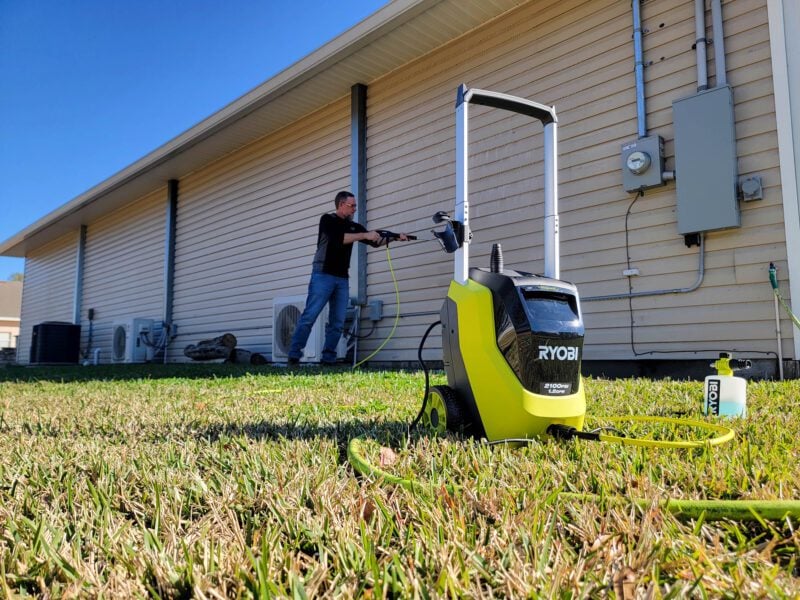
- Model: Ryobi RY142012
- Power Source: 120V AC
- Storage Dimensions (LxWxH): 11 in. x 14.5 in. x 25 in.
- Weight: 22 lbs
- Wheel Diameter: 5.75 in.
Profile
This pressure washer is relatively lightweight and compact, tipping the scales at around 22 pounds and standing just 25 inches tall, not including the handle. However, the telescoping handle collapses down for easier storage in a cramped garage.
The wheels are just shy of 6 inches in diameter, allowing them to roll smoothly over concrete and grass without much trouble. Of course, the lightweight design also plays a significant role in its easy portability.
Hose and Accessories
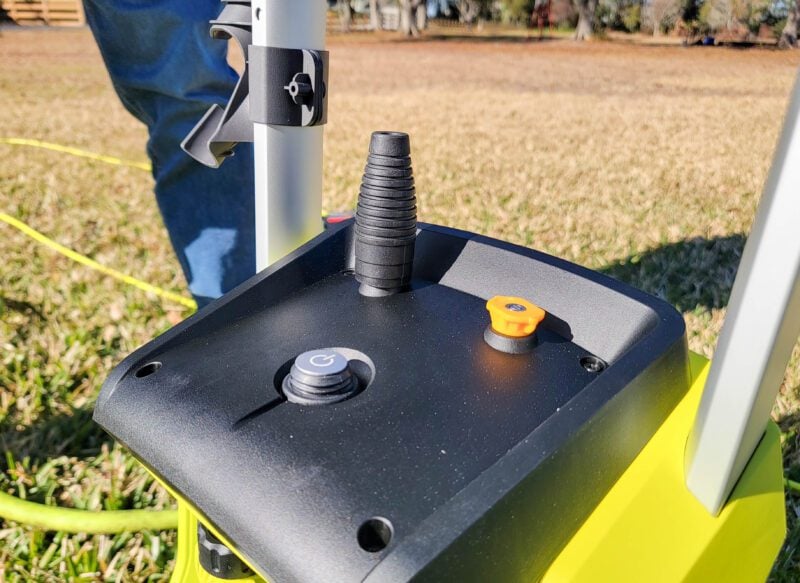
This model comes with a standard 15-degree nozzle, a turbo nozzle, and a foamer. If you’re new to pressure washers, the turbo nozzle has a 0-degree tip but spins in a 25-degree pattern, giving you more powerful cleaning with a broader spray.
The foamer may also be a new concept to you. It essentially removes the soap dispenser from the pressure washer and connects it directly to the soap nozzle, similar to a foam cannon. It doesn’t create as thick of a foam as a foam cannon, but it’s excellent for applying a cleaning agent to your work surface while avoiding contact with any of the pump components.
The first two nozzles store right on top of the pressure washer, while the foamer stows away in an enclosed compartment of the front. Most pressure washer soap cannons require separate storage from the pressure washers themselves, so it’s clear Ryobi put some thought into this design to address a common accessory pain point.
Note that if you would like a dedicated 0-degree or 40-degree nozzle, you’ll need to purchase those separately.
To go with those nozzles, Ryobi equipped this pressure washer with a 34 1/2-inch wand that stows conveniently on the telescoping handle.
As for the hose and power cord, those stow away neatly in a pocket on the back of the pressure washer. Admittedly, the compartment is a little small, so getting both the hose and cord to fit took a little experimenting.
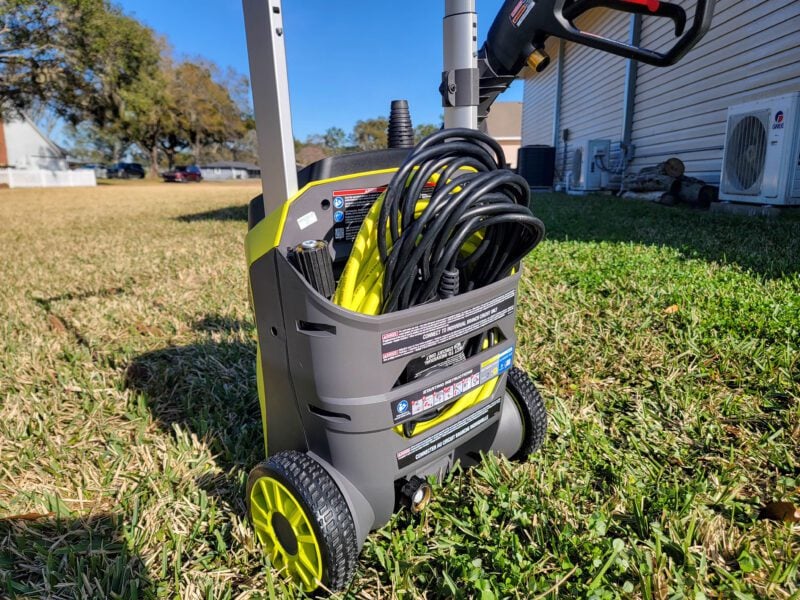
I found the best method was to coil the hose and insert it into the pocket first, and then nestle the power cord inside the coiled hose. Optionally, you could always coil the power cord around the telescoping handle, but personally, it doesn’t look as neat and tidy.
Should You Buy It?
After getting some hands-on time with this pressure washer, there are a few things that really stand out to me. First, the power level and flow rate are spot on for a wide range of cleaning applications, but it’s also light enough for more delicate tasks. Second, the design is purpose-built for easy, compact storage and transportation. Plus, it’s electric, so you can get to work faster, and there’s no engine maintenance, noise, or emissions to worry about.
The pressure and water flow are dialed into a popular level, so it’s an excellent choice for most cleaning tasks around your home. Be sure to grab Ryobi’s surface cleaner to clean your driveway and sidewalks more efficiently, though. For the price and design, it’s hard to beat for regular outdoor cleaning.
That said, this isn’t a Pro-grade high-performance model, so don’t expect it to remove things like graffiti or work as quickly as commercial pressure washers do. It’s also not a top-of-the-line brushless electric model, so you could gain better cleaning efficiency if you’re willing to up your budget.
Like what you see? The Ryobi 2100 PSI Electric Pressure Washer retails for $199 and comes with a 3-year limited warranty.