
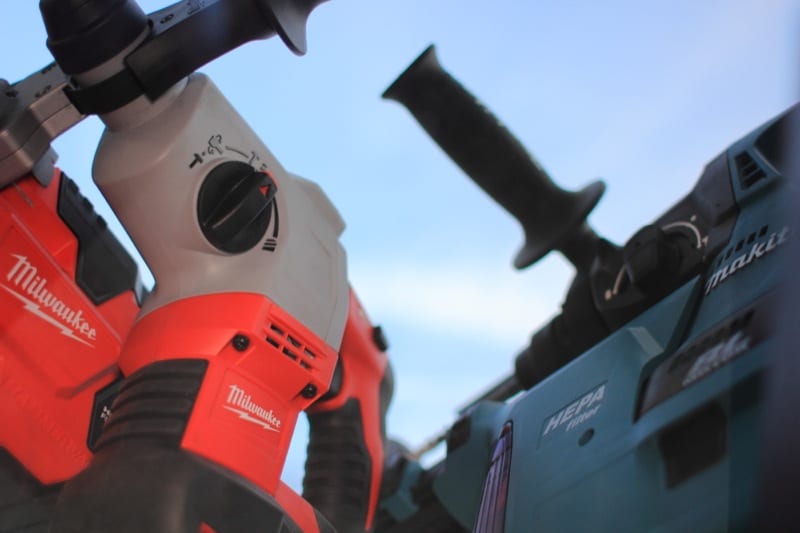
Currently, we’re aware of exactly two cordless HEPA rotary hammer vacuum systems on the market. One is the Milwaukee M12 HammerVac, and the other is the Makita DX01 HEPA Dust Xtraction Vacuum Attachment. On the surface, both the Milwaukee & Makita Cordless Rotary Hammer Vacuums look to be excellent tools from manufacturers whose tools, on the whole, are consistently reliable, tough, and long-lasting. I can, therefore, already hear the protests of those on opposite sides of the fence. And that’s my point—most avid tool users are loyal to a fault, so persuading any of them to jump ship is pointless.
Introduction
It doesn’t help that both tools have more than ample drilling power, and there was little difference in their speed or performance in concrete or cinderblock. Both excelled at chiseling and demo work in old tile, mortar and concrete. Each basic tool also had similar controls that were easy to access and adjust.
The added wrinkle in this side-by-side is dust containment. So, while you may be a dyed-in-the-wool Milwaukee fanatic, Makita may have a surprise for you. If you’re a fan of Teal, though, Big Red might have you coveting some of its features. Either way, here are some different aspects of each of these cordless rotary hammer vacuums to consider before reaching for your wallet.

Milwaukee & Makita Cordless Rotary Hammer Vacuums Set-Up
One of the methods to my madness in reviewing any tool is to see how easily I can figure out how it’s put together, without reading the instructions. Once I think I’ve assembled everything, I generally check my work against said instructions to find out if I was brilliant or not. If nothing else, I’m hoping this self-challenge staves off dementia in my later years, like crossword puzzles.
When assembling the Makita, I was a stone-cold genius right out of the box. Slide and click. Done. And it worked.

Milwaukee—not so much. It took a few minutes of simply staring at the pieces and parts in the case before I was able to connect the extractor. I compared my assembled rig with the drawings in the booklet. I was pretty sure it was all put together correctly, but the pictures weren’t much help. It works, though, so I did something right.
On a side note, the HammerVac and Xtraction Vacuum pack down into two blow-molded cases. Yes—two cases, for one tool. The flip side of that coin is that you have several rigging options for the Xtraction Vacuum, so it’s a mixed blessing.
The Makita and accessories fit into one bag. That’s something to consider if space is hard to come by in your truck, van, or on the job site.
Battle of the Heavyweights
The hard, cold truth is this: if you use a rotary hammer on a daily basis, the majority, or at least a significant chunk of your work, is likely above your head. Drilling into concrete 10 feet off the ground is hard work. The upside is beefy forearms and strong shoulders. But really, the weight and balance of any tool used for these jobs is at least important to consider.
Each of the tools weighs in at over 10 pounds, with Milwaukee’s fully dressed unit about a pound heavier than Makita’s. Is it noticeable right off the bat? No, not really, but after a day of hoisting that extra pound over your head, it may tend to get on your nerves—literally.

Makita won the balance challenge hands down. Its inline form naturally results in a balanced feel in your hands. The tool doesn’t have a tendency to lean left or right. Once I had the Milwaukee correctly set up, balance became an issue. To its credit, the adjustability of the HammerVac seems nearly infinite. Yes, that’s an exaggeration, but it sure gives you some options as far as the placement of that little sucker is concerned.
The only problem is that adjustability means a whole new set of buttons, locks, knobs, and clamps to set, adjust, tighten, and lock. About midway through the process, I almost forgot why I was adjusting it. Dementia may be creeping in sooner than I thought.
At the end of it all, the Milwaukee HammerVac isn’t a terribly balanced machine. Unlike the Makita Xtraction system, it will not sit straight up on its own without the kickstand/auxiliary handle. More importantly, it is a little bulkier in use, especially if you’re working those tight corners and spaces that every job seems to have, but in that case, you could always remove the dust unit.

Details, Details
At the end of the day, the real winner is the tool and dust extractor that does the best job of extracting dust. In that case, they’re co-winners, which is something I detest in our PC world, unless it is actually the truth.
The Milwaukee extractor uses an isolator brush around the tip of the bit, much like a fiber door sweep. Because it’s composed of thousands of short synthetic hairs, it does a superb job at keeping a tight seal around the bit and sending dust down the vacuum port. Makita chose a rubber grommet system that seems effective, but leaves one to wonder what would happen if a sharp piece of aggregate tangled with it. Toughness factor here has to go to Milwaukee.

Both the Milwaukee & Makita Cordless Rotary Hammer Vacuums allow for adjusting the bit depth stop incorporated into the extractors. Red has a few more buttons and locks to fiddle with, but once you figure out exactly how cleverly it’s engineered, you’ll realize how versatile the mechanism is.
Speaking of options, the Milwaukee HammerVac lets you choose between ON, OFF, and AUTO. Why have an option for ON? Well, combine that with the optional crevice tool and you have a Dustbuster, of sorts. It may be a bit awkward to hold onto as you’re cleaning out the shop, but for hard-to-reach spots on a job site, it works in a pinch. Plus, it’s a lot easier than running back to the truck to grab the shop vac, right?
Collecting the Dust
Makita’s extractor has a clear plastic housing, which makes a show out of dust collection. For whatever reason (probably my A.D.D.), it’s fascinating to watch the dust swirl around inside the container. I remember staring at my glass-top washing machine when I first bought it, but the novelty eventually wore off. In the case of the Makita visual experience, I’m a little concerned about dropping the tool and watching that clear plastic container become an amalgam of shards and splinters.

Milwaukee’s dust container is situated inside the extractor unit and seems to be a bit more protected. Score another point for Red. Wait, what’s the score now? Someone should keep track.
So, which dust containment system worked best? I wish there were a clear-cut winner to report, but the fact is—they both did an excellent job at removing nearly every speck of dust from the holes we drilled. And that goes for both overhead and horizontal drilling. Of course, I wouldn’t advise testing these over a patient in surgery, but I’d be tempted to try—they were both that good.
Over the course of time, as the filters and containers get full, that efficiency is bound to decrease, but out of the box, there really is no appreciable difference in their sucking power that we could see—and we looked.
One Tool, Two Batteries?
OK, it’s technically a tool with an accessory attached, but go with me on this.
There are sometimes drawbacks to being all things to all people. That’s often the case with “Universal” tools of any kind. Because the HammerVac is designed to work with other brands of rotary hammers and hammer drills, it requires its own power source.

Just think of the technology and licensing that would be required to piggyback on another brand’s power system. We’re much more likely to see a flying pig before tool companies share or interface battery tech.
That being the case, the HammerVac runs on Milwaukee M12 Li-ion batteries. That means that no matter what tool you attach the unit to, you’ll be lugging around two batteries, including any Milwaukee brand cordless tool.
Not so with Makita. Since the extractor works only with the Makita LXRH01Z Rotary Hammer, it simply leaches battery power from the already-installed tool battery. Sure, that shortens the drill’s power allotment, but it’s one less thing to keep track of and lug around.
When The Dust Clears
Clearly, it’s tough to compare two animals with decidedly different goals. On one hand, Makita is presenting you with a dedicated accessory that delivers performance and convenience all tied up with a bow in a neat little package. That should make Makita loyalists ecstatic, and rightfully so. You should probably keep a couple of extra dust cups on hand, just in case you get fumble-fingered.

Milwaukee, however, is offering a multi-tool. That’s not a typo. Its HammerVac system is designed to play well with others as well as by itself. (Remember that crevice tool attachment?) It lives up to these goals, but that comes at a cost—a separate power plant and some rigging that could leave some scratching their heads at assembly time.
I guess the real question is—do you prefer Red or Teal?