
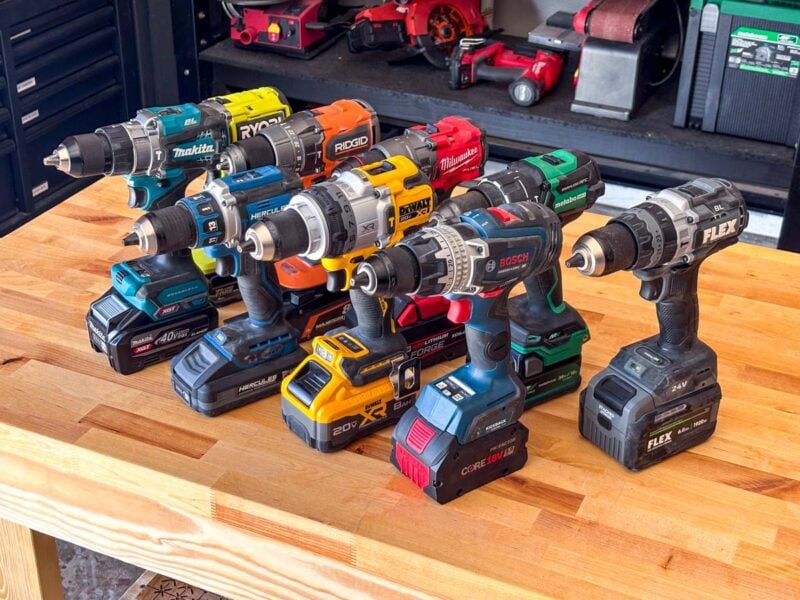
If you’ve ever wanted to pull back the curtain and learn more about how Pro Tool Reviews tests cordless drills, today is your day. We offer a summary of our testing methods in the comparison guide, so you can have confidence in our results. However, in this article, I’m going to share a bit more for those of you who are interested in not only how we test, but why we choose the tests we do.
READ
Best Cordless Drills Head-to-Head Review
RSS Screwdriving Test

RSS (Rugged Structural Screws) are often favored over lag screws. For the same structural strength, they’re smaller and easier to drive. It’s possible to drive them with either a cordless drill or an impact driver, so we run the same test with both types of tools.
You might be surprised to find that drills are much faster in this application. In our 2026 test results, every single Pro-grade drill we tested was more than twice as fast as the fastest impact driver. Food for thought the next time you’re working with RSS screws.
READ
Best Cordless Impact Driver Head-to-Head Review
For this test, we start by gluing OSB subfloor boards together and drive a 1 1/2-inch pilot hole to ensure the 3/8-inch x 8-inch screws go in straight.
We know OSB isn’t the typical material you’re driving RSS screws into during a construction project. However, most lumber is inconsistent in its density and knots, whereas OSB is much more predictable. The glue makes the test a little bit tougher and won’t allow the boards to separate or slip while we’re driving.
Before we start the test, we ensure the drill is set to high speed, and the battery we’re using has a full charge.
With the RSS screw set in the pilot hole, we start the timer on the trigger pull and stop it once the head is flush with the top board. We use only enough downforce to keep the bit engaged with the fastener so that the drill has to do all the work.
Thanks to 4K video, we’re able to pull times down to the 1/100th of a second. The result we report is the average of three successful runs. If we note any outliers or detect errors, such as an angled drive or bit slip, we’ll run the test again until we get three solid results.
Spade Bit Test

Spade bits are commonly used for rough-in jobs and present a medium-load test for our drills. We use the 1-inch size for our tests and only use ones with a self-feeding tip. This helps us maintain consistency as we only need to control the drill rather than trying to apply the same downforce with each hole.
Like our RSS screw test, we use the same material because of its consistency: stacked and glued OSB subfloor. This time, though, we only stack it 4 inches thick, so we’re able to measure the time it takes to bore all the way through.
We start with a freshly charged battery and the drill set to high speed. In today’s cordless world, it’s unusual that a drill can’t complete this test in its high-speed gear. However, if it can’t, we’ll drop it to a lower gear until it can consistently complete the task.
As before, the results we report are the average of three successful runs, throwing out any outliers or errors.
Self-Feed Bit Test
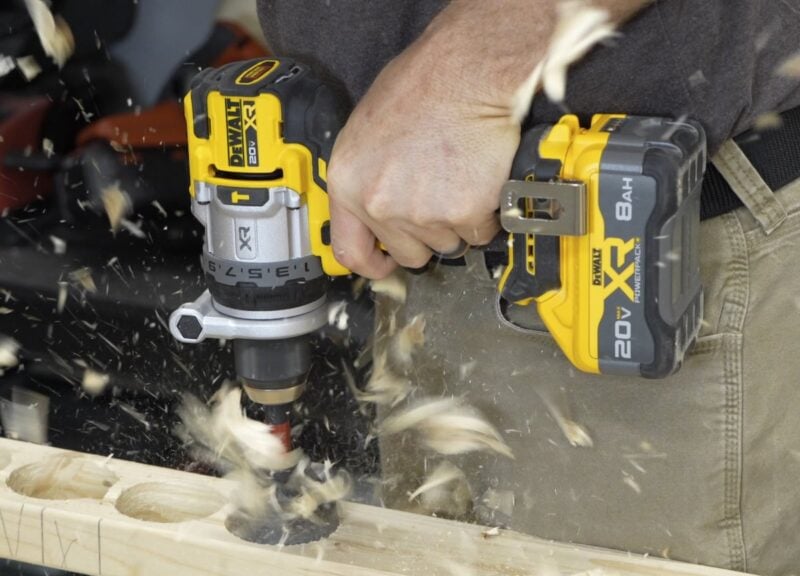
Staying on the application theme of rough-ins, our third performance test involves a 2 9/16-inch self-feed bit. Common for plumbing rough-ins, it’s a tough ask of a cordless drill, and it’s much more common that some will not be able to complete it in the high-speed gear.
For this test, we switch the material to 2×4 studs. From our suppliers, they’re going to be pine. Even though studs aren’t as consistent as OSB from a density standpoint, the nature of a self-feed bit’s cutting action and OSB layered chips made it hard to get consistent results. Our early test development gave us better consistency with studs.
We’re careful to keep an eye out for knots or other indicators of major density changes. That, combined with analyzing and retesting any outlier results, gives a high degree of confidence in the validity of the test.
Like our other tests, we start with a fully charged battery, and we’re looking for three successful runs with no outliers or errors. We report the average time from trigger pull to break through.
Concrete Bit Test

When we test hammer drills (which is our preference if there’s a choice), we test their drilling speed in concrete.
Well ahead of our testing day, we pour 4000 PSI concrete into forms and let it fully cure according to the manufacturer’s guidelines (usually a 28-day minimum).
Starting with a fully charged battery, the drill in high gear, and in hammer drilling mode, we load a 3/8-inch carbide-tipped concrete-specific bit into the chuck and put a flag made from electrical tape at the 3-inch depth mark. As we drill into the concrete, a small pile forms around the hole, and this tape flag pushes it out of the way, making it easier for us to see when we’ve reached our target depth.
We report the average of three successful tests, tossing any outliers or errors. We don’t use a pilot hole in this test, so we’re careful to drill straight down and retest if we started at an angle.
Almost every drill we test is capable of concrete drilling with a 1/2-inch bit. However, most manufacturers only recommend 3/8-inch as the maximum capacity. To avoid testing outside the manufacturer’s design intent, we stick with the smaller size.
Testing Compact Cordless Drills and Hammer Drills

The tests I described above are how we test flagship and high-performance drills. Those tests can push compact and mid-range drills beyond their intended capabilities, though.
So, when we evaluate drills designed for lighter-duty tasks, we typically scale down our tests by using smaller bits, and we often skip the self-feed bit test altogether.
Of course, a set of results with no context isn’t very helpful, so we will only report those results when we have data from other drills in the same class we’ve tested in the same manner.
Additional Tests
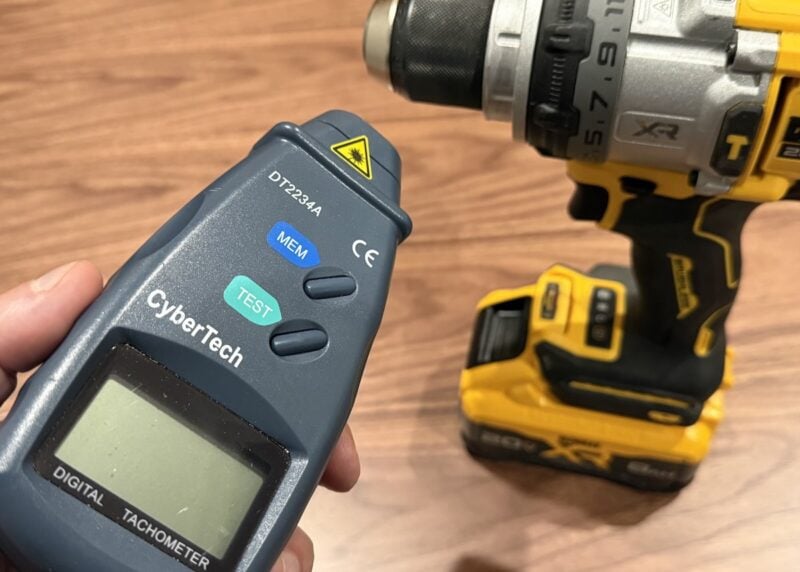
While performance testing is where most of our time and effort go, we also evaluate a number of other items. Some are highly objective, like weight. Others are more subjective, such as our opinion of the handle shape and overmold grip.
Here are the other items we measure and/or evaluate during our testing:
- Speed and torque ratings
- Bare weight
- Weight with tested battery
- Balance
- Length
- Drilling and driving modes
- Ergonomics
- Feature set
- Battery system
- Warranty
- Price