
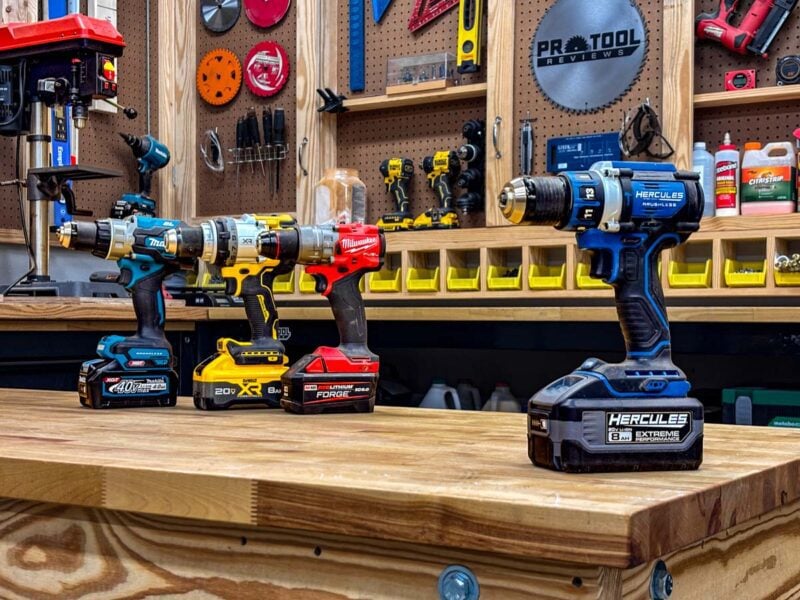
Harbor Freight is well-known for comparing its cordless power tools against Pro brands like Milwaukee and DeWalt. I’ve read the fine print, and on paper, the claims seem legit. But what happens when we leave the spec sheet and start doing real work? We compared Harbor Freight’s Hercules hammer drill to flagship Pro models from DeWalt, Milwaukee, and Makita to find out.
The first time around, some of you pointed out that Hercules was unfairly handicapped because we used the 4.0Ah Extreme battery instead of the 8.0Ah Extreme. We heard you, and I got my hands on the larger battery to run a new set of tests. And just to add fuel to the fire, I also retested DeWalt, Makita, and Milwaukee with their respective advanced 1P packs.
Hercules vs Pro Drill On Paper
Harbor Freight caters to people who want to spend less on their tools. Before we jump in, let’s consider the prices of the drills we’re comparing.
| Model | Bare Tool | Kit | 2-Tool Combo |
|---|---|---|---|
| DeWalt DCD1007 | $249 | $299 | $329 |
| Hercules HCB92B | $79.99 | Not Available | $249.99 |
| Makita GPH01 | $259 | $524 | $469 |
| Milwaukee 2904 | $229 | $329 | $349 |
At the risk of stating the obvious, Hercules has a much lower price tag. It’s one of the reasons the Hercules line is so compelling.
Harbor Freight specifically calls out the Milwaukee 2904 as the hammer drill to compare Hercules to, so it’s part of our test group. Here’s how all four drills compare on paper:
| Model | Max Speeds | Hammer Rate | Max Torque |
|---|---|---|---|
| DeWalt DCD1007 | 450/1300/2000 RPM* | 38,250 BPM | 1530 UWO** |
| Hercules HCB92B | 550/2000 RPM | 32,000 BPM | 1200 in-lbs |
| Makita GPH01 | 650/2600 RPM | 39,000 BPM | 1250 in-lbs |
| Milwaukee 2904 | 500/2100 RPM | 33,000 BPM | 1400 in-lbs |
** Note that DeWalt specs the power of their drills in unit watts out rather than in-lbs of torque.
A quick glance shows us that Hercules is starting at a disadvantage in speed and power. However, it’s not like it’s completely outclassed. It wasn’t that long ago that the 2000 RPM and 1200 in-lbs of torque Hercules claims would have been the best available. When brands like Milwaukee first pushed into those performance levels, we were thrilled with them and praised the productivity gains compared to previous generations.
The point is that even though Hercules is a little behind on paper, we still expect it to at least be in the ballpark of its competitors in these tests.
How We Tested
For this evaluation, I’m focused only on performance, since that’s the claim we’re testing. Normally, we’ll also consider features, ergonomics, and other characteristics as we determine a tool’s final rating.
We ran all our drills through the same series of tests, controlling as many variables as possible to ensure fair and representative results. While you can read the full details in our Best Cordless Drills Head-to-Head Review, I’ve included a quick breakdown of each below, along with the results.
Battery Selection
To get the most out of each hammer drill, we tested with two batteries: the smallest 1P advanced pack and the most reasonable 2P advanced pack that wasn’t stupid-heavy.
| Model | Tested 1P Battery | Tested 2P Battery |
|---|---|---|
| DeWalt DCD1007 | PowerStack 1.7Ah (30.6Wh) | PowerPack 8.0Ah (144Wh) |
| Hercules HCB92B | Extreme 4.0Ah (72Wh) | Extreme 8.0Ah (144Wh) |
| Makita GPH01 | 2.5Ah (90Wh) | High Power 4.0Ah (144Wh) |
| Milwaukee 2904 | High Output 3.0Ah (54Wh) | Forge 8.0Ah (144Wh) |
RSS Screws
- Material: Stacked and glued OSB subfloor, 9 inches thick
- Fastener: GRK 3/8 x 8-inch RSS screw
- Bit: T25
- Pilot Hole: 1 1/2-inch
- Mode: Drilling, high speed
| Model | Average Speed 1P Battery | Average Speed 2P Battery |
|---|---|---|
| Makita GPH01 | 2.00 sec | 2.03 sec |
| DeWalt DCD1007 | 3.29 sec | 2.42 sec |
| Milwaukee 2904 | 3.97 sec | 2.49 sec |
| Hercules HCB92B | 7.98 sec | 3.43 sec |
Editor’s Note: Hercules had to be run at low speed with its 4.0Ah battery to finish the test.
This is the easiest test we put our drills through. While Makita’s 2600 RPM top speed easily won, we expected Hercules to be closer to DeWalt and Milwaukee.
It was interesting to see that the three Pro models were able to complete the test in high speed with their smaller batteries, but Hercules had to drop into low gear. Clearly, using the larger 8.0Ah Extreme battery helped close the gap significantly.
Spade Bits
- Material: Stacked and glued OSB subfloor, 4 inches thick
- Bit: 1-inch self-feeding spade bit
- Pilot Hole: None
- Mode: Drilling, high speed
| Model | Average Speed 1P Battery | Average Speed 2P Battery |
|---|---|---|
| DeWalt DCD1007 | 3.61 sec | 2.54 sec |
| Makita GPH01 | 2.77 sec | 2.62 sec |
| Milwaukee 2904 | 3.15 sec | 2.62 sec |
| Hercules HCB92B | 3.88 sec | 3.33 sec |
Moving on to our mid-range test, we still expect all of these drills to complete it in high speed, which they all did easily. Hercules closed the gap, but was still a noticeable distance behind.
Self-Feed Bits
- Material: 2 x 4 pine stud
- Bit: 2 9/16-inch self-feed bit
- Pilot Hole: None
- Mode: Drilling, high speed (low speed if unable to complete in high)
| Model | Average Speed | |
|---|---|---|
| Makita GPH01 | 1.59 sec | 1.59 sec |
| DeWalt DCD1007 | 2.83 sec | 1.73 sec |
| Milwaukee 2904 | 2.50 sec | 1.89 sec |
| Hercules HCB92B | 5.50 sec | 2.18 sec |
Switching things up to the toughest test we run, Hercules once again lost ground to its competitors with its smaller battery. We weren’t able to get it to complete the run in high speed, so we had to drop it to low.
We thought the shift to the 8.0Ah battery would make a difference, and it did. However, it wasn’t a total success. We were able to get enough complete tests in high gear to get an average, but it did stall several times that we didn’t count.
Concrete Bits
- Material: Fully cured 4000 PSI concrete
- Bit: 3/8-inch carbide-tipped concrete bit
- Drilling Depth: 3 inches
- Pilot Hole: None
- Mode: Hammer drilling, high speed
| Model | Average Speed 1P Battery | Average Speed 2P Battery |
|---|---|---|
| DeWalt DCD1007 | 6.39 sec | |
| Milwaukee 2904 | 6.84 sec | |
| Makita GPH01 | 7.56 sec | |
| Hercules HCB92B | 9.52 sec |
The concrete retest proved to be a problem. The other three tests we ran rely on self-feeding bits and screws, so they’re easily repeatable. With concrete bits, we have to control the downward pressure by hand. After analyzing the results, it was obvious my technique was different than Tom’s, who ran the first set of tests. My results were significantly faster, so the data isn’t a reliable comparison between these drills.
Final Analysis

Does Harbor Freight’s Hercules hammer drill have what it takes to compete against premium professional brands?
I’m sticking with my original answer. No, not based on the tests we’ve run. However, it’s clear that the 8.0Ah Extreme battery did make a difference and made Hercules a more competitive hammer drill.
Even though it didn’t keep up with flagship models from DeWalt, Makita, and Milwaukee, it was able to complete all of our tests, and we didn’t feel like we had to strain the drill to do them. In fact, I’d say from a performance standpoint, it closes the gap enough to be a relevant option if you’re willing to take a step down from the top tier in order to save some money… but you need the larger 8.0Ah Extreme battery to realize it. Furthermore, its size, weight, and handle comfort make it a nice drill to use.
But that begs the question… what is the price difference by the time you add it all together? The Hercules hammer drill doesn’t come as a kit, so you need to buy everything a la carte. That’s $79.99 for the hammer drill, $99.99 for the battery, and $49.99 for a basic charger. Your total for all three is $229.97.
Now, that’s still a nice chunk of change lower than any of the other drills we tested in this group. If you ask me, I’d be content with the 2-tool combo and the two 5.0Ah batteries that come with it. Yes, the performance won’t be quite as high, but you still get two capable tools to get you started for $249.99.
So, if you’re going to buy the Hercules hammer drill (or its drill driver counterpart), buy it because it can do the same jobs we use our Pro drills for and has a compelling price tag. Just don’t expect it to work as quickly as models that cost twice as much or more.
READ


I worked construction for 6 decades. The more expensive tools are what thiefs go after. I’ve had my share of expensive name brand tools stolen over the years…but never had a Harbor Freight or Ryobi tool taken. It wasn’t until i got older i learned that price matters. There’s not too many circumstances that expensive brands would make ANY “noticeable” difference. On paper….yes…but in real use the difference are impossible to tell the differences.
It’s too bad Ryobi wasn’t part of the test. It’s difficult to not like how Ryobi has such a large choice of tools their famous battery system can be used with.
Ryobi was part of the main group. You can see those full results here: https://www.protoolreviews.com/best-cordless-drill-reviews/
At the company I work for, we were solidly in the Milwaukee camp. When we opened a third site, I opted for Hercules simply based on the idea that if someone from another shop “borrowed” a tool, it would be easy to spot and useless to them as soon as the battery ran out of juice.
After two and a half years of serious abuse, none of the Hercules tools have died not have any of the multiple batteries crapped out.
There are times that I run a multi-tool for an entire work day. Milwaukee couldn’t keep up and I was constantly replacing them.
I am perfectly fine with a more reliable tool that’s a little bit slower since that’s still less time in the long run if you are waiting on a new tool to be delivered or sent back from a repair shop.
Just my two cents
Thanks for sharing that! It’s great to get a longer-term perspective on how Hercules is doing in the field.
Plus can’t forget about the 5 year warranty the 20v Hercules tools come with. All in store exchanges too. The batteries even have 3 year warranties.
No. As you said twice in the article, this isn’t a fair test, go get the eight amp hour battery and do it again, this article should have never even released, it’s immediately skewed by the offset of power.
This is poor journalism, it feels like you just needed to get an article out and chose to run it even with the lesser capacity battery.
If you ad the cost of the 8 Amp Hour battery how much closer is the overall price comparison?
The battery is $100, so you’d be in for $180. If you need a charger, that’s another $50, so $230 all-in.
If you don’t need the hammer function, you can get the drill kit for $98 with a 2Ah battery and charger, and then just add the 8Ah battery and spend a little less.
None of the other drills we tested comes with those higher-capacity advanced batteries in their kits, so those would be add-ons as well, and you still come out way ahead on price with Hercules.
You are right. It waa hard to not notice at least three sentences that technically did not make sense how they wrote it. Yes. I knew what it meant…but the grammar was rediculously bad. 6th grade writing.
Which ones? I’m happy to jump in and edit anything that’s confusing.
Not in the trade anymore and my former trade was not one that revolved around drilling speed – accuracy and abiding to established codes and state laws is the preeminent philosophy. Thus, that Hercules (which I do not own), is more than good enough for 99% of Americans. It will do the job handsomely and I would strongly recommended for DIY use and for light-trade work.
Meanwhile, I’ll stick with my trusty DW.
You bring up a really good point! I’d say the majority of my real-world drilling frustrations have more to do with walking bits and runout than drilling speed.