
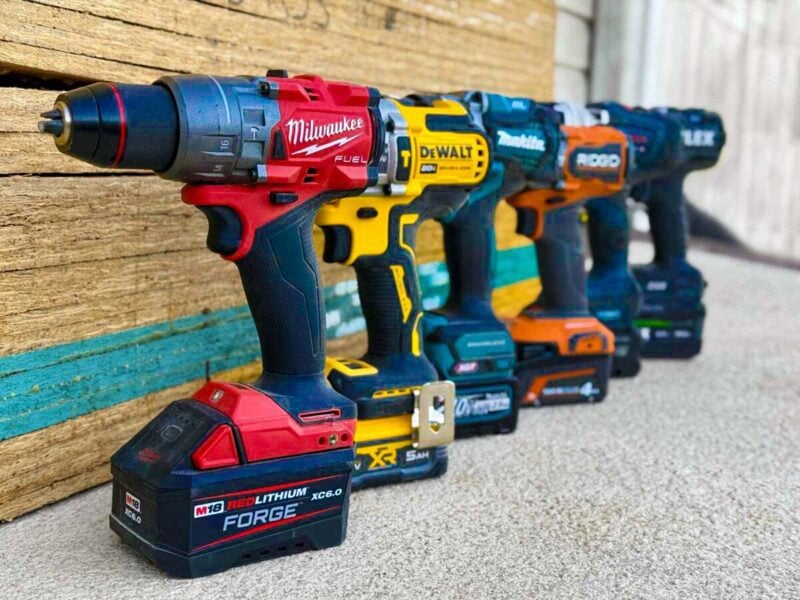
When I started at Pro Tool Reviews almost 13 years ago, there were no cordless drills that exceeded 1000 in-lbs of torque, and 2000 RPM was about the best you could hope for.
Lithium batteries had finally gained widespread traction, but the advancements of tabless connections, pouch cells, or even high-density round cells hadn’t found their way into the market. Brushless motors were becoming more common, but hadn’t completely taken over.
In 2015, we got our hands on three cordless drills with torque ratings over 1000 in-lbs. Hilti’s SF 10W-A18 boasted 1062 in-lbs. Makita launched the XPH07 and broke the barrier with 1090 in-lbs of torque. Then, Milwaukee hit 1200 in-lbs on its M18 Fuel 2703/2704, and we thought we’d arrived at the ultimate performance level for the traditional pistol grip class of drill.
Things settled down for a while, but then in 2021, Flex exploded onto the scene and raised the mark to 1400 in-lbs. Makita upped the ante once again, using its 40V max XGT battery system to push 1590 in-lbs in its GHP03 model. Most recently, Flex expanded its limits higher to hit 1500 in-lbs and a blazing 3000 RPM in its second-generation flagship hammer drill.
Tim “The Tool Man” Taylor would be impressed.
READ
Best Cordless Drills Head-to-Head Review
How Much is Too Much Power?
But how much is too much? Are cordless drills becoming too powerful?
I suppose that depends on what we mean by “too much” power. By my reasoning, it would mean dangerous levels of power. Performance levels that would put you at undue risk of injury.
No major tool brand I know of would knowingly put their users at risk. Sure, there’s inherent risk in the trades, but regulations, training, and processes exist to mitigate them as much as possible.
Efforts to mandate certain highly effective safety features, such as SawStop’s flesh detection technology, have failed. Yet, there are safety features that make so much sense they become a voluntary industry standard. For cordless drills, that technology is kickback control.
Every major manufacturer I’m aware of uses kickback control on their high-torque drills. While it won’t prevent every possible drill injury, when it comes to mitigating the danger of extreme torque levels, it’s highly effective. Combined with properly matched side handles, injury risk goes way down.
So I would say, no, cordless drills aren’t becoming too powerful.
READ
Cordless Drill Kickback Control: Why It’s (Mostly) Non-Negotiable
Is All That Power Necessary?
But let’s shift the premise: Are cordless drills becoming unnecessarily powerful?
Or to rephrase it, are there any real benefits to pushing performance higher?
When Milwaukee’s M18 Fuel drill first hit 1200 in-lbs of torque, one of the biggest benefits wasn’t its ability to hit that new benchmark; it was what we could do in high gear that we couldn’t before. For the first time, we could bore 2 9/16-inch self-feed bits into studs in high gear instead of the slower low gear. For rough-in applications, it was a huge jump in productivity.
While there’s always the drill’s specific gearing in play, raising the maximum torque also improves the capabilities of your high speed gear.
In our own evaluations, Josh came across a surprise result when he ran the Flex FX1272T through our standard drill tests. It was able to sink a 10-inch x 1/2-inch lag screw. Normally, that’s something only our elite mid-torque impact wrenches can do.
READ
Best Cordless Impact Wrench Head-to-Head Review
Giving a drill that capability means you can drive them faster and without the impact vibration. With the brushless motor’s sensors and kickback control stopping the motor when the head is flush, driving large structural screws is a compelling argument for these high-torque drills.
Let’s go back to the rough-in conversation. If you can confidently, productively, and safely use 6-inch hole saws with your standard cordless drill, do you still need a high-torque right-angle drill (AKA Hole Hawg)?
Potentially not, though the right-angle drill still holds a significant advantage in squeezing into tight spaces and still wins the day with long auger bits between studs. But for many of the holes you need to make in rough-in applications, you won’t have to grab a larger, heavier right-angle drill, and for some Pros, you may be able to eliminate it altogether.
Those are just three examples, and I’m sure we can come up with more. The point is, I don’t think cordless drills are becoming unnecessarily powerful. They’re expanding their relevant applications because of the increased power.
READ
I’ve Changed My Mind About High-Torque Impact Drivers
Forecasting the Future of Cordless Drills
These more powerful drills come with a size and weight increase as well. So, I think what we’re seeing is the emergence of a three-class drill system based on power. Instead of entry-level, mid-tier, and high-performance, where there’s some significant application overlap, I believe we’ll see something more distinct, like how we classify impact wrenches into compact, mid-torque, and high-torque models.
Currently, a mid-tier drill can do most, if not all, of what a high-performance drill can, only slower. But if these new high-torque drills shift into a new level of application focus, we can stop debating whether we want the “good enough” drill because it’s cheaper or pay the premium for the high-performance drill that helps us work faster. Instead, we can choose the right tool for the job.
Sure, we’ll always have entry-level options designed to hit a price point and attract users onto a battery platform. My point is that high-torque drills can help product teams move from a “good, better, best” way of rounding out their cordless drill offerings to paying closer attention to dialing in the performance levels more intentionally based on application.
We may see compact drills get even more compact and high-torque drills continue to push higher performance, leaving mid-torque drills in the sweet spot between size, performance, and price. As they distance themselves from each other, they’ll become more specialized, and each level will be more valuable because of it.
Or maybe I’m just overthinking it (it wouldn’t be the first time).
What do you think? Drop us a comment below and join the conversation!


How about a head to head with some of the new high power cordless units against an old school, corded 1/2″ Milwaukee Magnum or similar “traditional” drills?
That sounds like fun.
In my opinion: There is no such thing as too much power. There is lack of control, inexperience, insufficient knowledge. Think the old Milwaukee Hole Hawg 120 V version. Over my 40 years of field experience I have seen operators break fingers, wrists, ribs, be knocked out by this tool, sustain major bruising. Always due to operator error, unfamiliarity with the tool, wrong speed set at wrong torque setting etc. etc. Failure to assess density of material being drilled, type of bit employed, not a well balanced stance, secure stance, positioning of tool all resulted in unexpected results. Big muscular guys would get wiped out. I’m a smaller guy that was taught to respect the power of the tool and operate it safely. I was always prepared for potential kick back, held that mule in a controlled manner. You could not be afraid of the tool. The power had to be used under control. Like the difference driving a 4 cylinder compact vs a 600hp Corvette. They both require operating but in very different manner.
#respect