
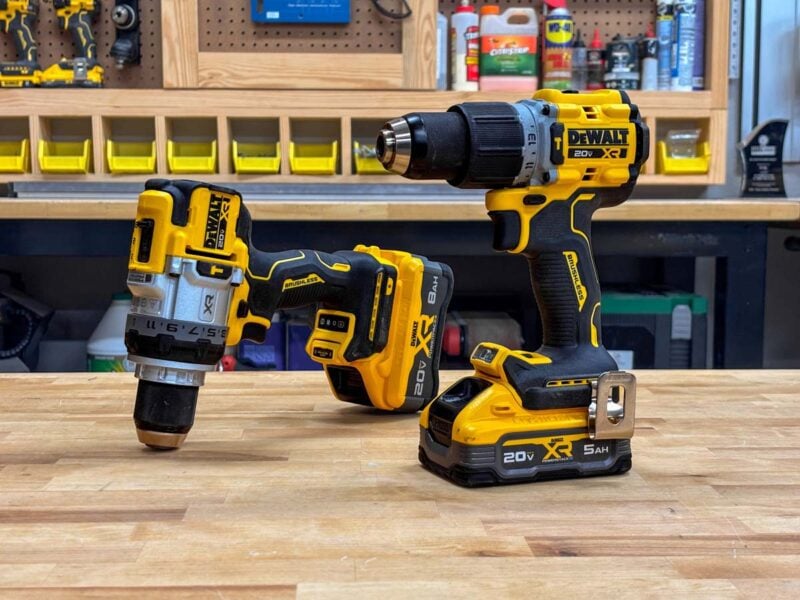
The DeWalt DCD1007 is an impressive cordless drill, and it scored 91 points to finish second in our 2025 head-to-head testing. Despite its high performance and flagship positioning, it’s not the one I recommend to most Pros. Let me explain.
The DeWalt Drill I Recommend Most Often
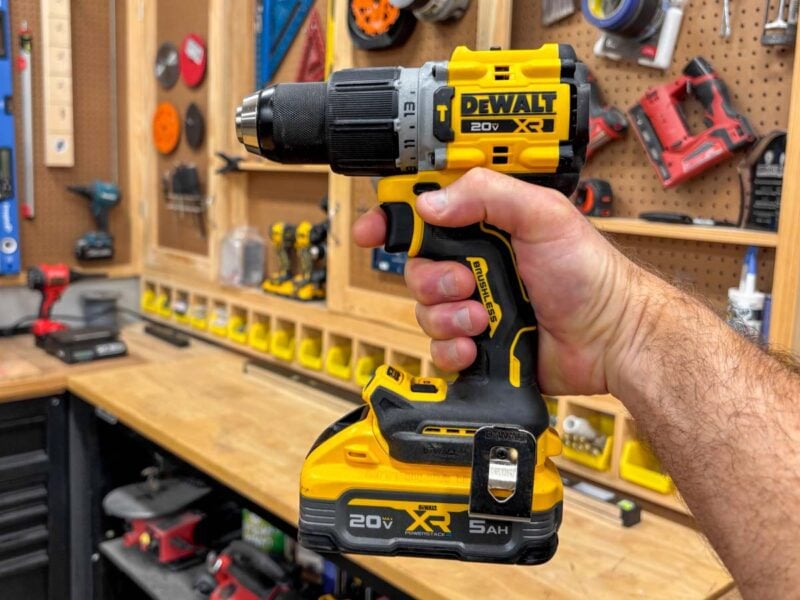
First of all, it’s not that I don’t like the DCD1007. I do. It’s the most powerful drill on DeWalt’s extensive 20V Max battery system and is highly competitive against any other brand’s top drills.
You may assume that means I’m an Atomic kind of guy. On the compact side of the lineup, the DCD799 is an attractive option, but that’s not my top pick, either.
More often than not, it’s the DCD806 that I want to reach for, and I think it has the widest overall appeal for Pros who prefer the DeWalt 20V Max system. It’s a model that doesn’t get as much attention, which is so often the fate when you’re the middle child in your family (if you know, you know).
A quick look at the specs begins to reveal why it’s my favorite in the line.
| DCD799 | DCD806 | DCD1007 | |
|---|---|---|---|
| Max Speeds | 450 / 1650 RPM | 650 / 2,000 RPM | 450 / 1,300 / 2,000 RPM (2250 in Hammer Mode) |
| Max Hammer Rate | 28,050 BPM | 34,000 BPM | 38,250 BPM |
| Max Power | 585 UWO | 1,050 UWO | 1530 UWO |
| Bare Weight | 2.5 lbs | 2.9 lbs | 4.2 lbs |
| Head Length | 6.5 inches | 7.0 inches | 7.5 inches |
| Bare Tool Price | $169 | $199 | $249 |
| Kit Price | $219 w/5.0Ah battery | $279 w/5.0Ah XR battery | $349 w/8.0Ah XR battery |
Let’s break it down line by line to complete the picture.
Speed: How Fast is Fast Enough?
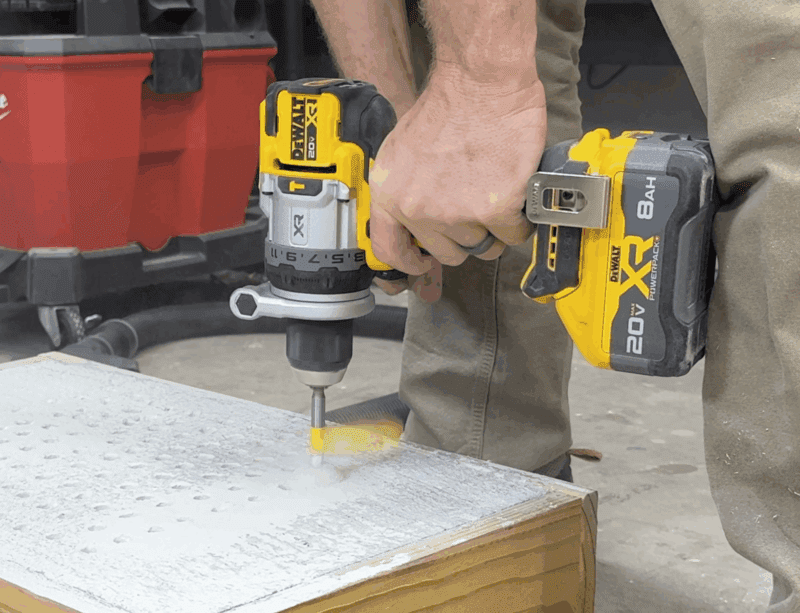
The Atomic’s 1650 RPM feels almost painfully slow for most standard drilling tasks, though I do appreciate the control it offers for lighter or more delicate drilling duties.
However, there’s a big difference in productivity between 1650 RPM and the 806’s 2,000 RPM. Plus, it matches the 1007’s top speed in standard drilling and driving.
I’ll freely admit that the boost in hammer drilling speed is really nice on the 1007, especially when you’re using concrete bits on the larger side of the scale. But when you’re drilling in wood or metal, which is most of the time for me, there’s no advantage.
Looking at competing brands, most top models are dialed in at 2,000 or 2,100 RPM on the top end, so I really don’t feel like I’m missing much when it comes to the 806’s speed.
Hammer rate is a similar story. The 1007’s 38,000+ BPM rate is blazing fast, but that’s not where most of the competition lives. In fact, many brands’ top hammer drills are closer to or even a little below the 806’s 34,000 BPM.
Torque: How Much Power Do You Really Need?

DeWalt uses unit watts out (UWO) to describe the power level of its drills. I understand the relevance, but when everyone else uses in-lbs of torque, it can be kind of annoying when you’re trying to compare.
But even with that aside, it’s pretty obvious that with 1,050 UWO of power, the 806 is significantly stronger than the Atomic 799 with roughly half that amount.
However, the 806 is almost 500 UWO less powerful than the 1007. That’s a lot of power to give up.
It’s tempting to say that power isn’t everything, but when you’re boring through studs with a 2 9/16-inch self-feed bit, reality begs to differ.
But what is reality?
Not to worry, I’m not getting philosophical on you, but I did do some research across the pond to learn more about the actual torque level of these drills. It just so happens that DeWalt reports torque in Newton-meters overseas. Converted to the in-lbs we’re used to and rounded a little, here’s what we get:
- DCD799: 650 in-lbs
- DCD806: 800 in-lbs
- DCD1007: 1500 in-lbs (2100 in-lbs MAX torque according to DeWalt)
READ
Over the Limit: Are Cordless Drills Becoming Too Powerful?
That doesn’t actually help my case much, since it reveals an even larger gap than the UWO ratings. However, I want to focus on that 800 in-lbs number. If you’ve been in the trades for 10 years or more, you can probably remember when 800 in-lbs of torque was the best we had in a cordless drill, and we were darn glad to have that much.
Of course, higher torque has helped improve our productivity. However, the point is we got our work done with less, and it’s still a relevant amount of power for light to medium-duty tasks.
Where the DCD806 Pulls Ahead
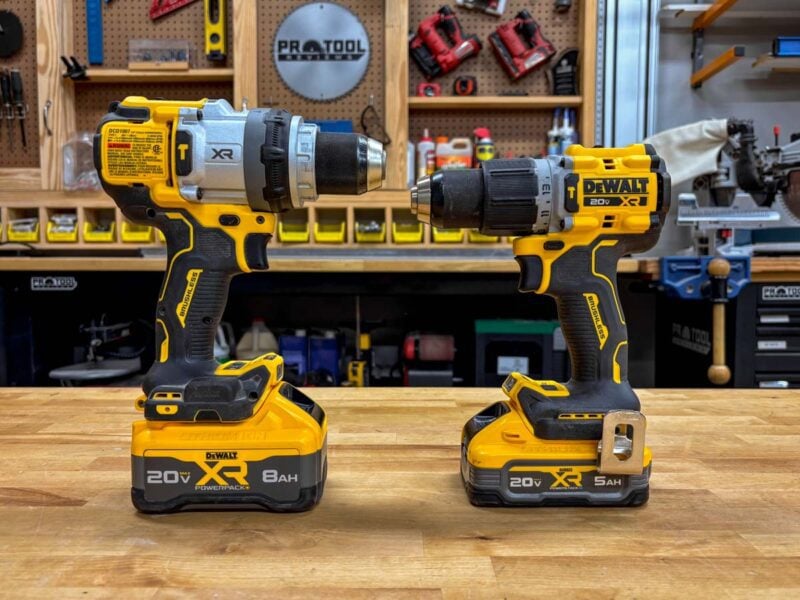
The reason I’m so willing to give up the 1007’s power is all about size and weight. The 806 is 1/2-inch shorter. At 7 inches, it’s almost as compact as Milwaukee’s M18 Fuel 2904, though the Atomic model is even more compact.
It’s the weight that makes an even bigger difference, though. The 806’s weight is 2.9 pounds—1.3 pounds lighter than the 1007. That’s a huge difference. At the same time, it’s only 0.4 pounds heavier than the Atomic.
Because of its lower weight and smaller size, the 806 is also better balanced with a smaller battery. The 1007 is optimized for the 8.0Ah XR battery, while the lighter 5.0Ah XR pack shifts the balance to feel more top-heavy. On the other hand, that same 5.0Ah XR battery is great on the 806, giving it an even bigger weight advantage.
READ
DeWalt 20V Max Battery Changes: Powerstack and Powerpack Are Out
Kickback Control Seals the Deal
For me, the addition of kickback control is what seals the deal. In my opinion, it’s a must-have feature on flagship drills because of how powerful they’ve become. However, most brands leave it off their mid-range and compact drills.
READ
Cordless Drill Kickback Control: Why It’s (Mostly) Non-Negotiable
I’m on board with leaving it off the compact models. Most users won’t have trouble controlling their lower power levels in a bind-up situation, and these tools tend to target a lower price point.
But the mid-range class is a different story. There’s enough power to cause injury or discomfort, and I appreciate the extra level of safety.
The Bottom Line
The reason I tend to recommend the DCD806 over the DCD1007 or DCD799 is that it has the right balance of performance, size, weight, and features. For the majority of tasks you use a drill for, it has all the speed and torque you need in a much less fatiguing package. At the same time, it’s a legitimate step up in productivity from the compact Atomic model. It’s a sweet spot drill.
That doesn’t mean it’s the best for everyone, though. Some of you really do need the highest performance available, while others need access in tight spaces and better control.
My advice is to buy the performance level you need to do the job well. Don’t overbuy and deal with more weight than you have to, and don’t underbuy and regret not having enough performance.