
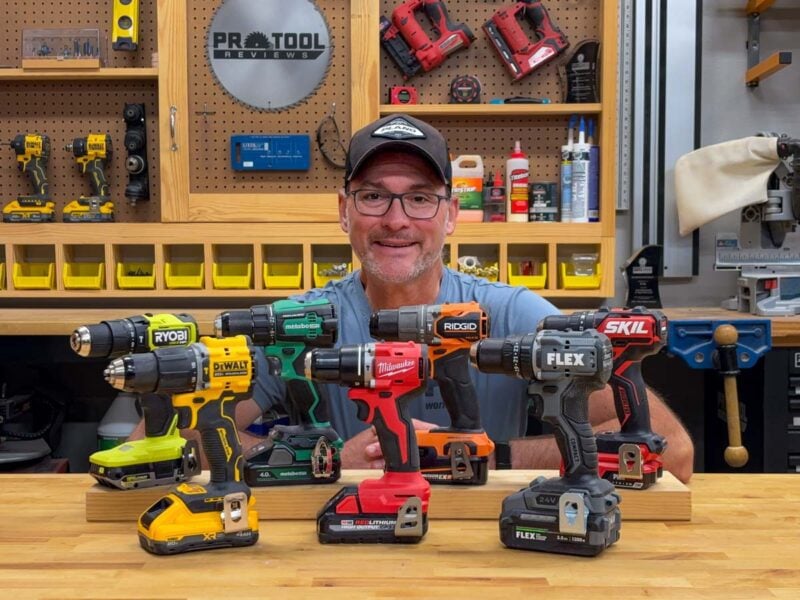
We’ve reviewed tons of cordless drills in the nearly two decades since Pro Tool Reviews entered the scene, and the landscape has changed tremendously in that time. While flagship models have pushed the boundary further than we would have anticipated, the compact class has also benefited from new motor and battery technology. In this review, we tested seven lightweight, compact drills head-to-head to see which one really is the best. I’ll share what we learned from our testing and give you some tips to help you shop with confidence.
READ
Best Cordless Drill Head-to-Head Review
Best Lightweight Compact Cordless Drills
Scoring
Note that the scoring is different from our normal rating system. The scores are based on how each drill performed and compared in this specific group and this set of tests only. Our typical rating system offers a comparison of the tool to the entire range of what is available. Here’s how to interpret the scores from this test:
- 90 – 100: Outstanding. You’ll love using this drill.
- 80 – 89: Excellent. There may be minor tradeoffs.
- 70 – 79: Very good. There are more significant tradeoffs.
- 60 – 69: Good. Notable tradeoffs, but still earns our recommendation.
- < 60: Not recommended in the compact drill class.
Best Lightweight Compact Drill
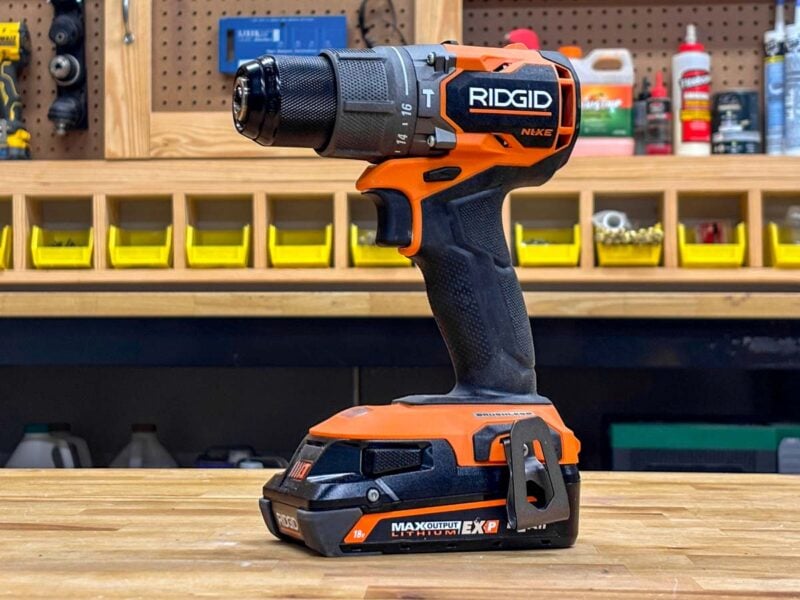
Ridgid 18V Nuke SubCompact Brushless Hammer Drill RNKSHM01
Score: 95 points
- No-Load Speeds: 600 / 2000 RPM
- Max Hammer Rate: 32,000 BPM
- Max Torque: 750 in-lbs
- Head Length: 6.25 in
- Bare Weight: 2.63 lbs
- Tested Weight: 4.08 lbs w/4.0Ah EXP battery
- Price: $159 kit w/2.0Ah Max Output battery
- Hammer Drill/Impact Driver Combo (Best Value): $249
Pros
- Best overall performance in our tests
- Lifetime service agreement (registration required)
Cons
- Heavier than most of our test group
On paper, Ridgid had the most promising performance specs with 2000 RPM in high gear and 750 in-lbs of torque in low. To put that in perspective, those stats would have been near the top of the charts in the first cordless drill head-to-head tests I performed more than a decade ago.
When we put it to the test, Ridgid backed up its resume with a legitimately impressive performance, finishing first in 3 test categories and second in the other. Only Milwaukee gave it a serious challenge for the top spot in performance.
The downside is that it was one of the heavier drills in our test group, joining Flex as the only 2 models with a working weight over 4 pounds. However, if you use the 2.0Ah Max Output battery that comes in the kit instead of the 4.0Ah Max Output we tested with, the weight drops back under the 4-pound mark. You’ll give up a little performance and quite a bit of runtime, though.
That said, if performance is your top priority in a compact drill, Ridgid’s Nuke is the best option.
If you don’t want the hammer drilling mode, you can also get this model as a drill driver kit with a 2.0 Ah Max Output battery for $139, or as a drill and impact driver combo for $219 (best value).
| Test | Result (Ranking) |
|---|---|
| Auger Bit | 3.55 sec (2nd place) |
| Structural Screw | 6.28 sec (1st place) |
| Self-Feed Bit | 4.97 sec (1st place) |
| Concrete Bit | 5.45 sec (1st place) |
Best Lightweight Compact Drill Runner Up
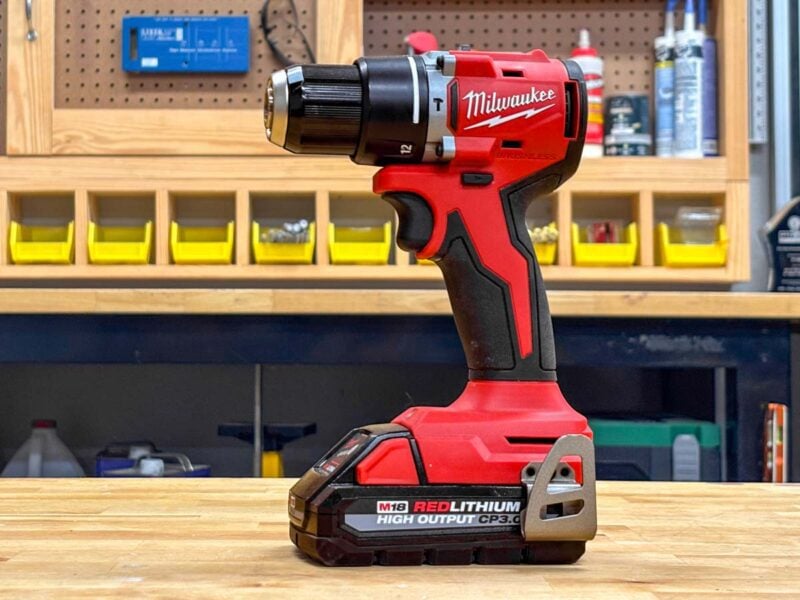
Milwaukee M18 Compact Brushless Hammer Drill 3602
Score: 94 points
- No-Load Speeds: 550 / 1700 RPM
- Max Hammer Rate: 25,500 BPM
- Max Torque: 550 in-lbs
- Head Length: 5.75 in
- Bare Weight: 2.33 lbs
- Tested Weight: 3.61 lbs w/3.0Ah High Output battery
- Price: $159 bare, $219 kit w/two 2.0Ah batteries
- Hammer Drill/Impact Driver Combo (Best Value): $299
Pros
- Most compact in our test group
- Lightest Pro model in our test group
- Outstanding overall performance
- Extensive system of compatible tools and batteries
Cons
- No significant drawbacks
Milwaukee finished just one point behind Ridgid in our final calculations, and it was a tight race. While Ridgid won 3 out of 4 tests, it didn’t put nearly as much distance on Milwaukee as other brands. In fact, if we’d tested Ridgid with the 2.0Ah Max Output instead of the 4.0Ah Max Output, I’d put money on Milwaukee having the edge.
What makes those results even more impressive is that this model has the second-lowest top speed and the lowest torque of the Pro models in our test group.
Where Milwaukee had an undeniable advantage was in its ergonomics—specifically size and weight. It’s the only model in our tests to measure under 6 inches across its head and was a full 3/4-inch shorter than the least compact models. It’s also lighter than most. Both as a bare tool and with the battery we used, it was the lightest Pro model we tested.
So, if compact size and weight are your top priority, or you’re looking for the best balance of size, weight, and performance in a Pro-quality build, Milwaukee’s 3062 is easily the best.
If you don’t want the hammer drilling mode, you can also get this model as a bare tool for $149, as a kit with a 2.0 Ah battery for $199, or as a drill and impact driver combo for $249 (best value).
Performance Testing Results
| Test | Result (Ranking) |
|---|---|
| Auger Bit | 3.35 sec (1st place) |
| Structural Screw | 6.77 sec (2nd place) |
| Self-Feed Bit | 5.02 sec (2nd place) |
| Concrete Bit | 5.52 sec (2nd place) |
Third Place Lightweight Compact Drill
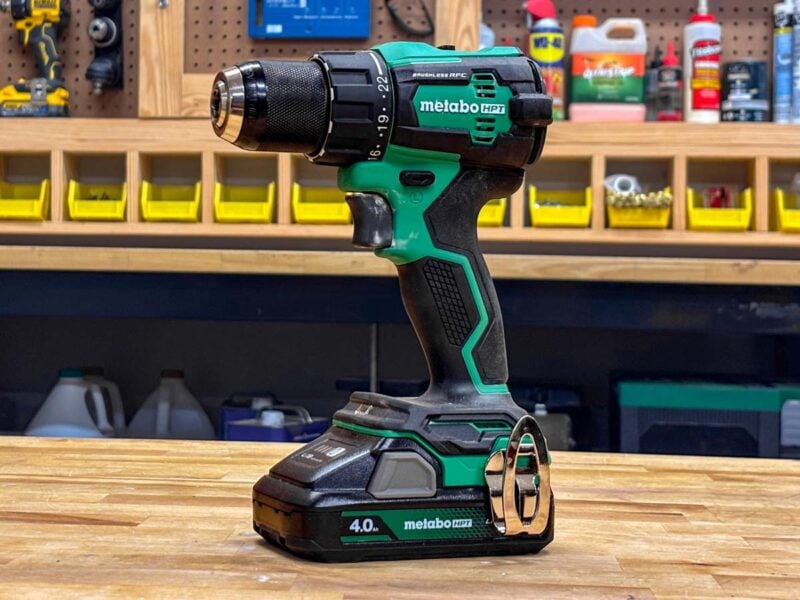
Metabo HPT 18V MultiVolt Hammer Drill DV18DEX
Score: 82 points
- No-Load Speeds: 550 / 2000 RPM
- Max Hammer Rate: 30,000 BPM
- Max Torque: 620 in-lbs
- Head Length: 6.19 in
- Bare Weight: 2.69 lbs
- Tested Weight: 3.90 lbs w/4.0AH battery
- Price: $199 kit w/two 2.0Ah batteries
Pros
- Very good performance
- Well-balanced between high gear speed and low gear power
- Excellent handle ergonomics
- Lightweight
- Lifetime warranty
Cons
- No significant drawbacks
Alongside Ridgid, Metabo HPT is the only other compact drill in our test group to hit 2000 RPM on the top end. But rather than keeping pace in low gear, Metabo HPT drops to a slower 550 RPM. In practice, this helps the DV18DEX prioritize high drilling speeds for lighter tasks while feeling extremely confident when it needs to dig deep in low gear.
In our tests, Metabo HPT went back and forth with Flex in a race for third, but was clearly a step down in performance from Ridgid and Milwaukee. I’d describe it as having a more classic compact drill feel: capable of 80% of what you do with your heavy-duty drill while remaining so much lighter that it’s the drill you want to pick when you can.
After the dust settled, the DC18DEX finished mid-pack in performance, size, and weight, making it a valuable sidekick to Metabo HPT’s 18V and 36V heavy-duty drills.
If you don’t want the hammer drilling mode, you can also get this model as a drill driver kit with two 2.0 Ah batteries for $179, or a drill and impact driver combo for $219 (best value).
Performance Testing Results
| Test | Result (Ranking) |
|---|---|
| Auger Bit | 3.62 sec (3rd place) |
| Structural Screw | 8.25 sec (4th place) |
| Self-Feed Bit | 5.24 sec (3rd place) |
| Concrete Bit | 6.10 sec (4th place) |
Flex 24V Compact Hammer Drill FX1231
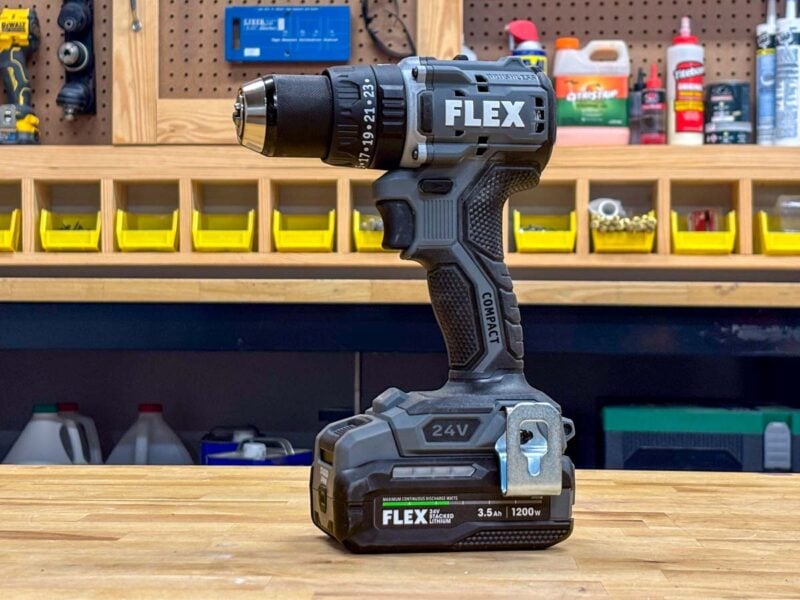
Score: 80 points
- No-Load Speeds: 500 / 1800 RPM
- Max Hammer Rate: 28,800 BPM
- Max Torque: 650 in-lbs
- Head Length: 6.44 in
- Bare Weight: 2.80 lbs
- Tested Weight: 4.39 lbs w/3.5Ah Stacked Lithium
- Price: $189 kit w/2.5Ah battery
Pros
- Very good performance
Cons
- Heaviest compact drill in our tests
Flex traded blows with Metabo HPT but ultimately came up just short in a battle for third place. With a deep analysis of the performance results, Flex has a slight advantage, but it weighs nearly 1/2 a pound more using the batteries we tested, which tipped the scale in HPT’s favor.
Don’t let that get you down if you’re on the Flex 24V system, though. This drill is a solid performer that you should own as a compact supplement to Flex’s flagship FX1272 hammer drill. Having both at your disposal gives you class-leading performance for heavy-duty tasks plus a highly capable option when you want to work with less weight or access tighter areas.
If you don’t want the hammer drilling mode, you can also get this model as a drill driver kit with a 2.5 Ah battery for $169, or a drill and impact driver combo for $199 (best value).
Performance Testing Results
| Test | Result (Ranking) |
|---|---|
| Auger Bit | 3.65 sec (4th place) |
| Structural Screw | 7.75 sec (3rd place) |
| Self-Feed Bit | 5.70 sec (4th place) |
| Concrete Bit | 5.79 sec (3rd place) |
DeWalt Atomic 20V Max Hammer Drill DCD799
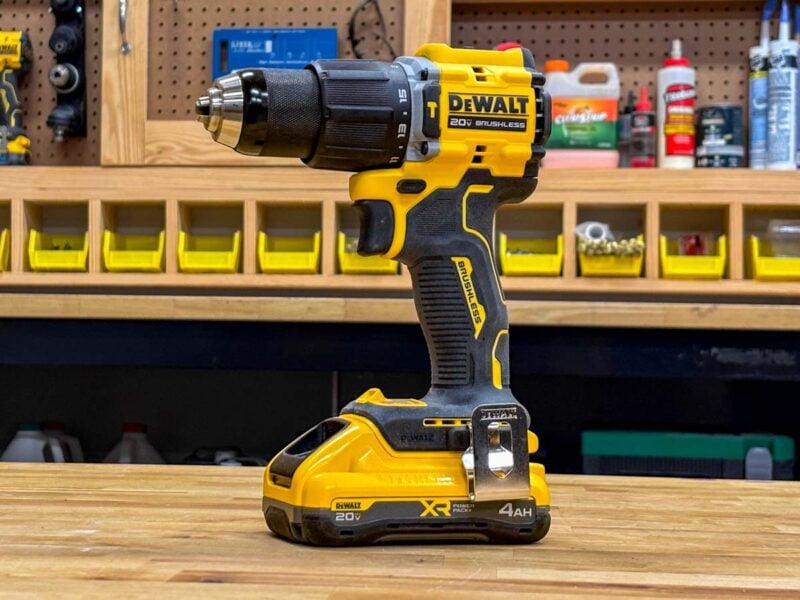
Score: 72 points
- No-Load Speeds: 450 / 1650 RPM
- Max Hammer Rate: 28,050 BPM
- Max Torque: 655 in-lbs (585 UWO)
- Head Length: 6.50 in
- Bare Weight: 2.65 lbs
- Tested Weight: 3.91 lbs w/4.0Ah XR battery (Powerpack)
- Price: $143 bare, $199 kit w/5.0Ah battery
Pros
- Lightweight
- Very good torque
- Extensive system of compatible tools and batteries
Cons
- Longest Pro model in our tests
- Lower drilling and driver speeds than other Pro models
DeWalt’s Atomic compact hammer drill struggled against its Pro competitors, but that’s really not surprising when you look at the spec sheet. Geared to 450 RPM in low and 1650 RPM in high, it was always going to drill and drive slower. However, it delivers solid torque, so don’t assume that slower means underpowered. In fact, you could make the argument that the DCD799 offers the most controlled power in our tests because of its lower speeds.
If you need the most compact hammer drill DeWalt offers on its 20V Max system, the DCD799 is the way to go. But if you’re looking for something lighter and more compact than the beastly DCD1007 without as big a productivity gap, consider the DCD806 as a high-performance middle ground. It’s 1/2 an inch longer and 0.4 pounds heavier, but a huge step up in performance.
If you don’t want the hammer drilling mode, you can also get this model as a drill driver bare tool for $149, or a kit with a 2.0 Ah battery for $179.
READ
The DeWalt Drill I Usually Reach for Isn’t Their Most Powerful: Here’s Why
Performance Testing Results
| Test | Result (Ranking) |
|---|---|
| Auger Bit | 4.51 sec (5th place) |
| Structural Screw | 10.28 sec (5th place) |
| Self-Feed Bit | 7.16 sec (5th place) |
| Concrete Bit | 7.43 sec (5th place) |
Skil 20V Compact Hammer Drill HD6294B
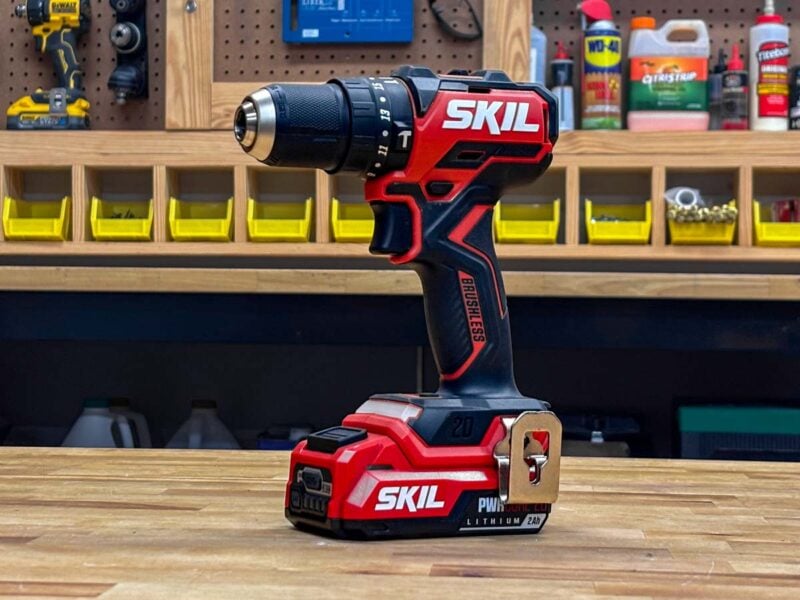
Score: 68 points
- No-Load Speeds: 500 / 1800 RPM
- Max Hammer Rate: 27,000 BPM
- Max Torque: 450 in-lbs
- Head Length: 6.50 in
- Bare Weight: 2.10 lbs
- Tested Weight: 3.11 lbs w/2.0Ah battery
- Price: $129 kit w/2.0Ah battery
Pros
- Lightweight
- Excellent value
Cons
- Clear step down from Pro models in performance
- Longest drill we tested (tie with DeWalt)
Alongside the Pro-focused compact drills we tested, we included two that target DIYers. Skil ended up topping Ryobi in the final analysis. On paper, that’s the result we would have expected, with them matching each other in torque but Skil boasting a higher top speed.
However, it’s a clear step down in performance compared to the Pro models we tested. It will certainly do all of the tasks we expect a compact drill to perform, but productivity becomes a bigger part of the conversation.
On the other hand, it’s excellent as a compact drill for homeowners and DIYers. It’s not the most compact or lightest you can buy, but the performance level is higher, and the build quality is better than you’re likely to get from a cheap drill on Amazon. And as usual, Skil offers a lot of bang for your buck with a really compelling price tag compared to other quality DIY options.
If you don’t want the hammer drilling mode, you can also get this model as a drill driver kit with a 2.0 Ah battery for $109 or a drill and impact driver combo for $169.99 (best value).
Performance Testing Results
| Test | Result (Ranking) |
|---|---|
| Auger Bit | 4.72 sec (7th place) |
| Structural Screw | 11.55 sec (6th place) |
| Self-Feed Bit | 7.19 sec (6th place) |
| Concrete Bit | 8.12 sec (6th place) |
Ryobi 18V One+ HP Compact Brushless Hammer Drill PSBHM02
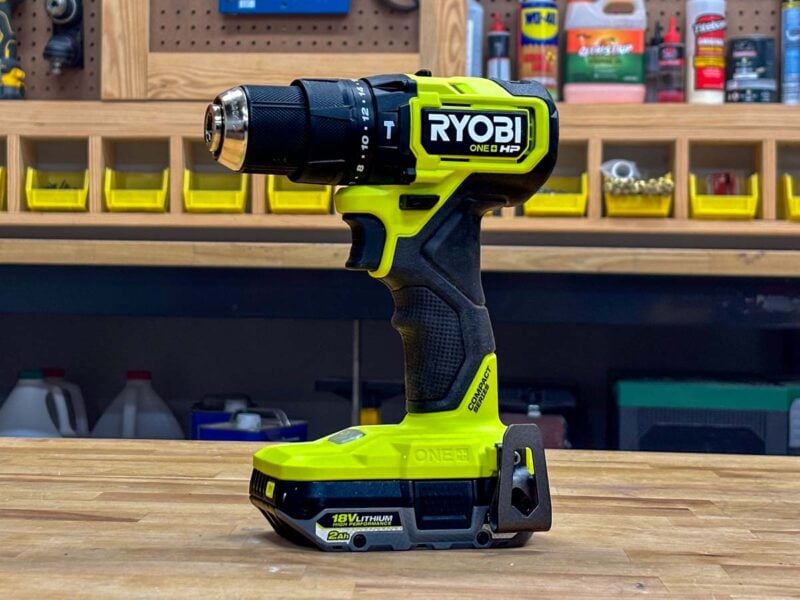
Score: 65 points
- No-Load Speeds: 450/ 1700 RPM
- Max Hammer Rate: 27,200 BPM
- Max Torque: 450 in-lbs
- Head Length: 6.44 in
- Bare Weight: 2.29 lbs
- Tested Weight: 3.25 lbs w/2.0 Ah battery
- Price: $119 bare, $159 kit w/1.5Ah battery
Pros
- Lightweight
Cons
- Clear step down from Pro models in performance
- Longer than most drills we tested
The final compact hammer drill to make the cut in our head-to-head testing was Ryobi’s 18V HP Compact model. Though it lagged behind Skil in our performance tests, it completed most of them just fine. However, it was only able to sink our RSS screw in 1 of 3 runs, indicating it’s not quite as strong.
I have no problem recommending it for DIY projects, though. This is one that, if you don’t really need the hammer drilling function, the drill driver is really appealing because of its lower pricing as a kit and in a combo set with Ryobi’s compact impact driver. That 2-tool combo is $20 less than the hammer drill kit, and it gives you the extra tool plus an extra battery.
If you don’t want the hammer drilling mode, you can also get this model as a drill driver bare tool for $96.86, as a kit with a 2.0Ah battery for $99, or a combo kit for $139 (best value).
Performance Testing Results
| Test | Result (Ranking) |
|---|---|
| Auger Bit | 4.66 sec (6th place) |
| Structural Screw | 11.83 sec (7th place) |
| Self-Feed Bit | 7.94 sec (7th place) |
| Concrete Bit | 8.37 sec (7th place) |
How We Tested
READ
How Pro Tool Reviews Tests Cordless Drills
Performance Specifications
Before we consider some of the choices we made, measurements we took, and test results, here’s a quick look at how our compact drills compare in rated performance.
| Model | Top Speeds | Max Torque | Max Hammer Rate |
|---|---|---|---|
| DeWalt DCD799 | 450 / 1650 RPM | 655 in-lbs (585 UWO) | 28,050 BPM |
| Flex FX1231 | 500 / 1800 RPM | 650 in-lbs | 28,800 BPM |
| Metabo HPT DV18DEX | 550 / 2000 RPM | 620 in-lbs | 30,000 BPM |
| Milwaukee 3602 | 550 / 1700 RPM | 550 in-lbs | 25,500 BPM |
| Ridgid RNKSHM01 | 600 / 2000 RPM | 750 in-lbs | 32,000 BPM |
| Ryobi PSBHM02 | 450/ 1700 RPM | 450 in-lbs | 27,200 BPM |
| Skil HD6294B-1C | 500 / 1800 RPM | 450 in-lbs | 27,000 BPM |
Battery Selection
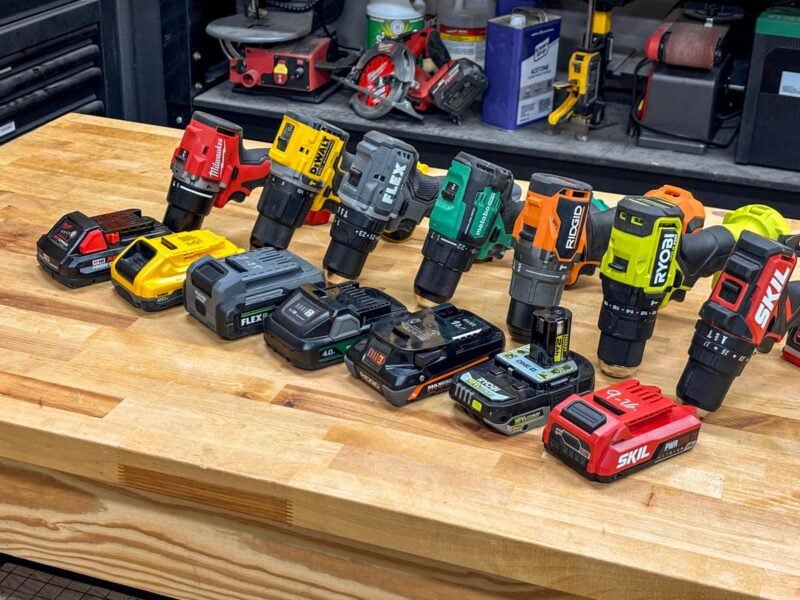
Our goal in these tests was to determine each drill’s maximum performance while avoiding the trap of using too large a battery. So, we went with the most advanced compact packs we had available. For most brands, that was a high-density 1P battery with either pouch cell or tabless technology. However, not every brand has advanced compact batteries, so we used standard packs on those models instead.
| Model | Tested Battery |
|---|---|
| DeWalt DCD799 | 4.0Ah XR (PowerPack) |
| Flex FX1231 | 3.5Ah Stacked Lithium |
| Metabo HPT DV18DEX | 4.0Ah |
| Milwaukee 3602 | 3.0Ah High Output |
| Ridgid RNKSHM01 | 4.0Ah EXP |
| Ryobi PSBHM02 | 2.0Ah |
| Skil HD6294B-1C | 2.0Ah |
Tested No-Load Speed
We checked each drill’s no-load speed using an optical tachometer and freshly charged batteries. Most of the drills posted lower numbers than their ratings, but Milwaukee was close and Ryobi actually tested higher.
| Model | Measured Top Speed | Change from Rated Speed |
|---|---|---|
| DeWalt DCD799 | 1546 RPM | -104 RPM (-6.3%) |
| Flex FX1231 | 1667 RPM | -133 RPM (-7.4%) |
| Metabo HPT DV18DEX | 1943 RPM | -57 RPM (-2.9%) |
| Milwaukee 3602 | 1683 RPM | -17 RPM (-1.0%) |
| Ridgid RNKSHM01 | 1935 RPM | -65 RPM(-3.3%) |
| Ryobi PSBHM02 | 1732 RPM | +32 RPM (+1.9%) |
| Skil HD6294B-1C | 1635 RPM | -165 RPM (-9.2%) |
Size and Weight
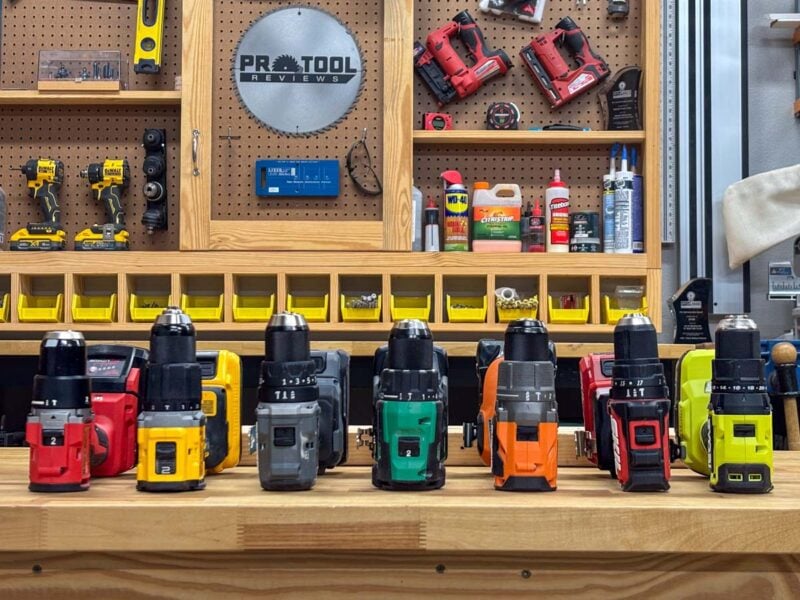
While all of the drills we tested qualify as compact models, some are more compact and/or lighter than others. Below are the head lengths and weights we measured.
| Model | Head Length | Bare Weight | Tested Weight |
|---|---|---|---|
| DeWalt DCD799 | 6.50 in | 2.65 lbs | 3.91 lbs |
| Flex FX1231 | 6.44 in | 2.80 lbs | 4.39 lbs |
| Metabo HPT DV18DEX | 6.19 in | 2.69 lbs | 3.90 lbs |
| Milwaukee 3602 | 5.75 in | 2.33 lbs | 3.61 lbs |
| Ridgid RNKSHM01 | 6.25 in | 2.63 lbs | 4.08 lbs |
| Ryobi PSBHM02 | 6.44 in | 2.29 lbs | 3.25 lbs |
| Skil HD6294B-1C | 6.50 in | 2.10 lbs | 3.11 lbs |
Test 1: Auger Bit
In this high-speed drilling test, we timed how long it took to run a 3/4-inch self-feed bit through 4 inches of stacked and glued OSB subfloor. We tested each model in drilling mode and high gear with a freshly charged battery. The result is the average of three runs.
| Model | Result |
|---|---|
| Milwaukee 3602 | 3.35 seconds |
| Ridgid RNKSHM01 | 3.55 seconds |
| Metabo HPT DV18DEX | 3.62 seconds |
| Flex FX1231 | 3.65 seconds |
| DeWalt DCD799 | 4.51 seconds |
| Ryobi PSBHM02 | 4.66 seconds |
| Skil HD6294B-1C | 4.72 seconds |
Test 2: Structural Screw
In this power test, we timed how long each drill needed to drive an 8-inch x 3/8-inch rugged structural screw (RSS) into stacked and glued OSB subfloor. Each model was set to drilling mode in low gear and started with a freshly charged battery. The result is the average of three runs.
| Model | Result |
|---|---|
| Ridgid RNKSHM01 | 6.28 seconds |
| Milwaukee 3602 | 6.77 seconds |
| Flex FX1231 | 7.75 seconds |
| Metabo HPT DV18DEX | 8.25 seconds |
| DeWalt DCD799 | 10.28 seconds |
| Skil HD6294B-1C | 11.55 seconds |
| Ryobi PSBHM02 | 11.83 seconds* |
*Ryobi was only able to sink the screw in 1 out of 3 test runs.
Test 3: Self-Feed Bit
In this light rough-in application test, we timed how long it took to run a 1 1/2-inch self-feed bit through a 2 x 4 pine stud. We tested each model in drilling mode and low gear with a freshly charged battery. The result is the average of three runs.
| Model | Result |
|---|---|
| Ridgid RNKSHM01 | 4.97 seconds |
| Milwaukee 3602 | 5.02 seconds |
| Metabo HPT DV18DEX | 5.24 seconds |
| Flex FX1231 | 5.70 seconds |
| DeWalt DCD799 | 7.16 seconds |
| Skil HD6294B-1C | 7.19 seconds |
| Ryobi PSBHM02 | 7.94 seconds |
Test 4: Concrete Bit
To test concrete drilling speed, we used a 1/4-inch concrete bit and timed how long it took to drill 3 inches deep in cured 4000 PSI concrete. Each drill was set to hammer drilling mode in high gear and used a freshly charged battery. The result is the average of three runs.
| Model | Result |
|---|---|
| Ridgid RNKSHM01 | 5.45 seconds |
| Milwaukee 3602 | 5.52 seconds |
| Flex FX1231 | 5.79 seconds |
| Metabo HPT DV18DEX | 6.10 seconds |
| DeWalt DCD799 | 7.43 seconds |
| Skil HD6294B-1C | 8.12 seconds |
| Ryobi PSBHM02 | 8.37 seconds |
What to Look for When You’re Shopping for Lightweight and Compact Cordless Drills
Performance
Speed, blow rate, and torque give you an idea of a cordless drill’s performance. You should also look at the type of motor it has. Today, a brushless motor is non-negotiable. If you’re serious about the work you do, whether you’re a Pro or DIYer, the higher performance, runtime, and service life of a brushless motor should be a priority.
When comparing specs, torque is my top priority because more muscle means I can do more before switching over to a heavier tool. So, torque trumps speed in my book. However, that doesn’t mean I want a slow drill. For Pros, I’d prefer something with 1800 RPM on the top end and at least 500 in-lbs of torque. DIYers can get away with a little less, especially if it saves money.
Size and Weight
Size and weight tend to go hand in hand, with larger drills weighing more. Typically, we want the lightest and most compact tool that still does the job effectively. That keeps fatigue to a minimum while maximizing access.
That said, I’m willing to use a slightly larger, heavier drill if it means real performance gains. So for me, it’s about finding a balance. However, none of the brands we tested and recommend really violate the title of “compact,” so you could choose any of them unless you’re looking for the absolute lightest or most compact.
Ergonomics
Beyond the size and weight, how the weight is balanced and how the grip feels in your hands brings the ergonomics full circle. As you narrow down your choices, there’s something to be said for a tool that feels right in your hands.
Just because these tools are compact, don’t assume that means they only feel well-balanced with the smallest battery available. Even though it adds some weight, sometimes stepping up one battery size can balance the weight better.
Features
As you move up from entry-level cordless drills, you should expect more features that make working more convenient than just performance boosts alone. Here’s what to look for:
- Multiple Speeds: 2 speeds are a must, but more generally gives you even better control, though it’s uncommon to find 3+ speeds in the compact class
- Kickback Control: Stops the motor if the bit binds up, but it’s rare on compact drills
- Side Handle: While absolutely necessary to avoid injury when using drills with higher torque, the compact class usually skips it
- Smart Controls: Helps with inventory management and tracking, and some offer customizable controls, but again, it’s uncommon in the compact class
- Interchangeable Chucks: Switching to a specialized chuck can help you reach areas a standard chuck can’t access
- All-metal Chuck: Improves durability and is a must-have for Pros
- LED Light: Nearly every drill has LEDs, but our favorites use ones that surround the chuck to better reduce shadows
- Belt Hook: Usually reversible, belt hooks are super-helpful when you have materials to carry, or you’re climbing a ladder
Why You Can Trust Pro Tool Reviews
Ever check out a “review” site and you can’t tell if they actually tested the tools or if they’re just “recommending” the Amazon top sellers?
That’s not us. We only recommend what we’d use, even if we don’t earn a commission from it. It’s all about giving you a legitimate recommendation and our honest opinion of each product.
We’ve been in business since 2008 covering tools, writing reviews, and reporting on industry news in the construction, automotive, and lawn care industries. Our Pro reviewers have the skills and experience to know whether tools can perform well in the field.
Each year, we put our hands on hundreds of individual products through our head-to-head testing, reviews, media events, and trade shows.
We consult with innovators in the technology and design of tools to gain a broader grasp of where these products fit and how they work.
We’ll provide hundreds of pieces of new content this year, absolutely free for our readers—including objective evaluations of individual tools and products.
The result is information you can trust because of the editorial, scientific, and real-world professional experience we collectively utilize each and every time we pick up and test a tool.


Could you do a similar test but for 12V platforms, such as Dewalt’s 12V platform?
Thanks for the suggestion! I’ll pass it along to the team.