
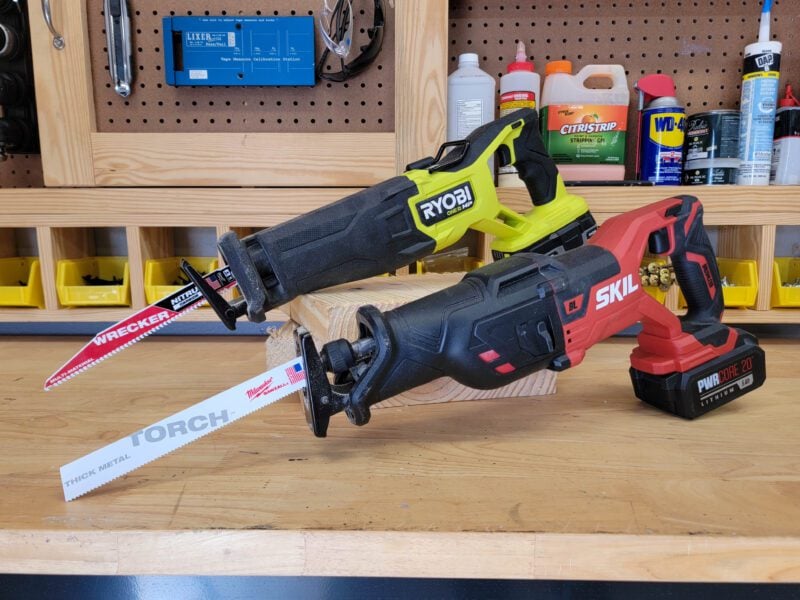
We recently wrapped up testing eleven flagship reciprocating saws from brands you know and trust. Today, we’re comparing two prominent DIY-focused contenders: the Ryobi 18V HP Brushless PBLRS02 and the Skil PWRCore20 Brushless RS5884. Which saw will come out on top in a head-to-head challenge? Let’s break it down and find out!
Curious who makes the best cordless reciprocating saw? Click here to see the results of our full head-to-head testing!
Skil VS Ryobi Reciprocating Saw Specifications
Here’s a quick look at the key specs to know before we jump into testing:
| Skil RS5884 | Ryobi PBLRS02 | |
|---|---|---|
| No-Load Speed | 3000 SPM | 3200 SPM |
| Stroke Length | 1.13 in. | 1.25 in. |
| Variable Speed Settings | No | No |
| Orbital Action | Yes | No |
| Length | 17.25 in. | 18.5 in. |
| Bare Weight | 6.33 lbs | 6.58 lbs |
| Working Weight | 7.93 lbs (with 5.0Ah battery) | 8.06 lbs (with 4.0Ah battery) |
As you can see, there are some notable differences. Ryobi has a clear advantage in stroke length and rate. On paper, Ryobi cuts an extra 51 linear feet every minute—an 18% advantage over Skil. However, Skil has orbital action that could make a difference in wood cutting.
Can Skil beat the expectations and close the gap? Let’s find out!
Skil VS Ryobi Reciprocating Saw: How We Tested
Battery Selection
We decided to pair each tool with batteries that would give them the best balance of performance and weight management. For Ryobi, we went with the 18V 4.0Ah Edge and Skil was equipped with a PWRCore 20 5.0Ah battery.
PVC Pipe Cut
For this test, we set up a 4-inch schedule 40 PVC pipe and made a series of three cuts with each saw. This isn’t a very demanding task for a reciprocating saw, but it’s well within the scope of duty.
For this test, we used the Milwaukee 9-inch Torch Thick Metal Sawzall 10 TPI blade (buy it here).
Clean Wood Cut
This test involves making three cuts in a pressure-treated 2×12 board. These cuts are timed, and the results are then averaged to find out how fast each saw can make the cut.
For this test, we used the Milwaukee 9-inch Carbide Ax Sawzall 5 TPI blade (buy it here).
Nail-Embedded Wood Cut
Our nail-embedded wood test amps up the intensity a little bit compared to the clean wood cut. It involves each saw making three cuts in a simulated wall comprised of Hardie board, plywood, and three 2×4 studs with nine total framing nails driven into them. While this may seem excessive, it’s meant to highlight each saw’s capabilities in a very common demo scenario.
For this test, we used the Milwaukee 9-inch Nitrus Carbide Wrecker Sawzall 6 TPI blade (buy it here).
Cast Iron Cut
This is far and away the most challenging task for any reciprocating saw. Cast iron is extremely hard to cut, so for this test, we opted to make one cut in our 3-inch pipe and timed our results.
For this test, we used the Milwaukee 9-inch Nitrus Carbide Torch Sawzall 8 TPI blade (buy it here).
Testing Results
| Skil RS5884 | Ryobi PBLRS02 | |
|---|---|---|
| 4-Inch PVC | 4.32 sec | 3.78 sec |
| Clean Wood | 14.07 sec | 11.47 sec |
| Wall Sandwich | 41.70 sec | 31.65 sec |
| Cast Iron | Did Not Finish | 1 min 41 sec |
As you can plainly see, Ryobi is the clear winner when it comes to performance. Not only did it finish faster than Skil across the board, but Skil was not able to get through the cast iron cut within the time limit. Now, this is an extremely tough test, and both of these tools are geared towards the DIY market rather than hardcore demo jobs, so we don’t expect them to do what something like the Milwaukee M18 Fuel Super Sawzall can.
Looking back at the specs, Ryobi’s win is no surprise. But was Skil able to close the gap? Let’s look at those numbers again from a percentage standpoint:
- PVC: 12.5% faster cutting for Ryobi
- Clean Wood: 18.5% faster cutting for Ryobi
- Wall Sandwich: 24% faster cutting for Ryobi
As you can see, as the tests increased in load, Ryobi’s advantage grew. When you look at where these two saws are positioned, it’s not a surprise. Skil targets a lower price point while Ryobi’s HP Brushless model takes aim at the Prosumer market.
We’re not done yet, though. Let’s take a look at the key features and price specifics before we make our final judgment.
Skil VS Ryobi Reciprocating Saw Key Features
Skil PWRCore 20 Brushless Reciprocating Saw
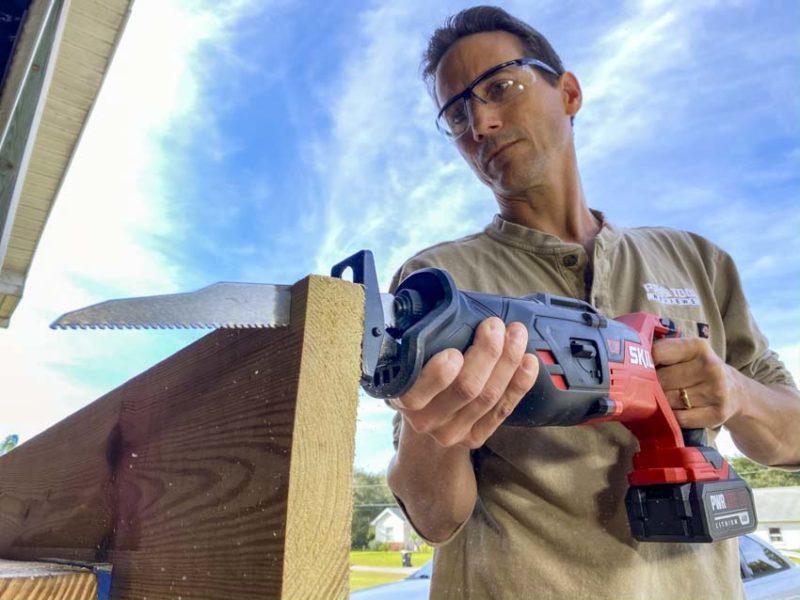
- Brushless Motor: Better performance, longer runtime, longer service life, and no carbon brushes to change
- Selectable Orbital Action: Flip to more aggressive, faster cutting in wood
- Adjustable Shoe: Helps extend the life of your blades by exposing unused teeth
- LED Work Light: Easily illuminate dark work spaces
Ryobi 18V One+ HP Brushless Reciprocating Saw
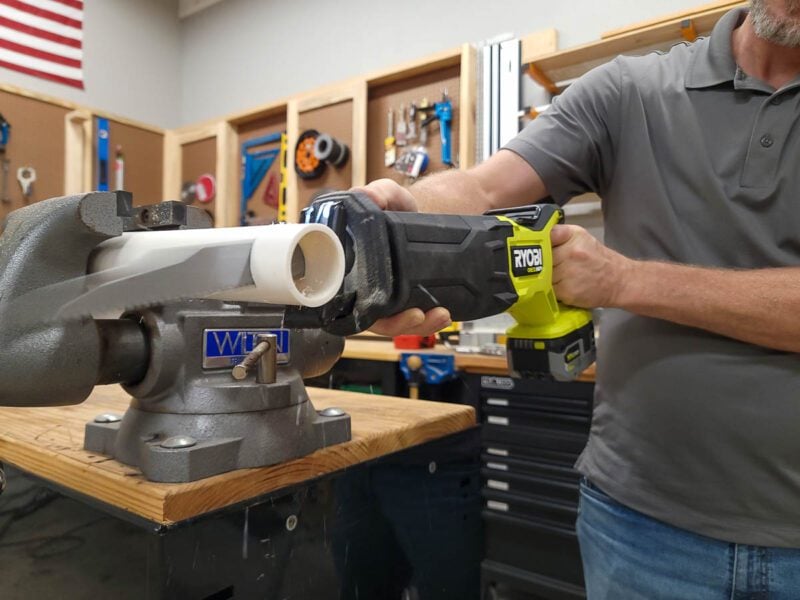
- Brushless Motor: Better performance, longer runtime, longer service life, and no carbon brushes to change
- Folding Rafter Hook: Offers a convenient hanging option
- Blade Change Lever: Releases blades more easily than shaft-mounted designs
Reciprocating saws aren’t known for having a ton of bells and whistles to begin with, and there’s not a ton separating these two saws from a feature standpoint. However, Skil has orbital action to give it a boost in wood cutting and an adjustable shoe that can help extend your blade life. On the other hand, Ryobi has a rafter hook that more Pro-oriented folks look for.
Pricing and Final Thoughts
| Skil RS5884 | Ryobi PBLRS02 | |
|---|---|---|
| Bare Tool | N/A | $139 |
| Kit | $169 | $209 |
| Warranty | 5-year | 3-year |
After all our hands-on testing, I’m obliged to declare Ryobi as the winner in this head-to-head challenge. It delivers confident cutting power, sound ergonomics, and an approachable price tag.
There is still some room for improvement on the feature side, though. An adjustable shoe would be nice, but orbital action would be the next best step forward for this model.
If you’re a handyman, run a facility maintenance crew, or you’re into tackling some serious home renovations on your own, it’s the way to go.
Don’t discount Skil, though. With a price that’s $40 lower, it’s a compelling option for value-minded DIYers who want the longer runtime and service life of a brushless motor. If your projects include lighter remodeling, demo, or metal cutting, it’s a low-cost way to get the job done without sacrificing quality.