
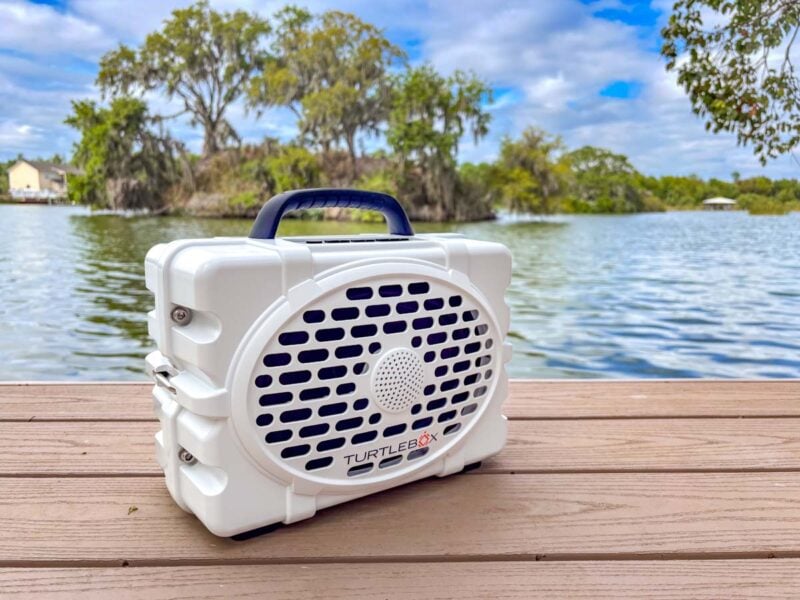
Sure It’s Loud, But How Does the Turtlebox Stack Up Against Other Outdoor Bluetooth Speakers?
When it comes to jobsite radios and speakers, many people think of the ones that run on their favorite power tool battery system. But there’s a class of rugged outdoor speakers moving into the space, and today, I’m sharing my experience with the Turtlebox Original Gen 3 Bluetooth speaker, including what I learned listening to it side-by-side with two of my favorite outdoor speakers.
Pros
- Excellent sound quality
- Louder volume levels than competitors
- Super-tough design
- Waterproof and dust-proof
- Floats
- Auxiliary and microphone support
- USB-C out for charging devices
- Can pair with additional Turtleboxes
Cons
- Expensive
- Some loss of sound fullness at the highest volume levels
Turtlebox Original Bluetooth Speaker Build
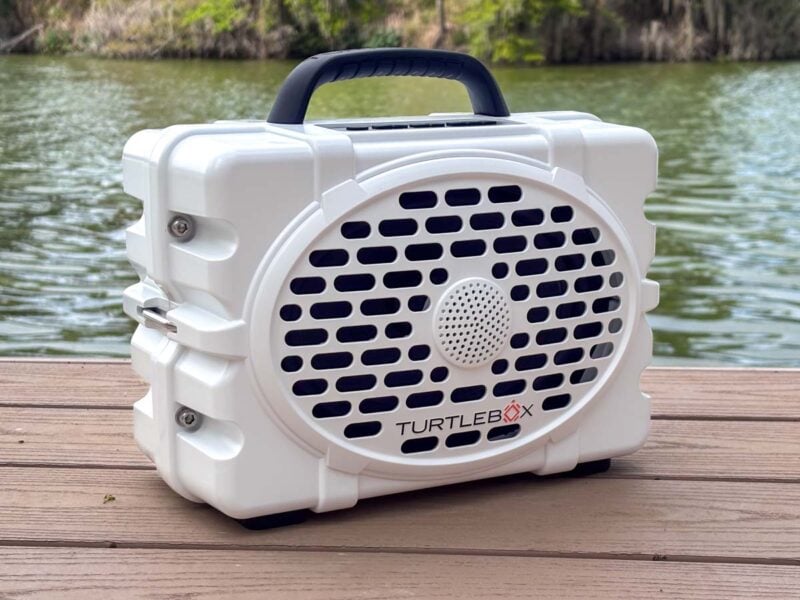
There are outdoor speakers, and then there are rugged outdoor speakers. The Turtlebox original belongs to the latter.
The speaker and battery are built into a super-tough exterior shell that’s drop and crush-proof. Better still, it’s IP67 waterproof and dust-proof. That rating translates to surviving 3 feet underwater for 30 minutes. Considering it floats, that’s overbuilt for what it needs, and that’s just the way I like it.
If you’re like me and enjoy saltwater, you can still take your Turtlebox with you. Just like you do with your rods and reels, be sure to rinse it off well with freshwater as soon as you’re able.
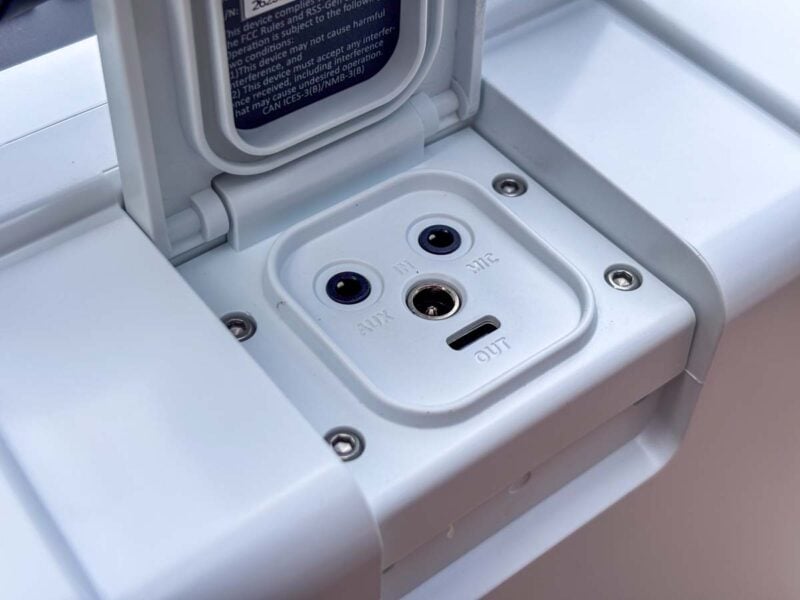
There is a caveat, though. You need to be sure the cable port door is securely shut. It’s a little tough to open compared to other speakers, but it closes with a confident snap, so there’s no question when you’ve closed it.
When you open the door, you’ll find four ports. There’s one each for the charger, USB-C out, auxiliary in, and microphone in. Considering the state of most Bluetooth speakers, that’s a surprisingly versatile mix. So go ahead and amplify your voice as you sing your heart out while charging the iPad you’re running a karaoke app on.
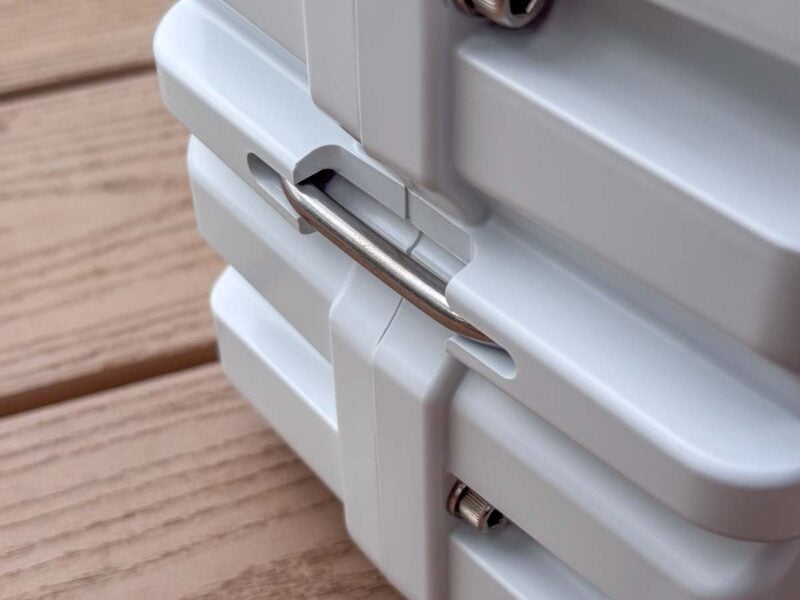
On the sides, there are two stainless steel tie-down points. If you’re taking your Turtlebox along in the boat, kayak, or ATV/UTV, it’s nice to keep it from bouncing around or falling out. The speaker weighs 10 pounds and has non-slip feet on the bottom and back, so it’s capable of staying put to a degree. But when that 42-foot Freeman sends its wake toward your kayak, you’ll want it secure.
Turtlebox Original Bluetooth Speaker Sound
Hardware and Controls
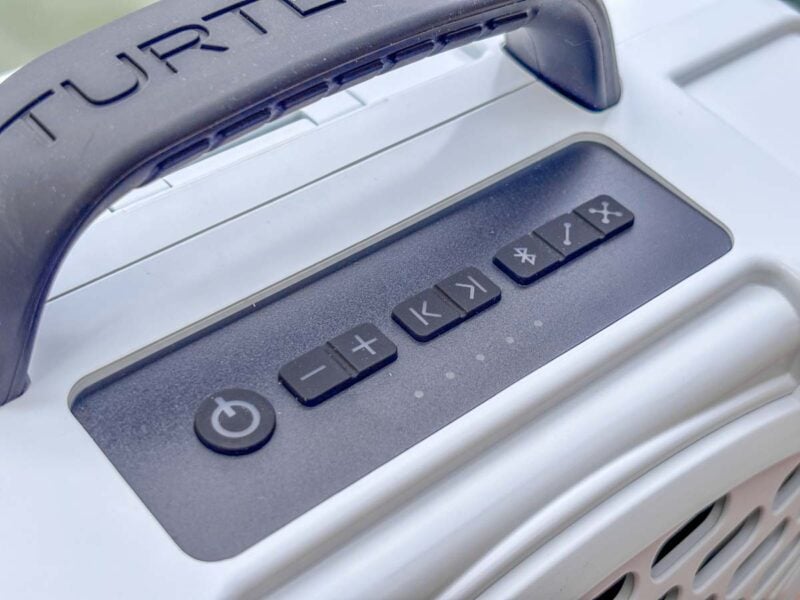
The sound is generated by three key components: a 1-inch titanium tweeter, a 6-inch x 9-inch woofer, and a Class D digital amplifier. The amplifier is particularly interesting to the conversation. Even though it’s not as high-fidelity as Class A, B, or AB amplifiers, it helps produce louder output and set the Turtlebox apart.
All the controls are on top and don’t have to be covered to maintain water protection. Moving from left to right, you have power, volume down/up, reverse and forward skip, Bluetooth connect, TWS pairing, and Party Mode multi-speaker pairing. Below those buttons, there’s also a 5-level LED battery indicator.
If you’re not standing right next to the speaker, you still have full control over volume and skipping using the controls on your phone and music app.
Sound Quality
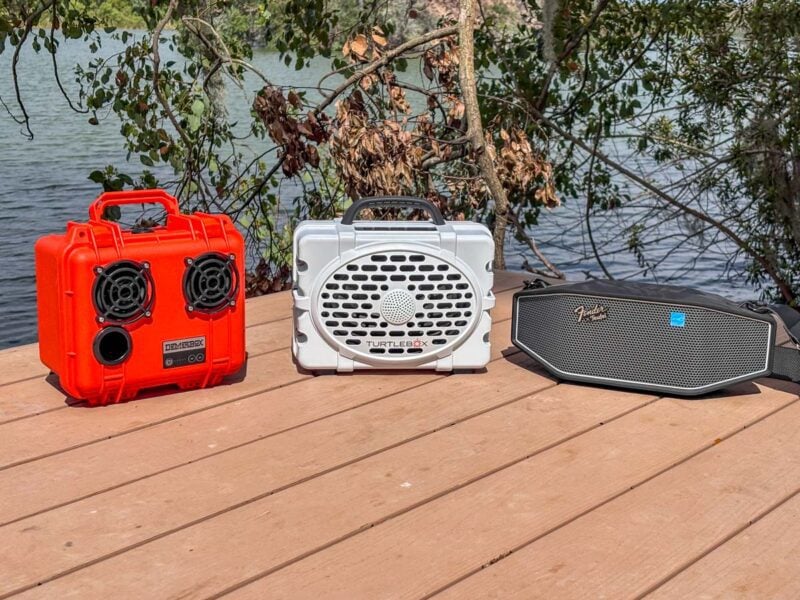
To test the quality and loudness of the sound, I brought a couple of other mid-size outdoor-rated speakers along and spent some quality time on the dock listening to a wide range of audio.
My benchmark speaker is the Fender x Teufel Rockster Cross. Teufel’s German-engineered Dynamore technology, Qualcomm aptX upgrade, and speaker selection give it the best audio quality I’ve heard in an outdoor-rated speaker its size. While it has some impact protection and waterproofing, it’s not nearly as rugged as the Turtlebox, though.
I also brought along my DemerBox DB2. Similar in size and very much a rugged outdoor speaker, as it’s built into a Pelican case, it leans on two 3-inch speakers, but lacks separate tweeters and a woofer.
I started with a 40 hz test to see how the bass compares, and the Turtlebox shines in that department. There’s almost no comparison to the wooferless DemerBox, and it kept up well with the Rockster.
Moving on to musical selections that included rock, blues, classical, country, and more, I could tell how much more depth the Turtlebox has in its range. In these tests, the Rockster maintained its status as having the best overall quality, mainly because of the crispness of its output. However, the Turtlebox was not far behind and noticeably better than the DemerBox.
The only test where the Turtlebox slipped was in high-quality spoken audio from podcasts. Here, the DemerBox was slightly clearer, while the Rockster maintained the overall best audio. Now, that’s not to say the Turtlebox had poor audio; it just wasn’t as clean.
Volume
When it comes to loudness, there’s no competition. With a max volume of 120 decibels, Turtlebox blows everyone out of the water, or off the dock in this case. Plus, you can pair an infinite number of the Gen 3 Originals together with Party Mode and create a truly immersive outdoor listening experience.
If you connect two speakers, there’s a TWS (true wireless stereo) mode that offers true left/right stereo sound.
That Class D amplifier helps keep too much distortion from coming in, but it’s not perfect. Listening at the highest volume levels, I noticed the bottom end having trouble keeping up with the highs and mids. It certainly wasn’t as bad as some of the jobsite radios I’ve reviewed, but the sound wasn’t as full as it was at lower volume levels.
While the sound quality and volume are excellent, I’m 100% onboard with the Turtlebox team’s encouragement to listen responsibly. There are times when cranking it up is the right call, but be respectful to the people around you and don’t miss the opportunities nature offers to unplug and listen to the subtle peace of God’s creation.
Runtime
How long you can listen on a charge is dependent on how loud you run your audio and whether you’re charging other devices via the USB-C port.
In ideal conditions, you can expect the 85Wh lithium battery to last around 25 hours.
Turtlebox Original Pricing and Options
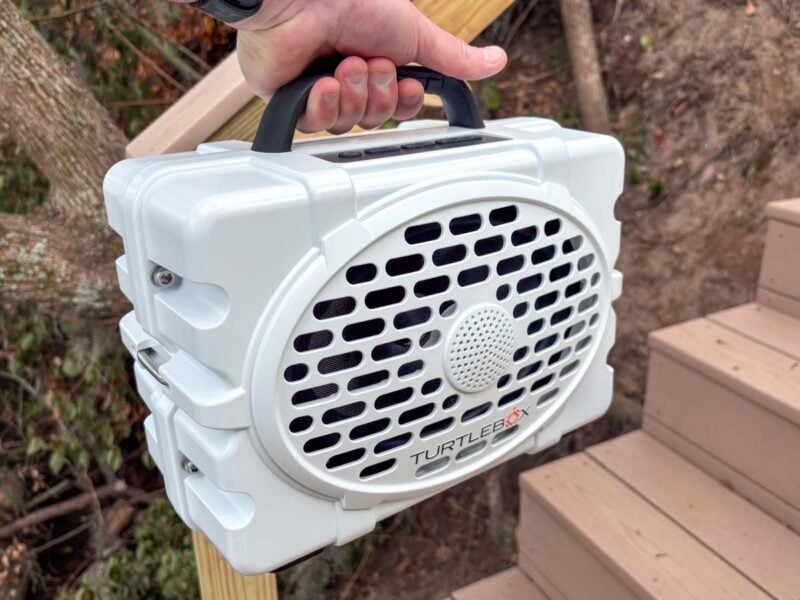
You can get the Gen 3 Original in one of its five base colors for $430. There are limited edition Fighting Lady Yellow and Delta colors that are also $430, as well as a limited edition Bass print for $480.
If you’re looking for something a little different, the Gameday Series has three options also priced at $430: Purple and Gold, Burnt Orange and White, and White and Orange.
If you love the idea of Turtlebox’s ruggedness, but you’re looking for something more packable, check out the Ranger model at $250.
On the other side of the scale, the larger Grande is $730.
Should You Buy It?
When it comes to finding the right balance of sound quality, volume, and outdoor survivability, the Turtlebox Original earns two thumbs up from me.
It’s not for everyone, though.
If you don’t need a truly rugged, waterproof build, you can get better sound quality for less money. If you need less weight to take hiking or camping, you can go smaller. Plus, it’s not cheap.
But in this rugged mid-size class, you’ll have a hard time finding a better overall Bluetooth speaker. Besides that, the team behind Turtlebox has your back, and they’re passionate about enjoying and respecting the outdoors like many of you are.
Let’s bring this back to our core focus, though. How does the Turtlebox Original rate as a jobsite speaker for the construction industry?
Frankly, unless you’re dead-set on using your power tool batteries to run your jobsite entertainment or connecting it to your modular tool box stack, I don’t think there’s a better jobsite speaker available. While there are a few options that can compete in sound quality or have features like dry storage, Turtlebox’s pure ruggedness puts it a step ahead of the rest.