
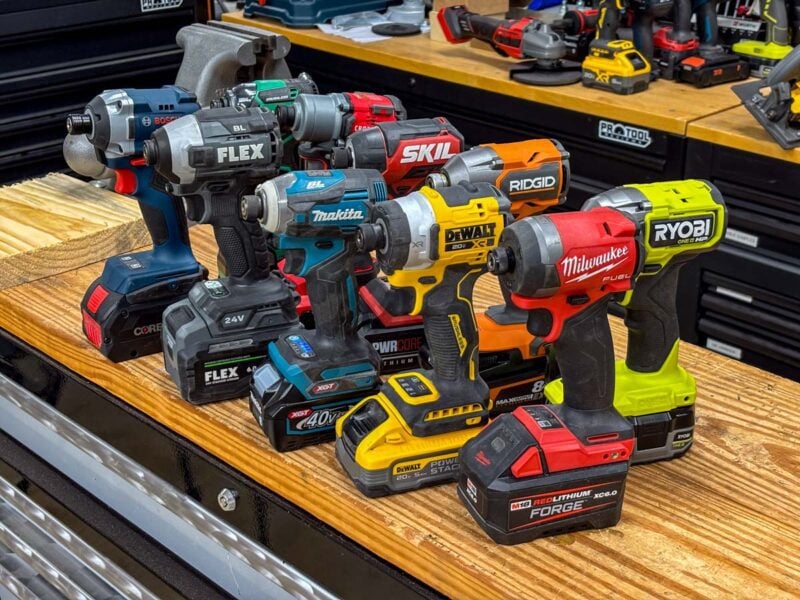
At Pro Tool Reviews, we strive to be transparent in how we test impact drivers. With so much information to share, our Best Impact Driver Head-to-Head feature is already really long without getting into the fine details of our testing methods, so we share a summary. For those of you who want to know more, this article is for you.
RSS Screwdriving
Driving large structural screws is the easiest test we run in terms of torque, but it’s immensely relevant. These screws have taken over for traditional lag bolts, even though they’re thinner, lighter, and much easier to drive.
Our test method is identical to the one we use for cordless drills. As a point of interest, impact drivers are actually slower than drills, despite having a higher no-load speed and torque. Their impacting action creating a pause as the hammer rotates around. In our 2026 testing, not a single impact driver managed to beat any of the Pro-grade drills we tested.
Food for thought.
READ
Best Cordless Drills Head-to-Head Review
Getting back to the test itself, we first prep by cutting OSB subfloor into smaller strips, gluing them together until we get a test block that’s at least 8 1/2 inches thick. That number is intentional to make sure the 3/8-inch x 8-inch RSS screws (Rugged Structural Screws) we use can drive flush without breaking through the bottom.
Of course, OSB isn’t the most common material you’ll connect with RSS screws, but it is much more consistent in its density than lumber. In addition to keeping the boards from separating or slipping, the glue adds some extra toughness to the build. The goal is to see differences in driving speeds, and this setup has worked well for us.
Before we start the test, we drill 1 1/2-inch pilot holes to give us as straight a start as we can control. With a fully-charged battery fresh off the charger and the impact driver set to its fastest driving mode, we set the screw to the bottom of the pilot hole, pause, and fully pull the trigger. During the drive, we only provide enough downforce to ensure the T25 bis stays engaged with the fastener head.
The result we report is the average of three successful tests. If we have any outliers, camouts, side breakthroughs, or other odd runs, we’ll redo that portion of the test.
For this test, we start by gluing OSB subfloor boards together and drive a 2-inch pilot hole to ensure the 3/8-inch x 8-inch screws go in straight.
We video our tests in 4K, and that gives us enough detail to get the exact times from the trigger pull to the end of the drive down to the 100th of a second.
Lag Screw Driving
Okay, so maybe RSS screws haven’t completely replaced lag screws… at least not for us, anyway. Our second fastening test involves 1/2-inch x 10-inch lag screws. If you’ve ever worked with these, you know they’re a bear to drive, and most of the time, an impact wrench is the better tool. However, this test gives us a better idea of how well our impact drivers can produce high-torque driving power.
READ
Best Cordless Impact Wrench Head-to-Head Review
The material is the same we used in the RSS screwdriving test, but this time, we stack it to at least 10 1/2 inches thick. We stick with the same pilot hole depth of 2 inches, though it’s wider to accommodate the thicker screw diameter.
Starting with a fully charged battery and the tool in its strongest mode, we pull the trigger and give it 30 seconds to see how far it can drive the lag. We then measure the distance remaining to the top of the boards and report that number. In this test, the smaller the number, the better.
As of our 2026 testing, no impact driver has managed to drive it flush within the time limit.
This is a very hard test for impact drivers, and it pushes them to the limit. We run it just one time to avoid damaging the tool. However, if we detect any odd results or behavior, we’ll rerun the test until we’re confident in the result. If we do have to rerun it, we give the tool time to cool back down and the battery time to fully recharge.
Bolt Breaking
Today’s cordless impact drivers have enough power to break bolts, including lug nuts on vehicles. Even though that’s not their primary job, we can use it as a measure of their potential to be more versatile in automotive, MRO, and utility applications.
For this test, we built a rig to hold a series of eight semi truck studs and lug nuts. We set each one to 1800 in-lbs (150 ft-lbs) using a digital torque wrench.
With the impact driver set to its strongest setting and a freshly charged battery installed, we see how long it takes to break all eight lug nuts.
As with the RSS screw test, we have our cameras rolling, so we’re able to get the time from the trigger pull to the point the lug breaks loose down to the 100th of a second. We don’t count the time we move from one lug to the next.
The result we report is the total time it takes to break all eight lug nuts loose.
Incidentally, this is the same setup we use to test mid-torque impact wrenches. The difference is that for those tools, we set the lugs to 500 ft-lbs.
Testing Other Impact Drivers
Our formal tests are designed to help us objectively evaluate high-performance impact drivers. However, there are others that come through, most notably, compact models.
For those, we typically take them on a job and see how they perform. It’s subjective, but it gives us an idea of whether the smaller size, lower weight, and/or lower price is worth the performance trade-off.
We may also run the same tests as the flagship models, though. The RSS screw test is particularly helpful in that many compact impact drivers can complete it, and we can see how close they’re able to get to their more powerful counterparts.
Other Considerations
While performance is our highest priority when we test flagship impact drivers, there are other characteristics we evaluate and score as we determine our winners. Here are the other things we look for:
- Speed, torque, and impact rate
- Bare weight
- Weight with tested battery
- Balance
- Length
- Drilling and driving modes
- Ergonomics
- Feature set
- Battery system
- Warranty
- Price