
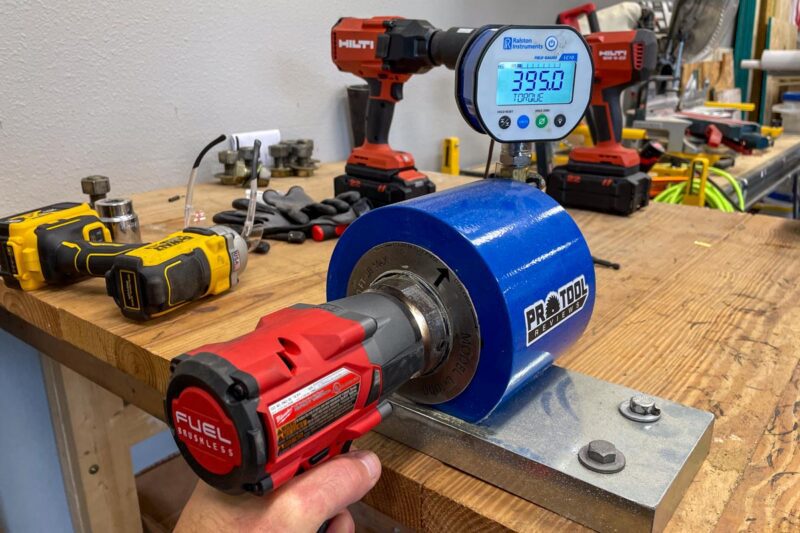
At Pro Tool Reviews, there’s a method to our madness when we test impact wrenches head-to-head. While we share enough details in our main review article to give you a good idea of how we test, we know some of you would like more details. In this post, I’ll dive deeper into the designs and the rationale of how we evaluate these tools.
READ
Best Cordless Impact Wrench Head-to-Head Review
How We Test Impact Wrenches Head-to-Head
Battery Selection
For cordless impact wrenches, battery selection is crucial. Since we typically focus our head-to-head testing on the mid-torque class, it’s possible to err with something too small or too large. Either can throw off the balance, and low-capacity batteries can result in lower performance.
For this class, it’s typical for the impact wrench to be kitted with a standard 2P battery. For most brands, that’s a 5.0Ah pack.
However, we want to see how well these tools perform in optimal conditions, so we select an advanced 2P pack. These are usually 6.0Ah to 8.0Ah in capacity, and those with upgraded technology usually have pouch cell or tabless designs. If it’s a choice between those two techs, we go with tabless batteries.
Inertia Torque Test: Measuring Power Delivery
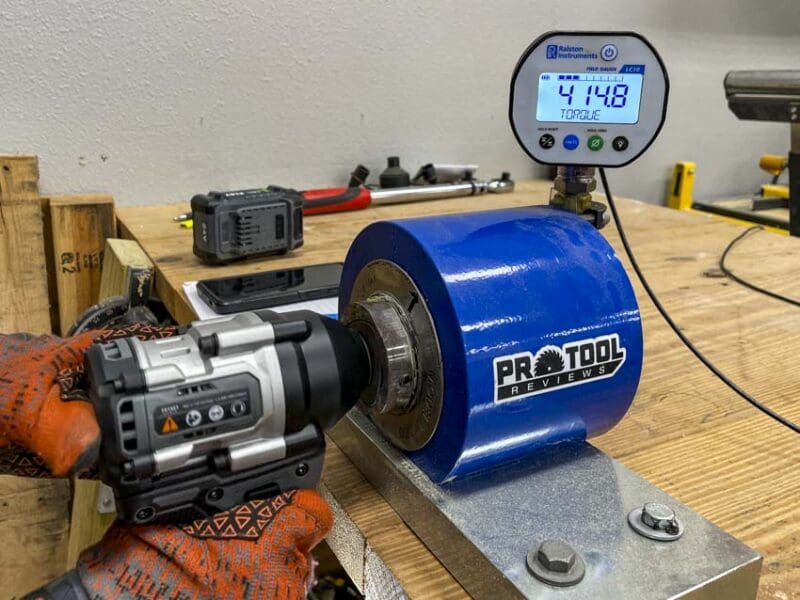
The first of our three performance tests uses Inertia Torque’s L1000 torque tester. It’s unique because measuring torque on an impact tool is notoriously difficult.
When you see the results of this test, you’ll notice the torque we measured is usually much lower than the rated torque from the manufacturer. It’s common for us to get measurements that run 60% – 80% of what the spec sheet notes.
This is partly due to the nature of the L1000 and partly to our methodology. However, Inertia Torque’s design intent fits our testing needs very well.
Impact tools lose performance over time, and the L1000 allows crib managers to keep an eye on that loss. It can indicate when it’s time for maintenance or to pull the tool out of service.
For our purposes, it gives us a reliable, repeatable torque measurement in head-to-head testing. It registers real impact force that we can use as a comparison.
The method we use is intended to let each impact wrench deliver peak power without overheating. In the highest power mode, we run it for 5 seconds, rest for 3 seconds, and repeat 2 more times. The result we report is the highest torque reading the L1000 measured.
Lag Bolt Test: Measuring Applied Force
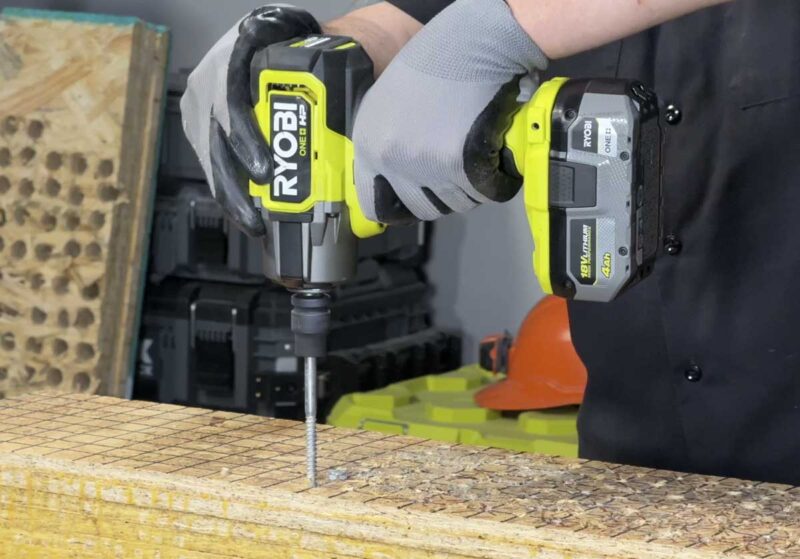
On the surface, our second test looks like we’re evaluating structural fastener capabilities. However, the 1/2-inch x 10-inch lag screws we drive require a pilot hole if you’re actually building with them.
Instead, we only give them a 2-inch pilot hole to ensure they get a straight start into the stacked and glued OSB subfloor we drive them into. Granted, you’ll likely never drive lags of this size into OSB, but the material has much less variability in its density and is unlikely to split like traditional lumber.
This is a hard test for any impact wrench, and most don’t drive the lag flush. Each model has 30 seconds to make as much progress as it can. Even if it’s still making progress, we stop there to prevent overheating and tool failure.
There are two possible results we report. If the impact wrench doesn’t drive the lag flush, we measure how much of it is still above the wood surface. If it does, we record how much time it took to finish.
Bolt Breaking Test: Delivering Raw Power
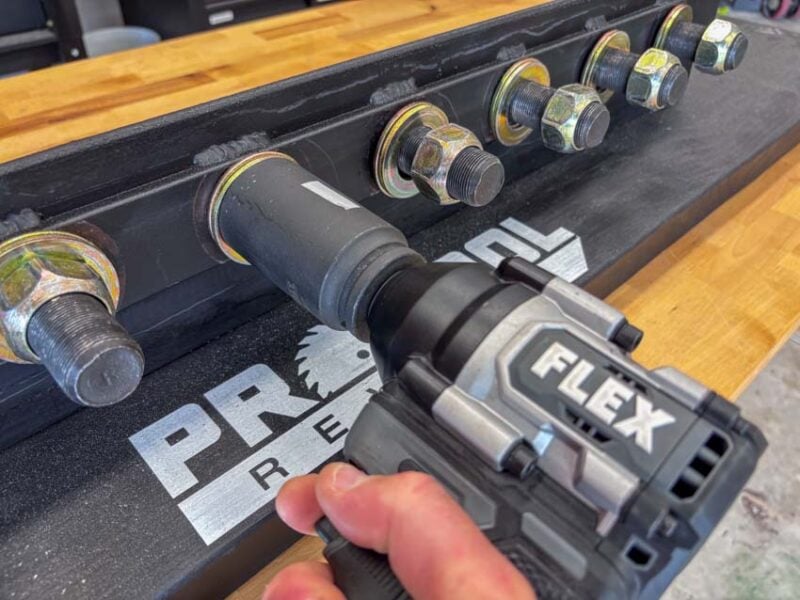
Our final performance test measures the time it takes to break loose a series of nuts. This is no ordinary rig. We set eight 1 1/8-inch semi truck studs through the back of thick angle iron and connect them with the corresponding 1 1/4-inch lug nuts on the front. Using a digital torque wrench, we set each one to 500 ft-lbs.
It’s a much tougher test than loosening typical lug nuts. However, those are usually set to 80 – 125 ft-lbs on most passenger vehicles. Today’s cordless mid-torque impact wrenches are strong enough to loosen those without breaking a sweat. In fact, if you were to install lugs in the most powerful mode, they’d easily shear off the studs.
So, we use this beefed-up rig for two reasons. First, to make sure it’s tough enough to create meaningful separation in the results. Second, the nuts and bolts are rated to handle even more torque than we set them to, so we don’t risk damaging the threads.
The result we report is the average amount of time it takes to break each of the 8 lug nuts, and doesn’t include the time it takes to reset the impact wrench on each one.
Testing Impact Wrenches that Aren’t in Our Head-to-Head Reviews
For mid-torque impact wrenches that don’t make our head-to-head, we still run the same series of tests. They’re all repeatable enough that we can compare them to previous results and be able to see where they stand against the competition.
For compact models, we usually look for applications around a real vehicle, like changing wheels or doing brake jobs. We may also use our bolt break rig set to passenger vehicle lug nut torques and compare to other compact models on the L1000 torque tester.
When we have the opportunity to review high-torque impact wrenches, it’s a different ballgame. Our rigs aren’t designed for the amount of torque they produce, so we connect with Pros like Eli Mosely, who has heavy equipment on his ranch, or our resident diesel mechanic, Isaac Leuchtefeld. We’ll let them use them for the applications they tackle on a regular basis and tell us how they compare to what they normally use.
Other Considerations
In addition to performance, there are plenty of other characteristics that go into evaluating an impact wrench. Here are the ones we look for:
- Motor type
- Head length
- Weight and balance
- Handle ergonomics
- Speed
- Torque
- Impact rate
- Modes (including assist modes)
- Drive type
- Smart connectivity and controls
- LED light design
- Available accessories (such as protective boots)