
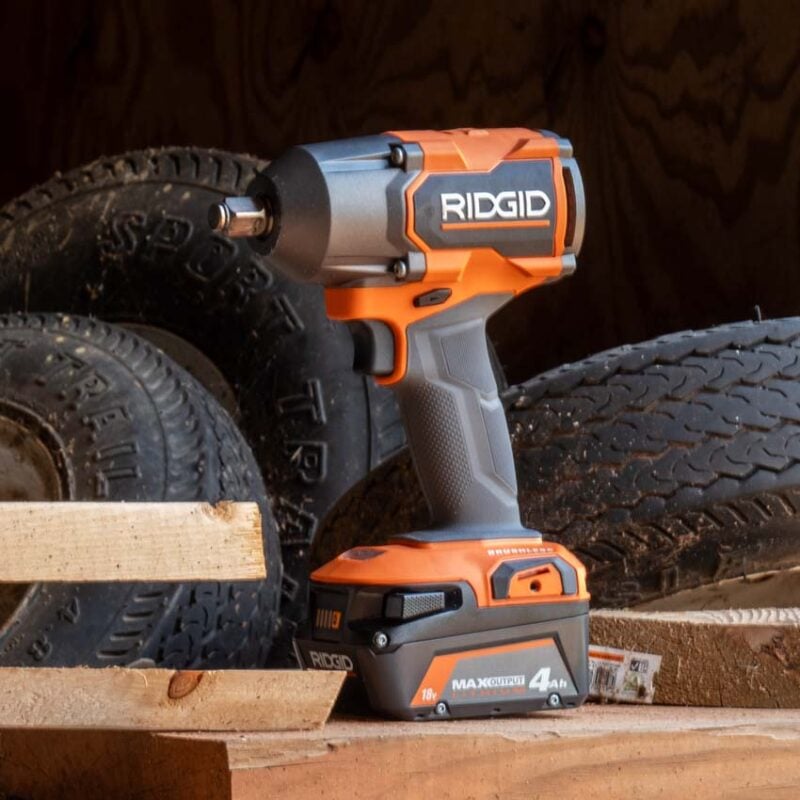
We’ve tested our fair share of impact wrenches over the years, and this time, I’m putting two popular Home Depot brands head-to-head in a Ryobi vs Ridgid impact wrench comparison. The Ryobi HP Brushless P262 and Ridgid 18V Brushless R86012 sit at the top of their respective lineups and share plenty of similarities. But when the results are in, how close are they really?
That’s an interesting question considering both brands are part of the same TTI family. Ridgid has traditionally positioned itself as the Pro-focused value option, while Ryobi has built its reputation around DIYers and homeowners. However, Ryobi’s HP Brushless line has continued to close that gap, making this a worthwhile comparison.
We put both impact wrenches through our hands-on testing to see how they compare in speed, power, and overall performance. Here’s what we found.
READ
Best Cordless Impact Wrench Head-to-Head Review
Ryobi VS Ridgid Impact Driver Specifications
Here’s a quick look at the key specs to know before we jump into testing:
| Ryobi P262 | Ridgid R86012 | |
|---|---|---|
| Max No-Load Speed | 2,800 RPM | 2,800 RPM |
| Max Impact Rate | 3,200 IPM | 3,800 IPM |
| Max Torque | 600 ft-lbs (breakaway) 450 ft-lbs (fastening) | 650 ft-lbs (breakaway) 500 ft-lbs (fastening) |
| Head Length | 7.19 in. | 6.75 in. |
| Bare Weight | 3.69 lbs | 3.69 lbs |
| Working Weight | 5.19 lbs (4.0Ah Edge battery) | 5.69 lbs (8.0Ah Max Output EXP battery) |
On paper, it looks like Ridgid has a slight performance advantage. However, it’s the test results that will tell the full story.
Ryobi VS Ridgid Impact Wrench: How We Tested
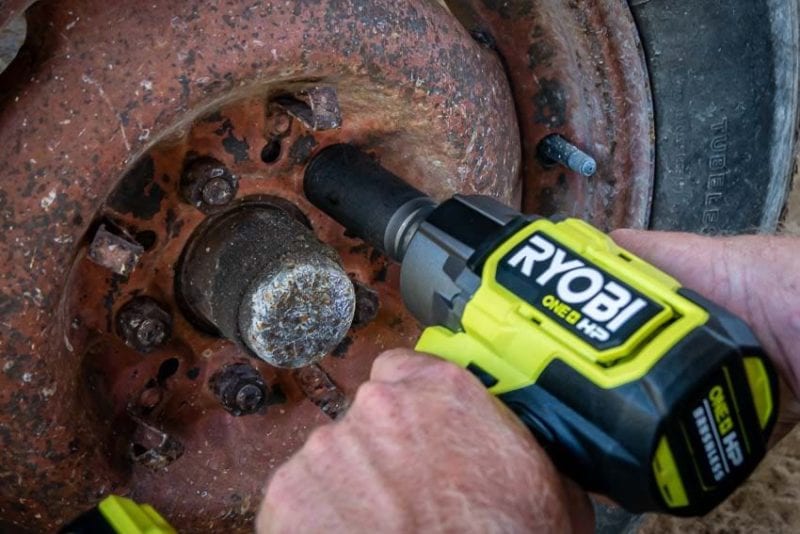
Bolt Break Test
This test focuses on breakaway torque. We torque eight 1 1/2-inch lug nuts to 500 ft-lbs using a specialized torque wrench, then time how long each tool takes to remove all eight. The results give us a consistent way to compare how each tool handles heavily loaded fasteners.
Lag Bolt Test
For our fastening torque test, we drive a 10 x 1/2-inch lag bolt into a laminated OSB test block. Each tool has 30 seconds to fully sink the bolt. If it falls short, we measure how many inches remain above the surface. It’s a demanding test for most mid-torque impact wrenches, but it gives us a consistent look at each tool’s raw driving power.
Inertia Torque Test
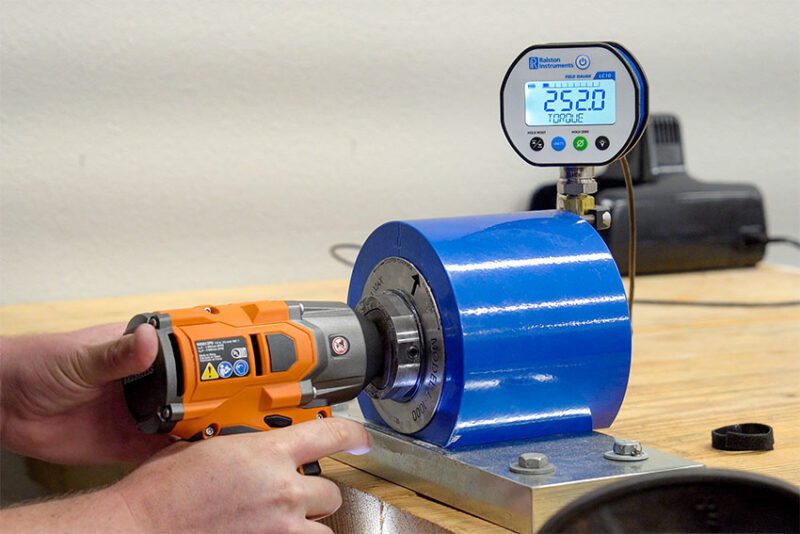
Our final test measures torque using an Inertia Torque L1000 torque tester. Unlike our other tests, this setup isolates torque, with neither speed nor impact rate influencing the results.
We run three 5-second intervals with a 3-second break between each one, recording the highest torque reading. This gives us a look at the actual torque output of each impact wrench and provides a different data point from the methods manufacturers use to rate their tools.
Testing Results
| Ryobi P262 | Ridgid R86012 | |
|---|---|---|
| Bolt Break Test | 33.27 sec (total) 4.16 sec per nut | 33.68 sec (total) 4.21 sec per nut |
| Lag Bolt Test | 0.36 inches remaining | 0.31 inches remaining |
| Inertia Torque Test | 236.6 ft-lbs | 283.4 ft-lbs |
Looking at the results, these tools seem fairly evenly matched outside of the inertia torque test, but realistically, their actual torque specs really aren’t too far apart when you look at the numbers.
During the first two tests, each tool only held a slim margin to emerge as the victor. It makes sense when you look at their respective speed and torque numbers. So then, why such a disparity during our inertia torque test?
The answer is pretty simple—impact rate.
Ridgid’s anvil is hitting at 18.75% higher speed than Ryobi’s, and that extra 600 IPM is really putting in the extra effort for the R86012. Speed is absolutely important, but Ridgid’s extra impact rate gives it a slight edge over the P262, which also allows it to advance the lag bolt further than Ryobi.
So while the Ryobi P262 is certainly a contender in the Prosumer realm and only lagged behind by a slim margin, the Ridgid R86012 takes the cake in this matchup.
Ryobi VS Ridgid Impact Wrench Key Highlights
Ryobi P262
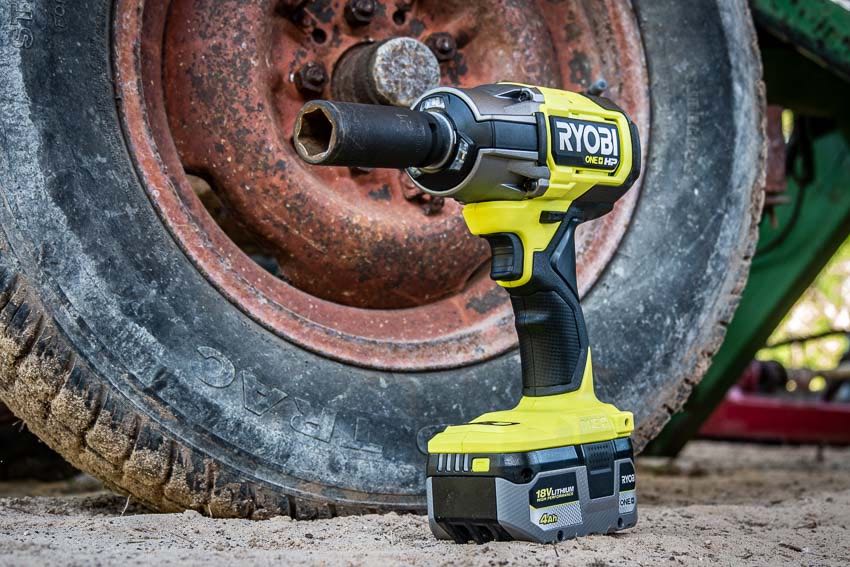
- Brushless motor
- 3 speed modes with Assist Mode
- Tri-LED lights
- Die-cast gearbox
- 1/2-inch friction ring anvil
Ridgid R86012
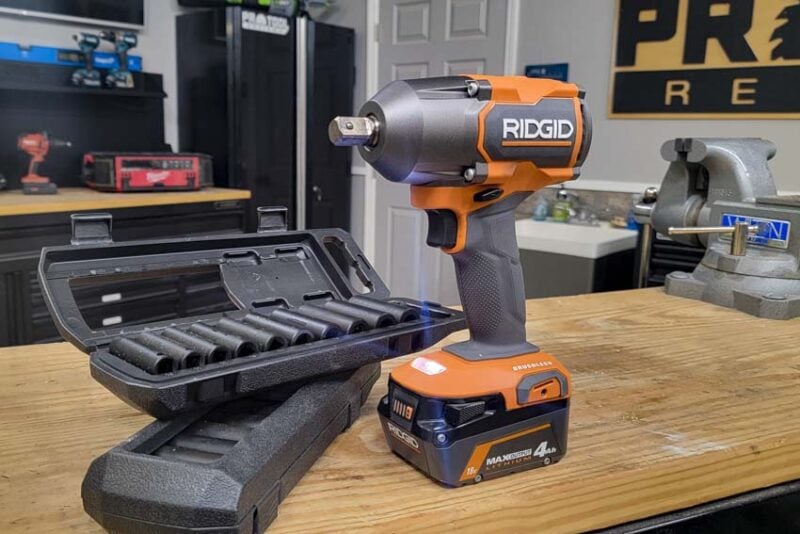
- Brushless motor
- 3 speed modes with Assist Mode
- Foot-mounted LED light
- Die-cast gearbox
- Available with both a friction ring or a pin detent anvil
Pricing and Final Thoughts
| Configuration | Ryobi P262 | Ridgid R86012 |
|---|---|---|
| Bare Tool | $179 | $189 |
| Kit | N/A | N/A |
| Warranty | 3-year | Lifetime Service Agreement |
So, after all our hands-on testing, I’m obliged to declare Ridgid the winner… but let’s be honest, this one was close. The R86012 pulled ahead during two of our three tests, but the overall performance of each tool is very evenly matched.
On paper, Ridgid has the upper hand with its superior torque and impact rate, but this wasn’t a total blowout for Ryobi either. If you look at our results, Ryobi only fell behind by a small margin and held its own against a well-established Pro brand. Furthermore, these tests proved that Ryobi’s overall performance level on the One+ lineup is starting to blur the line between Pro and Prosumer.
For me, I could go either way and be perfectly happy. I think this all boils down to a matter of preference and, since both models are only available as a bare tool, which battery platform you’re already working with.
But, since this is a head-to-head (and we’re not a fan of ties), I tip my hat to the folks over at Ridgid. The R86012 displayed confident power, comfortable ergonomics, and it goes pretty easy on the wallet compared to other premium brands. If you’re in the market for a new mid-torque impact wrench, the Ridgid R86012 deserves a serious look.