
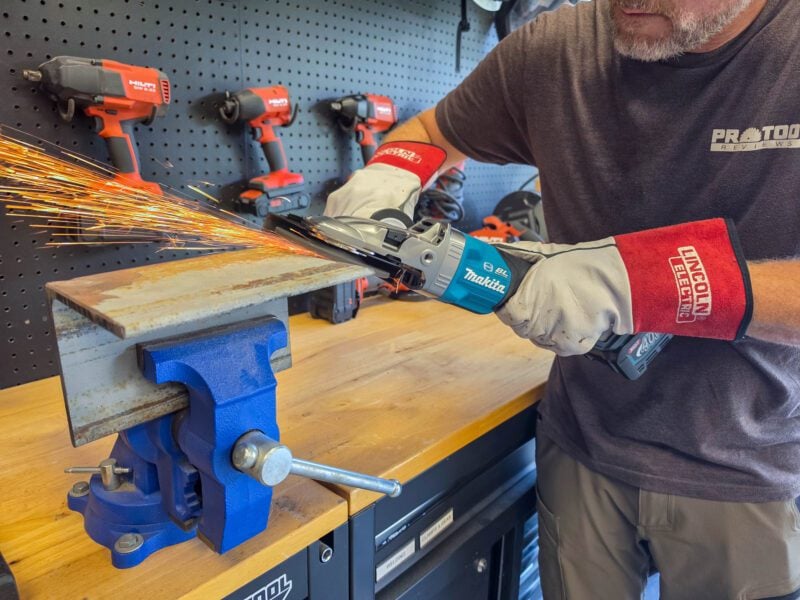
Cordless angle grinders are now capable of handling demanding metalworking tasks without the hassle of a power cord. Makita takes that idea a step further with the 40V max XGT flathead angle grinder (GAG16), a design centered on one particular advantage: getting into spaces where a traditional grinder can’t. We put this grinder against some of the top performers in our shop to see where it stands in the lineup so you can decide if it deserves a place in your tool arsenal.
Pros
- Confident power level
- Slim head profile
- Multiple speed modes
- Easy guard adjustments
- Metal guards
Cons
- Expensive bare tool price
Makita 40V max Flathead Grinder Performance
Speed and Power
Makita equips the GAG16 with a brushless motor and a five-position speed dial ranging from 3,000 to 9,000 RPM. The available settings are 3,000, 4,500, 6,000, 7,500, and 9,000 RPM, giving you a perfectly reasonable amount of control depending on your application.
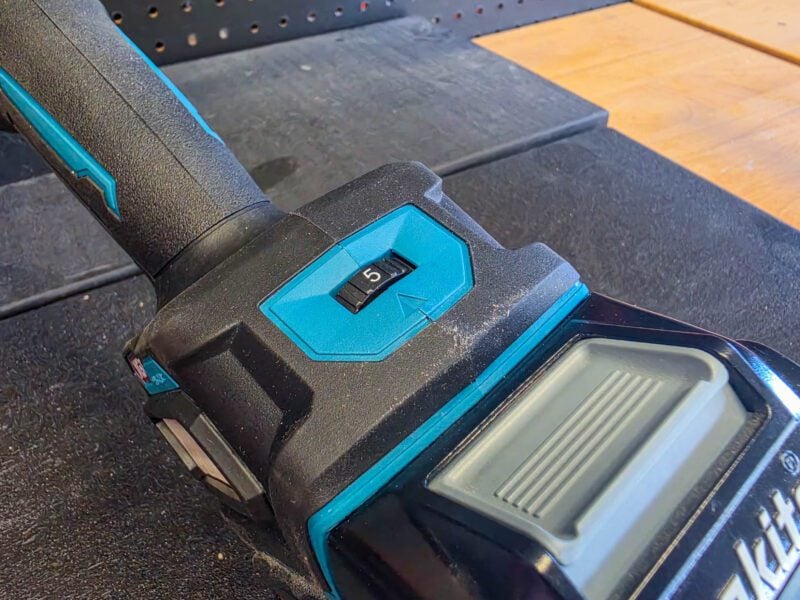
That range is useful because grinding, cutting, and finishing tasks don’t always call for the same speed. Having five settings lets you dial the grinder back for applications where full speed isn’t necessary, rather than running the wheel wide open all the time.
At the top end, Makita rates the GAG16 at 13-amp corded power. That’s a substantial power class for a cordless 5-inch grinder, putting this grinder firmly in the medium- to heavy-duty category rather than treating it as a simple convenience tool for occasional cutting and grinding tasks.
Flathead Design
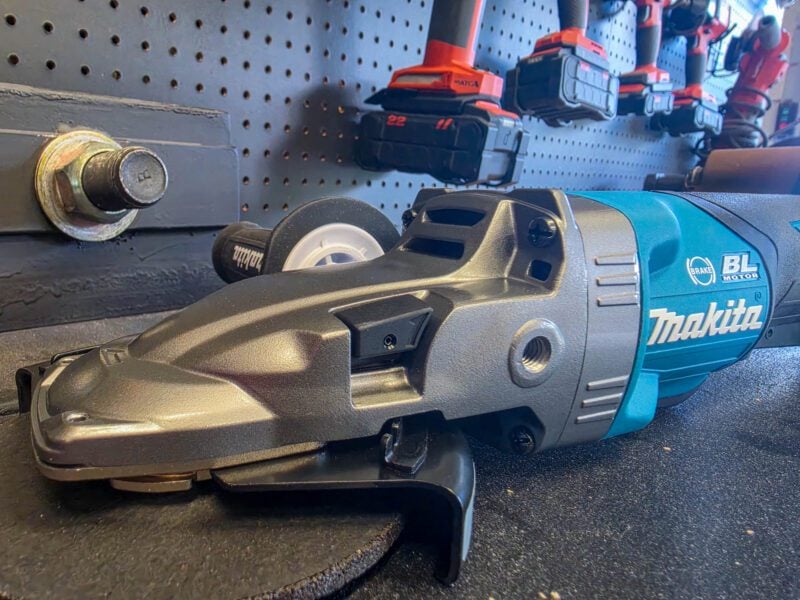
The biggest reason to consider the GAG16 isn’t simply the power. It’s the head design that really matters here.
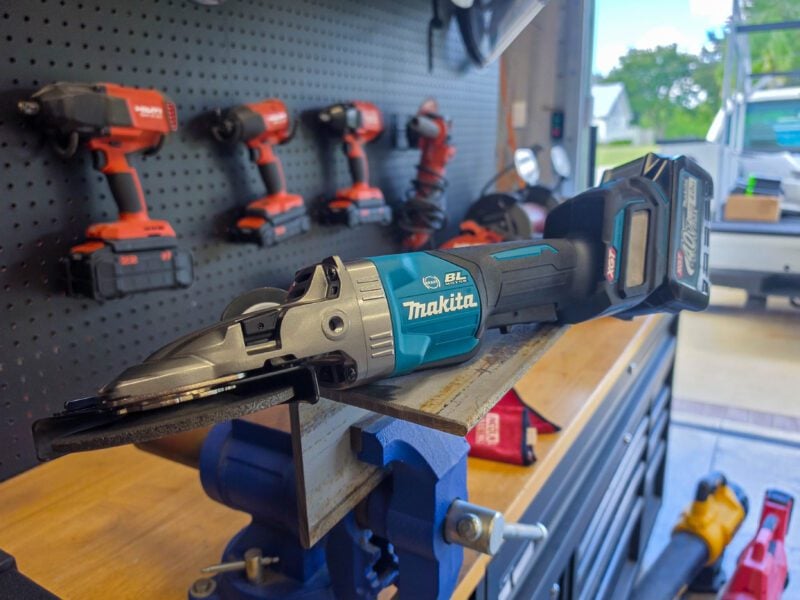
Makita built the grinder around a 39° low-profile flathead configuration that they say provides up to 45% more access in tight spaces compared to a conventional full-profile angle grinder. This really shows when I broke out a set of calipers and discovered the head was a mere 1.9 inches thick. That’s much thinner than many of the angle grinders I’ve tested, and it just goes to show that Makita was very intentional with their design.
That’s particularly useful for metalworkers, welders, and pipe fitters who regularly find themselves working around obstacles in tight spaces. A conventional grinder will run into clearance issues when the gear housing gets in the way, but Maktia’s flatter head gives the wheel a better chance of reaching those hard-to-access areas.
Variable Speed Dial
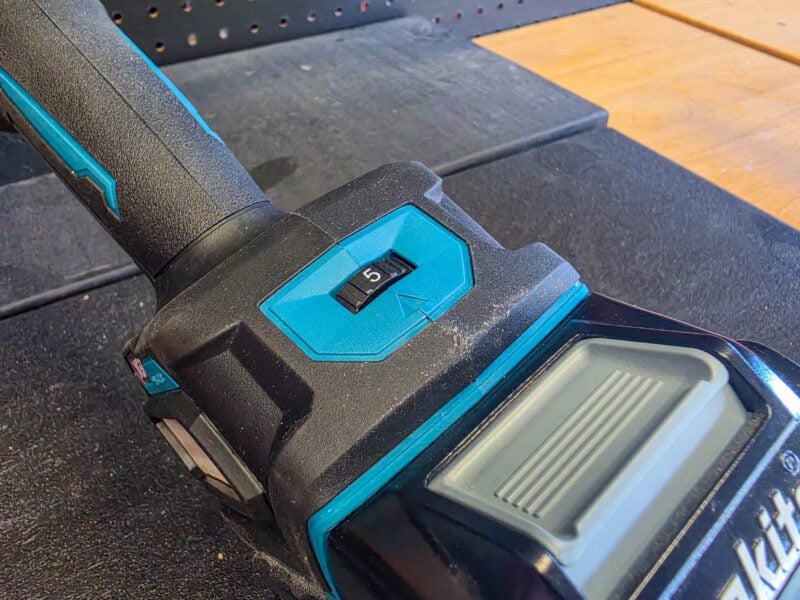
As I mentioned earlier, this grinder sports a multi-speed dial. The five speed modes add another layer of control as you work. You can run the GAG16 anywhere from 3,000 to 9,000 RPM, depending on the needs, rather than being locked into a single speed like some grinders.
This is especially useful when you’re switching between different accessories or applications. The ability to control that speed gives you more flexibility for work where maximum RPM isn’t the best choice.
You’re not simply getting a powerful tool—you have greater control over how that power is delivered when necessary.
Makita 40V max Flathead Grinder Design Notes
Size, Weight, and Ergonomics
The GAG16 measures 16-1/8 inches long with a bare tool weight of 4.8 pounds. Adding a 4.0Ah battery brings the total weight to 7.1 pounds, which is fairly consistent with other 13-amp-equivalent models we’ve tested.
While this grinder is a bit longer than normal, the size makes more sense when you consider what Makita is trying to accomplish. This isn’t a typical compact 4 1/2-inch grinder designed around portability. It’s a high-power 5-inch model built to handle demanding work while offering improved access around the wheel.
The 4.0Ah battery does add some weight compared to similar models, but I found it gave this grinder a very pleasant balance. With that said, the overall weight is something to keep in mind if you’re spending long periods grinding overhead or working in awkward positions.
Paddle Trigger
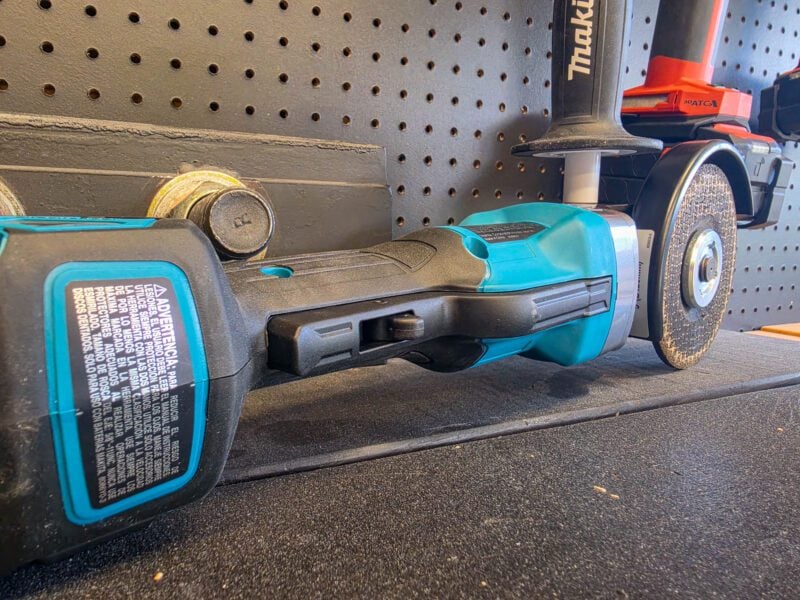
Makita went with a paddle switch on the GAG16 rather than the more traditional slide switch, which gives you convenient on/off control while maintaining a grip on the body of the grinder.
I generally like paddle switches on grinders because they make it easy to shut the tool down simply by releasing your grip. That’s particularly useful when you’re moving between different cutting and grinding positions.
There’s also a lock-off function so you won’t need to worry about unintended activation while in transit.
Side Handle Adapter
Makita includes a side handle and a side handle adapter with the GAG16. The adapter extends the grip length and provides another option for controlling the grinder, which is particularly helpful given the tool’s size and power.
That extra flexibility makes sense on a grinder designed for more demanding work. You can configure the tool around the application instead of having to work around a fixed grip position.
Should You Buy It?
The Makita GAG16 takes a different approach to the cordless grinder. Rather than chasing higher speeds, it seeks to solve the unique problem of space. Its flattened design allows it to reach where most grinders can’t, giving it a distinct advantage in a crowded field.
Now, for me, the biggest hurdle is the bare tool price of $339. This is a serious investment, especially if you’re not already working on the XGT battery platform. However, for welders, pipe fitters, metalworkers, and other Pros who can take advantage of the flathead design, it certainly makes a strong case for itself.
Yes, it’s a specialized tool, but that’s also what makes it interesting. The design addresses a specific limitation of conventional grinders…but it still delivers the power and features you’d expect from a high-end cordless grinder. With that said, if you can get past the upfront cost, I’m sure the 40V max XGT flathead grinder will pay dividends in the end.
Specs
- Model: Makita GAG16
- Power Source: Makita 40V battery
- No-Load Speed: 3,000 / 4,500 / 6,000 / 7,500 / 9,000 RPM
- Weight: 4.8 lbs (bare tool), 7.1 lbs (with 4.0Ah battery)
- Max Wheel Diameter: 5 in.