

Ryobi’s Next-Gen 40V HP Brushless AWD Self-Propelled Lawn Mower Sharpens Its Competitive Edge
Ryobi introduced its first-generation CrossCut lawn mower back in early 2021. It was definitely a huge improvement over its previous mowers, but we felt there were a few things that could be improved. A year later, the second-generation Ryobi 40V HP Brushless AWD self-propelled lawn mower hit the market and garnered high praise from our team.
Now, five years after the initial release, we have the next-generation Ryobi 40V AWD self-propelled lawn mower. It promises more power, longer runtime, and an improved suite of helpful features. Does it live up to the hype? Let’s find out!
Pros
- AWD provides added traction on slopes
- Excellent cutting power
- Digital fuel gauge
- Quiet operation
- Adjustable thumb paddles
- On-the-fly drive changes
- Single-point deck height adjustment
- Very efficient side discharge, mulching, and bagging
- One-touch folding action for compact vertical storage
- Turbo mode for thick grass
- Made in the USA with global materials
Cons
- Clippings can get caught in the chute and make the mulching knob movement sticky
Read
Best Self-Propelled Lawn Mower
Ryobi 40V HP Brushless AWD Self-Propelled Lawn Mower Performance
- Gas Equivalence: 196cc
- Motor Type: HP Brushless
- Drive Type: AWD and Smart Trek RWD
- Torque: 9.7 ft-lbs
- Deck Size: 21 in.
- Mowing Function: Mulching, Bagging, Side Discharge
- Cutting Height: 1 in.- 4 in. (10 positions)
- Max Runtime: 75 minutes
Cutting Power
As we’ve seen in previous models, the CrossCut designation means this mower features a stacked-blade system. This configuration provides improved cutting performance and mulching capabilities over a traditional single-blade mower. It’s essentially a two-stage cut where the first blade cuts higher and the second finishes it off.
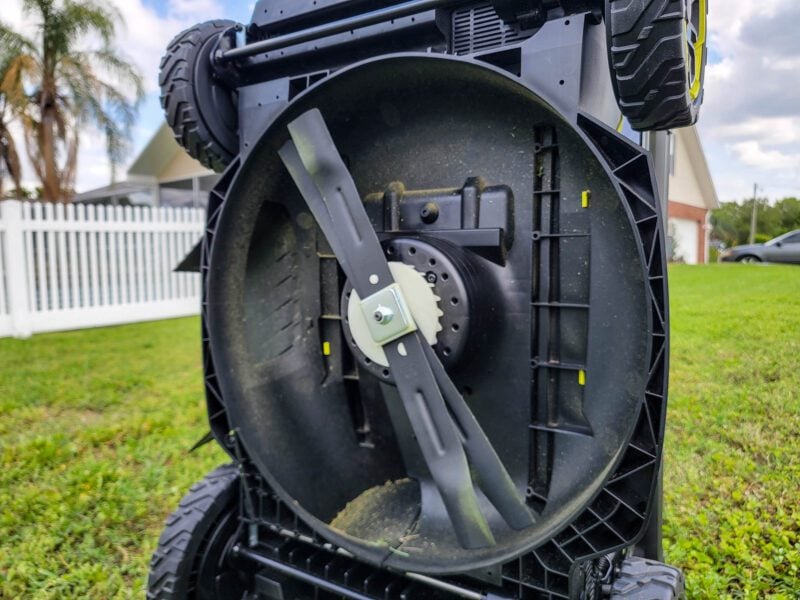
The concept is something we first saw on Honda gas mowers years ago, and Ryobi’s brushless motors on CrossCut mower are strong enough to handle the extra mass.
More importantly, it really does make cutting more efficient, especially with fast-growing species like the St. Augustine and Bahia we cut in our testing.
Ryobi tells us that this mower’s power level is equivalent to a 196cc gas-powered model, making it a true gas replacement for residential use. At that power level, reclaiming your thick overgrown lawn is within your reach.
To put that in context, entry-level gas mowers often have a 140cc engine, and quality mid-range options step up to 160cc. So with equivalent power to a 196cc engine, Ryobi offers performance that really does a nice job of tackling thick grass and moderate to heavy overgrowth.
Mulching
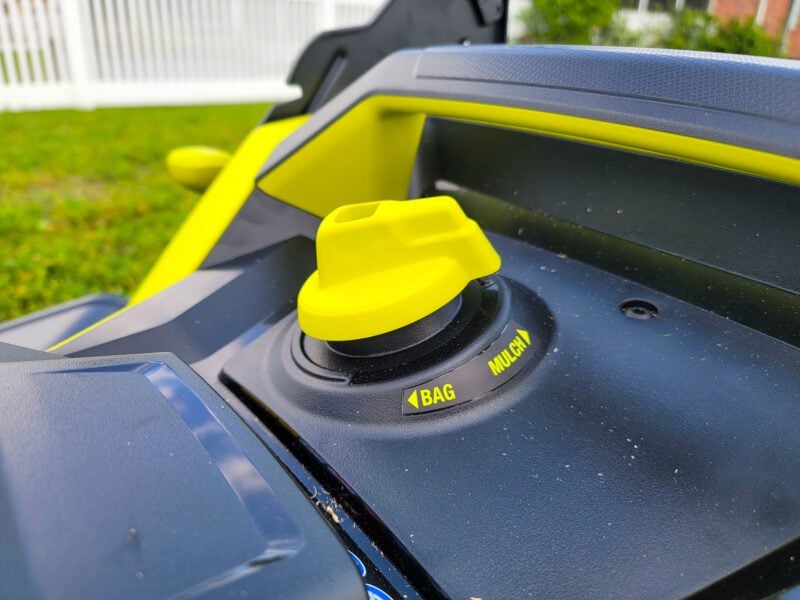
Ryobi did us a huge favor by incorporating the mulch plug into the deck construction, so there are fewer pieces to keep track of. One difference from the previous version is that they did away with the large sliding mulch door lever in favor of a more low-profile knob. This design is far more streamlined and just as effective—simply turn the knob to your desired setting, and you’re good to go.
While I do like this design, it’s not perfect. From time to time, we noticed the mechanism would stick or be hard to turn. There’s a little bit of a gap that grass can catch in and make it tough to turn. We found that blowing out the stray grass clippings after mowing is the easiest and most effective solution.
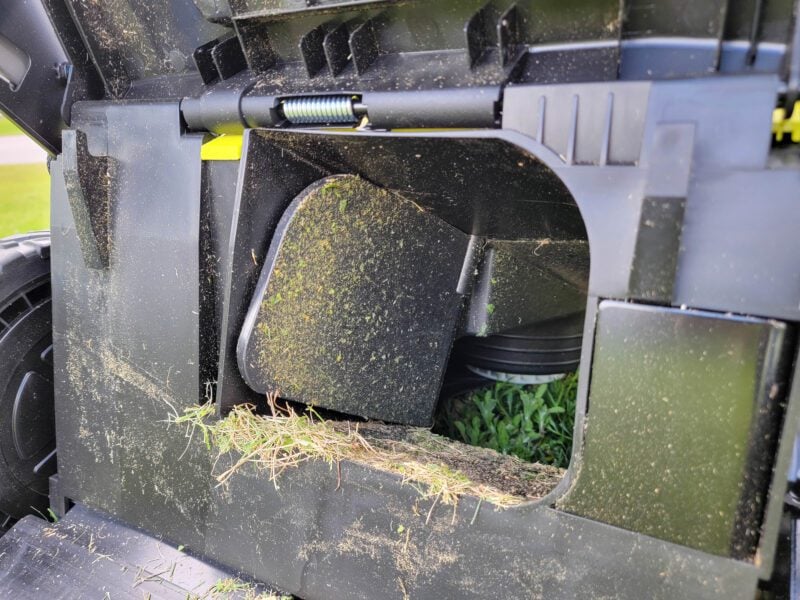
During our testing, the mulching function performed as well, if not better, than its predecessor during our testing. That’s a really big deal because we know that it is already an area where Ryobi’s past mowers already excelled, so kudos to the development team!
Read
Mulching Grass the Right Way for a Healthier Lawn
Bagging
Take those excellent mulching characteristics, combine them with high airflow and lift, and you get some of the best bagging we’ve seen from a battery mower. Cutting from 5 inches down to 3 inches, we filled the bag in a matter of minutes, and it was both dense and full to the brim!
I did manage to find a few stragglers left behind when I fluffed the grass with my hand, but overall, it collected the vast majority of the clippings and left the yard looking great. Add Ryobi’s optional high-lift blade to get the best bagging. It reduces your runtime a little, but you’ll get a stronger vacuum to pull the clippings into the bag.
Read
Lawn Care Conundrum: Mulching vs Bagging – Which is Better?
Side Discharge
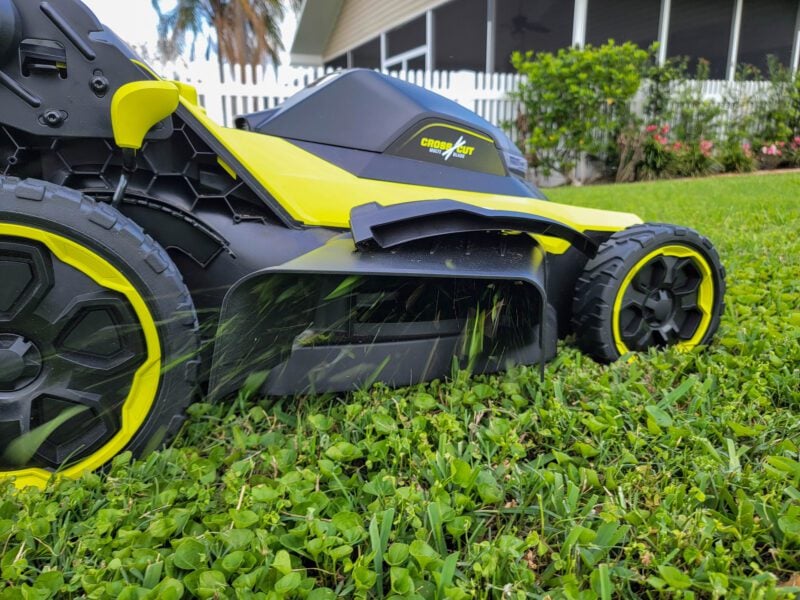
With such excellent bagging and mulching, it wasn’t a surprise to us that the side discharge was highly effective as well. Ryobi opts for a true side discharge rather than a rear attachment, and it did a far better job of distributing the grass clippings than other battery-powered lawn mowers we’ve used.
As of right now, our grass conditions are pretty dry, so we’re obviously seeing improved performance due to the lower moisture. Higher water content will make the clippings a little heavier, but given my past experience with Ryobi mowers, I don’t expect subpar results so long as you keep your lawn regularly maintained.
Cut Quality
As I looked back over thousands of square feet of cut grass, I couldn’t help but notice that it looked more even than what I’m used to from a battery-powered mower. Getting down on ground level confirmed that it’s another area that has remained consistent from the previous Ryobi CrossCut model. A few straggling grass blades were sticking up, but that’s typical with our grasses.
Runtime
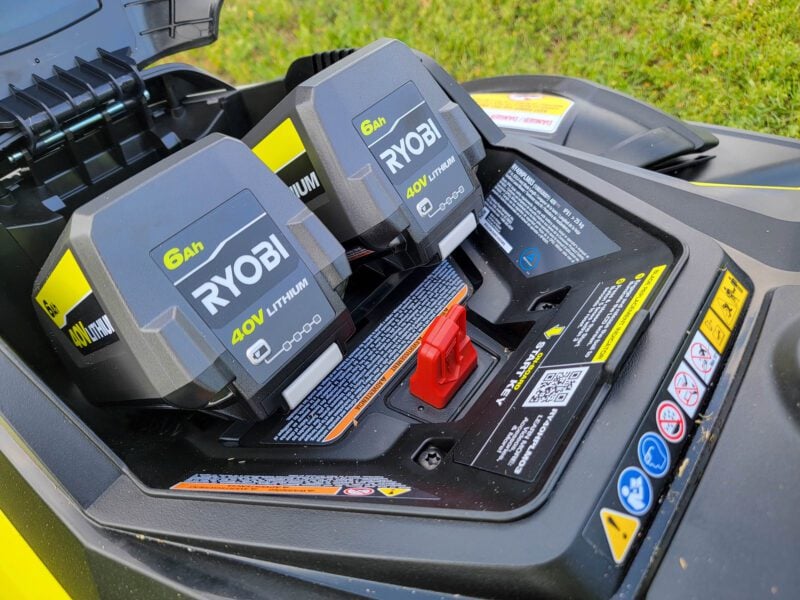
Ryobi tells us to expect up to 75 minutes of continuous runtime using two 6Ah batteries, which is respectable for a battery-powered mower. As for coverage, this mower is ideal for lawns between 1/2 and 3/4 acres, and based on our past experience, this number is well within reach. If you’re regularly mowing much more than that, I’d recommend stepping up to one of Ryobi’s new riding mowers instead…unless you’re just trying to get your steps in.
| Battery Selection (x2) | Estimated Runtime |
|---|---|
| 6Ah | 75 min. |
| 8Ah | 100 min. |
| 12Ah | 150 min. |
While you can run this mower on a single battery, Ryobi recommends using two for optimal performance and runtime.
One major improvement is that Ryobi nixed key-based battery selection in favor of an automatic switchover system. This means there’s no need to stop and manually turn the key when one battery is depleted.
Moreover, they moved the battery gauge from the back of the motor housing to the LCD display on the main handle. This means it’s easier to actively monitor your battery life while mowing.
Ryobi 40V HP AWD Lawn Mower Design Notes
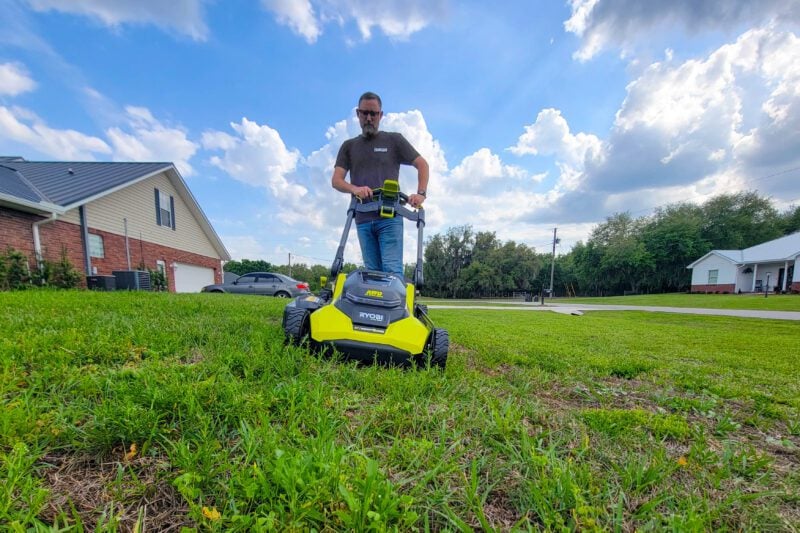
- Model: Ryobi RY40HPLM03
- Power Source: Ryobi 40V batteries (recommended 2)
- Deck Material: Polymer Composite
- Wheel Size: 8 in. (front), 11 in. (rear)
Drive Train and Controls
Starting with the basics, you can run this mower in RWD or AWD depending on your needs. I found the AWD was exceptionally helpful when mowing laterally on hills, but on flat level ground, it’s not necessary. The additional traction kept me on my line, so I didn’t have to fight to keep the rear wheels from slipping.
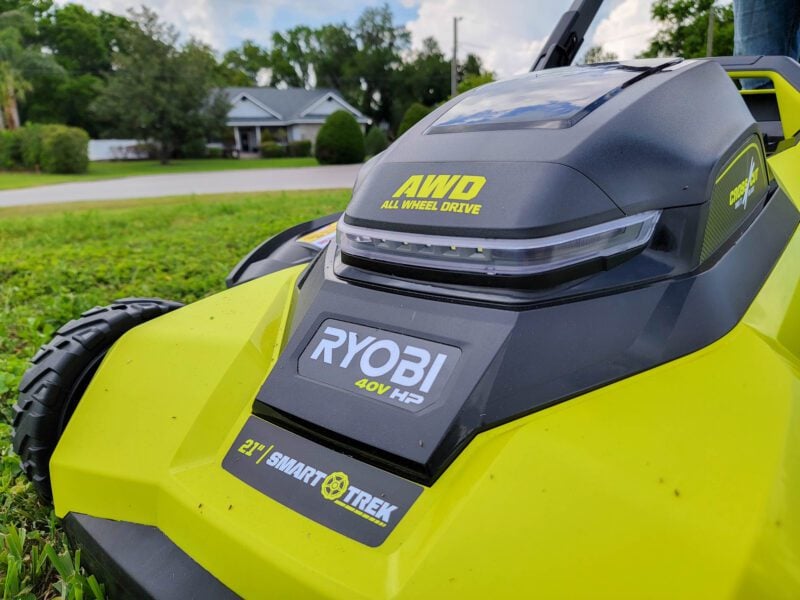
Ryobi retained the same Smark Trek drive system from the previous model, and I think that was a smart play. But there are a few key improvements that I want to highlight.
First, Ryobi ditched the slide switch design in favor of a simple arrow button on the control panel to adjust the speed. Second, they redesigned the drive paddles and added a small patch of rubber overmolding, making them more comfortable during longer mowing sessions.
The drive levers are adjustable up and down to fit your favored grip position, and the presence bar folds down into a recessed groove for improved comfort.
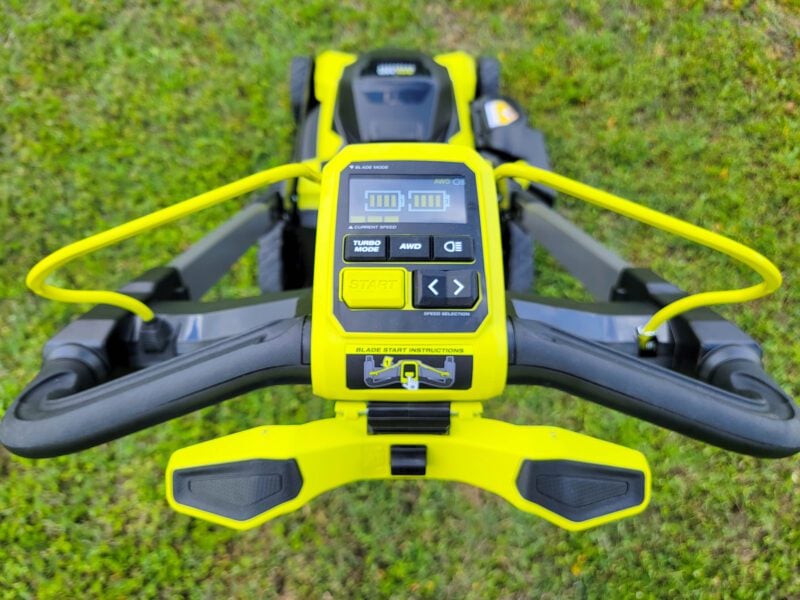
Looking down at the control center, Ryobi took a detour from their normal design. Rather than a simple setup, they opted for a more advanced LCD control panel that lets you adjust speed, activate turbo mode, and turn on the headlights. You’ll also find a battery-life meter that tracks both batteries simultaneously, along with a blade replacement reminder. This setup is similar to the RWD RY40HPLM02’s design, but it’s more refined and certainly a huge step up from their first-gen AWD model.
Drive Speed
An area where Ryobi excelled is the drive speed—I nearly had to break out my best speedwalking skills just to keep up at top speed! I found that setting the speed just south of 50% made for a comfortable, sustainable pace.
Deck Design
As expected, Ryobi went with a molded poly deck rather than steel or aluminum. There is some debate in the mower community about the durability and longevity of a plastic deck, but in our experience, there are significant benefits.
First off, plastic decks are usually lighter, with some exceptions depending on size. Second, since they’re molded, designers can engineer the mold to create optimal airflow and structural integrity. Lastly, they’re impervious to rust, so they’re not affected by repeated exposure to wet mowing conditions.
One more thing before I move on—with more than a decade of mower testing under our belts, we have yet to break a poly deck.
Height Adjustment
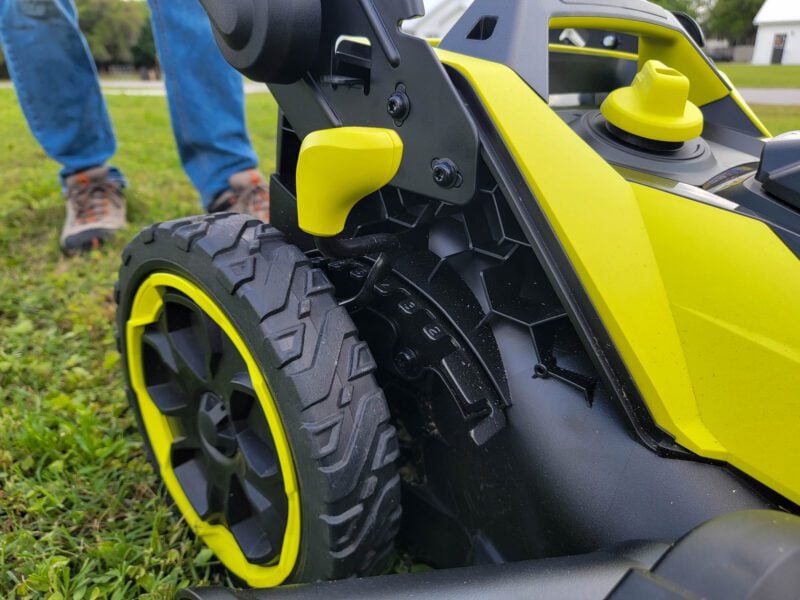
Another feature that carried over is the single-point height adjustment lever. We like this design because it makes the process much faster and easier than adjusting each wheel individually.
This mower has 10 adjustment points ranging from 1 to 4 inches, in roughly 1/2-inch increments. This is a suitable range for the majority of grass species you’re likely to encounter.
Ryobi 40V HP Brushless AWD Self-Propelled Lawn Mower Price
The Ryobi RY40HPLM03 retails for $849. Inside the box, you’ll find two 40V 6.0Ah batteries, a rapid charger, a collection bag, and a side discharge chute. Ryobi backs this mower with a 5-year limited warranty.
The Bottom Line
Ryobi continues to refine its CrossCut lineup in all the right ways, and this latest AWD model is a strong example of that progress. With gas-equivalent power in the 196cc class, it has no trouble handling routine maintenance or tackling thicker, overgrown sections when needed. Pair that with excellent mulching, top-tier bagging performance, and a genuinely effective side discharge, and you’re looking at a mower that delivers across the board.
There are a few minor drawbacks—namely, the occasional sticking in the mulch plug and the expected runtime trade-offs when pushing performance—but they’re easy to work around and don’t overshadow the overall experience. In fact, the automatic battery switchover, upgraded control center, and improved ergonomics all make this mower feel more polished and user-friendly than previous generations.
At the end of the day, this Ryobi 40V HP AWD mower isn’t just keeping pace with gas—it’s making a strong case to replace it for lawns in the 1/2- to 3/4-acre range. If you’re after a cordless mower that blends power, versatility, and thoughtful design improvements, this one deserves to be on your short list.