

Over the last few years, Stihl has continued to develop their AP battery-powered OPE lineup, which includes many core tools that landscaping Pros depend on. Today, I’m highlighting their latest foray into backpack blowers—the Stihl 36V BRA 280. I’m going to review the key specs and design elements, test it on our force meter to see how it performs, and help you decide if it’s the right model for you!
Pros
- Comfortable shoulder straps
- Telescoping blower tube
- Excellent blowing force
- Tool-free adjustable grip
- Capable of running on a single battery
Cons
- A little pricey
Stihl BRA 280 Backpack Blower Performance
- Tested Blowing Force: 22 N (high), 26.7 N (turbo)
- Max Airflow: 571 CFM
- Max Airspeed: 192 mph
- Tested Runtime: 23 min. 22 sec. (high), 15 min. 39 sec. (turbo)
- Noise Level: 80 dBA (high), 82 dBA (turbo)
Blowing Force
On paper, the STIHL BRA 280 delivers 26 Newtons of blowing force, which is solid for battery-powered backpack blowers. It also produces up to 571 CFM of airflow with a top airspeed of 192 mph.
These numbers are pretty impressive, and Stihl is usually spot-on with their technical specs. With that said, we always like to test for ourselves to see how tools perform in our Central Florida conditions.
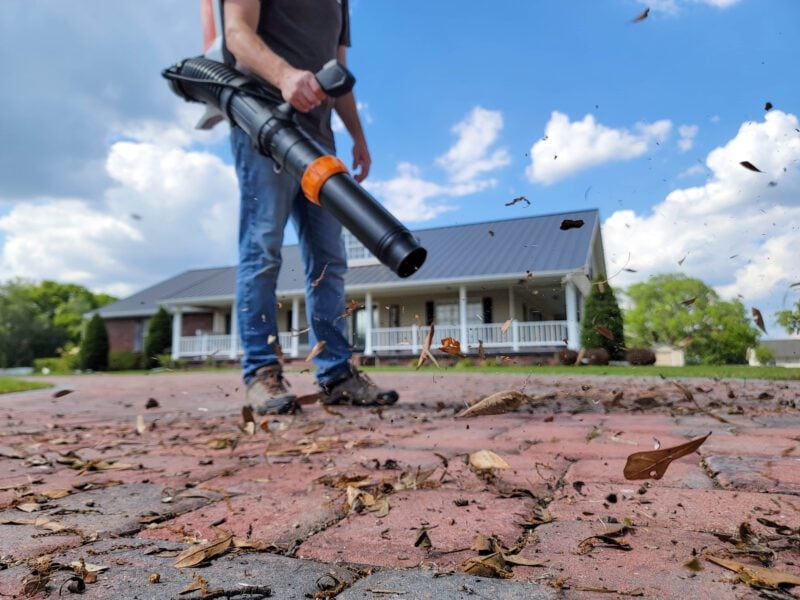
Using our force meter, we clocked this blower at 22 N on high and 26.7 N with the turbo mode engaged. This clearly exceeded Stihl’s technical specs, which is a big win for the production team.
What this translates to in the real world is an improved ability to round up heavy leaf buildup, remove stubborn wet grass, and clear off debris from the hardscape around your home.
What stands out more than raw power, though, is how it delivers it. Stihl’s constant power system keeps blowing output consistent throughout the battery’s lifecycle. This means that the power won’t dwindle down like the old NiCad batteries of yesteryear.
Runtime
Runtime is one of those factors that has plagued battery-powered OPE in the past, but improved battery technology and motor efficiency are making significant gains.
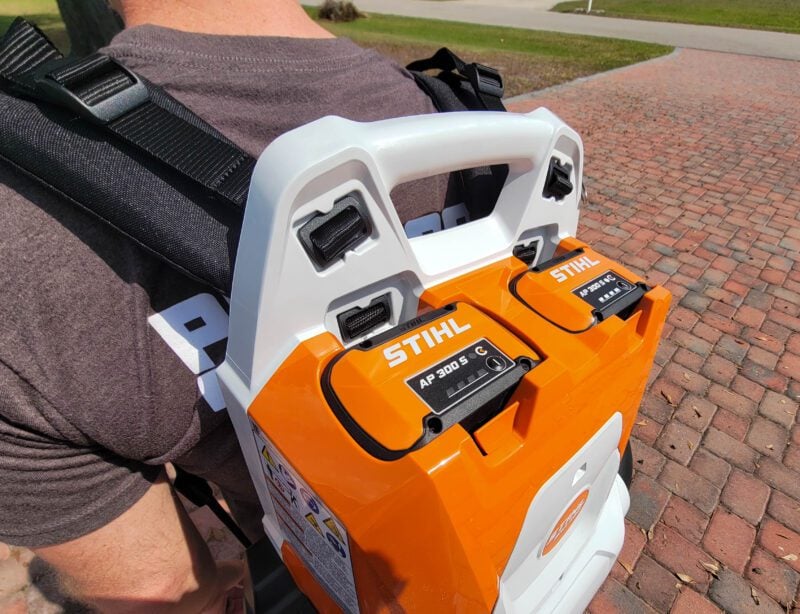
Stihl claims up to 25 minutes of continuous runtime with the kitted AP 300 S batteries, so we set out to test how those numbers hold up in our high-humidity spring conditions. I loaded up two freshly charged batteries and set the cruise control to high speed.
All in, the BRA280 ran for 23 minutes and 22 seconds on high, which is just shy of Stihl’s estimate. Going a little further, I loaded up two more fresh batteries and set the cruise control on the turbo mode. In this case, I got a max runtime of 15 minutes and 39 seconds. Let’s digest these numbers a little further.
Stihl claims 25 minutes, but this is under ideal conditions. Although it ran less than the stated runtime, it’s still hot here in Central Florida, which makes the batteries work harder, so we’re still giving Stihl our seal of approval.
Moreover, the greatest benefit of battery-powered OPE is that there’s no fuel waste due to idling. So while 23 minutes doesn’t sound like a lot at first, remember: this is total trigger time, not a ticking clock that counts down once the batteries leave the charger.
Noise Level
When it comes to lawn equipment, municipalities and HOAs across the country are cracking down on acceptable noise levels. This is a great opportunity for battery-powered alternatives to take the lead in these communities.
Stihl claims that the BRA 280 produces 68 dB(A) at 15 meters (49.2 ft.), which aligns with ANSI testing standards. However, we always like to measure from the operator’s ear because it provides a more accurate representation of what you’ll experience.
Using our SPL meter, I clocked this blower at 80 dB(A) on high and 82 dB(A) with the turbo mode engaged. This is pretty competitive for a battery-powered blower with these performance specs, especially given that comparable gas-powered models can easily exceed 100 dB(A). Plus, it’s well under OSHA’s noise limits for required hearing protection.
Stihl BRA 280 Backpack Blower Design Notes
- Model: Stihl BRA 280
- Power Source: Stihl AP battery
- Weight: 15.7 lbs (bare tool), 23.5 lbs (with 2x AP 300 S batteries)
Fit and Comfort
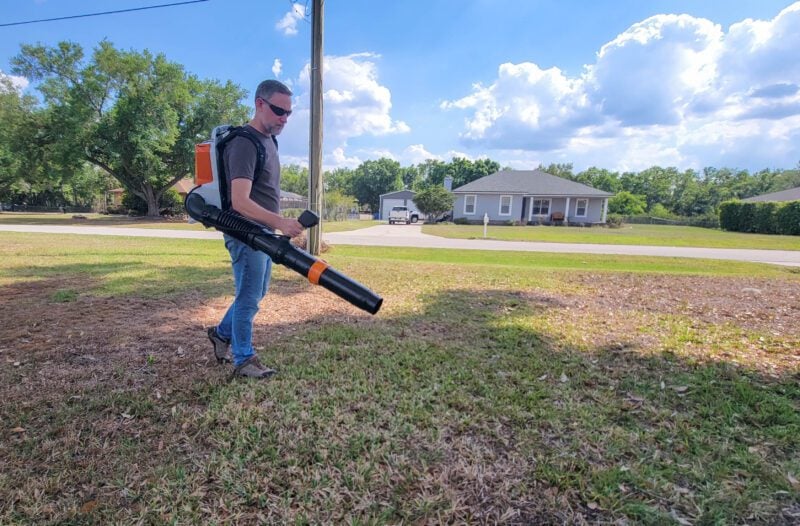
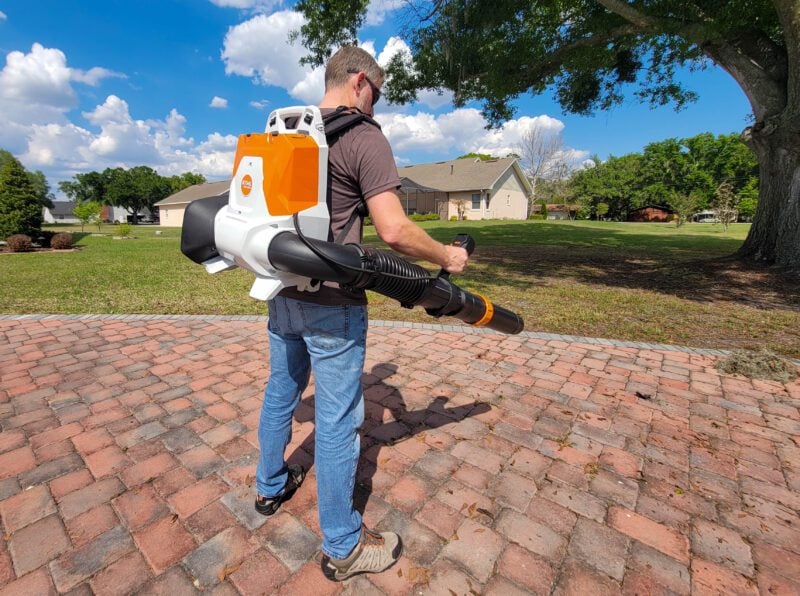
Overall, Stihl did a great job concerning comfort and adjustability. As you’d expect, the padded shoulder straps feature backpack-style adjustment buckles that you can loosen or tighten as needed, and you can also adjust the ride height using a set of straps that attach directly to the blower’s frame. This system offers a ton of versatility and lets you customize the fit to your comfort level.
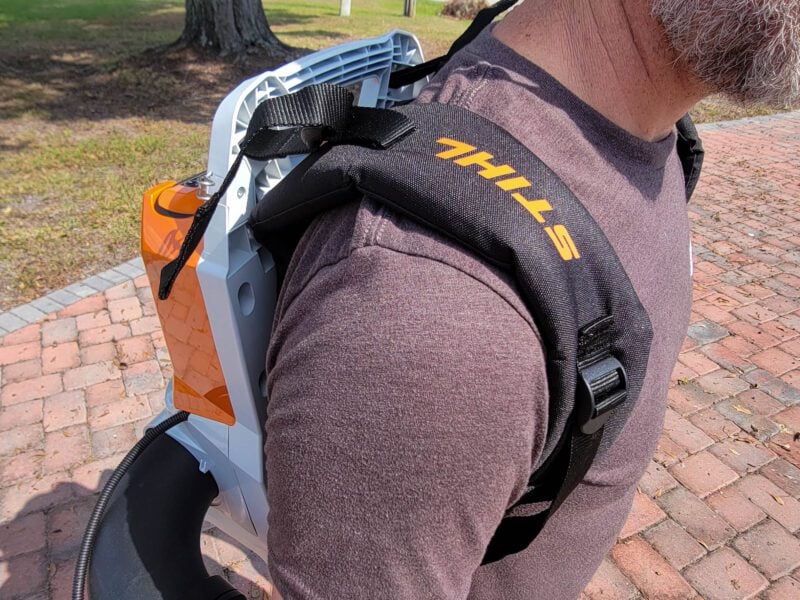
There is also a generous amount of plush padding on the blower frame for added comfort during extended use.
There are really only two things missing—a chest clip and hip straps. While the chest clip isn’t a major oversight, I do wish Stihl had included hip straps to help take some of the weight off your shoulders.
Granted, at 23.5 pounds, Stihl is still a featherweight when compared to Echo’s 56V DPB-5900T or Milwaukee’s M18 Fuel 3009, which both eclipse 32 pounds fully loaded.
Grip and Trigger
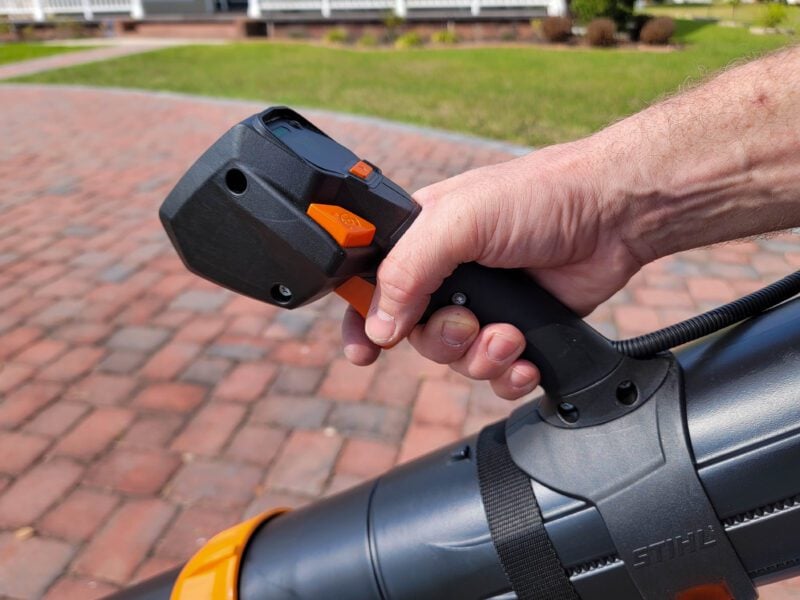
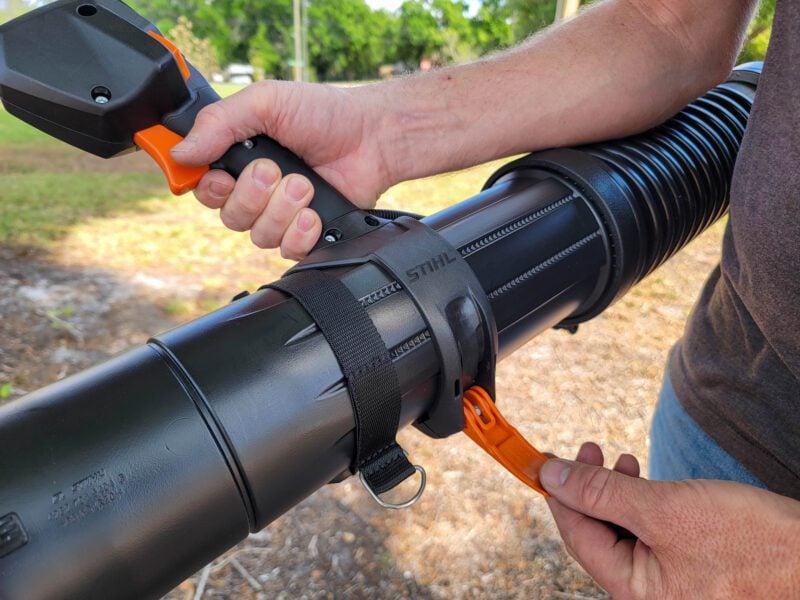
Keeping with the theme of versatility and adjustment, Stihl incorporated a tool-free adjustable grip system onto the arm of this blower. This design ensures the BRA 280 fits a range of body types, so you can get the optimal fit.
To adjust the grip, simply release the orange tensioner clamp on the underside of the grip and slide it to your favored position.
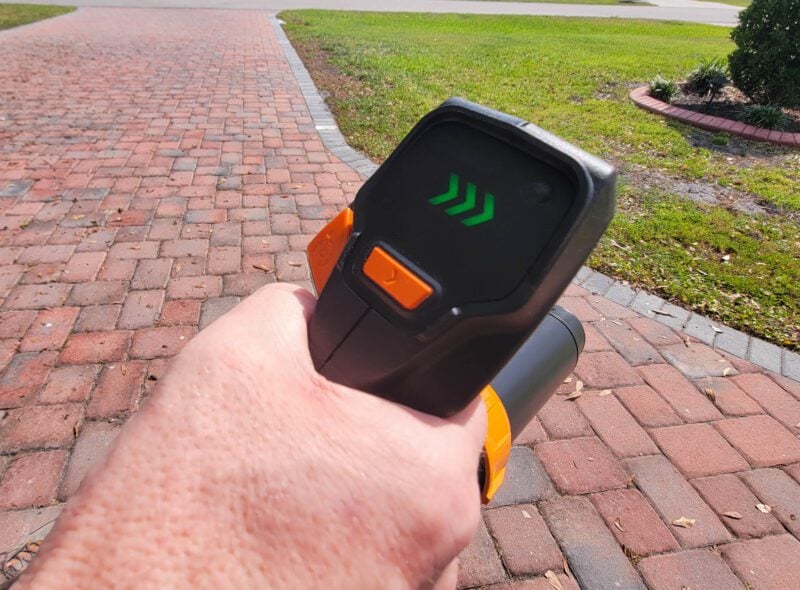
Stihl kept the user interface pretty simple on this blower, and I appreciate that. You get an LED battery gauge, an LED mode indicator, a mode selection switch, and a cruise control button. No fancy LCD screen, just a straightforward interface that’s easy to navigate at any skill level. On top of that, the LEDs are highly visible in direct sunlight—a problem that often plagues LCD alternatives.
Additional Features
- Telescoping Blower Tube: Reduces the overall profile for easier storage
- Blower Arm Hook: Store the blower tube in an upright position
- Removable Concentrator Nozzle: Direct airflow right where you need it most
Where it Fits
Stihl Battery-Powered Backpack Blower Comparison
The BRA 280 moves into the mid-range class. While Stihl already has the BGA 300 at the same performance level, the 280 may very well replace that model. Its dedicated AP battery slots move away from the high-capacity AP 3000 backpack battery and it’s lower price tag is certainly appealing.
You’ll definitely want to count the cost if you want the highest blowing force Stihl has available, though. Not only do the more powerful BRA 500 and BRA 600 models cost more, but they also run at 72V, so they require two batteries to operate.
As it stands, the BRA 280 is Stihl’s sweet spot option. It balances performance, weight, and cost well. Even though it doesn’t reach the performance levels of the BR 450 or BR 600 on the gas side, I expect this will be the most popular model in the lineup for professional lawn care crews converting to battery power.
| Max Blowing Force | Bare Weight | Bare Price | |
|---|---|---|---|
| BRA 200 | 21 N | 15.2 lbs | $479.99 |
| BRA 280 | 26 N | 15.7 lbs | $649.99 |
| BGA 300 | 26 N | 15.4 lbs | $749.99 |
| BRA 500 | 32 N | 22.4 lbs | $1019.99 |
| BRA 600 | 35 N | 22.4 lbs | $1069.99 |
Stihl BRA 280 Backpack Blower Price
The Stihl BRA 280 retails for $649 as a bare tool and $999 as a kit that includes two AP 300 S batteries and a single-port charger.
The Bottom Line
Overall, I’m genuinely impressed with the BRA 280 backpack blower. It’s lightweight, it has comfortable shoulder straps, and it produces solid performance. There’s always room for improvement in runtime, but with Stihl’s current battery options, there’s a good loadout for nearly any lawn care crew.
There’s no getting around the start-up cost, though. Dropping almost $1,000 on a battery-powered backpack blower can be a hard pill to swallow for some crews. But keep in mind you aren’t buying gas or spending money on maintenance. Plus, there’s the convenience factor to consider and the fact that battery power opens up new business opportunities that are closed to gas crews.