
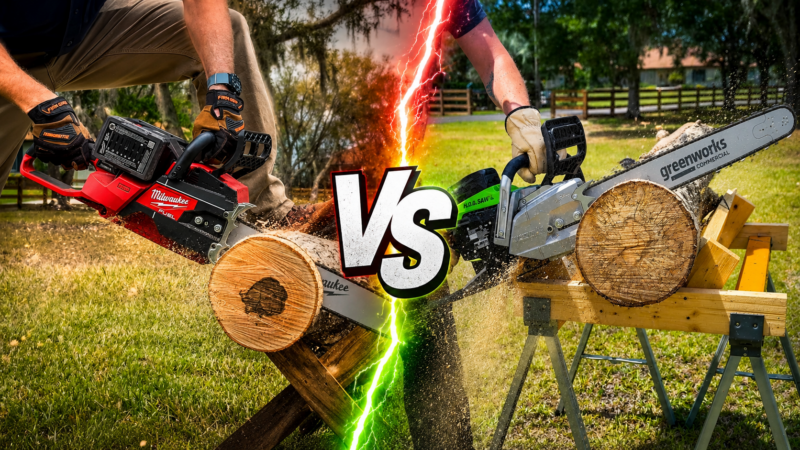
Battery-powered chainsaws have reached a point where the conversation is no longer about whether they can compete with gas—it’s about which cordless platform delivers the best performance for the job.
That’s exactly what makes this matchup so interesting. On one side, you have Milwaukee’s M18 Fuel Dual-Battery Chainsaw, a premium model that pushes deep into mid-range Professional territory. On the other hand, there’s Greenworks Commercial’s 82V H.O.G., a purpose-built Pro saw designed to challenge high-displacement gas equipment head-on.
While these saws share similar feature sets and Pro focus, their performance approaches are very different. The real question is how those differences translate once the chips start flying.
Quick Model Overview
Both of these saws are top performers for their respective brands. Here’s a quick look at each saw’s key specs before we dive deeper into how they perform in the real world.
Milwaukee M18 Fuel Dual-Battery Chainsaw 2827
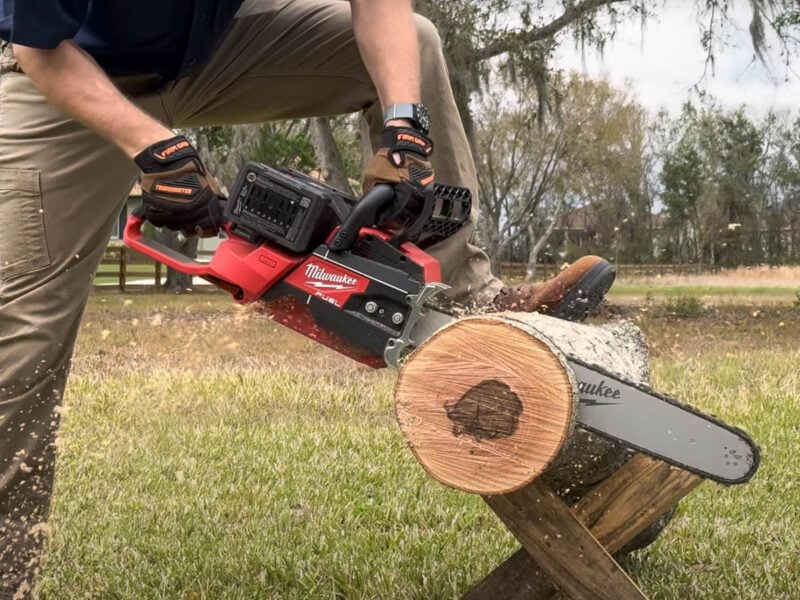
Milwaukee went with a rugged, heavy-duty build here, and the dual-battery setup makes its presence known the moment you pick it up. Even so, nearly every detail of this saw points toward Professional-grade intent. Beyond the high-output brushless motor powering a 20-inch bar and chain, features like the dual metal bucking spikes and captured bar nuts reinforce that this saw was designed with demanding cutting applications in mind. Those are the kinds of practical touches Pros appreciate when reliability and bar retention matter on the jobsite.
We’ll get into the tradeoff of carrying two batteries shortly, but there are a few important things to keep an eye on during testing. For starters, this isn’t just Milwaukee’s most powerful chainsaw—it also ranks among the most powerful battery-powered models currently available based on its gas-equivalent performance rating, trailing only Greenworks Commercial’s H.O.G. saw. Another notable difference is chain speed, which comes in lower than the Greenworks model. Once we get this saw into the cut, we’ll see how that impacts overall cutting performance.
- Gas Equivalent: 70cc
- Chain speed: 14.3 m/s
- Motor Type: Brushless
- Power Output: 4.4 HP (low), 5.8 HP (high)
- Max Torque: 9.5Nm
- Chain pitch: 0.325-inch
- Chain gauge: 0.050-inch
- Weight: 15.1 pounds bare; 19.9 pounds w/ (2) XC8.0 Forge batteries
- Bar Length: 20 inches
- Tool Length: 37.5 in.
- Chain Length: 78 links
Greenworks Commercial 82V H.O.G. Chainsaw OCS800
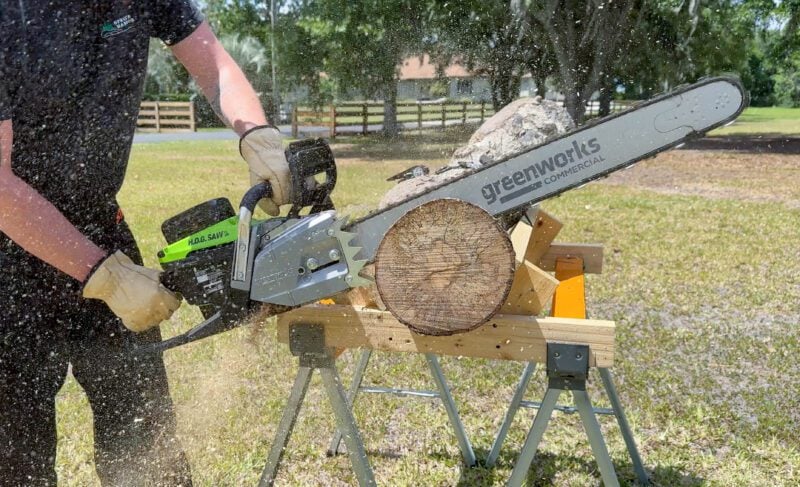
The Greenworks Commercial 82V H.O.G. chainsaw feels like a genuine turning point for battery-powered outdoor power equipment. With a massive 5.0 kW power output and support for bars up to 28 inches, this saw delivers the kind of muscle that used to belong exclusively to high-displacement gas models.
The overall build quality also reinforces its professional focus, with features like metal bucking spikes, captured bar nuts, and a rugged chassis that feels ready for serious work. While the stock Oregon chain favors torque and efficiency over all-out cutting speed, it still performs well, helping maximize runtime and motor longevity.
That said, the H.O.G. isn’t completely without compromise. Runtime takes a noticeable hit during extreme full-bar cuts, especially when working through dense hardwoods, and the overall weight is substantial once the large 7.2Ah battery is installed. Still, those trade-offs feel understandable considering the level of performance this saw delivers.
What really stands out is how confidently it handles tough cutting tasks without the noise, vibration, maintenance, or startup headaches of gas equipment. In the end, this chainsaw proves that cordless technology is no longer just an alternative for lighter-duty work—it’s becoming a legitimate Professional solution for serious cutting applications.
- Gas Equivalent: 80 cc
- Chain Speed: 98 ft/s (30 m/s)
- Motor Type: Brushless
- Power Output: 5.0kW (6.7 hp)
- Max Torque: Not specified
- Chain Pitch: 3/8 in.
- Chain Gauge: 0.050 in.
- Weight: 18.25 lbs (bare tool), 24.2 lbs (with 7.2Ah battery)
- Bar Length: 20 in. / 24 in. / 28 in.
- Tool Length: 46 in. (with 24 in. bar)
Milwaukee vs Greenworks Commercial: Head-to-Head Comparison
As we begin to look more closely at the chainsaws side-by-side, it’s important to understand that even though these are both Professional-grade, there are significant differences that push them into separate classes. The most obvious is that Milwaukee has a maximum bar length of 20 inches, putting it more in line with what we use for storm cleanup. On the other hand, you can fit the Greenworks Commercial H.O.G. with a bar up to 28 inches, making it better for felling larger trees.
So, even though they share similar feature sets, we expected to see appreciable differences in their performance levels. This was most certainly the case when we made a series of cuts in a seasoned Oak log and compared our results.
Cutting Power
In terms of gas equivalent power, Greenworks boasts an impressive 80 cc power level, while Milwaukee sits squarely at the 70 cc mark. This makes them two of the strongest in the battery-powered chainsaw arena.
Another key factor is chain speed. Greenworks tops out at 30 m/s, and Milwaukee boasts a humble 14.3 m/s.
So if there’s such a discrepancy between the chain speeds, why even bother comparing the two? The reason is simple—power. While these saws have wildly different chain speeds, their gas-equivalent power levels speak volumes about their real-world capabilities. With that in mind, we headed outside to put these saws to the test.
Hands-On Testing
Our testing method is pretty simple, but it’s effective. I started by setting up a seasoned 9-inch Oak log and timed myself as I made a series of three cuts with each saw to show off its brute strength and cutting speed. Although it’s not exactly scientific, I like to time these tests so I can compare the data.
On this go around, Milwaukee finished with a total time of 32.16 seconds, while Greenworks took the win with a time of 16.04 seconds. Now, these results don’t really come as a surprise, since the OCS800’s chain speed is twice that of Milwaukee’s. However, they do serve to help us understand where each saw falls in the battery-powered food chain.
During my testing, I pushed both saws to the max, and I never got the feeling that either saw would stall mid-cut. This brute strength is a big deal, especially for battery-powered chainsaws.
Both of these saws performed remarkably with respect to their class, and they’re within sight of each other in terms of gas-equivalent power, but there’s a clear difference in our testing results. So again, why make the caparison? Well, the price.
The Milwaukee 2827 retails for $899 as a kit, while the Greenworks Commercial OCS800 carries a base kit price of $1,809.99. This is a huge difference.
The price difference is pivotal. Milwaukee’s price point is within easier reach for more crews, making it an attractive option for Pros on a smaller budget. On the other hand, if cutting speed is the name of the game, then Greenworks Commercial is the obvious choice.
Quick Model Comparison
| Milwaukee 2827 | Greenworks Commercial OCS800 | |
|---|---|---|
| Voltage | 36V (2 x 18V) | 82V |
| Tested Battery | 2x 8.0Ah Forge | 7.2Ah battery |
| Working Weight | 19.9 lbs | 24.2 lbs |
| Bar Length | 20 in. | 20 – 28 in. |
| Gas Equivalent | 70cc | 80cc |
| Chain Gauge | 0.050 in. | 0.050 in. |
| Chain Pitch | 3/8 in. | 3/8 in. |
| Kit Price | $899 | $1,809.99 |
Milwaukee vs Greenworks Commercial Chainsaw Conclusion
Both of these chainsaws prove that battery-powered technology is capable of serious cutting performance, but they target very different users.
The Milwaukee 2827 strikes an impressive balance between power, price, and accessibility. It delivers strong real-world performance, Professional-grade features, and enough muscle to satisfy demanding Pros without pushing into ultra-premium territory. Its slower chain speed holds it back against the Greenworks in outright cutting speed, but it still performs extremely well considering its intended market and significantly lower price point.
The Greenworks Commercial H.O.G., however, operates on another level. Its higher chain speed and massive power output translate into dramatically faster cuts and a more aggressive overall feel. Combined with its rugged build and support for larger bars, it’s clearly designed for full-time Pro use where productivity matters most.
In the end, the decision comes down to priorities. If you want maximum cordless cutting performance and don’t mind paying for it, Greenworks takes the crown. But if you’re looking for a more affordable high-performance option that still delivers serious capability, Milwaukee offers tremendous value and lands much closer to the H.O.G. than the price gap might suggest.


The other question is how long is the working battery life and how long does it take to charge the batteries