
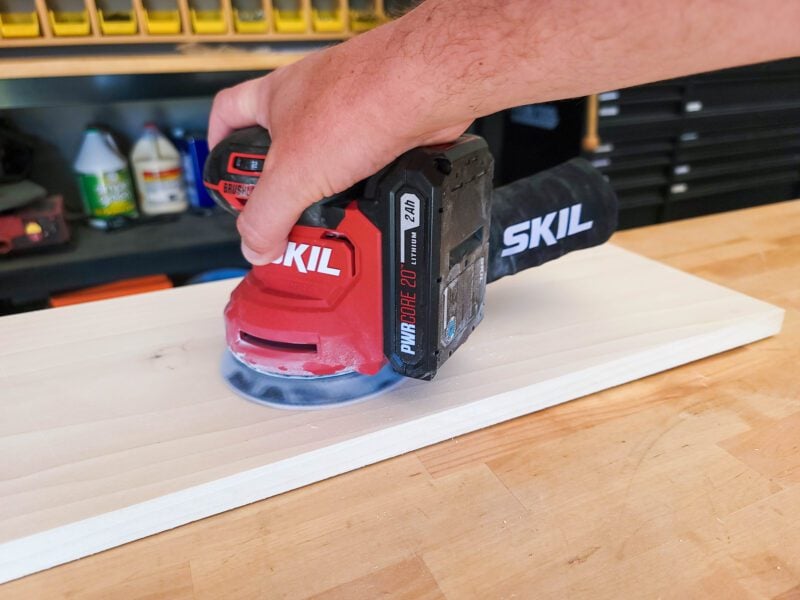
Random orbital sanders are one of those tools where balance matters more than brute force. You need enough speed to remove material efficiently, but also enough control to avoid gouging your workpiece. You also want easy disc changes and good dust evacuation. Today, we’re taking a look at the Skil 20V Random Orbital Sander—an entry-level sander whose roots run deep in the woodworking space. Is it the right sander for your next project? Let’s find out!
Pros
- Excellent kit value
- Approachable design
- Variable speed settings
- Excellent dust collection
Cons
- Vibration level is a little high
Skil 20V Random Orbital Sander Performance
Material Removal
The amount of material removed in a single pass depends primarily on the sandpaper, but a few other factors also come into play. First, let’s talk speed. The Skil SR7603B houses a brushless motor and features six speed settings ranging from 7,000 OPM up to 11,000 OPM on a 7/64-inch oscillation arc.
This is a pretty solid range for most wood and metal sanding applications, and it actually falls right in line with what we expect from this class.
Vibration Level
Vibration control is a tricky nut to crack on some tools, especially with sanders. I can still remember the hand-numbing vibrations of my Dad’s old corded 1/4-sheet sander radiating up my forearm.
In the case of Skil, they did a decent job of keeping felt vibration down, but there’s some room for improvement. During my hands-on time with this sander (more on that later), I experienced more when I applied pressure to my workpiece. However, if I simply let the sander float across the surface and allowed the sandpaper to do its thing, the overall experience was manageable.
In all honesty, though, it’s important to remember that this is an entry-level sander, so top-tier Pro vibration-dampening isn’t really on the menu.
Sanding Pad
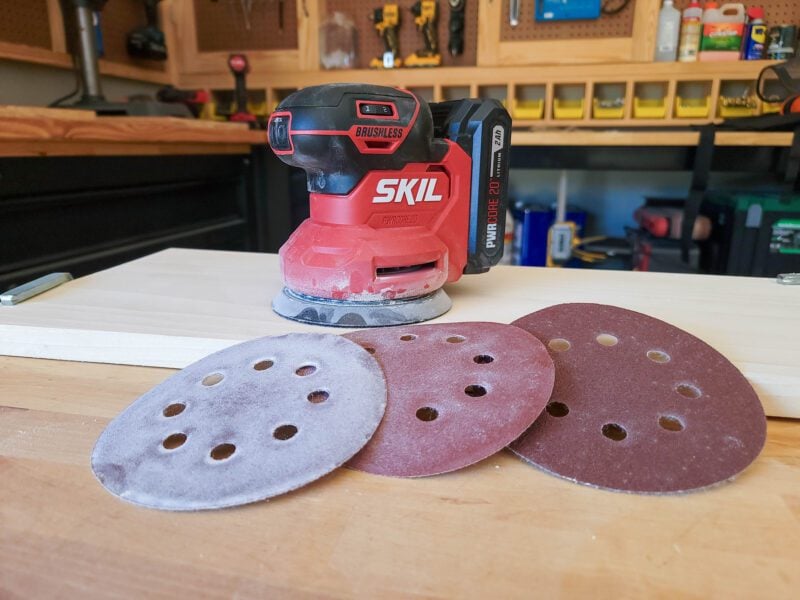
The Skil SR7603B features a 5-inch hook-and-loop pad with ventilation holes that allow dust to flow directly into the collection bag. Skil is kind enough to include three pieces of sandpaper to get you started, but since this is a very common sander, finding replacements isn’t too difficult.
Skil 20V Random Orbital Sander Design Notes
Size and Weight
This sander weighs 1.9 pounds as a bare tool and 2.75 pounds with the kitted 2.0Ah battery. The overall profile is fairly tall and narrow, but I still found it large enough for two-handed use. The pommel is draped in a generous amount of rubber overmolding, and the speed and power controls are well within reach, making them easy to manipulate as you work. I also found it easy to swap the tool back and forth between my hands as I worked.
Dust Collection
Dust management is another one of those tough topics for sanders, as their job is to literally create dust! Okay, okay, slight exaggeration… But I actually think Skil did a pretty good job collecting into the included bag. It’s positioned on the right side of the tool and features a twist-lock connection type.
The dust port is 1-1/4 inches wide, so we easily paired it with a dust extractor we had on hand. Once we were pulling dust through the pad, it did a much more thorough job of sanding. Removing more dust really speeds up the job and lets me work my way through a sequence of sanding paper grits to get down to the desired finish (typically 180 grit). You can use any dust collector or vacuum provided you have the right adapter.
Hands-On Testing
To put this sander to work, I set up a simple test to see how quickly I could refinish one of our scrap boards. I scored and gouged the surface with a utility knife, then made a series of pencil markings to track my progress.
Using the included sandpaper, I worked my way up (or is it down?) from 80-grit to 180-grit over about 5 or 6 minutes, completely removing all my scratches and markings.
Swapping out the disc only takes a matter of seconds, thanks to the hook-and-loop design, meaning you can spend more time working on your project.
As I mentioned earlier, the vibration level doesn’t match that of many Pro models I’ve tested in the past. It also lacks advanced features like an LED light ring. But that’s alright—after using this sander during our testing, I can honestly say I don’t find the vibration level offensive. I would certainly reach for it again on future projects.
Should You Buy It?
The Skil SR7603B hits a solid middle ground for an entry-level cordless sander.
It offers enough speed and material removal capability to handle a wide range of projects, from surface prep to light refinishing. The hook-and-loop pad, straightforward controls, and effective dust collection setup make it easy to use, while the lightweight design keeps it comfortable for extended sessions.
You get more vibration, particularly when applying heavier pressure, but it remains manageable as long as you let the tool do the work. That’s a fair trade-off to me at this level.
In the end, this isn’t a sander built for heavy production work—but it doesn’t need to be. For DIYers, hobbyists, and anyone looking for a capable, easy-to-use cordless option, the SR7603B delivers reliable performance without overcomplicating the experience.
You can pick up the Skil 20V SR7603B for $99 as a kit, which includes a 2.0Ah battery, charger, and three sanding pads. Skil backs it with a 5-year limited warranty.
Specs
- Model: Skil SR7603B
- Power Source: Skil 20V battery
- Weight: 1.9 lbs (bare tool), 2.75 lbs (with kitted 2.0Ah battery)
- Top Speed: 11,000 OPM
- Pad Size: 5 in.
- Pad Type: Hook and look
- Orbit Diameter: 7/64 in.
- Dust Port Diameter: 1 1/4 in.