
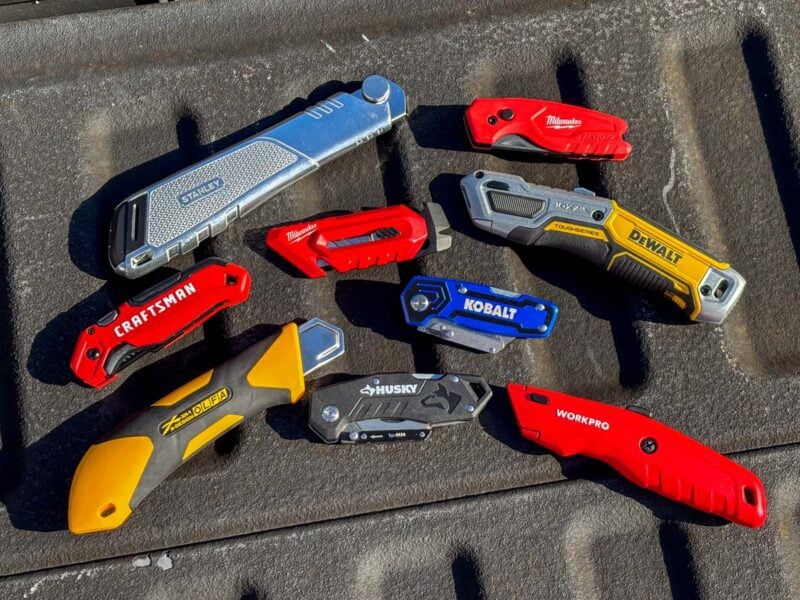
As I write, I’m sitting here with a pile of 9 utility knives on my desk from 8 brands, including Milwaukee, DeWalt, OLFA, Stanley, and others. They have different sizes, shapes, blade types, blade change mechanisms, and more. But which one is the best?
To find out, I ran a series of tests on the most popular models to evaluate the blades, ergonomics, blade changes, and how well they carry. The results may surprise you, and after seeing how our tests shook out, you might just decide to ditch your current model in favor of an upgrade.
Best Utility Knife
Scoring
Note that the scoring is different from our normal rating system. The scores are based on how each utility knife performed and compared in this specific group and this set of tests only. Our typical rating system offers a comparison of the tool to the entire range of what is available. Here’s how to interpret the scores from this test:
- 90 – 100: Outstanding. You’ll love using this utility knife.
- 80 – 89: Excellent. There may be minor tradeoffs.
- 70 – 79: Very good. There are more significant tradeoffs.
- 60 – 69: Good. Notable tradeoffs, but still earns our recommendation.
- < 60: Not recommended.
Best Utility Knife
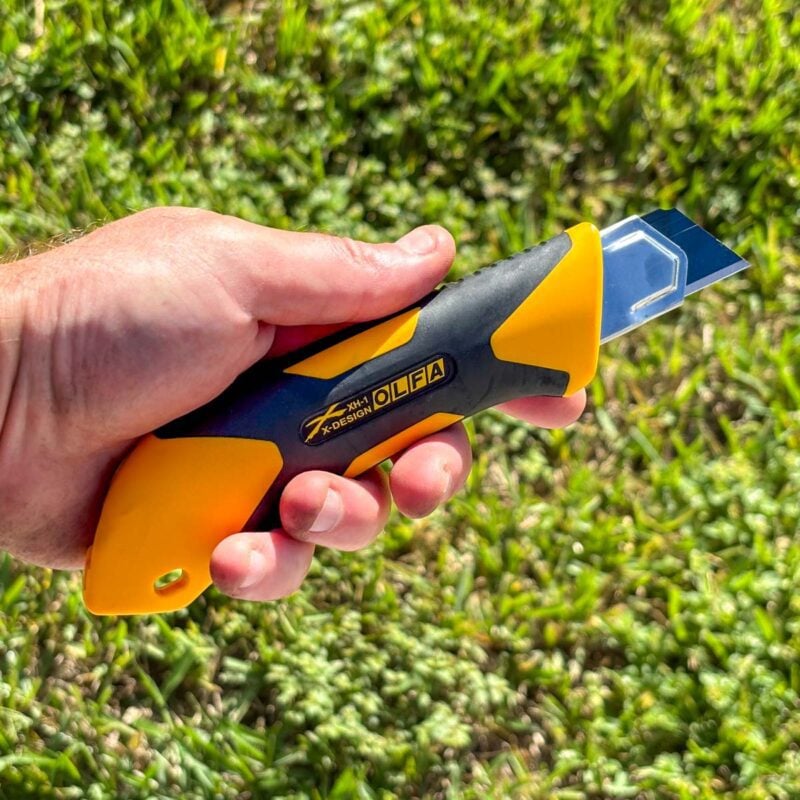
OLFA XH-1 25mm Extra Heavy-Duty
Score: 93 points
- Style: Retractable
- Blade Type: Snap-off
- Weight: 4.9 oz
- Length: 7.3 in
- Recommended Carry: Tool belt/bag
- Price: $17.99
Highlighted Features
- Fiberglass-reinforced Housing: Lighter and less heat conductive than metal, yet plenty strong enough for Pros
- Wrap-around Anti-slip Grip: Improved comfort and grip security, even with sweaty hands
- Ultra-sharp Black Blade: 25% sharper than OLFA’s Silver blades with excellent edge retention
Pros
- Highest ergonomics score in our testing
- Highest cutting performance in our testing
- Highest edge retention in our testing
- Zero blade movement when locked
- Smooth extension and retraction
- Easy blade changes
Cons
- Most expensive in our test group
- Replacement blades are more expensive than others
- No onboard spare balde storage
Ergonomically, it’s tough to beat OLFA’s XH-1, and it was easily the best in our test group. No matter which way I gripped it, only the lock wheel got in the way. It shifts depending on how much blade you’re using and how much you have left, but unless you’re using it left-handed, it has only a minor effect on the comfort of a finger or two. Plus, the overmold adds comfort and offers a solid grip with sweaty hands.
OLFA put a ton of research and development into their blades, and it shows. From thin to thick materials, it cut easily and cleanly, while maintaining better edge retention than any other blades in our test. The Ultra-Sharp Black Blade that comes with this knife is made from Japanese carbon steel and is 25% sharper than OLFA’s Silver blades; a difference that showed in our testing.
Extending and retracting the blade is a multi-step process. You have to loosen the lock wheel to free the blade and then tighten it back down to secure it in place. The blade slides with only slight resistance, and the wheel is easy to work with gloved or bare hands.
The big benefit of snap-off blades is the ability to break off the dull portion and keep working without stopping to dig out your spare blades. It’s much easier and safer to grab a blade disposal can. Even though it’s an extra product to buy, it helps you snap off the blades quickly and contains them where they won’t cut anything.
Blade changes are straightforward and simple enough. With the lock wheel loose, pull it out through the back of the handle. The blade slips off the peg on the wheel, allowing you to swap blades in just a few seconds.
Test Results
| Test | Score (out of 10) |
|---|---|
| Ergonomics | 9.2 |
| Cutting Performance | 9.4 |
| Edge Retention | 10.0 |
| Ease of Retraction/Extension | 9.0 |
| Blade Lock Security | 10.0 |
| Ease of Blade Change | 9.0 |
Best Utility Knife Runner-Up
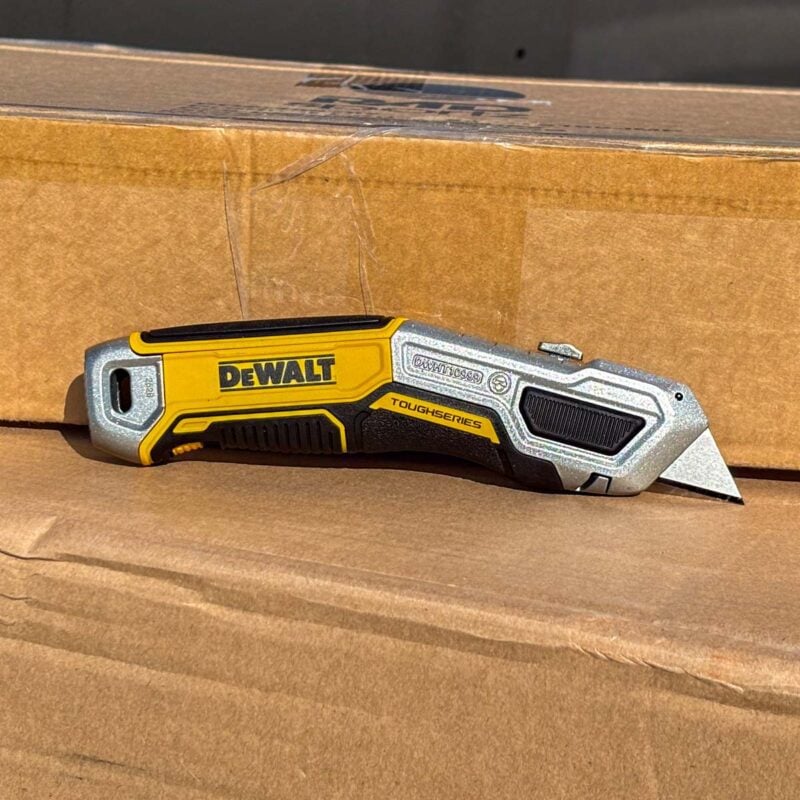
DeWalt ToughSeries Retractable DWHT10999
Score: 89 points
- Style: Retractable
- Blade Type: Trapezoid
- Weight: 8.7 oz
- Length: 7.0 in
- Recommended Carry: Tool belt/bag
- Price: $19.99
Highlighted Features
- Reinforced Strike Zone: Additional rear material protects against repeated strikes
- Overmolded Handle: Improves comfort and grip security, even with sweaty hands
- Slide and Click Blade Changes: Blades automatically lock in place without pressing a button
Pros
- Best trapezoidal blade edge retention (tie)
- Extremely durable build
- Smooth blade extension and retraction
- Confidently slips into blade lock detents
- Onboard storage for up to 10 additional blades
Cons
- Some people may not like the angled design
- Thicker girth than most utility knives we tested
- Stock blade isn’t as sharp as most others
DeWalt’s distinctively angled design is somewhat polarizing between those who love it and those who don’t. I think it depends on how you prefer to grip your utility knife. With a traditional grip (thumb on top, fingers wrapped around the bottom), it fills your hand, contours with it well, and feels great. On pull cuts, I usually shift my grip to place my thumb and forefinger on the sides. With that grip style, it feels more awkward. The thicker girth may also be a bit too much if you have smaller hands. My advice is to try to it before you buy it.
On the plus side, since this model opts for a slider instead of a lock wheel like the snap-off models, its uniformity makes it equally comfortable for right- and left-hand users.
The cutting experience was interesting. Unlike most of the blades I tested, DeWalt’s had a hard time cutting paper with a fresh blade. However, it did fine cutting cardboard and sharpening carpenter’s pencils, so it may be that it sacrifices sharpness slightly to gain edge retention.
The sliding action for blade extension and retraction is remarkably smooth. I also really like how confidently it slips into each blade lock detent. Of the trapezoidal blade models, I like this mechanism the best.
DeWalt’s blade changes can be easier than most. When you press the release button, the blade slides out easily. When you insert a new blade, you don’t have to push the button at all. As you slide it in, a magnet helps with alignment, and the detents automatically push out of the way and lock into the blade slots. It’s smooth when you get it right, but it’s pretty picky about the blade alignment. It becomes second nature with a little use, though.
Test Results
| Test | Score (out of 10) |
|---|---|
| Ergonomics | 8.3 |
| Cutting Performance | 7.4 |
| Edge Retention | 9.0 |
| Ease of Retraction/Extension | 10.0 |
| Blade Lock Security | 10.0 |
| Ease of Blade Change | 9.0 |
Third Place Utility Knife
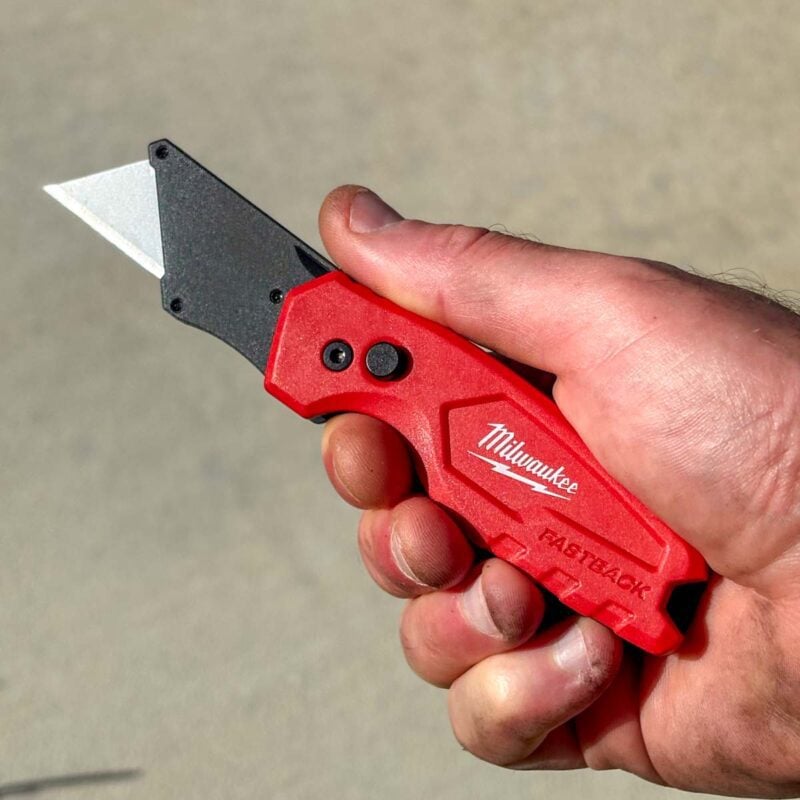
Milwaukee Fastback Compact Folding 48-22-1500
Score: 86 points
- Style: Flip
- Blade Type: Trapezoid
- Weight: 3.7 oz
- Closed Length: 4.0 in
- Open Length: 5.8 in
- Recommended Carry: Pocket
- Price: $9.97
Highlighted Features
- Press and Flip Opening: Smooth, fast opening and closing
- Wire Clip: Easily carry in your pocket or on your belt
- Scoring Blade Holder: Designed to help score drywall easily
Pros
- Best trapezoidal blade cutting performance (tie)
- Best trapezoidal blade edge retention (tie)
- Best folding utility knife ergonomics
- Smooth, fast flipping action
Cons
- Two-hand opening can feel stiff and gritty
- No onboard spare blade storage
The 48-22-1500 isn’t Milwaukee’s most advanced utility knife, but it’s the top-selling model at Acme Tools, so we decided to see if its popularity is warranted.
It’s tough to compete ergonomically with non-folding utility knives, but Milwaukee did an admirable job with this design. The biggest thing you’ll notice on your grip is the presence of the pocket clip. It’s not really uncomfortable in any grip position, just present. However, its placement for right-handed access means it’s more out of the way for left-handed use.
Milwaukee prides itself on innovative accessory development, but they don’t brag about its utility knife blades. Maybe they should. Among the trapezoidal blades that came with the knives in our test group, Milwaukee’s had the best overall cutting performance and edge retention. Though others were able to earn a tie in a test or two, Milwaukee didn’t come in second in any category by any other trapezoidal blade.
If you prefer one-hand flip opening and closing, you’ll love Milwaukee’s Fastback design. It’s fast, it’s smooth, and the release button placement makes it easy. However, if you use a two-hand opening, you’ll notice the action is somewhat stiff and gritty feeling. That’s because the spring-loaded button is creating friction. If you press the button in slightly or all the way, you’ll reduce that friction and make it easier.
The blade release button sits under a metal protector that keeps you from accidentally pressing it. However, that also makes it tougher to press if you’re wearing gloves. The blade swap is pretty easy, as it slides in and out smoothly. It’s harder to get the blade aligned with such a thin slot, but even that’s only a minor annoyance.
Test Results
| Test | Score (out of 10) |
|---|---|
| Ergonomics | 8.3 |
| Cutting Performance | 9.0 |
| Edge Retention | 9.0 |
| Ease of Folding/Flipping | 10.0 |
| Blade Lock Security | 10.0 |
| Ease of Blade Change | 8.0 |
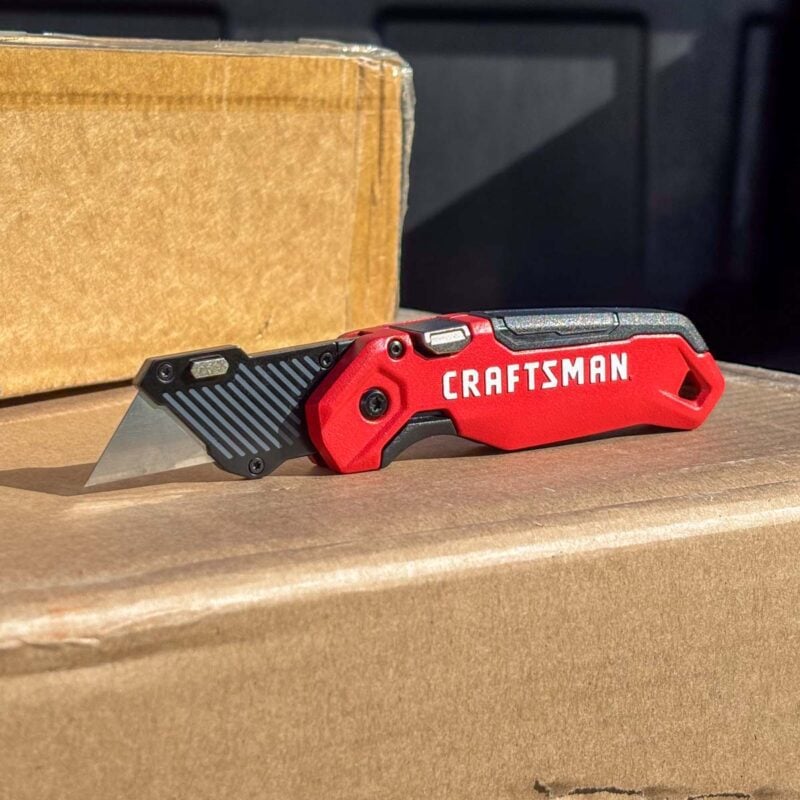
Craftsman Folding Utility Knife CMHT10353
Score: 85 points
- Style: Flip
- Blade Type: Trapezoid
- Weight: 4.1 oz
- Closed Length: 4.4 in
- Open Length: 5.9 in
- Recommended Carry: Pocket
- Price: $12.99
Highlighted Features
- Press and Flip Opening: Smooth, fast opening and closing
- Reversible Wire Clip: Easily carry in your pocket or on your belt; switch between tip-up or tip-down carry positions
Pros
- Best trapezoidal blade cutting performance (tie)
- Smooth, fast flipping action
- Onboard storage for up to 3 additional blades
Cons
- It’s possible to accidentally hit the blade release button with some grip techniques.
Craftsman’s folding utility knife shares a very similar design to Milwaukee’s Fastback folder, and has a couple of upgrades.
Ergonomically, the length and shape aren’t too far off Milwaukee’s, but the girth is a little thicker, which mainly affected the alternative grip I use for pull cuts. However, the clip is reversible between tip-up and tip-down carry, so you can try it both ways and see which one you like better. Personally, I found the tip-up carry (default position) was the more comfortable of the two, and you don’t have to flip the knife around to deploy the blade when you remove it from your pocket.
Craftman’s blade performed well in our cutting tests, keeping up with Milwaukee’s in every material and cut type. It only lost a little bit of group in edge retention, but is still a very good blade based on my experience.
The flipping action is just as quick and snappy as Milwaukee’s. If you prefer a two-hand opening, it’s a little smoother against the release button. I actually like Craftsman’s button more than Milwaukee’s. It’s a little longer, so more of your thumb is against it, which reduces the overall pressure you feel and makes it more comfortable.
Blade changes are very similar to what we found on DeWalt’s. Exit and entry are smooth, and you don’t have to hold the button down to insert the new blade. There’s no magnetic help with alignment, though, so you have to be a bit more intentional about it. The one downside is that the button is fully exposed, so it’s possible to grip it a way that your thumb engages the release.
Test Results
| Test | Score (out of 10) |
|---|---|
| Ergonomics | 8.0 |
| Cutting Performance | 9.0 |
| Edge Retention | 8.0 |
| Ease of Folding/Flipping | 10.0 |
| Blade Lock Security | 10.0 |
| Ease of Blade Change | 8.0 |
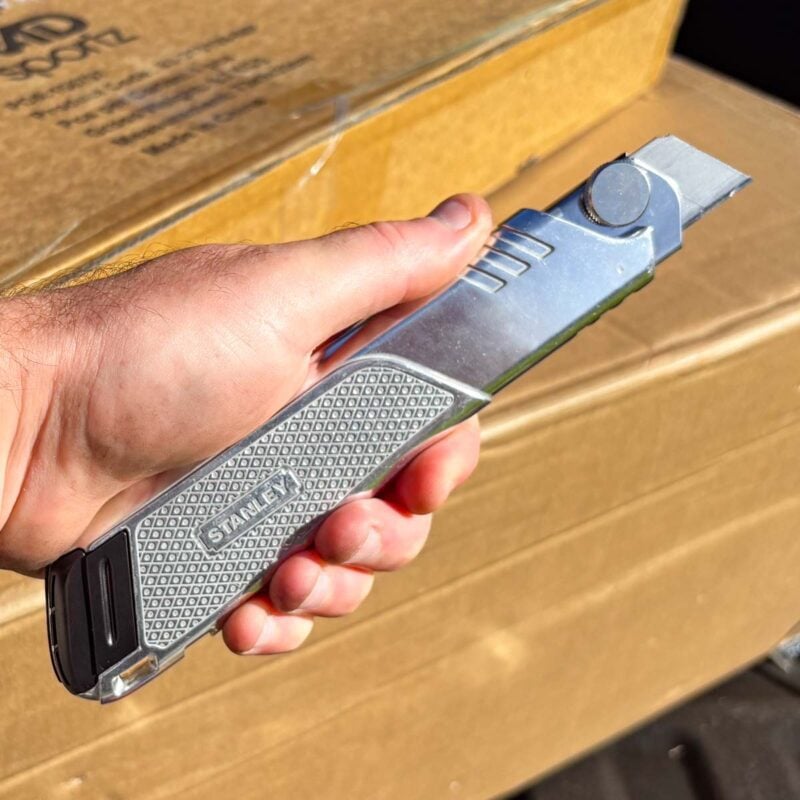
Stanley FatMax 25mm Xtreme Utility Knife 10-817
Score: 82 points
- Style: Retractable
- Blade Type: Snap-off
- Weight: 9.8 oz
- Length: 8.1 in
- Recommended Carry: Tool belt/bag
- Price: $12.99
Highlighted Features
- Blade Cartridge: Holds 4 snap-off blades on board
- Auto-loading Blades: Pull the old blade out and the pusher automatically picks up the next one
Pros
- Excellent cardboard and wood cutting
- Easiest blade changes
- Durable, all-metal build
- Onboard storage for up to 3 additional blades
Cons
- Bulky design
- Handle can be slick
- Off-balance with an extended reach grip
The Stanley FatMax Xtreme Utility Knife is a beefy son of a gun, and I thought I was going to hate it at first glance. But the more I used it, the more I liked it.
There’s no getting around the fact that this is a large, heavy utility knife compared to the rest of our test group. Unlike DeWalt and OLFA, there’s no overmold to help with the comfort and grip security. Even though it has knurling to help, it’s slicker, especially once your hands start sweating.
While cutting, I didn’t mind the size and weight as much as I thought I would. It was only when I was cutting out sealant that it bugged me. In that test, I brought my grip down to reach into the corner better, and the extra weight made it out of balance and harder to control compared to the others.
The blade Stanley includes is hit-or-miss. It didn’t cut paper as easily as most of the others, so it’s not quite as sharp. However, it was outstanding while cutting cardboard and sharpening carpenter pencils, and I felt the weight helped the blade control through tougher cuts. But then the blade retention seemed to suffer, especially compared to OLFA’s. Normally, there’s a trade-off between initial sharpness and edge retention, but this one was a little below par on both.
The blade extension and retraction aren’t as smooth as OLFA’s, but I wouldn’t consider it a con. The lock wheel is in a more convenient position where you can adjust it by rolling your thumb forward or back. With OLFA’s, you need to use two fingers to twist the wheel, and I like Stanley’s design better.
Stanley earned a well-deserved first place in blade changes. Up to 4 blades can be housed in the magazine. Once you’ve snapped off all the previous sections, make sure the pusher is all the way forward and pull the old blade straight out. When you return the pusher to the bottom, it picks up the next blade automatically. And when you finally run out of blades, push the magazine out from the bottom to reload. It’s a highly convenient system that keeps you cutting better than the others in our test group.
Test Results
| Test | Score (out of 10) |
|---|---|
| Ergonomics | 7.5 |
| Cutting Performance | 9.0 |
| Edge Retention | 7.0 |
| Ease of Retraction/Extension | 7.0 |
| Blade Lock Security | 10.0 |
| Ease of Blade Change | 10.0 |
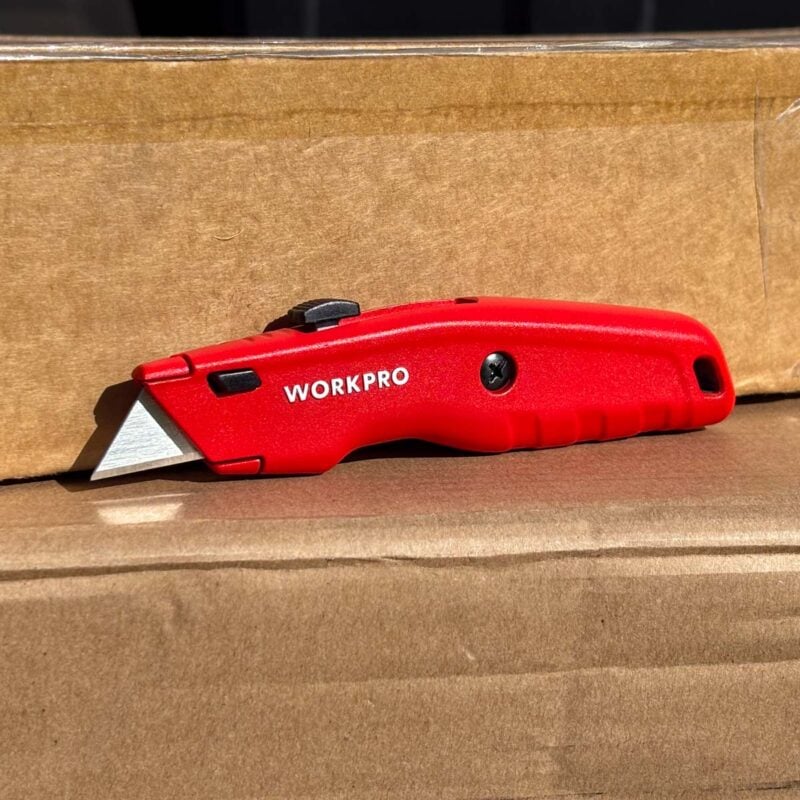
WorkPro Premium Utility Knife W013053AE
Score: 79 points
- Style: Retractable
- Blade Type: Trapezoid
- Weight: 3.2 oz
- Length: 6.3 in
- Recommended Carry: Tool belt/bag
- Price: $11.99
Highlighted Features
- Aluminum Alloy Housing: Keeps the weight down while maintaining durability
Pros
- Comfortable size and shape
- Excellent blade sharpness
- Very good blade edge retention
- 10-pack of blades included
Cons
- Grip slips easily
- No onboard spare blade storage
When we were building our list of utility knives to include in this review, WorkPro’s was the number 1 top-selling on Amazon, so we decided to see how it would fare against the others.
The overall size and shape is very similar to Stanley’s basic, highly-affordable utility knife that’s been a staple in the category for decades. WorkPro didn’t change much, so its light angle and rounded edges are comfortable to grip. My biggest complaint is that it’s slick. Even without sweaty hands, my grip slides easily.
WorkPro’s blades cut paper well out of the box, but they struggled to cut in cardboard. I didn’t detect any excessive flex that would have caused it, but cut after cut, it had a hard time keeping up. Its edge retention was average, so it wasn’t an issue of dulling that much quicker than others. Something about it just doesn’t seem to like cardboard.
Blade extension and retraction don’t stand out or really work against this model. I picked up a slight bit of friction, and the mechanism settles into its detents well enough. There’s nothing that suggests it should be a con, but head-to-head against DeWalt’s butter-smooth action, you can tell it’s not a good.
Blade changes are a similar story. It’s tool-free with a push-button release and just needs good alignment for a quick swap.
Test Results
| Test | Score (out of 10) |
|---|---|
| Ergonomics | 7.7 |
| Cutting Performance | 8.0 |
| Edge Retention | 8.0 |
| Ease of Retraction/Extension | 8.0 |
| Blade Lock Security | 10.0 |
| Ease of Blade Change | 8.0 |
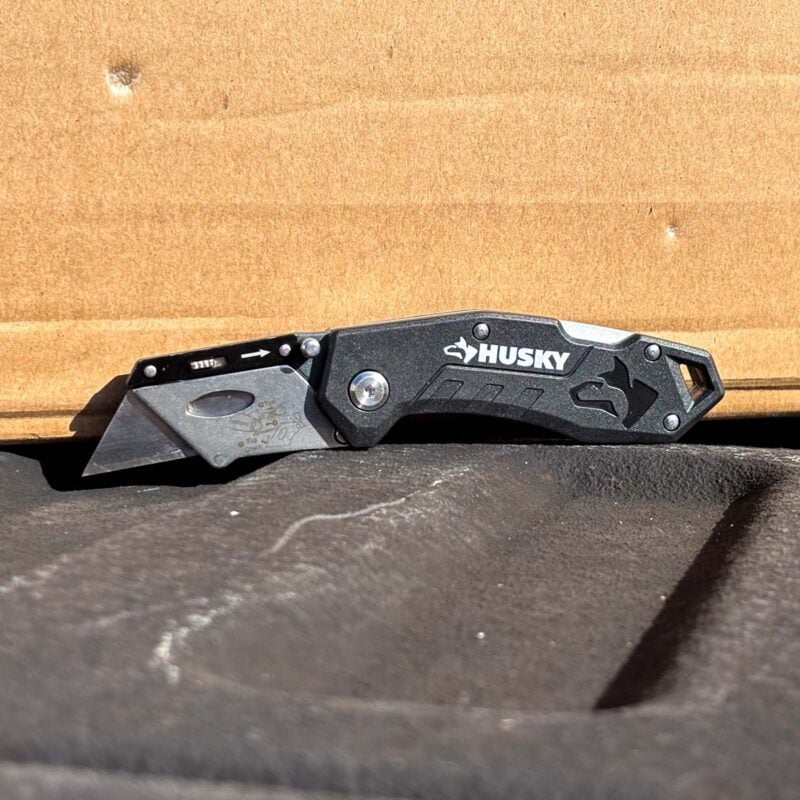
Husky Folding Lock-Back Knife 00057
Score: 72 points
- Style: Folding
- Blade Type:Trapezoid
- Weight: 4.8 oz
- Closed Length: 4.2 in
- Open Length: 6.1 in
- Recommended Carry: Pocket
- Price: $7.97
Highlighted Features
- Lockback Design: Rock solid blade security in the open position
- Resin Handle: Resists slipping better than metal
- Thumb Stud: Assists in one-hand opening
- Belt Clip: Easily carry in your pocket or on your belt
Pros
- Most secure blade lock in our tests (tie)
- Inexpensive
- Includes 10 replacement blades
Cons
- Blade change mechanism poses more cut risk than some
- Stock blades aren’t very good
- No onboard spare blade storage
Husky makes one of two lockback utility knives we tested. Unlike the flip mechanisms from Milwaukee and Craftsman, opening and closing this style is usually a two-hand operation, and it’s slower than flip knives. Husky provides a thumb stud that potentially offers one-hand opening, but it’s fighting against so much friction that it digs into your thumb uncomfortably. On the plus side, the lockback design is rock solid, so there’s virtually no chance it can flip back toward you accidentally.
Its ergonomics in hand are acceptable. Like other models that include a clip, it’s more in the way for right-handed users than lefties, but it’s more present than truly uncomfortable in your grip. My main complaint is that the edges aren’t as rounded off as some of the others, and they can dig into your hand more, especially on tougher cuts that you’re using a stronger grip for.
The blade that comes with this knife is okay, but it’s not as sharp, nor does it hold its edge as well as others. Once you work through the 11 blades that come with it, I’d grab some Milwaukee blades to upgrade your cutting experience.
The blade change is very different from other models we tested, and there are pros and cons to it. To access the blade, you need to pull the release slide back and pull down the blade guard. That leaves the blade exposed, where you can easily lift it off and set the new one in place. It’s a bit easier than getting the alignment just right on the slide out/slide in mechanisms, though the steps are more complex.
What I don’t like about it is that you’re pushing your finger towards the blade to close the cover back up. There’s a hole in the cover, similar to the hole in a Spyderco knife, to make closing safer. You can also push up from the bottom of the guard. But if you’re not paying attention, it’s possible to cut yourself.
Test Results
| Test | Score (out of 10) |
|---|---|
| Ergonomics | 7.7 |
| Cutting Performance | 6.4 |
| Edge Retention | 7.0 |
| Ease of Folding/Unfolding | 5.0 |
| Blade Lock Security | 10.0 |
| Ease of Blade Change | 7.0 |
Kobalt Compact Lockback Folding Utility Knife 58976
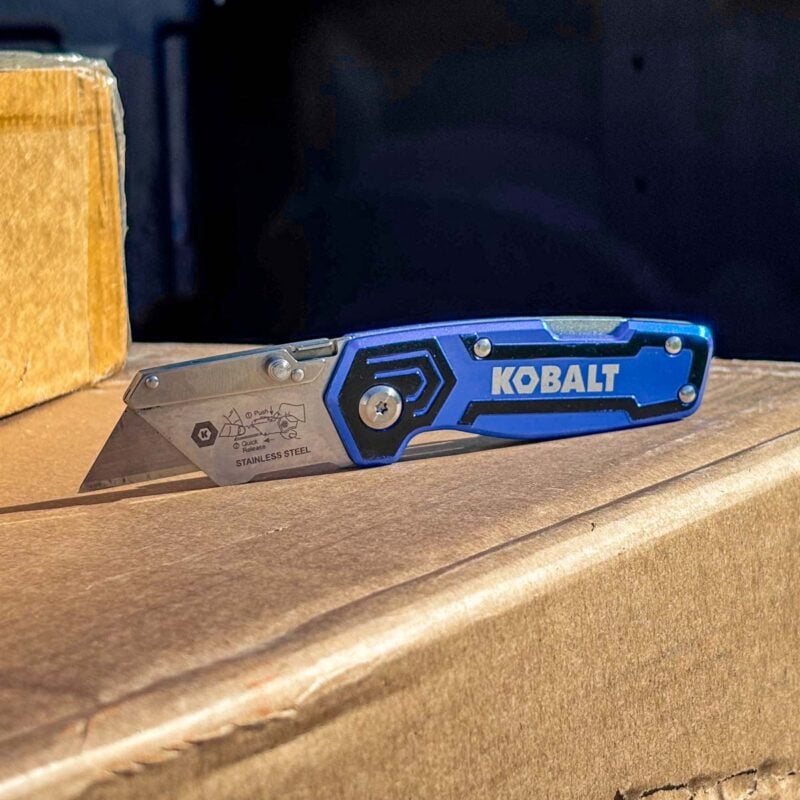
Score: 71 points
- Style: Folding
- Blade Type: Trapezoid
- Weight: 3.2 oz
- Closed Length: 3.6 in
- Open Length: 5.4 in
- Recommended Carry: Pocket
- Price: $8.68
Highlighted Features
- Lockback Design: Rock solid blade security in the open position
- Thumb Stud: Assists in one-hand opening
- Belt Clip: Easily carry in your pocket or on your belt
Pros
- Most secure blade lock in our tests (tie)
- Inexpensive
Cons
- Stock blades aren’t very good
- No onboard spare blade storage
Kobalt’s folding utility knife was the best-selling model at Lowe’s when we built our list of utility knives to test. It shares some similarities with Husky’s design, but it’s even more compact. The consequences of that are primarily that it doesn’t fill you hand well with the alternative grip I use for pull cuts, making it less stable. It’s reasonably comfortable in hand, and I found the clip less intrusive than others. However, this is another model with some edges that can be uncomfortable as you tighten your grip.
The stock blade that comes with the knife is okay. It did its best work on pencil sharpening, but wasn’t as sharp or able to hold its edge as well as others. I’d grab a pack of Milwaukee blades to upgrade it, or grab some from Craftsman, since this one is sold at Lowe’s.
Like Husky, you’re best off considering the lockback opening and closing as a two-hand operation. There’s a thumb stud, but the opening is stiff enough that I didn’t care to use it. However, it’s an impressively secure system, with almost no risk of the blade flipping back toward you before you release it.
To change the blade, you need to press down on a small release lever just behind the thumb stud. The blade slides in and out easily enough, but I found the narrow channel a bit tougher to align than the ones on other models.
Test Results
| Test | Score (out of 10) |
|---|---|
| Ergonomics | 7.5 |
| Cutting Performance | 7.6 |
| Edge Retention | 7.0 |
| Ease of Folding/Unfolding | 5.0 |
| Blade Lock Security | 10.0 |
| Ease of Blade Change | 7.0 |
Milwaukee Multi-Function Compact Utility Knife 48-22-1517
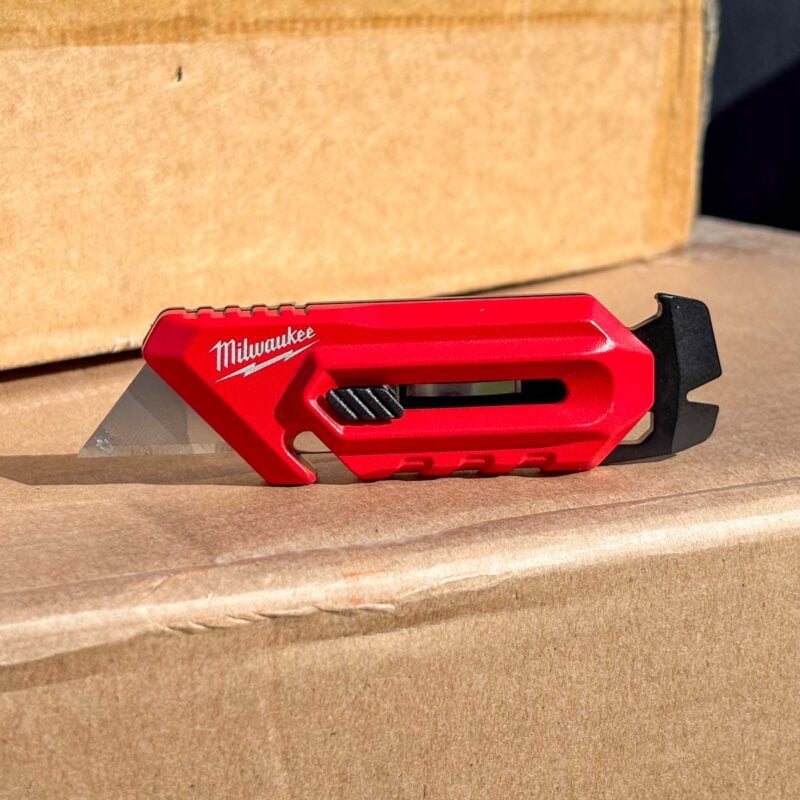
Score: 70 points
- Style: Retractable Multi-function
- Blade Type: Trapezoid
- Weight: 3.7 oz
- Length: 4.4 in
- Recommended Carry: Pocket
- Price: $16.97
Highlighted Features
- Multi-Function Design: Cut, scrape, pull nails and staples, strip wire, open cans and bottles, all with one tool
- Reversible Wire Clip: Easily carry in your pocket or on your belt; switch between tip-up or tip-down carry positions
Pros
- 5 tools in 1
- Best trapezoidal blade cutting performance (tie)
- Best trapezoidal blade edge retention (tie)
Cons
- Pry bar can dig into your hand during standard cutting
- Blade extension and retraction are harder than others
- Blade can often hang up when removing
- No onboard spare blade storage
Milwaukee ended up with two utility knives in our test because they had two best-sellers, and the Multi-Function model was Home Depot’s. The design is very similar to Gerber’s Prybrid utility knife, and it’s worth exploring the pros and cons of the design before you buy.
From an ergonomic standpoint, this is the worst of the group. However, it kind of has to be due to the intent of its compact, multi-function design. The extra tools create pressure points that dig into your hand, even though Milwaukee rounds off the edges as best they can without hurting their functions.
The blade extension and retraction are on the rough side. You have to press down against a reasonably strong spring, so it takes some real effort on the part of your thumb. However, that same spring helps the blade lock solidly into its detents better than most.
At first, the blade change on this model seemed like it would be easier than the Fastback. The button is a little larger, and it’s plastic, so it’s a little more comfortable. But I found that the blade liked to hang up more often, mainly when I was removing it.
Using the same blade as the Fastback, it was no surprise that the cutting effectiveness and edge retention were equally as good, though. The Multi-Function design adds a bonus wire-stripping slot, making it easier and a bit safer to handle those tasks. It also includes a tool at the bottom that can pry open paint cans, pry nails, and open your evening beer. However, it’s that bottom tool that likes to dig into your hand during standard cutting tasks.
My recommendation is to grab this one if you’re really going to use the extra tools, or it’s going to be an occasional-use option for you, and you like the multi-tool approach. Otherwise, a dedicated utility knife will be more comfortable to use.
Test Results
| Test | Score (out of 10) |
|---|---|
| Ergonomics | 6.0 |
| Cutting Performance | 9.0 |
| Edge Retention | 9.0 |
| Ease of Retraction/Extension | 6.0 |
| Blade Lock Security | 10.0 |
| Ease of Blade Change | 7.0 |
Best Utility Knife Blades
Snap-off Blades
Based on my experience using utility knives for more than a decade, I’ve been partial to OLFA, especially its Black Ultra-Sharp Blades. Our testing confirmed that these are indeed the best for overall cutting performance and edge retention.
These blades are 25% sharper than OLFA’s Silver blades, and the Japanese carbon influences the edge retention. I’ve also used the Silver blades, and they’re better than most other snap-off brands, but there’s a very real difference between them and the Black blades. If you rely on your utility knife to make a living, the premium price is worth it.
Trapezoidal Blades
However, OLFA doesn’t make trapezoidal blades. While it’s tempting to think there aren’t any major differences since they look the same and they’re interchangeable, Milwaukee proved to have the best cutting performance and edge retention.
If you’re a Lowe’s shopper, Craftsman’s blades are also a good bet. They didn’t hold their edge quite as well as Milwaukee, but they were able to match them in cutting performance in our tests.
If you already have a utility knife you prefer, or you’re thinking about getting one from our test group that didn’t perform as well, simply upgrading the blade can make a world of difference.
More Utility Knife Reviews
- Lenox Fast Snap Utility Knife Review
- Toughbuilt Scraper Utility Knife
- OLFA X-Series Utility Knife Review
- Klein Cable Skinning Utility Knife Review
- Gerber Prybrid Utility Knife Review
How We Tested
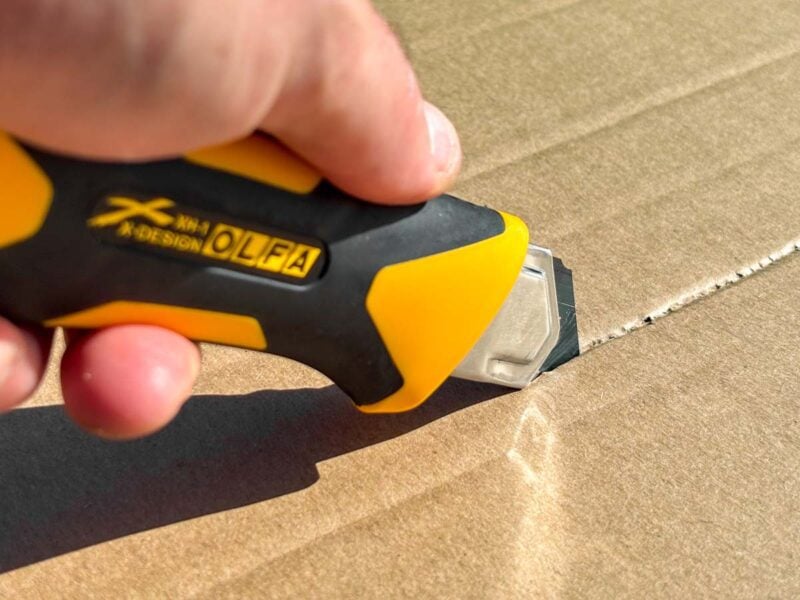
Unlike most of our head-to-head reviews, where each test tells us something specific about a tool’s performance or design, each of our utility knife tests helps us evaluate multiple parts of its characteristics.
For each application, we extended the blade, performed the task, and retracted the blade. That allowed us to consider the ease of blade movement, the effectiveness of the blade’s cutting edge, ergonomics in use, and folding action (if present). Here are the cutting applications:
- Paper (a common sharpness test)
- Cardboard boxes
- Sharpening carpenter’s pencils
- Removing sealant
We also evaluated the ease of blade changes and the best carry options.
Cutting and Edge Retention
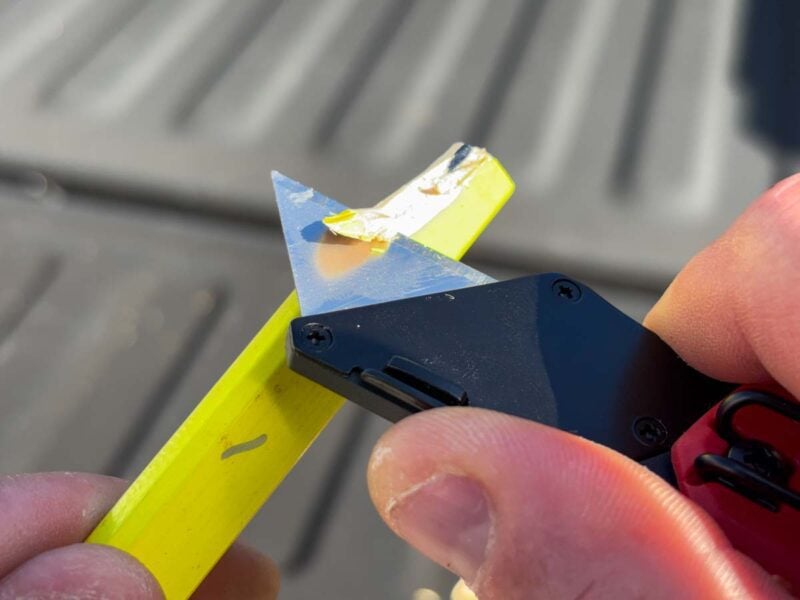
If you’re going to be on the cutting edge of utility knives, your blade needs to do the talking. It needs to be sharp enough to easily and cleanly cut through light materials, yet strong enough to avoid bending and breaking on tough cuts. As we perform our cutting tests, we evaluate the sharpness, edge retention, and tendency to bend or break.
We rate each blade on its overall effectiveness in each of our cutting tests on a scale of 0 – 10 and average the results. Once we’ve made all the test cuts, we return to the paper cutting test to determine how well the blade held its edge.
While the results do factor into our scoring, take it with a grain of salt. All of the trapezoidal blade models in our test use a universal fit, so you can swap them for other brands. The 25mm snap-off blades are also interchangeable. So, you’re not stuck with just one brand of blades. Buy the knife because of its other characteristics, and then pair it with your favorite blade to lift it to its full potential.
| Model | Cutting Performance | Edge Retention |
|---|---|---|
| OLFA XH-1 | 9.2 | 10.0 |
| Milwaukee 48-22-1500 | 9.0 | 9.0 |
| Milwaukee 48-22-1517 | 9.0 | 9.0 |
| Craftsman CMHT10353 | 9.0 | 8.0 |
| Stanley 10-817 | 9.0 | 7.0 |
| WorkPro W013053AE | 8.0 | 8.0 |
| Kobalt 2418020 | 7.6 | 7.0 |
| DeWalt DWHT10999 | 7.4 | 9.0 |
| Husky 00057 | 6.4 | 7.0 |
Blade Extension and Retraction
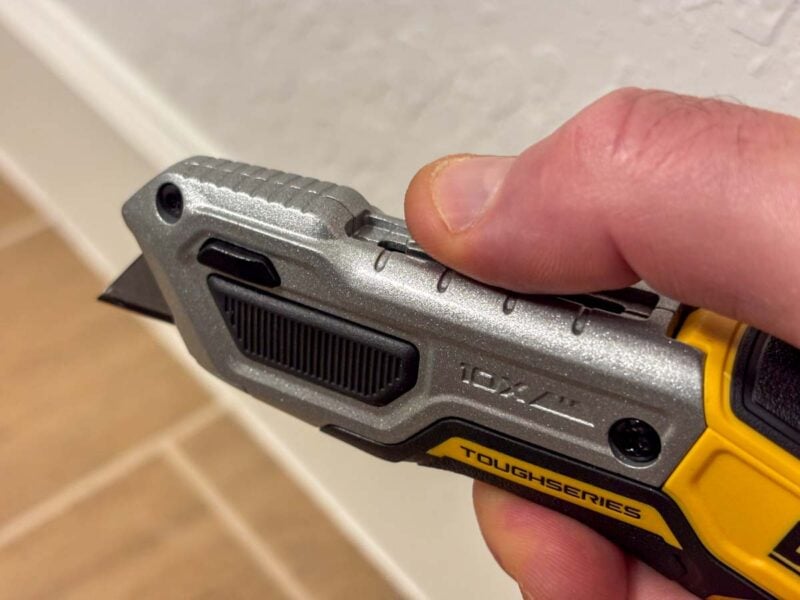
Utility knives used in the trades have to hide their blades to prevent accidental cuts, and there are a couple of primary ways to accomplish it. The most popular use a slider, while others have a flipping action.
No matter what mechanism the knife uses, we’re looking for smooth action and rock-solid blade position locking.
We rate each utility knife on its overall ease of blade extension and retraction, locking, and folding on a scale of 0 – 10.
| Model | Blade Action | Lock Security |
|---|---|---|
| Craftsman CMHT10353 | 10.0 | 10.0 |
| DeWalt DWHT10999 | 10.0 | 10.0 |
| Milwaukee 48-22-1500 | 10.0 | 10.0 |
| OLFA XH-1 | 9.0 | 10.0 |
| WorkPro W013053AE | 8.0 | 10.0 |
| Stanley 10-817 | 7.0 | 10.0 |
| Milwaukee 48-22-1517 | 6.0 | 10.0 |
| Husky 00057 | 5.0 | 10.0 |
| Kobalt 2418020 | 5.0 | 10.0 |
Ergonomics
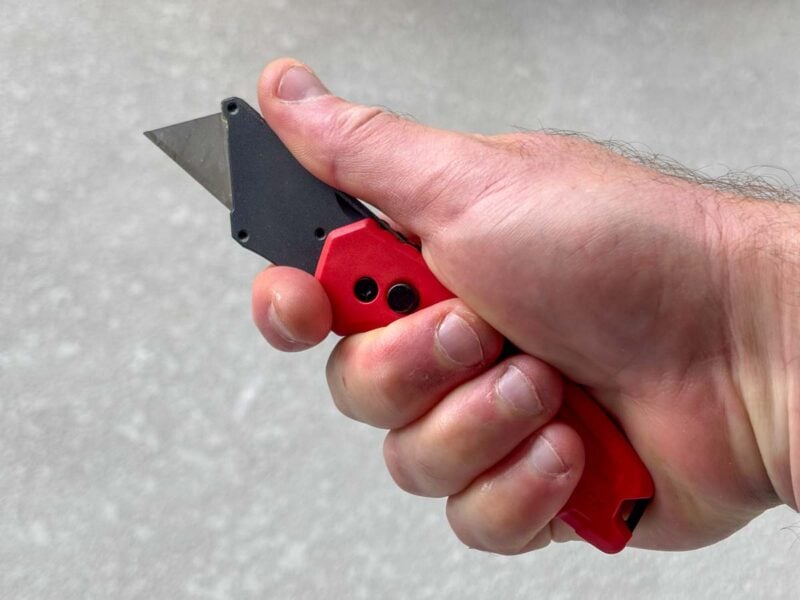
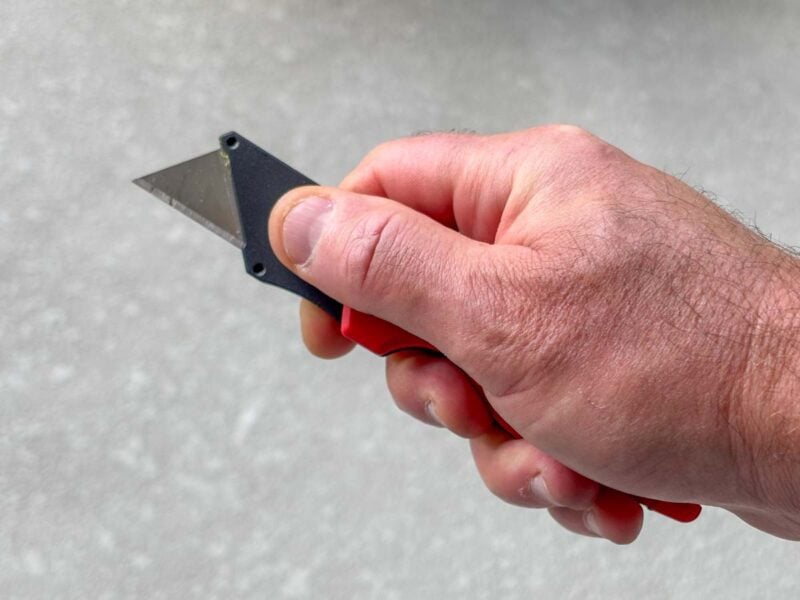
Ergonomics takes into consideration the size, weight, and shape of the utility knife. Size and weight aren’t definitive on their own, though. With a quality hand-conforming shape, even a larger, heavier model can feel really good in your hand while you’re cutting.
Our tests help us evaluate the ergonomics on pull cuts, push cuts, and extended reach cuts. As we cut, we’re looking for pressure points and hard edges against our hands, how secure the grip feels, and whether the shape forces a grip that creates any additional hand fatigue.
We rate each utility knife on its ergonomic feel in our hands during cutting applications on a scale of 0 – 10.
| Model | Ergonomics | Weight w/1 Blade | Length (folded/open) |
|---|---|---|---|
| OLFA XH-1 | 9.2 | 4.9 oz | 7.3 in |
| DeWalt DWHT10999 | 8.3 | 8.7 oz | 7.0 in |
| Milwaukee 48-22-1500 | 8.3 | 3.7 oz | 4.0/5.8 in |
| Craftsman CMHT10353 | 8.0 | 4.1 oz | 4.4/5.9 in |
| Husky 00057 | 7.7 | 4.8 oz | 4.2/6.1 in |
| WorkPro W013053AE | 7.7 | 3.2 oz | 6.3 in |
| Stanley 10-817 | 7.5 | 9.8 oz | 8.1 in |
| Kobalt 2418020 | 7.5 | 3.2 oz | 3.6/5.4 in |
| Milwaukee 48-22-1517 | 6.0 | 3.7 oz | 4.4 in |
Blade Changes
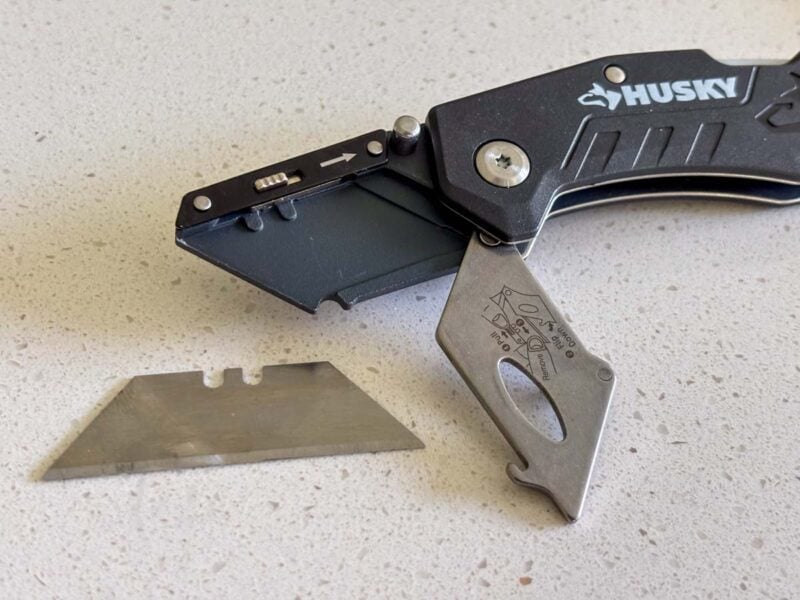
One of the reasons utility knives are better than pocket knives for most cutting is that the blades are replaceable and affordable. However, some blade changes are easier than others. When you’re in the middle of ripping out old carpet, stripping old caulk lines, or just cutting up boxes, an easy blade change makes it more likely you’ll stop and swap when it’s time instead of using a dull blade longer than you should.
As we perform blade changes, we’re looking for how easy it is to unlock the old blade for removal, how well the blades slide in and out of their positions, and how easy it is to secure the new blade and return it to a working position.
We change blades in each utility knife multiple times and rate each on a scale of 0 – 10 based on how easy they are to swap.
Utility knives with onboard blade storage receive a bonus in their final score for the added convenience.
| Model | Blade Change |
|---|---|
| Stanley 10-817 | 10.0 |
| OLFA XH-1 | 9.0 |
| DeWalt DWHT10999 | 9.0 |
| Craftsman CMHT10353 | 8.0 |
| Milwaukee 48-22-1500 | 8.0 |
| WorkPro W013053AE | 8.0 |
| Husky 00057 | 7.0 |
| Kobalt 2418020 | 7.0 |
| Milwaukee 48-22-1517 | 7.0 |
Carry
There are three primary ways Pros carry a utility knife: in their tool bag, in their tool belt, or in their pocket. We check each utility knife for how well it carries in each scenario and make a general recommendation of its effectiveness.
Since people carry differently based on the job, we do not use the carry recommendations as part of the scoring matrix.
| Model | Recommended Carry |
|---|---|
| Craftsman CMHT10353 | |
| DeWalt DWHT10999 | Tool Belt/Tool Bag |
| Husky 00057 | |
| Kobalt 2418020 | |
| Milwaukee 48-22-1500 | |
| Milwaukee 48-22-1517 | |
| OLFA XH-1 | Tool Belt/Tool Bag |
| Stanley 10-817 | Tool Belt/Tool Bag |
| WorkPro W013053AE | Tool Belt/Tool Bag |
What to Look for When You’re Buying a Utility Knife
Retractable vs Folding Utility Knives
The two main types of utility knives are retractable and folding, and each has its place based on how you intend to carry it.
Retractable utility knives have far more flexibility in the size and shape of their housing, so they tend to be the most comfortable ergonomically. They also offer the ability to move into snap-off blades, which we’ll discuss in a moment.
They take up more room than folding models, so you need to pick your battles in choosing how to carry them. Tool bags usually have a good pocket for them, and many tool belt pouches have a good spot as well.
Folding utility knives are best if you’re looking for something easy to carry. Some are nearly as compact and thin as a quality pocket knife, and include a clip so you can carry them in your pocket the same way.
The downside is that it’s tough to make them truly excellent ergonomically. There’s usually one part or another that digs into your hand, and the edges can be uncomfortable if the design team doesn’t round them off well.
My recommendation is to grab a retractable utility knife if you use it often, even if you don’t wear a tool belt. The added comfort makes a difference, and snap-off blades can make you more productive.
Grab a folding utility knife for more occasional use, or if you absolutely insist on carrying one in your pocket.
Trapezoidal vs Snap-Off Blades
Trapezoidal utility knife blades are the most common and cheapest. Most feature a universal fit design with two cutouts in the top. Once the exposed part of the blade is too dull to use, you can flip it around to use the opposite end.
Snap-off blades are more expensive, but are arguably a better value. As you dull one section, you snap it off and then push a new section forward. Typical designs can have upwards of a dozen segments, so it’s like having 12 individual blades. The OLFA Black Ultra-Sharp Blades I use have 7 segments.
The Milwaukee general-purpose utility blades I use are $12 for a pack of 50. Since you can use both sides, that’s basically 100 cutting edges, or $0.12 per cutting edge.
If we use my OLFA blades as an example, a 10-pack is $13. So, that’s 70 cutting edges, or ~ $0.19 per cutting edge. It’s more expensive, but they also cut better and last longer, so that needs to go into your consideration as well.
Snap-off blades also add a layer of convenience. When you need a new blade, just snap off the old section and keep going. With trapezoidal blades, you have to physically remove them to turn them around. Grab a purpose-built blade container to give you something to snap the blade against and contain the broken-off segments.
The other thing to keep in mind is that snap-off blades can be used with much more blade exposed. That’s helpful when you’re cutting foam or other thick, lightweight material.
Other Types of Utility Knife Blades
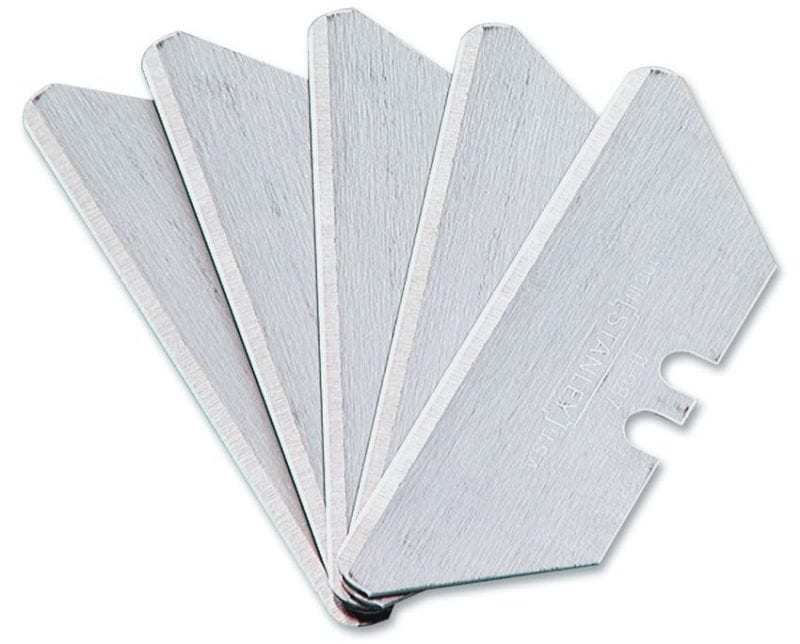
Several blade types are designed for specific applications, benefits, or jobsite requirement. Here are some of the more common styles you can buy:
- Round-point Utility Blades: Have blunted points to avoid accidentally piercing material or skin.
- Hook Blades: Designed for pull cutting material such as carpet and linoleum.
- Carpet Blades: Rectangular double-sided blades specifically for cutting carpet.
Features to Consider
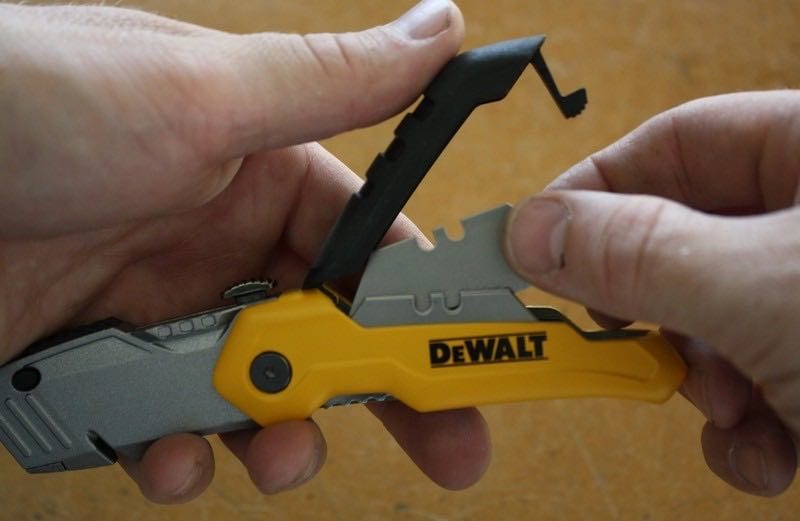
Look for the following features in a utility or razor knife to enhance and expand upon the standard features you’d expect to find in a knife. Sure, you can get a straight-up blade with no frills, but some of these make using a utility knife something easier or add versatility.
- Quick Blade-Change Mechanisms: Typically a form of push-button mechanism, these easily release the blade so you can change it without additional tools.
- Onboard Blade Storage: Keeps fresh blades close at hand for faster swaps and greater productivity.
- Wire Stripper/Strap Cutter: An additional slot in the housing that allows you to safely strip wire or cut a strap with less risk of cutting yourself.
Why You Can Trust Pro Tool Reviews
Ever check out a “review” site and you can’t tell if they actually tested the tools or if they’re just “recommending” the Amazon top sellers?
That’s not us. We only recommend what we’d use, even if we don’t earn a commission from it. It’s all about giving you a legitimate recommendation and our honest opinion of each product.
We’ve been in business since 2008 covering tools, writing reviews, and reporting on industry news in the construction, automotive, and lawn care industries. Our Pro reviewers have the skills and experience to know whether tools can perform well in the field.
Each year, we put our hands on hundreds of individual products through our head-to-head testing, reviews, media events, and trade shows.
We consult with innovators in the technology and design of tools to gain a broader grasp of where these products fit and how they work.
We’ll provide hundreds of pieces of new content this year, absolutely free for our readers—including objective evaluations of individual tools and products.
The result is information you can trust because of the editorial, scientific, and real-world professional experience we collectively utilize each and every time we pick up and test a tool.


Sales say Milwaukee Fastback. So I went with that. Very happy and I truly enjoyed using it. It takes a beating very well. HOWEVR….., this Spring I went on a vacation in Europe and saw the Bosch Utility Knife (flip) at a store. I bought it.
Sorry Milwaukee but it’s not even close. Not by any measure.
I haven’t used that one before. I’ll have to grab one and try it out!
Myself, I’ve got three of these brands in my toolbag, and work boxes. I try to stick with better quality, name brand tools. They all do what they’re supposed to but, to me the different styles suit the different tasks.
I agree. I keep both retracting and folding models, and grab whichever is most convenient for the task. Fortunately, they’re inexpensive enough to have multiples.
you cant compare folding and non folding utility knives. They are just 2 different things. It should be 2 diff. articles 1 for folding utility knives and 1 for non folding utility knives.
Since they all use razor blades, the judgment really comes down to ergonomics and features. That makes it tough for us to separate folding from non-folding. There doesn’t seem to be enough there to lead us to think we should split them up. That’s just our take, of course. There’s also an almost infinite number of options, and we try to grab a combination of the most popular, the most well-known, the unusual, and the newest models.