
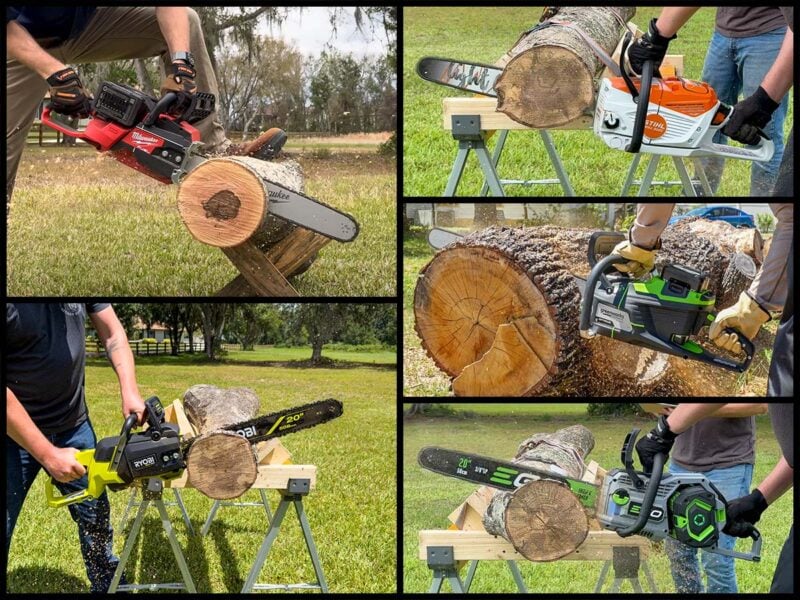
Not that long ago, there weren’t that many cordless chainsaws, and even fewer had high enough performance to make us want to replace our gas saws. Fast forward to 2026, and the best battery-powered chainsaws meet and exceed gas performance in the most popular sizes. There are even some Pro categories where battery is preferred over gas, and one model that boasts power equivalent to the 80cc class.
Tom Gaige, Josh McGaffigan, and I have been reviewing the latest models, and we’re ready to share which battery-powered chainsaws stand out from the rest.
READ
Best Chainsaw Reviews – Gas, Battery, and Electric
Best Battery-Powered Chainsaws
Best Battery-Powered Chainsaws for Pros
Best Battery-Powered Chainsaw
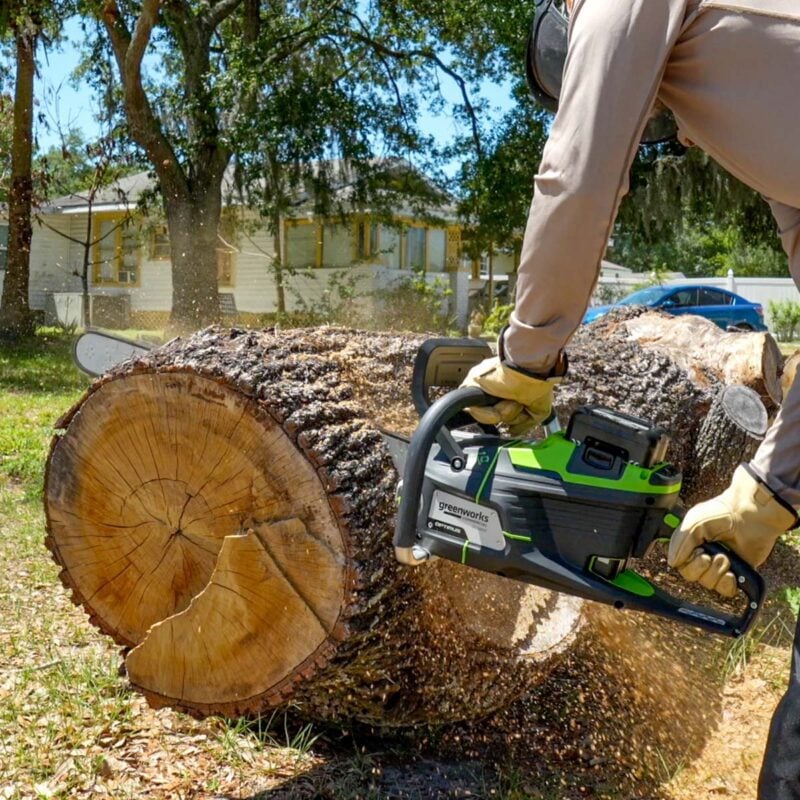
Greenworks Commercial 82V 28-inch H.O.G. OCS800
- Gas Equivalent Power: 80cc
- Chain Speed: 29.9 m/s (98 fps)
- Bar Length: 20 – 28 in.
- Bare Weight: 18.3 lbs
- Working Weight: 24.2 lbs w/7.2Ah Battery
- Price: $1809.99 – $1879.99 kit
Highlighted Features
- Electronic Chain Brake: Added layer of safety against kickback that works alongside the mechanical brake
- Low Oil Sensor: Easily see when the chain oil reservoir needs a refill
- Three Operating Modes: Prioritize between power and runtime based on the cut
- Vortex Air Duct Technology: Advanced air cooling design
- Felling Sights: Hi-vis molded lines along the housing to sight your cuts
Pros
- Most powerful battery-powered chainsaw
- Pro-quality build
- Helpful electronic features
- Captured bar nuts
Cons
- Expensive
- Heavy
For years, we saw incremental gains in battery-powered chainsaw power and capability. With the launch of their H.O.G. saw (High Output Gasless), Greenworks Commercial said “hold my beer” and busted out a 28-inch model with the equivalent power of an 80cc gas saw. As the most powerful available, it currently has no competition, and is my pick as the best battery-powered chainsaw.
In terms of design, it’s 100% Pro-focused with the robust, durable build you demand. It comes at a steep cost and a higher weight compared to other top-tier options, though. However, Greenworks Commercial has several capable rear-handle and top-handle models, giving you a full suite of gas-free options to fit your needs.
In one of our toughest tests, we sent the saw out with Tom Gaige to deal with a fallen oak tree. With the 28-inch bar, he could certainly feel the higher weight compared to other battery-powered options. But he could also feel how much more power was available when he needed the full length of the bar to section the trunk. Compared to gas saws and their more aggressive chains, the cutting speed was slower, but the H.O.G.’s ability to maintain its RPMs displayed truly impressive torque under load.
It also showed us how important battery management is. When you cut at the edge of the saw’s capacity, you’ll only get a handful of cuts per charge in harder species like oak. Greenworks Commercial has a 16-amp dual-port charger that fully charges two of the CORE530 batteries we used in 50 minutes. Depending on how you approach large trees, cycling two or three batteries should keep you running continuously.
Best Battery-Powered Chainsaw Runner Up
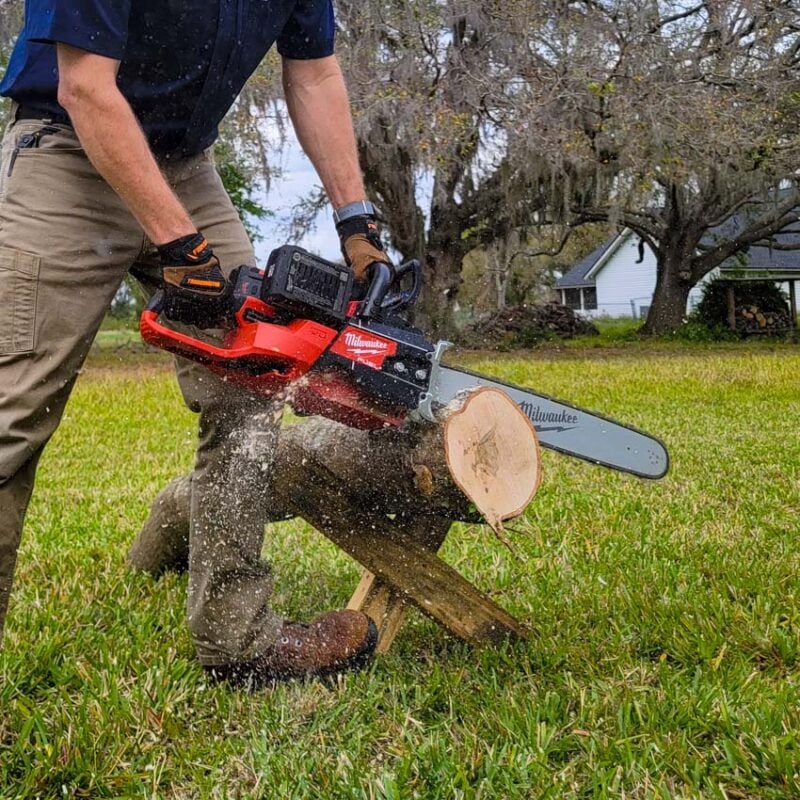
Milwaukee M18 Fuel Dual Battery 20-inch 2827
- Gas Equivalent Power: 70cc
- Chain Speed: 14.3 m/s (46.9 fps)
- Bar Length: 20 in.
- Bare Weight: 15.1 lbs
- Working Weight: 19.9 lbs w/two 8.0Ah Forge Batteries
- Price: $899 kit
- Two Operating Modes: Prioritize between power and runtime based on the cut
- Dual Metal Bucking Spikes: Bite into wood even more confidently with bucking spikes on both sides of the bar
- Felling Sights: Hi-vis molded lines along the housing to sight your cuts
Pros
- Pro-quality build
- Powerful cutting
- Excellent value
- Captured bar nuts
Cons
- Low chain speed can make light cuts feel slow
- Not as feature-rich as competitors
- Heavy
In order to compete with the best battery-powered chainsaws available today, Milwaukee went with two batteries to pull additional power while managing current and heat. While that makes their 20-inch chainsaw heavier than most, it has a ton of power. Claiming 70cc/5.8 HP on the top end, it’s the second-strongest battery-powered chainsaw on the market behind Greenworks Commercial’s H.O.G. chainsaw. Even its Standard mode at 4.4 HP is stronger than Stihl’s MSA 300 C-O.
This is an interesting model on a couple of levels. For one, its chain speed is roughly half that of other models we’ve reviewed. That’s a tradeoff for its noticeably higher torque. In our tests, we assumed it would be slower than models with high chain speeds. But in hardwoods like the oak we prefer to test in, the torque allowed us to use the dual bucking spikes and lean into the cut with much more force than we anticipated.
You’ll also notice this saw is much less expensive than the Stihl, Greenworks Commercial, and Makita XGT models. DeWalt’s 20-inch chainsaw has a lower price tag, but it’s only in the 50cc class, so it has the same power trade-off as Stihl and Makita. Compared to those higher-priced saws, Milwaukee isn’t quite as refined. It favors more of a gas-replacement feel than adding some of the bonus electronic upgrades. It’s also not quite as smooth under load, but it’s still way ahead of the roughness and vibration of a gas saw.
Paired with the M18 Fuel top-handle chainsaw, Hatchet pruning saw, and pole saw, Milwaukee has a compelling lineup with legit performance for crews who need professional builds without the high-end price tags.
More Highly-Rated Battery-Powered Chainsaws for Pros
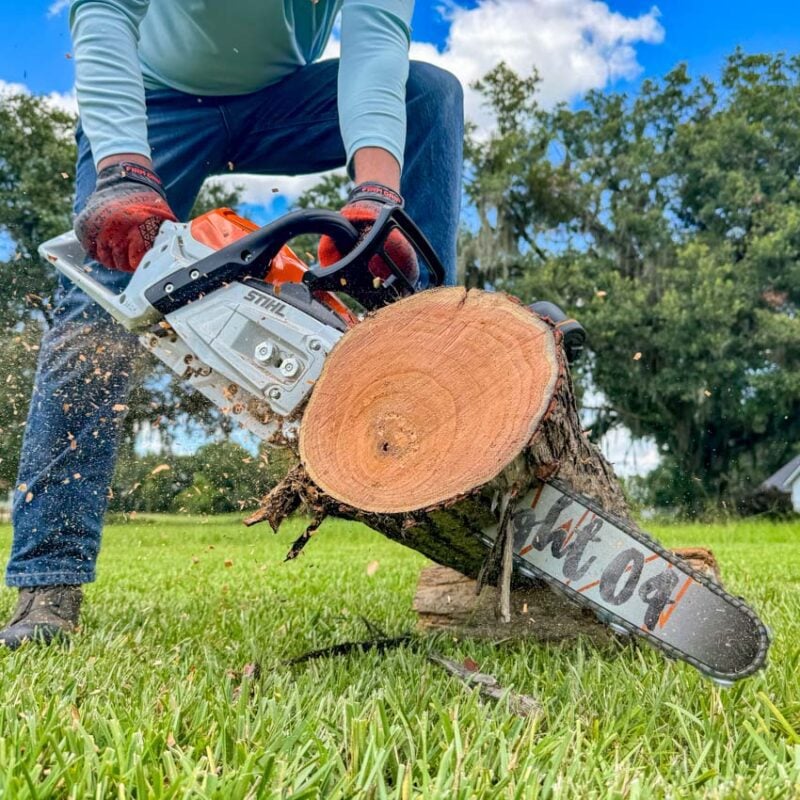
Stihl 36V 20-inch MSA 300 C-O
- Gas Equivalent Power: 50cc (estimated)
- Chain Speed: 30 m/s (98.4 fps)
- Bar Length: 16 – 20 in.
- Bare Weight: 13.1 lbs
- Working Weight: 17.2 lbs w/AP 500 S battery
- Price: $860 – $880 bare
Highlighted Features
- Vibration Reduction System: Reduces vibration while cutting, slowing fatigue buildup
- Electronic Operating System: Displays saw information you can see at a glance
- Low Oil Sensor: Easily see when the chain oil reservoir needs a refill
- Three Operating Modes: Prioritize between power and runtime based on the cut
- Connector 2 A Compatible: More easily manage large tool/equipment cribs
Pros
- Pro-quality build
- Fast chain speed
- Solid cutting power
- Smooth operation under load
- Helpful electronic features
- Captured bar nuts
Cons
- Expensive
Boasting ~50cc gas equivalent power, Stihl’s MSA 300 C-O is a solid replacement in the farm and ranch class, matching pretty closely with their MS 271 Farm Boss if you’re looking a comparison.
Notice that Stihl dialed in the chain speed to 30 m/s. This is higher than competition from Milwaukee, and one of the things that set it apart in our testing. In hardwoods, if you let the motor maintain high RPMs, it will melt through the cut easily. But even with the higher chain speed, we were able to push the saw pretty hard, showing us there’s plenty of torque to back it up.
Stihl also introduced the AP 500 S battery when they first debuted this saw. That was fortunate as that particular battery helps the MSA 300 C-O shine when using a larger 20-inch bar and chain. I highly recommend using this advanced battery if you want the best possible performance this saw has to offer. Pair it with an advanced high-speed charger to reduce the number of batteries you need to carry.
When it comes to applications, you can think of this model the same way you do the Farm Boss. It’s an excellent balance of weight and performance that hits the sweet spot as an all-around workhorse for small to mid-size trees of any species.
Now that Stihl has this model covering the mid-range farm and ranch class, a legit top-handle model for limbing and topping, the remaining question is… how soon will we see something in the 24 or 28-inch class to fill out the line? My guess is it won’t be long.
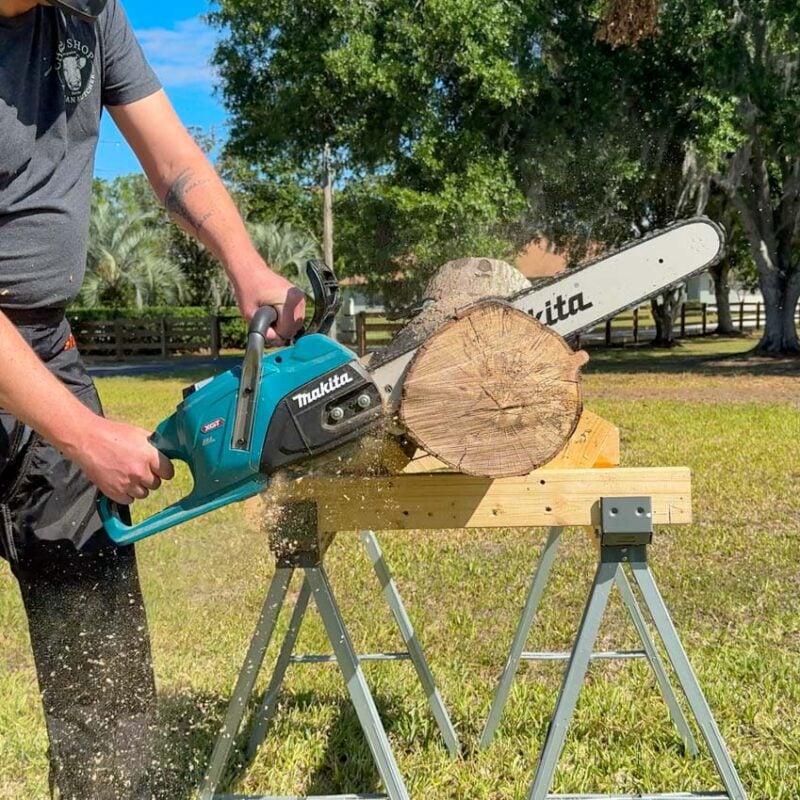
Makita 40V max XGT 20-inch GCU08
- Gas Equivalent Power: 50cc
- Chain Speed: 29.0 m/s (95 fps)
- Bar Length: 20 in
- Bare Weight: 12.9 lbs
- Working Weight: 17.0 lbs w/8.0Ah battery
- Price: $799 bare, $1349 kit
Highlighted Features
- Three Operating Modes: Prioritize between power and runtime based on the cut
- LED Indicator Panel: Monitor saw status and chain speed
Pros
- Pro-quality build
- Fast chain speed
- Solid cutting power
- Smooth operation under load
- Helpful electronic features
- Captured bar nuts
Cons
- Expensive
Looking at Makita’s first 40V max XGT 20-inch chainsaw, I noticed similarities to Stihl’s MSA 300 C-O. They’re both solidly in the same power class with similar chain speed and weight. They’re pretty even on the controls as well.
In fact, Makita and Stihl were very close in cutting speed when we tested them. Milwaukee was still faster, thanks to its higher torque, allowing us to lean into the cuts more aggressively, but that saw also has a 70cc power equivalent.
As is often the case with Makita’s tools, the GCU08 feels more refined. The balance, feel, controls, and smoothness of the motor under load give us the impression of controlled performance designed to minimize fatigue as you use it. Some of the other chainsaws we’ve reviewed feel a bit more raw in their power delivery by comparison.
Like Stihl and Greenworks Commercial, this is an expensive chainsaw. However, Makita’s XGT battery system is more than just a higher-voltage version of their popular 18V LXT platform. There are serious upgrades under the hood that make it a viable long-term option for landscaping Pros looking to electrify.
Best Battery-Powered Chainsaws for Homeowners
Best Battery-Powered Chainsaw
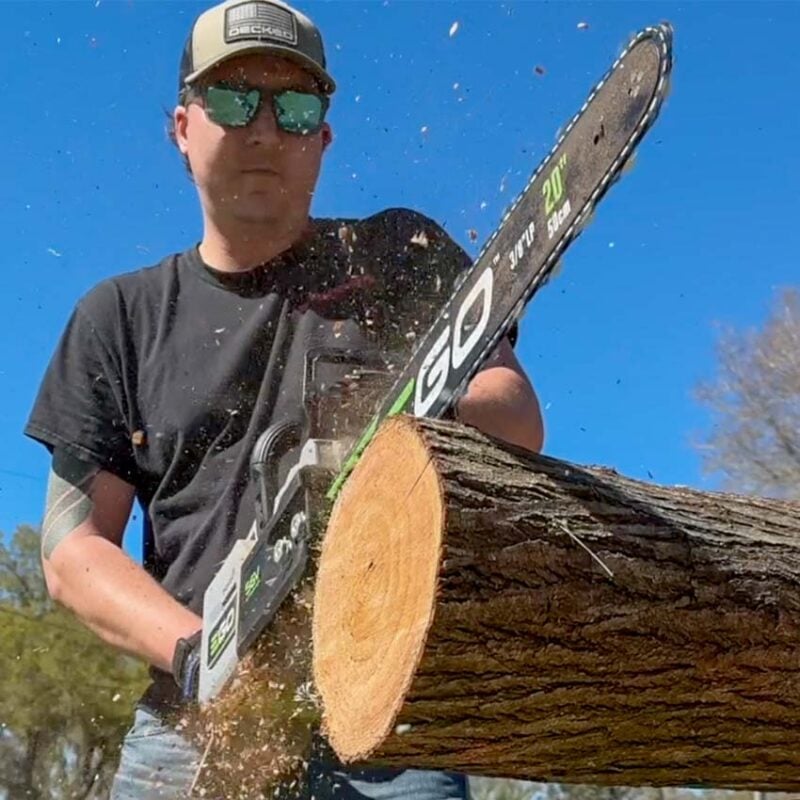
EGO 56V 20-inch Chainsaw CS2000
- Gas Equivalent Power: 55cc
- Chain Speed: 25 m/s (82 fps)
- Bar Length: 20 in.
- Bare Weight: 13.1 lbs
- Working Weight: 19.4 lbs w/6Ah battery
- Price: $329 bare, $549 kit
Highlighted Features
- Three Operating Modes: Prioritize between power and runtime based on the cut
- Omnidirectional Auto Chain Brake: Automatically stops the chain with the high inertia forces of kickback
- LED Light: Make cuts after dark without needing additional lighting
- Metal Bucking Spikes: Dig in better than with the plastic spikes many residential chainsaws have
- Safety Brake Indicator: Easily and quickly see if the brake is engaged
Pros
- Robust Pro-like build
- Solid cutting power
- Helpful electronic features
- Captured bar nuts
Cons
- Heavy
When EGO launched its 20-inch chainsaw, it gave homeowners and property owners a solid battery-powered farm and ranch class option without having to jump to higher-priced Pro options.
Thanks to its easier price point, it may even give some Pros a moment of hesitation before pulling the trigger on their typical brands. At 55cc, EGO actually tips the performance scale a little higher than Stihl, Makita, and DeWalt’s top options.
In our evaluations, we could certainly feel the difference in how confidently the 20-inch model cut compared to EGO’s Gen 2 18-inch model. But what may be surprising is that it also beat Milwaukee and Stihl in a head-to-head test of cutting speed.
With its Pro-inspired feature set, it really does feel like it’s in a class above what we would consider homeowner-grade.
It’s priced accordingly, and that may be an obstacle for some folks. If you’re looking for a battery-powered chainsaw for storm season prep and cleanup, the 18-model has the power you need at a lower price point. But if you’re a property owner with more trees to maintain, the 20-inch model’s performance boost offers a very real increase in your productivity.
Best Battery-Powered Chainsaw Runner Up
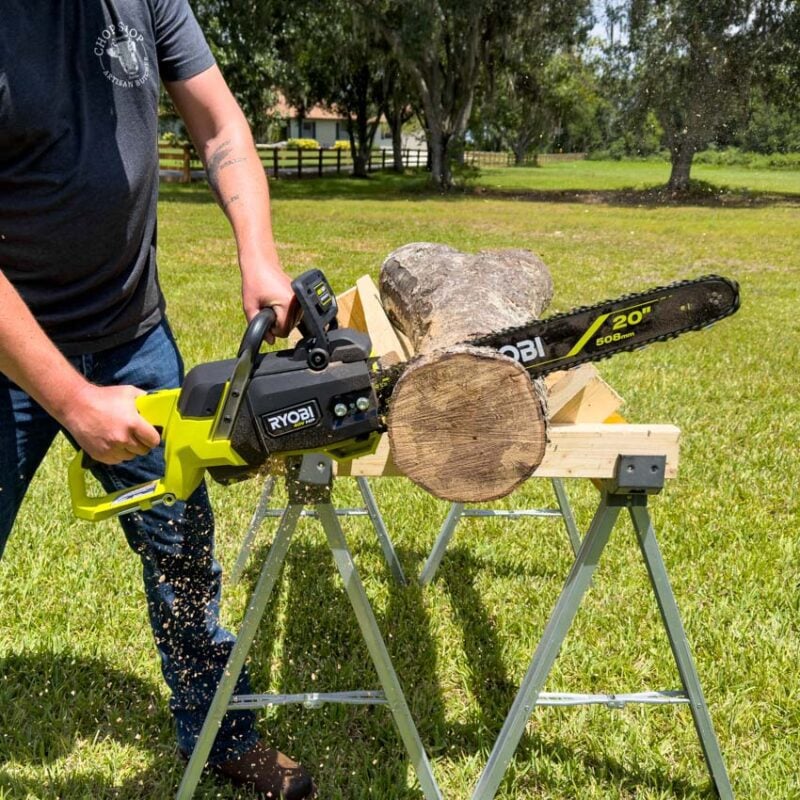
Ryobi Gen 2 40V HP Brushless 20-inch RY40HPCW03
- Gas Equivalent Power: 52cc
- Chain Speed: 25m/s (82.0 fps)
- Bar Length: 20 in
- Bare Weight: 13.1 lbs
- Working Weight: 17.2 lbs w/ 8.0Ah battery
- Price: $349 bare, $469 kit
Highlighted Features
- Metal Bucking Spikes: Dig in better than with the plastic spikes many residential chainsaws have
Pros
- Upgraded durability
- Solid cutting power
- Captured bar nuts
- Excellent value
Cons
- Not as feature-rich as competitors
Ryobi’s second-generation 20-inch chainsaw came with a bump in power and some very nice upgrades in durability. The increase in power was only from 50cc to 52cc equivalent, but it also came with an increase in chain speed. As we started cutting with it, it felt like a much stronger contender in the farm and ranch class than its predecessor.
At the moment, EGO still has the upper hand with a little higher power and more nice-to-have features. But don’t assume that means Ryobi is out of the race. The new design checks all the right boxes we expect to find on a quality gas model, so in use, it feels very familiar.
It’s also about $80 less for the kit, making it a more attractive option if you want a true farm and ranch class saw at a lower price.
Best Battery-Powered Chainsaw for the Money
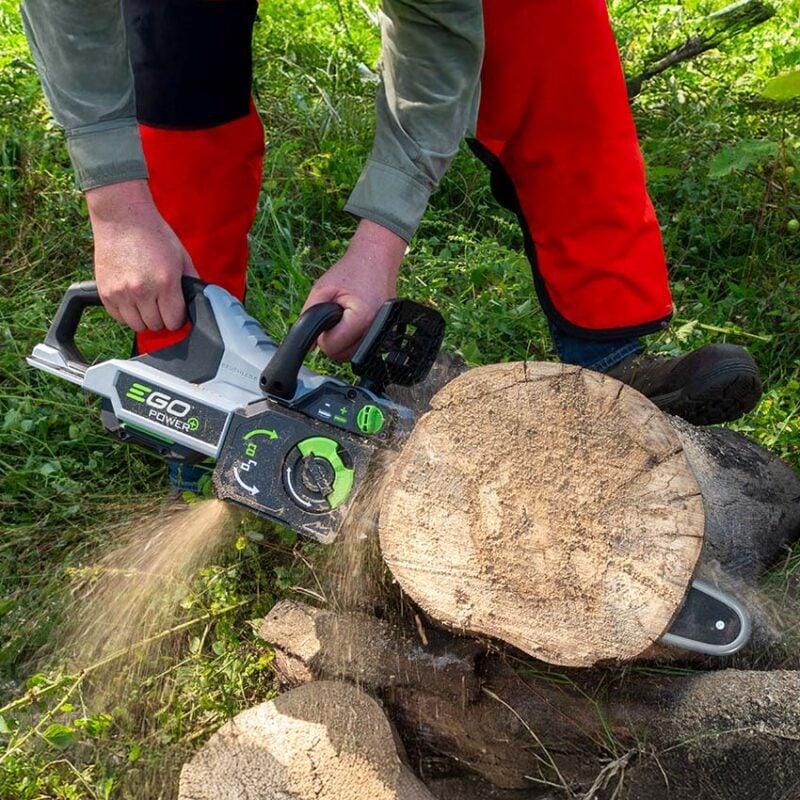
EGO 56V 16-inch Chainsaw CS1611
- Gas Equivalent Power: 40cc
- Chain Speed: 20 m/s (65.6 fps)
- Bar Length: 16 in.
- Bare Weight: 9.0 lbs
- Working Weight: 13.7 lbs w/4.0Ah battery
- Price: $219 bare, $329 kit
Highlighted Features
- Tool-free Chain Tensioner: Adjust the chain tension without having to grab your scrench
- Metal Bucking Spikes: Dig in better than with the plastic spikes many residential chainsaws have
- Safety Brake Indicator: Easily and quickly see if the brake is engaged
Pros
- More power than the previous 16-inch model
- Tool-free chain tensioning
- Excellent value
Cons
- Not as powerful as higher-priced options
EGO already had a solid 16-inch chainsaw on the market, but they released a new one in 2022 that made two big strides. First, it upped the performance to compete with (and even beat) gas saws in the 40cc class. Second, they added some much-needed features like a flip-top oil lid and metal bucking spikes.
In the field, the performance boost was noticeable as we cut through oak. Plus, the metal bucking spike upgrade really helped us control the saw through its thicker cuts.
That said, the cutting speed and power are nowhere near those of EGO’s 20-inch or even its current 18-inch models. If performance is high on your priority list, I’d think hard about spending more and going further up the food chain. But if you’d like a saw that’s easy to manage and easy on your budget for seasonal storm cleanup and general tree maintenance, you’ll have a hard time finding a better value.
Skil PWRCore 40 18-inch CS1800C-15
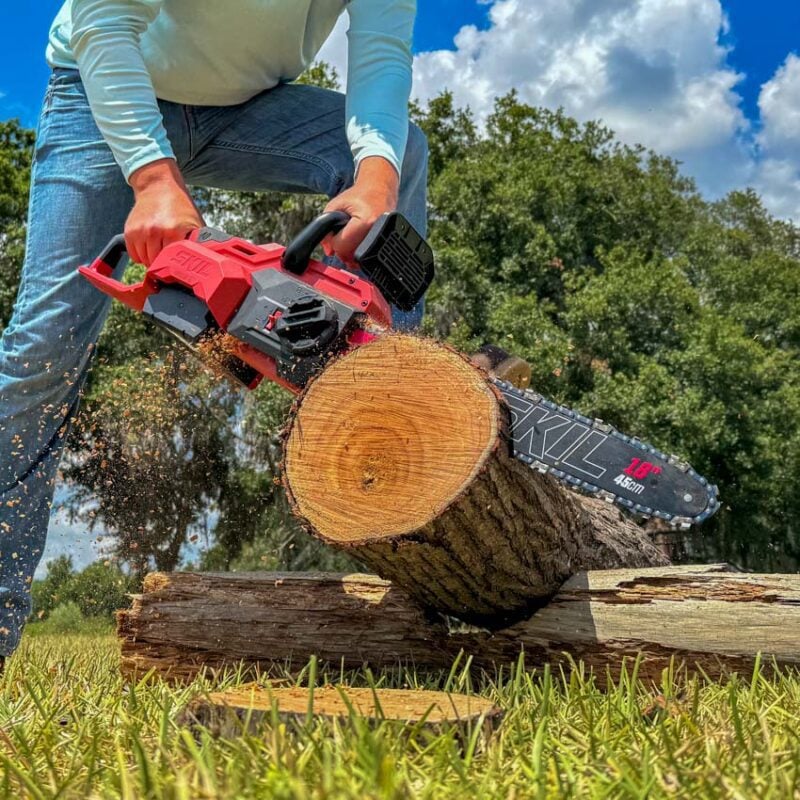
- Gas Equivalent Power: 40cc
- Chain Speed: 17.0 m/s (55.8 fps)
- Bar Length: 18 in.
- Bare Weight: 9.2 lbs
- Working Weight: 14.4 lbs w/6.0Ah Battery
- $329 kit
Highlighted Features
- Tool-free Chain Tensioner: Adjust the chain tension without having to grab your scrench
- Metal Bucking Spikes: Dig in better than with the plastic spikes many residential chainsaws have
Pros
- Tool-free chain tensioning
- Excellent value
Cons
- Not as powerful as higher-priced options
Skil has steadily built out a high-value line of battery-powered lawn care and landscaping tools that typically offers better bang for your buck at a given price point. In choosing the best battery-powered chainsaw for the money, it came down to EGO’s 16-inch model and Skil’s 18-inch offering.
Both run the same price as a kit. EGO has a more refined feature set while Skil give you a longer bar and cutting capacity. Both saws claim the same 40cc gas equivalent power, and we couldn’t tell a big difference in our testing. Skil runs a slightly lower chain speed, so it gets a torque bump, which is why it’s able to use a larger bar than EGO.
That said, from an application standpoint, they’re primarily suited for the same jobs. It’s a great saw for seasonal pruning and storm cleanup, and can be used for felling and processing small to medium-sized trees.
If you’re debating between the two, look closely at the platform you’re buying into. Skil tends to favor higher value and smaller lawns, while EGO tends to push toward higher performance and larger properties.
More Battery-Powered Chainsaw Reviews
Chainsaws
Top Handle Chainsaws
Pruning Chainsaws (Mini Chainsaws)
- ECHO 56V Pruning Saw Review
- Greenworks 24V Brushless Pruning Saw Review
- Milwaukee M12 Fuel Hatchet Pruning Saw Review
- Milwaukee M18 Fuel Hatchet Pruning Saw Review
- Skil 20V Brushless Pruning Saw Review
- Stihl Gen 2 12V Pruning Saw Review
Pole Saws
- Greenworks Commercial Optimus Carbon Fiber Pole Saw Review
- Milwaukee M18 Fuel Telescoping Pole Saw Review
- Ryobi 40V HP Brushless Pole Saw Review
What to Look for When You’re Buying a Battery-Powered Chainsaw
Performance is King
Thanks to advanced brushless motors, electronics, and batteries, voltage no longer tells the entire story. However, cutting speed with the torque to get through thick hardwood species is the number one priority for us.
Runtime is (Sort of) a Big Deal
Ideally, a battery-powered chainsaw balances cutting speed and power with runtime. Larger batteries are certainly helping. Advancements in battery technology are as well. Denser cells with more robust connections can more efficiently transfer energy from the battery to the chain. This gives you higher performance without a drop in runtime that makes the saw irrelevant.
The other side of the conversation involves rapid chargers. Most brands offer them now and several include them as a standard part of the kit. With today’s cordless technology, two batteries and a rapid charger can keep you running continuously all day.
Triggers, Safeties, and Lockouts
Most chainsaws are similar in form and share the same basic operational features. Where the best cordless chainsaws differ in form is primarily in their switches and triggers.
All of the saws have a UL or similar test lab certification on them, but they’re not all the same. In use, some of the saws in our test have more defined two-step triggers. Others easily activate using a single grasp around their lockout button and trigger. At the end of the day, we expect our chainsaws to keep us from accidentally activating the motor. My recommended saws above all meet that requirement. From there, it’s just a matter of the feel or function you prefer.
The true two-step lockouts aren’t difficult to operate in normal conditions. In odd positions, such as reaching around a tree while limbing, sometimes the mechanical lockouts can be tricky to slide.
For select cordless chainsaws, the first of two (or sometimes three) stages of starting is an electronic power button.
Some electronic switch saws can be run with a single grab once powered on. You just have to be mindful of the auto timeout feature. It can be frustrating the pull the trigger to no effect when you thought the saw was ready.
Check out our guide to Chainsaw Safety Rules for Beginners and Pros!
Ease of Adjustment
Chainsaw bars need to be adjusted nearly every time you use the saw. A new chain stretches out pretty quickly. You need to snug it up at least a few times as it breaks in.
If your chain gets tight rather suddenly, it usually means the bar is not getting oil. Don’t loosen it until you make sure the saw is oiling properly.
Pro Tip: Get into the habit of loosening your chain at the end of the day. Cold weather can cause it to tighten as it cools and damage parts.
A saw’s bar will be designed for either tool-free adjustment or will require a screwdriver-wrench combination tool called—yep, you guessed it—a scrench. Tool-free adjustment is the quickest and easiest with plastic knobs and/or dials built into the saw. They loosen the bar, move the bar forward or back to properly tension the chain, and lock the bar down tight again.
To keep your adjustment tool close at hand, look for models that have storage slots built into the saws.
Dual Studs vs Tool-free Adjusters
Saws with tool-free adjusters use a single stud to attach the bar to the saw, but manual adjusting models typically have two mounting studs (sometimes one on small or top-handle models). Some old-school users view dual studs as an indication that the saw is geared toward professionals, but we don’t think that’s a hard, fast rule. Not for modest-sized saws anyway. However, the biggest and strongest chainsaws all have dual stud bar mounts.
Pro Tip: Be sure to snug the nuts evenly because torquing down on only one can loosen the other.
Author’s Note on Captured Nuts
Lost bar nuts are a frequent occurrence during regular use in the field. To prevent this, some saws have the added feature of captive nuts that won’t come all the way off the cover no matter how much you spin them. If you don’t have this feature, keep a couple of spare nuts on hand — it’s not unusual to lose one in the field!
Your preferences may vary, but we can appreciate both adjustment methods. We like the speed and convenience of tool-free adjustments for small saws. For big saws, we feel more confident securing the business end of these powerful tools down with a wrench.
It’s not a deal-breaker either way for the saws in our test unless the mechanism itself is flawed. The best battery-powered chainsaw for you is the one that instills a sense of both confidence and convenience.
Bars and Chains
Most chainsaw brands don’t try to reinvent the wheel by making their own bars and chains. Instead, many use quality Oregon components, though Stihl makes their own bars and chains. Most cordless chainsaws use 3/8-in. pitch, 0.043-in. gauge chains while stronger models are moving up to 0.050-in. gauge.
Oiling Systems
Bar and chain oil is the lifeblood of a chainsaw as the saw cannot run without it for very long. Most saws oil readily, but we occasionally run across models that have issues after a while. If a saw oiled well out of the box, it usually just needs a good cleaning to unclog it.
Oil Visibility
Most battery-powered chainsaws have translucent windows that let you check if there’s oil in the tank, and most let you estimate the level pretty well. If yours has a small window or none at all, be sure to stop and check the oil level frequently. About every hour of working time or anytime you notice a change in performance is a good rule of thumb.
Oil Caps
The ease of filling the oil reservoir is a noteworthy convenience factor when considering the best battery-powered chainsaw. We don’t like having oily fingers, so being able to fill the tank while leaving our work gloves on is our preference. Look for oil caps with lugs that are easy to turn with gloves on and/or flip-up tabs that provide an even better grip.
Spills & More Spills
Chainsaws often leak oil while sitting because daily heating and cooling shrinks and expands a plastic tank like a rudimentary pump. Some saws are messier than others.
Wherever you store your saw, put a piece of cardboard underneath it to collect any oil. You can switch it out as needed and whenever an Amazon order arrives.
Be careful when filling your chainsaw. Some have a large section of the cap that goes inside the tank and displaces a surprising amount of oil when you fill it anywhere close to the top. Wiping gooey oil off a chainsaw is an annoying waste of time.
Another cause of spills is an oil tank with a filler neck that is too narrow. Bar and chain oil is thick and tacky. It can pour like molasses in the cold, so it easily “piles up” and overflows in a narrow neck.
Pro Tip: Only poke a small hole in the foil of your oil container or use a (clean) syrup bottle to dispense oil into your chainsaw’s reservoir.
Providing another challenge, plastic filters at the inlet of its tank can constrict the diameter.
Caps that cross-thread easily can also make the oil-fill process more of a chore.
Environmental Sidetrack: Try Biodegradable Bar and Chain Oil
The other part of this cleaner, greener, lithium-ion-powered story is you can pair your battery chainsaw with a biodegradable bar and chain oil made of vegetable-based ingredients, such as Stihl Bio Plus. Those barrels of useful wood waste also contain a few gallons of oil from the saws.
Aside from having to landfill all of your petroleum-preserved sawdust, it’s just good practice to minimize your exposure to petroleum oil on your skin, clothing, and the atomized portion that you breathe in.
Bucking Spikes
For pushing a saw through wood more efficiently, chainsaws come fitted with bucking spikes. You may also hear these called bumper spikes, felling spikes, or dogs. These spikes sit against the body of the saw alongside the bar. They anchor the saw in place while you pivot the bar through a cut.
The spikes allow you to apply a lifting motion of the rear hand instead of pushing downward. Holding the saw tight to the wood, the motor can exert its maximum pulling power. This saves you from some of the cutting vibrations common when holding a saw away from your work.
Our battery-powered saws all have some semblance of spikes. Most aren’t as long or as sharp as those on large gas saws. However, actual steel spikes are becoming more common. We prefer those to the simple plastic ridges on other models.
Pro Tip: Applying leverage with spikes adds control, but go easy and listen to the pitch of the motor. You can overload battery chainsaws with too much pressure, and the weaker models stall easily.
Balance
While the comfort and feel of a tool are largely subjective, it’s also true that some designs work better than others. Most Pros and experienced homeowners can immediately tell.
For the best battery-powered chainsaw, a balanced feel in your hands and the ability to cut straight without introducing a twisting motion to overcome are both important ergonomic factors.
Holding a saw with your left hand on the front handle in front of you should have the saw balanced fairly flat. Being a bit front-heavy is okay, but a rear-heavy saw lifts the cutting end of the saw up toward you and requires more effort and vigilance to use and carry safely.
Cutting Sideways
Determining whether a chainsaw has a good feel for felling cuts while holding it sideways is more about the comfort of applying force to the front and rear handles as you grasp it from the side, and also the ease of operating the trigger in that orientation.
Handles
In general, chainsaws with thicker handles are more comfortable to grasp because they have more surface contact. That tends to soften that contact with your hand. Of course, rubber handle surfaces help too, not only for padding but also for the increased grip they provide.
Trigger Comfort
Most cordless chainsaw triggers are large enough for two fingers to fit on them. Some have an extra-long trigger with more room to vary your grip stance for comfort. The best feeling triggers retract flush with the handle instead of leaving a raised bump your fingers have to push against.
Weight
The dry weight of the best battery chainsaws can swell to well over 15 pounds. Experience shows that a saw’s weight is less important than proper balance overall as you only feel the full weight when you’re NOT cutting.
But carrying around and positioning a heavy saw can certainly be more taxing over a long workday. The catch with these saws is that the batteries are a major part of the weight. Those stronger saws with the high-capacity battery packs and longer bars I prefer end up being the heaviest.
Battery Selection
While I do the majority of my testing with the kitted batteries, it’s worth looking at the full range a manufacturer has available for your cordless chainsaw. If you end up investing in the entire lineup, you’ll likely want to consider the biggest batteries you can buy for it to get all of your lawn chores done efficiently.
You might also want a lower-capacity battery to shave some weight when you don’t have a lot of work to complete.
“Current” State of Affairs
Voltage
Higher voltage means more power, right? There’s certainly an argument for that, but it doesn’t tell the whole story.
Power is measured in watts. That comes from multiplying the nominal voltage times the current. You can make a 36V chainsaw with the same power as a 56V model. The lower voltage simply has to produce more amps (current) to get there.
That’s why you see chainsaws with 40cc gas performance at 18V, 36V, and 60V. It’s all about the combination of volts and amps. All other things being the same, lower current does help a battery run cooler and potentially last longer.
Watt-Hours
Another thing that is interesting to note is the discrepancy between the amp-hour and watt-hour ratings on some of the batteries in our tests for their given voltage. We’ve covered the subject of battery voltage vs amp-hours, storage capacity, and current output many times. To review simply:
Volts x Amp Hours = Watt Hours
It’s the same basic equation we use for power, just applied to energy storage instead of output. It’s an easy way to compare the available energy of one battery to another when they have different voltages.
We’re increasingly finding that manufacturers—perhaps to simplify things for consumers—are rounding amp-hours. Some calculate their watt-hours with maximum voltage while most use nominal. Unfortunately, this makes some comparisons more challenging and adds to potential confusion.
Best Battery-Powered Chainsaw Accessories
While nearly every chainsaw comes with basic plastic scabbards to protect the chain while also protecting you from the chain, a few of the models go above and beyond.
We’ve seen an optional tip guard to make safe operation more foolproof. Attaching the guard makes you lose a few inches of cutting capacity and prevents any plunge cuts and other non-through cuts such as deep rips. However, casual users may feel more comfortable with the tip of the saw fully protected against kickback.
Once in a while, you can find a unique, form-fitting bag or case. It’s helpful for storage and transportation, though you might want to use it only after you’ve drained the oil from your saw.
Buy Into a System
One other consideration for these saws is the system of battery-powered OPE to which they belong. Like other cordless tools, you can purchase some of our best battery-powered chainsaws as bare tools at significant savings over the kit.
If you’re already invested in one of these systems, the overall winner may not interest you as much as seeing which model from your brand is the best in the lineup. Though not the best overall, it might be the best balance of performance and value for you.
Look at the Entire Model Lineup
If you haven’t bought into a system yet and may pick up more outdoor power tools in the future, check out the entire lineup from a brand. Make sure they can fulfill your wish list before going after just the chainsaw. For many users, the saw functions as a secondary tool when compared to the hours you spend with a string trimmer or mower.
Why You Can Trust Pro Tool Reviews
There are plenty of publications and authors out there trying to convince you that they know what the best battery-powered chainsaws are. Let’s give credit where credit is due—they use good SEO writers and may have even used a few popular tools in the process.
But do they have more than a decade of experience using chainsaws with an eye on comparative evaluation, understand the key features to look for, and have they really experienced differences in the quality of the components? Have they been around to see advances in design, the development of innovative new features, and how they affect Pros in the field?
We have. We’ve been testing and reviewing chainsaws since we started Pro Tool Reviews back in 2008.
You can trust Pro Tool Reviews because tools are what we do. When we recommend a chainsaw for you, it’s because it’s the one we would buy. Our primary motivation is to recommend what we genuinely believe is the best in each category based on our collective decades of experience and being involved in the tool and industry every day. If you choose to buy something we recommend, we hope that it works exactly the way you expected when the time comes.