
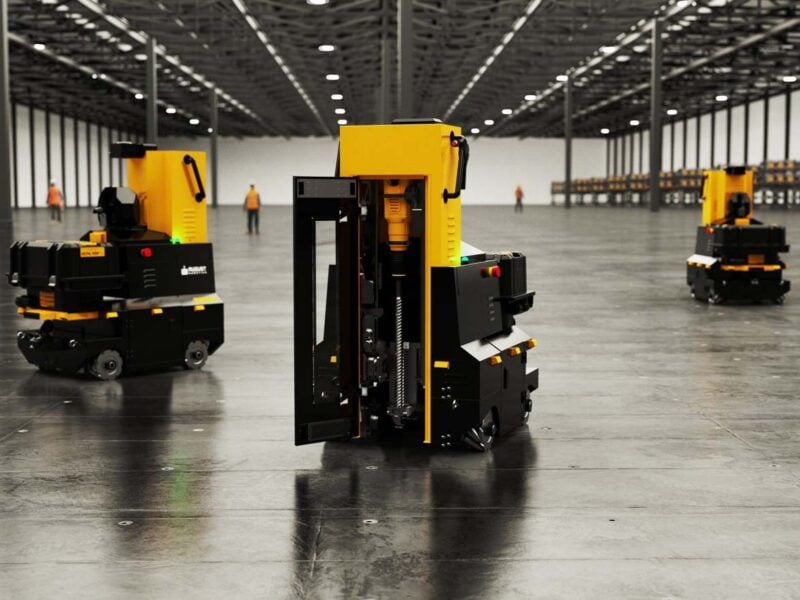
At World of Concrete 2026, DeWalt showed off the world’s first downward concrete drilling, fleet-capable robot. After completing pilot testing on 10 data center construction sites, the results show very real promise in accelerating large-scale projects.
The robot was designed in a partnership between DeWalt and August Robotics with the goal of meeting the needs of aggressive construction timelines. The industry at the heart of the problem is AI with its need for massive data centers.
Even if you haven’t been paying close attention, you’ve probably noticed how much AI is moving into more areas of your life. It’s hard to shop, search, or watch without some form of AI trying to help you (whether you want it to or not).
Behind the scenes, there’s a race going on with potentially trillions of dollars at stake for the winners. But without data centers, tech companies are limited in their ability to develop and expand the capabilities of their AI systems.
So, the speed of construction is a crucial element for the firms competing.
DeWalt Concrete Drilling Robot Overview
What this DeWalt robot does is pretty straightforward: it drills downward holes in concrete.
How the robot does it is not so easy, but the results speak for themselves. Check out these stats provided by DeWalt:
- 10 times faster drilling
- 99.97% position and depth accuracy over 90,000 holes
- 80 weeks of time savings across 10 construction projects
- One project saw a cost reduction from $65 per hole to $20 per hole
Let’s consider some of that in context. The average project in this pilot program shaved 8 weeks off of completion time. That’s nearly two months. Across all ten, that’s a time savings of more than a year and a half!
The cost-per-hole savings are eye-opening as well. If we apply the $45 per hole savings (which is likely the best among the ten projects) to all 90,000 holes, that’s a little more than $4 million in cost reduction, or $400,000 per project.
Even if it was only an average of $30 in savings per hole, you’d still gain $2.7 million in total savings, or $270,000 per project. Those are very real savings.
And consider this: those are the savings and gains that come from just one application.
You can bet industry leaders are looking at this and determining what other jobs they can apply this technology to.
Hilti came up with the overhead drilling JaiBot a few years ago. A drywall hanging robot was prototyped before that. There’s even a rebar-tying drone flying around.
The development of automated construction isn’t new, but we are now seeing what it’s capable of and how it’s integrating into processes.
What are your thoughts on automation and AI on the jobsite? Is it helpful? Hurtful? Somewhere in between? Join the conversation in the comments below!


I believe that Dewalt makes wonderful battery tools The only thing I as a contractor who has been utilizing to walk for over 17 years believe that battery prices for the drills and impacts Need a little more acceptance to the pocket book. If they were to allow tradition and with obviously proof of purchase with batteries replacements free as they are bad or go out or fall apart like I’ve had some do I think that would boost the sales product to where people that aren’t allowing that kind of deal Would lose out that customer.. The only downfall I see with Dewalt is the expense of the batteries and the longevity of them isn’t great Durability on the other hand is about a medium rate for me Porta cable will run a tight race As far as durability and longevity is concerned and it shouldn’t be running a tight race with the wall I think Y’all could blow out the competitors with the battery idea.
Interesting idea, Curtis!