
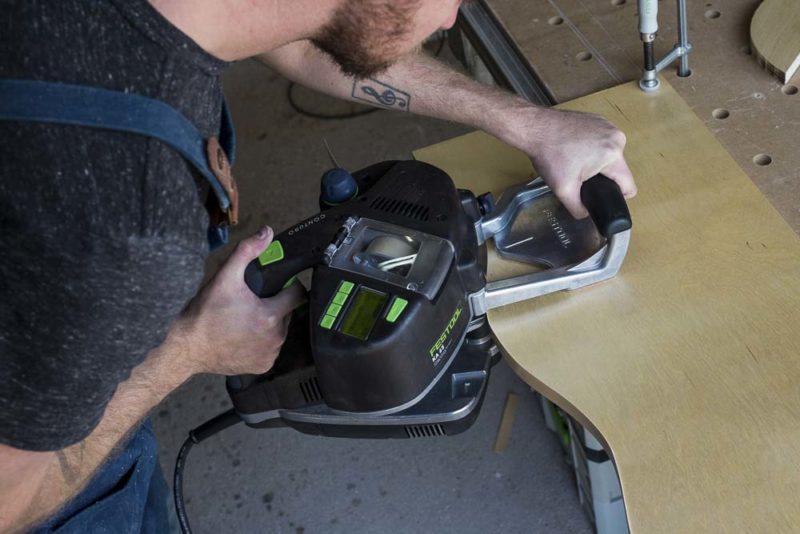
As a carpenter specializing in custom cabinetry and built-ins, I find the versatility of a new tool to be one of my top priorities. I rarely add a tool to my shop if it can’t perform more than three or four functions. My router, for example, has 4 different base attachments. This allows me to accomplish various tasks with one tool. I can cut dados, rabbets, turn decorative edges, and bore holes for shelf-ins and cabinet hinges.
With that prerequisite in mind, when I set out to upgrade my edge banding from the old, low-quality, iron-on products to something more professional, I didn’t have a lot of options for versatility. I was looking for a machine that could both upgrade the work that I’m currently doing as well as open up possibilities for future projects. As a Festool buff (15 tools and counting), obviously, the Conturo Edge Bander caught my eye. I’ve been working on a rather large cabinetry project and have now spent the past few weeks getting acquainted with the Festool Edge Bander KA 65 Conturo.
I have to say right off the bat: it’s a beautiful machine that produces even more beautiful results.
How Festool Developed the Conturo Edge Bander
Our editor-in-chief got to spend some time at a Festool media event in Stuttgart. There, he listened to Wolfgang Reines, who heads up the Edge Bander project (his first product with Festool was the well-regarded Domino). While there’s no standard approach or formula for how Festool generates ideas, they tend to look at the market and also combine that with the knowledge of their experienced product managers (Wolfgang was formerly a joiner, for example).
The edge Bander was developed to compete with some handheld edge banders that were already on the market, but which weren’t as capable and—quite frankly—looked like prototypes. They range anywhere from $10,000 stationary solutions to $200,000 CNC-style machines. Additionally, the gluing stations incur an extra $50,000. Because of this, the market allowed Festool to develop a handheld solution that could accomplish the job of a larger system with the convenience of existing hand systems—but with greater capability and efficiency.

What Really Set It Apart
They wanted a new type of tool that was “clean” to use—one that wouldn’t burn your hands. Also, there needed to be a new “non-beaded” cartridge system for glue that would allow them to use only what was needed. If they could develop a tool that didn’t require a glue circulation system, then it would be much cleaner. At the same time, work on ergonomics began so that the finished product would be user-friendly and practical.

The next challenge was to keep it to one technology as opposed to an electric system for the glue component and a pneumatic system for the edge Bander. A computer was needed to automatically calculate the levels of glue and how fast the motor needed to turn. This would minimize the adjustments needed by the user and, to a certain extent, automate most of the features—feed speed, glue quantity per edge band thickness, and temperature would all be automatically controlled by the system. This is how the Festool Conturo works and what makes it such an intelligent system for the user (and what allows it to have only minimal controls during general use.)

During the prototyping phase, adjustments were made to further reduce the size to accommodate enough glue to do a conference table in one job while optimizing the cartridge size. Festool also added an LCD display (the first ever in a Festool product) to inform the user of what was occurring with the tool (temperature, readiness, glue levels, distance remaining, etc). Balance, weight, and shape were refined next for further ergonomic advantages.
First Impressions
The Festool Edge Bander KA 65 Conturo comes neatly packed in Festool’s typical Systainer and molded styrofoam. The tool has some weight to it, but it’s also clearly a solid machine. One thing that I noticed: unlike other Festool products, the Conturo’s cord doesn’t detach like their typical “plug-it” cords. However, this minor detail won’t affect performance. Additionally, the base requires some assembly before you can use the edge bander. But, overall, the Conturo looks and feels like a professional piece of equipment.

Favorite Features
The hallmark feature of the Festool Edge Bander KA 65 Conturo is the edge bander’s ability to apply edge banding on both the inside and outside radii. Most automated machines on the market can only band straight edges on plywood. Considering the Conturo is handheld, I can easily guide the machine around curves as it applies the edge banding. The Conturo Edge Banding Trimming Kit includes an auxiliary roller that attaches to the machine. This auxiliary roller allows me to apply edge banding to tight inside radii, and it works like a dream.

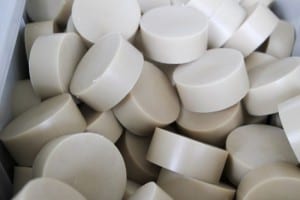
One of my favorite features revolves around the mechanics of the glue usage. Most portable edge banders use glue pellets, which all melt together inside what we call a glue pot. The problem with this is that once the glue melts, it can’t be reused. Ultimately, you wind up wasting a lot of glue. Instead, the Conturo Edge Bander uses adhesive pucks that fit into the top of the machine. The KA65 melts the face of the pucks and only uses as much glue as needed per run. This design is not only convenient, but it also allows for quick changes when you want to switch to a new adhesive color to match a different wood or stain.

The Festool KA 65 Conturo can also band beveled edges when used with the MFT/3 Edge Bander Table. This isn’t a feature I’ve had the chance to try out, but I can definitely see the benefits of this option when designing custom cabinetry or furniture pieces. This feature really sets the Conturo apart from other edge banders on the market right now.
Using the KA 65 Conturo
Setting up the Conturo takes little effort, and most of the settings flash from a digital display on the top of the machine. There are, however, a few settings that require some attention before use.
First, you’ll want to adjust the temperature. Though Festool is a German company, the engineers graciously gave us Americans the option of displaying the temperature setting in Fahrenheit instead of Celsius. Also helpful, Conturo adhesive has a suggested temperature setting printed on the box. Using the buttons below the display, the user will simply dial in the appropriate temperature setting.

The Festool Edge Bander KA 65 Conturo also lets you adjust the amount of glue being applied. This setting can be a little tricky to dial in, and it requires some trial and error. When I first started using the machine, I was using way too much glue. I ended up having a lot of excess glue to get rid of after banding. However, after some use, I found that the lowest glue setting works very well for the thin, pre-finished edge banding I’m using for a current cabinetry project. The Conturo has two speed settings: slow and slower. You’ll use the trigger on the ergonomic handle to adjust this.

Getting Familiar With the Feel of This Tool
It might take some time to get used to operating the Festool Edge Bander KA 65 Conturo. The machine does a few things at once, and you will need to make sure to place it against the workpiece at the right time.
After cutting the edge banding to length and loading the material into the Conturo, you’ll just need to press the start button to get going. The machine begins applying glue to the edge banding and feeding it through the machine. At this point, you’ll need to press the automated roller against the workpiece. Then, move the machine down the workpiece at the same speed that the Conturo feeds the edge banding.

It sounds a little complicated, but it’s actually pretty close to being fully automated. The user really just places the machine where it needs to be and lets it do its thing. If the project requires longer banding, the trimming set comes with an edge banding reel that attaches to the machine. This reel allows the user to roll up the banding in use and keep the material from getting tangled.
Trimming With Accessories
After applying the edge banding, you can immediately start trimming. The trimming set that comes in the Festool Conturo Edge Bander KA65 Set helps out a lot here. Functioning similarly to a guillotine, this trimmer works great and leaves a nice flush cut at the end of the workpiece. You can also use a draw knife to perform final finishing on cuts and get that perfect edge.

Next, we move to trimming the edges. This can be done using a handheld edge banding trimmer, but I highly recommend using the Festool MFK 700 Edge Banding router. This is a great tool because, not only does it trim the edge banding, but it also trims excess glue and bevels the edge in one pass.
It wouldn’t hurt to get a hold of Festool’s Carbide Scraper. You’ll use this to scrape off any excess glue, and it also has the ability to bevel the edges. One word of caution, though: don’t drop the scraper. I know from experience that it will break into a few pieces. Once the excess glue is removed and the edge is beveled, you can move to the sanding block, polishing compound, and pads to finish the edge to a pristine, professional level.

Final Thoughts
Most edge banders on the market have a singular purpose, which is to apply edge banding to a straight piece of plywood. Some automated machines will even apply the edge banding, cut off the ends, and trim the edges in one pass. However, they still only have the ability to apply edge banding to straight, 90° workpieces. Not to mention, the price range for an automated machine starts at around $10,000.
The Festool Edge Bander KA 65 Conturo Edge Bander meets the needs of a small, custom casework shop perfectly. For such a specialized machine, it’s capable of quite a few things that other, more expensive edge banders can’t handle. That alone passes my versatility test. I would recommend this machine to any professional carpenter, but especially those with a small shop that produces highly customized cabinetry. The Conturo won’t match the production rate of a more expensive stationary edge bander, but then again, it’s not supposed to. It exists in its own category.
Click to find a local dealer.
Festool Edge Bander KA 65 Conturo Features
- Inexpensive compared to alternatives like stationary edge banding machines
- Capable of edge banding curves, circles, convex and concave radii, and inside corners
- Electronically controlled precision glue distribution system for maximum adhesion
- Compact, portable, ergonomic design for easy use and flexibility
- Optional table mounting for working with small workpieces
Festool Edge Bander KA 65 Conturo Specs
- Heating time: 8 min
- Safety class: I
- Weight: 17.41 lbs (7.9 kg)
- Melting temperature: 212 – 410 °F (100 – 210°C)
- Edge height: 3/4″ – 2-9/16″ (18 – 65 mm)
- Power consumption: 1,200 watt
- Max. edge thickness: 1/64″ – 1/8″ (0,5 – 3,0 mm)
- Feed speed: 6.56 ft/min (2 m/min)/13.1 ft/min (4 m/min)
- Inner radius: > 2″ (50 mm)