
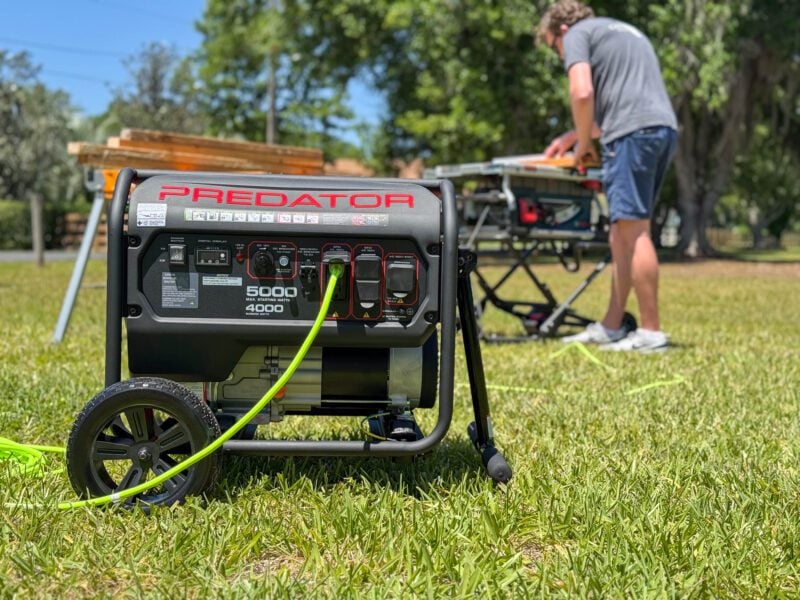
On the surface, Harbor Freight generators seem like a no-brainer. You’re getting ample stated power output with an approachable design—all at a price that undercuts most of the competition.
But here’s the real question: Is it actually worth it once you get past the spec sheet?
Budget generators always come with trade-offs, whether it’s build quality, convenience, or long-term reliability. And while Harbor Freight’s Predator lineup has earned a decent reputation, not every model is a slam dunk.
So before we recommend this generator for storm season, jobsite power, or weekend use, we wanted to take a closer look at what you’re really getting—and where it might fall short.
Pros
- Excellent price-to-power ratio
- Long runtime for its class
- CO shutdown adds practical safety
- Simple, easy-to-maintain engine
- Transfer switch-ready outlet
Cons
- No electric start
- Wheel kit sold separately
- Not ideal for sensitive electronics (no sine wave output)
READ
Best Portable Generators for Jobsite Use
Predator 5000 Watt Generator: Key Features
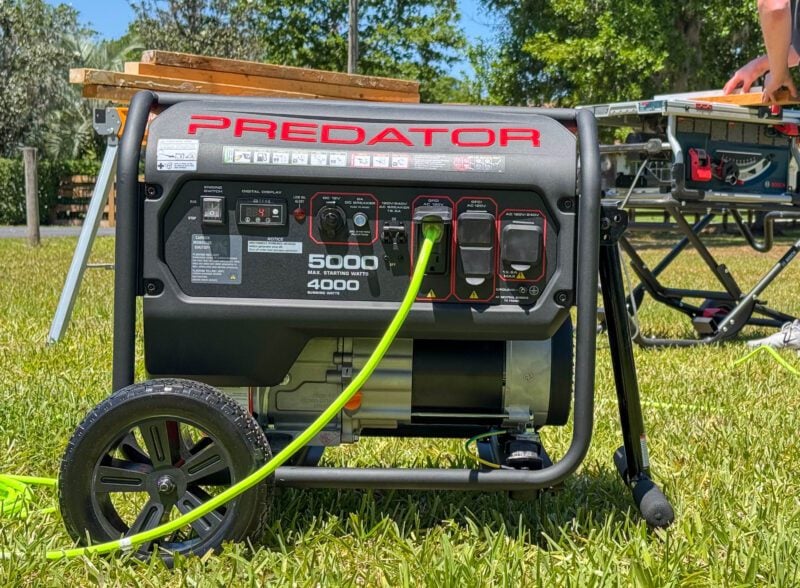
CO Secure Technology
Carbon Monoxide is often nicknamed “the silent killer”, and for good reason. The gas is colorless, odorless, and tasteless, making its presence hard to detect and incredibly dangerous. Fortunately, Predator outfitted this generator with a sensor that automatically shuts down the engine when the concentration is too high, ultimately reducing your risk.
If the engine shuts down due to CO levels, the sensor emits a red blinking light to alert you to potentially dangerous conditions. Be sure to give the area plenty of time to dissipate pooling CO before entering.
We hear stories every year of people who mistakenly thought they gave their generator enough room, only to have carbon monoxide pool up and cause sickness or death. Carbon monoxide detection helps reduce that risk, and we like that it’s more or less a standard feature on newer generators.
Digital Display
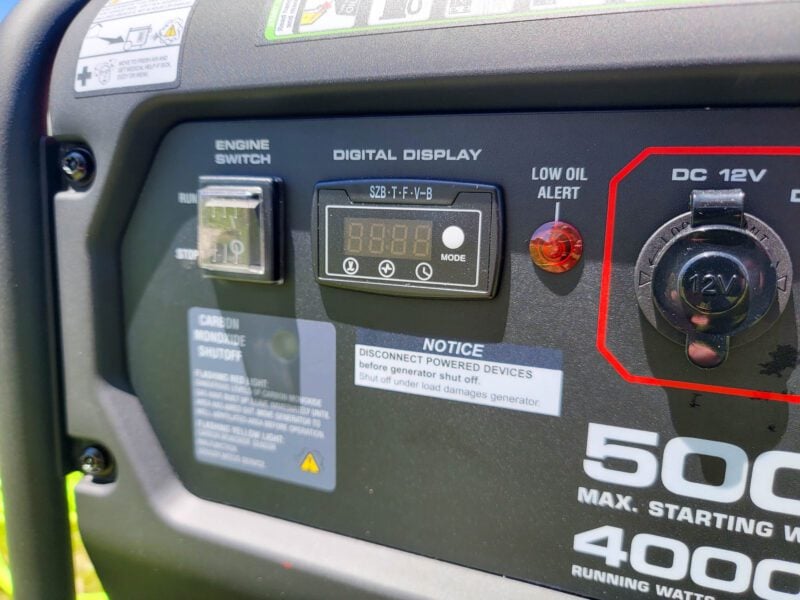
Another feature we like is the digital display. This display allows you to instantly monitor output volts, frequency, and runtime. It seems like a simple detail, but it makes life a whole lot easier! All you need to do is press the “mode” button to navigate through the menu.
Roll Cage Design
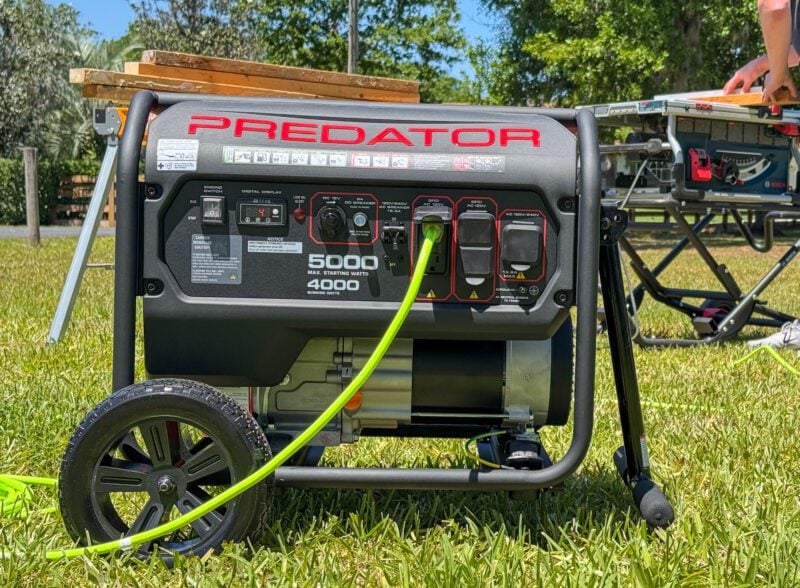
Predator went with a pretty standard steel-tube roll-cage frame on this generator. It features vibration-isolation points around the motor, giving the generator a rugged look.
While we do like this design, there is one fly in the ointment. Harbor Freight does not include wheels or a handle in the box. These accessories make it infinitely easier to move and transport the generator between uses, especially if you’re unable to lift heavy objects. That said, they do offer an accessory package you can purchase alongside the generator.
It’s not a deal-breaker, but making this an additional expense is a little annoying on a product this heavy. If, however, you plan to strap this to your vehicle or use it in a fixed location, then perhaps they’ve just saved you some money.
Predator 5000 Watt Generator Performance and Design
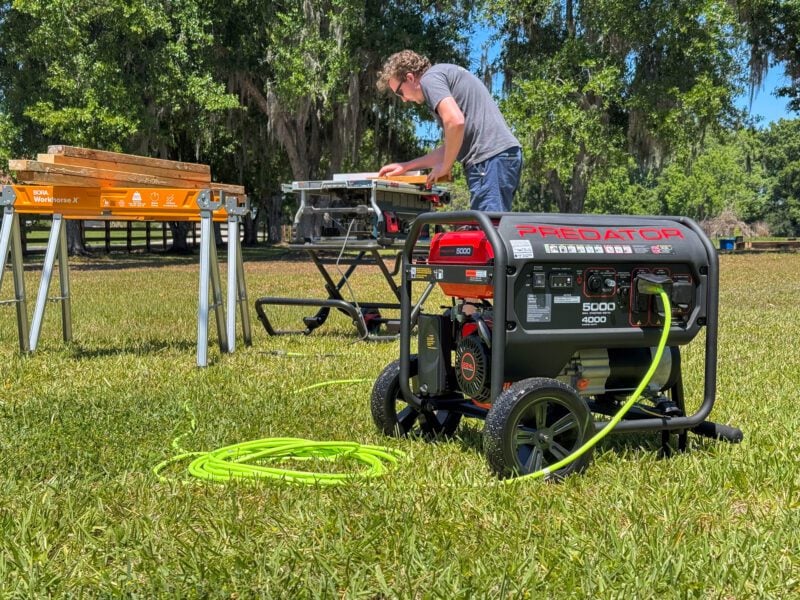
The Predator 5000 Watt Gas-Powered Portable Generator sits squarely in the “budget workhorse” category. It’s designed to deliver enough power for home backup, jobsite tools, and recreational use—without pushing into premium pricing territory.
The addition of CO Secure technology brings it more in line with modern safety expectations, which is a big step forward for Harbor Freight’s Predator lineup.
Power Output
On paper, this generator lands right where you’d expect for a 224cc engine class. In practice, it’s capable of powering essential home circuits—think refrigerators, lights, a microwave, and even smaller window AC units without much trouble.
With 5000 starting watts and 4000 running watts, this mid-sized open-frame generator prioritizes runtime and simplicity over refinement.
Where it starts to show its limits is with high-draw appliances. Central AC systems or large compressors are generally out of reach unless you’re running soft-start setups. That’s consistent with most generators in this wattage class.
Noise Level
One of the biggest surprises came when we actually fired up the generator for the first time…it was quiet! Granted, it wasn’t nearly as quiet as the premium Honda EU-series inverter generators, but we were still surprised given that this is an open-frame design.
Using our SPL meter, we measured 66 dBA at 25 feet and 81 dBA right next to it. This is exceptionally quiet—so much so that I could still carry on a conversation at just above a normal volume.
This is a really big deal, especially if you need to run the generator in a crowded residential area, campsite, or even overnight. We encounter the latter scenario more often during our yearly Central Florida hurricane season.
Runtime
Another big highlight here is runtime. At over 15 hours at half load, this unit is built to stretch fuel during outages—something that matters more than peak wattage when you’re running overnight.
Keep in mind that the more power you draw, the more fuel the motor will burn. Fortunately, Predator provides a handy guide to help you calculate the total wattage required to power what you need. This is an important step to reduce the risk of overloading the machine.
Available Outlets
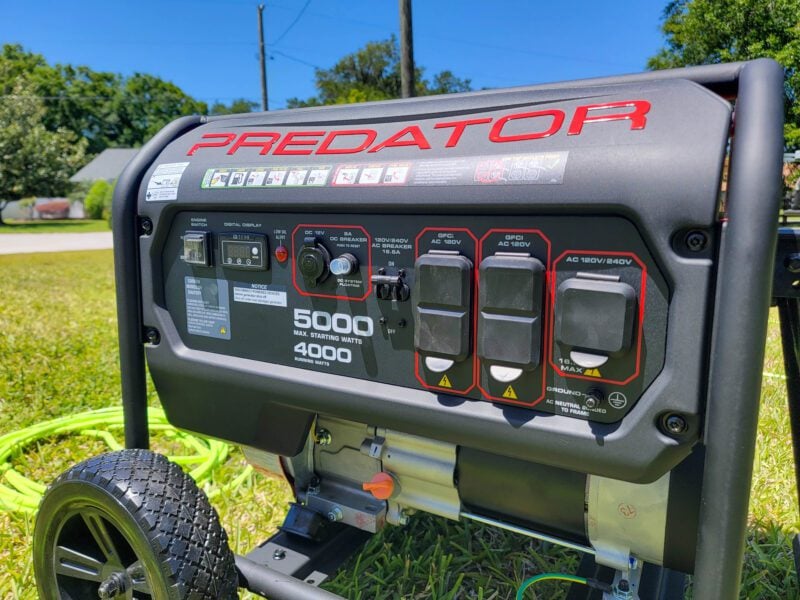
Okay, so we’ve got power…let’s put it to work! This generator is equipped with four 120V 5-20R (20A) GFCI outlets, one 120/240V L14-30R (30A) twist lock outlet, and a 12V DC outlet. This is a good mix that lets you power a wide variety of appliances, tools, and emergency equipment.
Additional Features
- Low Oil Indicator and Shutoff: Helps prevent damage to critical engine components
- Fuel Shutoff Valve: Easily close off the fuel line between uses and during storage
- 120V/240V AC Circuit Breaker: Helps prevent damage to vital electrical components in the event of a power overload
- External Fuel Gauge: Quickly monitor fuel levels at a glance
Getting Started
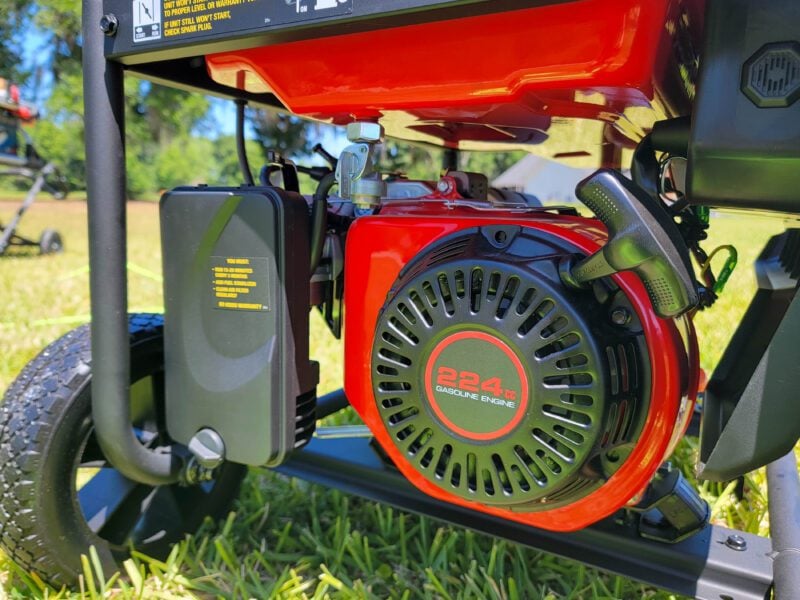
Starting this generator is very simple, but there are a few key things to know beforehand.
First and foremost, this generator does not ship with any oil—neither in the tank nor included with the machine. Harbor Freight recommends 10W-30 for regions with temperatures above 32°F, and 5W-30 for those who live in areas below 32°F. If you live in a hotter area like us here in Central Florida, standard SAE 30W is also acceptable. Although they don’t supply any oil, they are kind enough to include a small funnel so you don’t make a mess.
Once you add oil and fuel, starting the generator is a three-step process:
- First: Turn the power switch on the main panel to the “Run” position
- Second: Slide the choke lever (located about the air filter housing) to the “Start” position
- Third: Give the pull cord a firm, rapid pull to start the engine
How We Tested
To get a feel for how this generator will perform under load, we set up two tests—one jobsite related, and the other aimed towards homeowners.
For our first test, I set up two corded table saws and paired them with two corded vacuums. These tools draw a lot of power, so using all four at once should give us a good indication of this generator’s true capabilities.
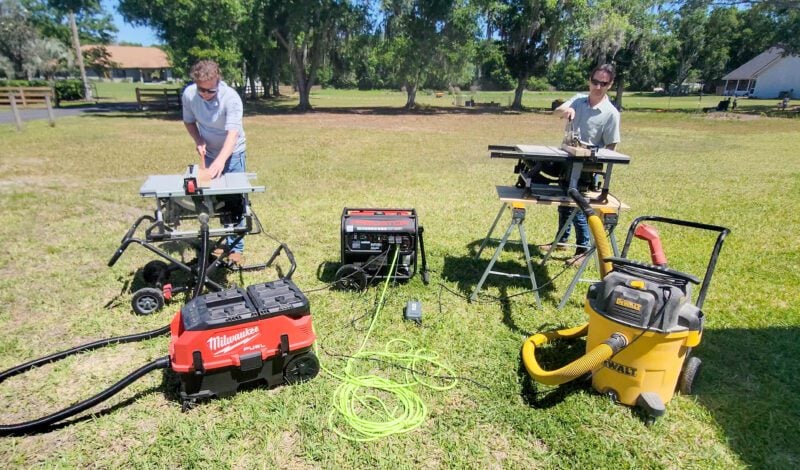
During this test, Clint and I were both making lengthwise cuts in pine 2x material. We started with shallow 3/4-inch cuts and then moved to a full-depth cut. On the first pass, both saws performed well, and the generator managed the load with poise.
However, on the second pass, Clint’s saw stalled halfway through because it simply wasn’t getting enough power. With that said, the generator never quit; it’s just that the saw needed more power than it could supply.
Next, we hooked up the Predator to our 2,600 sq ft shop, as you would during a power outage. Going one by one, we started each system in our shop to see how the generator would handle the larger load.
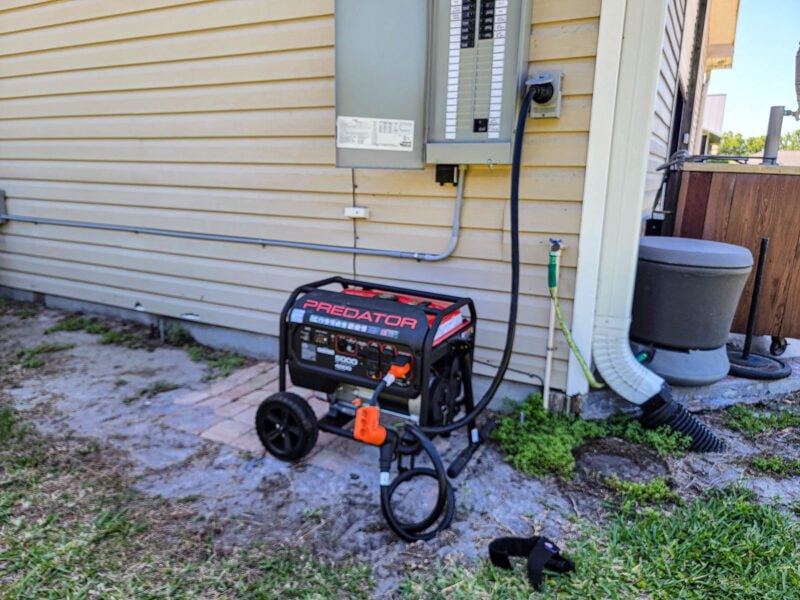
We started with the largest single system—the 3-ton central AC unit that cools our office space. Unfortunately, the generator was unable to handle the start-up current, which caused the breaker on the control panel to trip. This is both a failure and a win. On one hand, we couldn’t power that AC unit; on the other, the breaker did exactly what it was supposed to do and helped protect the electronics.
After disabling the AC, we then moved on to the other systems—lights, outlets, computers, and even our two mini-splits that cool our shop space. In this case, we were able to run every single one of them…but we don’t recommend it, and here’s why.
While we got power to almost everything, it was very clear that the quality of the electricity wasn’t sine wave level power. We could tell because all the LED lights in the shop flickered constantly. With all our computer equipment, and how sensitive refrigerators and coffeemakers are, you probably want a generator with less than 5% THD (total harmonic distortion) to feed those devices power.
So, while this particular model may not be a great solution for a whole-home power backup, we do heartily recommend it for jobsite use. Circular saws, grinders, miter saws, and table saws couldn’t care less about how much distortion they get on the cord…
Troubleshooting
If your machine doesn’t start after a few pulls, be sure to check that the fuel valve is open and the power switch is set to “Run”. I know it sounds silly, but these are easy to forget (like I did) if you’re in a hurry. Also, be sure that there’s enough oil in the reservoir by pulling the orange dipstick and visually observing the level.
If it still won’t start, check to make sure that the spark plug wire is firmly seated and hasn’t rattled loose during transport, and that the circuit breaker is not in the tripped position.
It’s also important to ensure you’re using fresh fuel—we recommend adding fuel stabilizer to your gas cans if they won’t be used right away.
Pro Tip: Always run your generator’s gas tank completely dry before long-term storage. Fuel left in the carborator can cause varnishing and lead to rough idling or render it completly inoperable until maintenance is performed.
If you’re still having issues after taking these steps, I recommend contacting your local small engine repair facility to discuss more in-depth solutions.
Predator 5000 Watt Generator Price
This Predator 5000-watt generator is available online or at your local Harbor Freight store. It retails for $499 and carries a 2-year warranty.
The Bottom Line
The Predator 5000W generator is exactly what it sets out to be: a budget-friendly, no-frills power solution that punches above its price point.
It’s not the quietest, the most refined, or the most feature-rich generator on the market—but it delivers dependable performance where it counts. For homeowners looking for occasional backup power or contractors needing a cost-effective jobsite option, it’s a compelling value.
If you want premium performance, you’ll need to spend more. But if you want solid power at a fraction of the price, this generator makes a strong case for itself.